
Frozen History, Mondo Gonzo: The Art & Times of Lawrence Tarpey, Kentucky's Women in Film
Season 31 Episode 5 | 27m 45sVideo has Closed Captions
After floods ravaged Eastern Kentucky in 2022, historical materials were recovered and...
After floods ravaged Eastern Kentucky in 2022, historical materials were recovered and then frozen for preservation; Lexington artist and punk rock icon Lawrence Tarpey helped create Central Kentucky's underground music scene; meet women who are leading the charge across Kentucky to introduce the art of filmmaking to all students. A 2025 KET production.
Problems playing video? | Closed Captioning Feedback
Problems playing video? | Closed Captioning Feedback
Kentucky Life is a local public television program presented by KET
You give every Kentuckian the opportunity to explore new ideas and new worlds through KET. Visit the Kentucky Life website.
Frozen History, Mondo Gonzo: The Art & Times of Lawrence Tarpey, Kentucky's Women in Film
Season 31 Episode 5 | 27m 45sVideo has Closed Captions
After floods ravaged Eastern Kentucky in 2022, historical materials were recovered and then frozen for preservation; Lexington artist and punk rock icon Lawrence Tarpey helped create Central Kentucky's underground music scene; meet women who are leading the charge across Kentucky to introduce the art of filmmaking to all students. A 2025 KET production.
Problems playing video? | Closed Captioning Feedback
How to Watch Kentucky Life
Kentucky Life is available to stream on pbs.org and the free PBS App, available on iPhone, Apple TV, Android TV, Android smartphones, Amazon Fire TV, Amazon Fire Tablet, Roku, Samsung Smart TV, and Vizio.
Providing Support for PBS.org
Learn Moreabout PBS online sponsorshipwhere historic archives of the region devastated by floodwaters are being reclaimed after sitting frozen for years.
We'll introduce you to four women making a difference in bringing the motion picture industry to our state.
We'll explore the setting for this week's show, the Old State Capitol in Frankfort.
And we'll introduce you to Lexington artist and punk rock icon, Lawrence Tarpey.
All that's next on Kentucky Life.
[music playing] Hey folks, and welcome to Kentucky Life.
I'm your host, Chip Polston.
It's good to see you again.
Now, as we continue to celebrate America's 250th birthday all this season on our show, we're here at the site of where our state's democracy literally came into its own, the Old State Capitol in Frankfort.
Now this is actually the third Capitol building that was constructed in Frankfort's old public square.
The first two burned in the early 1800s.
This facility was in the center of Kentucky's government from 1830 to 1910, when the House and Senate chambers moved just up the other side of the Kentucky River to our current Capitol building.
This is a remarkable historic structure that we'll be exploring during our show.
But first, when eastern Kentucky was ravaged by floodwaters in June of 2022, the loss of life and property was catastrophic.
Another potentially catastrophic loss there was the region's history, as archives of materials from Appalachian residents about the area were buried under mud and muck.
But thanks to the heroic efforts of conservators and volunteers who love the area, a good chunk of that history is still in the process of being saved to this day after spending the last few years frozen solid.
[music playing] At the Hindman Settlement School in Hindman, Kentucky, the last weekend of June 2022 initially seemed like any other.
There was a writer's workshop on campus, and otherwise it was business as usual at the site, which sits beside the appropriately named Troublesome Creek.
But then, the rains came.
[rain pouring] What's been described as the deadliest natural disaster in the region in 80 years rained down on eastern Kentucky.
The floodwaters took 45 lives and thousands of homes.
The writers at Hindman were awoken in the middle of the night, initially told just to move their cars because Troublesome Creek was rising.
It quickly became much worse.
You know, once the power went out, the only way that they could watch the rise of the water was by the lightning flashes.
And that was how they judged.
And they would see dumpsters and propane tanks and pools and cars and houses float by.
I think what was most horrific at the time was that we didn't know the full scale of it.
I knew what was happening here on campus to my friends and colleagues and teachers and mentors, but I didn't know the death toll even here in Knott County or what was unfolding in Breathitt County and Letcher County and other places.
The school became a literal shelter from the storm, quickly evolving into emergency housing, a donation center, and a place where people could get three meals a day for free, all done with no water or power for several days.
It didn't take long for staff at the school to know the floods had taken more than a human toll.
Their historical archives of life in the area appeared destroyed.
This is actual video of what it looked like at the school days after the flood.
Notice the high-water mark on the wall.
It was dark, and it smelled terrible.
And I walked in, and the first thing I noticed was all the books were knocked off the shelves because the water was 52 or 54 inches high in the archives.
When the floods happened, we had multiple rushes of water.
So, we had underground gas tanks and septic tanks that imploded in different areas around here, and that all fell into here.
So, it is not uncommon to get a whiff of gasoline or diesel, human waste.
Like, you'll get that smell.
The staff immediately reached out to archivists to see if there was something, anything, that could be done to save the collection.
Time is of the essence.
You've got 72 hours.
It's July.
Things are gonna to start molding.
The damage is gonna to be immediate.
And so, we put out this desperate call on social media saying anybody who can help, help us.
And some of the first people on the ground were actually on their way to Appalshop in Whitesburg, but Appalshop was literally still underwater, so they couldn't get there.
And when the floodwaters at Appalshop in Whitesburg receded, the scene was also one of total devastation.
When we all went in there as a team, you couldn't even walk in.
It was very slippery.
I mean, honestly, it was hard to even get around in there.
A lot of people wore, like, the Tyvek suits, you know, wearing masks, gloves, all that.
It was just straight nasty.
At both places, it became clear that some of their collections could be saved through a novel approach.
Freezing the items.
By doing this, the threat of mold growth is effectively stopped.
That bought everyone time to get back on their feet, at which point they could slowly start thawing items so important to the region's history.
Alex Brooks is a Lexington-based conservator, one of only two in Kentucky.
He's currently working to preserve documents damaged at Appalshop.
Brooks got in his car and headed to eastern Kentucky as the floodwaters were receding.
His background was in restoring books from medieval times, but he knew he wanted to help, and he knew freezing culturally important items were key to saving them.
Freezing the paper made sense because that basically presses pause.
And if you can freeze a book that's completely waterlogged, then it can stay frozen basically indefinitely until you have time to unfreeze it and then work on it.
Brooks immediately tried to get freezer trucks to the region to save the materials.
The problem was that there wasn't a single freezer truck in the area because all the freezer trucks, like commercial freezer trucks, were used for bodies.
I was on the phone with someone that has a lot of connections with shipping people in the area, and when he told me, like, “I'd love to help you, but all of the freezer trucks are being used for bodies,” that struck me and really affected me.
Several years after the flood, the Heinemann Settlement School's archivist, Sarah Insalaco, is still thawing out items.
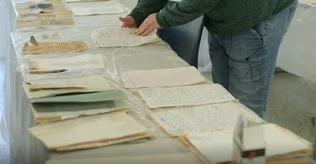
Their success to date has enabled them to restore more than 80% of the documents in their collection.
It's a tedious process.
For paper goods, she goes page by page, wiping down the paper with hydrogen peroxide.
The books and documents may be stained, but they are salvageable.
Mold tends to grow where it's the warmest, which is the spine of the book.
So, that's where you're mainly gonna find mold, as well as when you close it like this, the creases and the bottom bindings.
It's a far more complex situation at Appalshop.
Film and videotape require many more technical processes to be saved.
When you walk into the trailer that houses their remaining items to be thawed, you're immediately struck by the smell.
As Insalaco said, it's an overpowering mix of fuel, human waste, and mud.
The process there is much slower and relies mainly on big out-of-state labs like Iron Mountain to do the work.
Terry says some three years after the flood, they've only unthawed about one-fifth of the collection they hoped to save.
But what has been saved shows promise.
Film is, like, durable.
It's wild how durable it is.
But, you know, we're still experiencing things like emulsion loss and flood muck that just will not come off of a tape, and therefore you can't get a clear picture or clear sound off of it.
Years after floodwaters forever changed the face of Eastern Kentucky, important parts of its history sit in freezers waiting to be brought back to life.
It costs money to do this work, and Terry at Appalshop says a number of the grants they were using to preserve this heritage have evaporated.
But between the dedication of volunteers and the efforts of staff and conservators like Brooks, the legacy of Eastern Kentucky, as told by Eastern Kentuckians, will hopefully live on.
This is a region that's been historically denigrated.
It's a region that's had a lot of stories told about it from the outside, and not always with the greatest sensitivity or affection.
So, these two places that were majorly affected by the flood are repositories for a cultural heritage that's told from their point of view, which is really rare and very valuable.
[music playing] Kentucky may not be the first place that comes to mind when you think of the motion picture industry, but that is changing rapidly.
Big productions have been coming to the state, putting the Commonwealth on the map for filmmakers.
We want you to meet four women who are taking the initiative and stepping out from behind the cameras.
They're working to bring the art of filmmaking into their communities, shining a light on the importance of independent filmmaking and education.
Let's check it out.
Across Kentucky, women are shaping the future of film as artists, educators, and advocates for change in the industry.
These women are working behind the cameras, building communities, and opening doors.
For this Western Kentucky University professor, filmmaking begins with dreaming.
She's helping college students write their own narratives, both on and off the screen.
I found often that women written by men on screen appear and behave differently than women written and directed by women.
So, that's been part of my journey, is reclaiming what a woman is on the screen and more so than what a woman is, but what a woman could be.
So, I teach film because it's important to me to pass on what I know, passing on the torch while also actively, you know, lighting more torches, right, as I continue my work and just passing on that light of knowledge and passion.
The purpose of the program and my role is to build confidence in them because confidence can be learned and mastered.
I dream and I hope that one day I can make such an impact on the women in my classroom, reminding them to dream, reminding them that they are worthy.
There's always gonna be a seat at the table for them, and if not, build your own table your own table.
In Lexington, an independent filmmaker has created her own path, not just for herself, but for the next generation of storytellers.
Through nonprofits, she's opening doors for Kentucky's youth, helping them to see that a future in film is possible right here at home.
When I was in film school, I studied screenwriting.
I wanted to study directing, and I had a hard time, like, verbalizing that because I didn't know any female directors, and I still don't personally know.
I know a few, but not that many.
So, I think that, yeah, for a long time, like, that was something that I wanted to pursue, and I felt silly talking about it because I didn't know anybody who was doing that.
That's why my husband and I, part of why we have, like, our own production company.
Because I was like, “I wanna make my own stuff and, like, have some amount of say in the stories I tell and have some amount of control in the type of sets that I create.” I am always looking for, being in this area, ways to educate people about what opportunities are out there.
I have another nonprofit, Bluegrass Film Friends.
We've partnered with the Kentucky Theater on a film festival called Screen Slam.
That is high school students in Kentucky, basically a film festival that's just for them.
If any of my experience can be helpful to anybody else in helping them decide, like, what they wanna do or what they wanna pursue, then I'm happy to be of service.
In Louisville, this director's passion is her community.
She's a voice for those still waiting to be seen, and through her free film classes, she's making sure they don't have to wait much longer.
People need to tell their story, no matter how old or how young you are.
I'm a double minority when I go into a set.
It's not very many women, and it's barely any Black people.
It's been difficult, but that's not gonna stop me because film is my passion.
Honestly, the reason that I was put on this earth is to help share stories and to help amplify voices that doesn't have that chance to.
In the little position that I am here in Louisville, I try to be that beacon of change and hope, me and my friends, because nobody else is gonna tell our stories.
We're all trying to help each other, and that's what matters.
That's what it means for me to be rooted in [laughs] my film community here, to be heard, and that's something you can't take for granted.
Also in Louisville, this nonprofit leader has traveled the world, but her passion lies here in Kentucky, where she's helping women across the state find their place on set and their power in storytelling.
Working in the film industry, particularly as a woman is.
it comes with its own challenges.
There's challenges of freelancing for everyone.
It takes a lot of sacrifice, a lot of time away from your family, just a lot of hustles, and a lot of uncertainty.
The Women Film Chapter for Kentucky, we started that right at three years ago.
Women Film Kentucky, as a chapter, offers a lot of resources for women.
We have meetups, and we have networking groups.
One of the goals of Women in Film is to do more statewide outreach, because there's a lot of women out in rural areas that are maybe, like, looking for something different, that don't even know yet that this could be their next outlet, or their next, like, opportunity could be the film industry.
I think it's important for women across the state to know that this industry, there is a space for all kinds of creatives.
It doesn't just have to be a camera operator.
It doesn't just have to be a producer.
I mean, you're seeing, like, the creative work of wardrobe, of seamstress, of people that work in locations, of drivers, of chefs.
There's just so much room for people, and I would like to see a woman in every one of those positions.
And I want to make sure that people like me, who did not come from this background or don't have that degree, and that women across the State of Kentucky know that this option as a career does exist, and there's room for you.
With different paths but shared purposes, these women are changing what film looks like in Kentucky by showing the next generation what's possible.
Together, they're building something much larger than any production.
I would love to see, kind of, in the next era of Kentucky film, you know, filmmakers who are from Kentucky.
We have the talent here.
It's time to take your own project seriously.
I think one very important step for the future in Kentucky, the future film industry, is that there needs to be representation sitting at that table.
I invite all female filmmakers in Kentucky to create a support network so that we can make the best films possible, tell our stories, and deliver our messages, because the world is waiting.
[music playing] For more than 40 years, Lexington artist and punk rock icon Lawrence Tarpey has leaned heavily into the concept of DIY.
Born of the punk rock invasion of the late 1970s, Do It Yourself is the call to arms that unleashed one of Kentucky's most unique and compelling artists.
With chainsaws and razor blades and music with energy to burn, welcome to the bizarre mondo gonzo world of Lawrence Tarpey.
[music playing] As far as a punk rock band could have a rock star, he was kind of a rock star.
He was a rock star in our city and in our “scene.” As a teenager, I was always interested in music, and then punk rock came along in 1978, and once I started listening to some of the British punk bands, I was an instant convert.
[music playing] Since the 1980s, Lawrence Tarpey has been making provocative music and art, and he leans on some fundamental philosophies that inform both pursuits.
The whole idea of punk rock was DIY, do it yourself.
DIY, do it yourself, came up as an aesthetic, came up as an underpinning, and a sort of credo, and Lawrence's art represents the same punk rock DIY stuff.
[music playing] He has a kind of what I often call an alien vision.
I know the work probably comes a lot out of surrealism.
It probably comes a lot out of counterculture images, and he has, I think, probably the strongest, most unique personal vision that I know of in an artist, and I don't see any direct influences of anybody on his work.
I think he's the true original.
[music playing] I always had a desire to kind of sing in a rock band, you know, and this was an opportunity.
It's like, well, let's see what happens.
I got, you know, got together with a few guys, and we started a band, a band called Active Ingredients, and it was a lot of fun.
Active Ingredients was the band to measure by.
They were always the band that was asked to go up to Newport and open up for other really large punk rock bands.
The Jockey Club in Newport, Kentucky, was one of the premier punk rock venues in the Midwest.
In those days, stapling homemade flyers to telephone poles was how bands advertised their shows, and Lawrence has been creating flyers and album art for more than 40 years.
You could tell an Active Ingredients flyer immediately.
His stuff was hand-drawn.
It was figurative, but he was accentuating it to make it not real and not 100% representative.
Another element that's hard to miss in Lawrence's work is the underlying sense of humor.
The title of the EP was Bringing Down the Big Boys, and so I just thought, well, here's this, you know, character on the cover with the chainsaw, and he's chopping down some giants.
It has a comic sensibility, which isn't just silly, but beneath that, there is a real seriousness about composition and about making things work together and pulling off this little surface that he's controlling.
That's his little world at that time.
I think of his works as needing to be probably a small size.
It's intimate.
It's meant to be looked at by one person at a time.
But the music is a different matter altogether.
After Active Ingredients called it quits, Lawrence got together with a new band, and it wasn't long before they were filling local venues.
His next band, Resurrected Bloated Floaters, really embraced more of a bit of a country punk sing-along.
[music playing] The Floaters brought Lawrence and drummer Brian Polito together for the first time, and they've been collaborating ever since.
They played in notable bands like the Yellow Belts and Rabby Feeber.
And most recently, they resurrected Rabby Feeber into a two-man studio project.
[music playing] He's got a great setup down in his basement.
It's a pro recording studio.
So we just go down there in the lab and just have fun.
[music playing] ♪ I am a lab made man ♪ Lab made ♪ I am a lab made man ♪ Lab made ♪ I don█t have a guilty pleasure ♪ They covered me with plastic treasure The musical projects and album art involve lots of planning, but Lawrence's process for creating his fantastical paintings is completely different.
If I know what the end image is gonna look like, it's not that exciting to me.
So, that's why I like to work spontaneously, and just whatever happens, happens.
He's making all this up as he goes along, and it's a true stream of consciousness.
The materials, I think, speak to him at first of setting up a situation of starting to work and seeing possibilities in it.
So, I just can put paint down on the surface and start manipulating the paint kind of chaotically, and eventually images start to appear.
Using oil and graphite, Lawrence works on hard surfaces like clayboard or gesso on masonite because his process requires durability.
So, I go in with etching tools, and I can get pretty rough with it.
I like to use utility razor blades to pull paint off because I can get really nice, sharp edges.
And I use a lot of sandpaper and steel wool.
When images start revealing themselves to me, it's exciting.
I can say, “Okay, this is a character that's starting to poke its head through the surface.” He sees possibilities for creatures and heads in everything, I think.
You know, he can put a couple of eyes or even one eye on almost anything, and it becomes a living thing or something that has some kind of life to it.
Whether it's one of his paintings or a digital manipulation of an original work, the worlds Lawrence creates and the creatures that inhabit those worlds are what make his art so compelling.
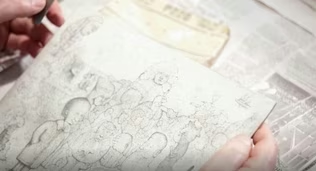
And for Ron, Lawrence's painting, A Much Better View, is a perfect example of the many elements that make a Tarpey a Tarpey.
It has everything in it that I would like to see in a Lawrence Tarpey work.
It has a cast of thousands, and they're all different.
Some are almost totally abstract and cubist.
There seems to be a heart of the action somewhere in the middle toward the bottom, where maybe two tiny guys might be arguing with each other or something, but we don't know.
[music playing] Unraveling the mysteries of Lawrence Tarpey's work is a delight because that journey inevitably turns our attention toward our own perceptions of reality and creativity.
His passion to create truly original work is an inspiration, and his wonderful creatures are a bizarre reminder of what brings us all together.
[music playing] We've had a great time here today at the Old State Capitol in Frankfort, so much so that we'll be back next week to dive into even more of the history of this remarkable building.
Now, if you've enjoyed our show, be sure to like the Kentucky Life Facebook page and subscribe to the KET YouTube channel for more of what we'd like to call Kentucky Life Extras, where you'll have access to lots of other great videos.
Until next time, I'll leave you with this moment.
I'm Chip Polston, cherishing this Kentucky life.
[music playing] [music playing]
Eastern Kentucky's Frozen History
Video has Closed Captions
Clip: S31 Ep5 | 8m 2s | Eastern KY historical archives destroyed by floodwaters saved by freezing them. (8m 2s)
Video has Closed Captions
Clip: S31 Ep5 | 7m 35s | Meet the women who are leading the charge across the state to introduce the art of filmmaking. (7m 35s)
Mondo Gonzo: The Arts & Times of Lawrence Tarpey
Video has Closed Captions
Clip: S31 Ep5 | 7m 53s | For more than 40 years, Lawrence Tarpey has been making cutting edge music and artwork. (7m 53s)
Providing Support for PBS.org
Learn Moreabout PBS online sponsorship













Support for PBS provided by:
Kentucky Life is a local public television program presented by KET
You give every Kentuckian the opportunity to explore new ideas and new worlds through KET. Visit the Kentucky Life website.