
Fur-ever and ever | Pet fostering guide and more (Episode 1002)
Season 10 Episode 2 | 26m 52sVideo has Closed Captions
Pet fostering guide, local vintage store closing, preview of new series: Cooking with Chef Fe.
Puppies, dogs, and cats, Oh my! If you’re not ready to make a new pet part of your forever family, you might consider fostering an animal from a local shelter. We look at what is involved when taking on this adventure. Also, we meet the owner of a vintage store about to close his shop. Plus, stir up your tastebuds with a preview of a new digital series called “Cooking with Chef Fe.”
Problems playing video? | Closed Captioning Feedback
Problems playing video? | Closed Captioning Feedback
Local Routes is a local public television program presented by WFSU
Fur-ever and ever | Pet fostering guide and more (Episode 1002)
Season 10 Episode 2 | 26m 52sVideo has Closed Captions
Puppies, dogs, and cats, Oh my! If you’re not ready to make a new pet part of your forever family, you might consider fostering an animal from a local shelter. We look at what is involved when taking on this adventure. Also, we meet the owner of a vintage store about to close his shop. Plus, stir up your tastebuds with a preview of a new digital series called “Cooking with Chef Fe.”
Problems playing video? | Closed Captioning Feedback
How to Watch Local Routes
Local Routes is available to stream on pbs.org and the free PBS App, available on iPhone, Apple TV, Android TV, Android smartphones, Amazon Fire TV, Amazon Fire Tablet, Roku, Samsung Smart TV, and Vizio.
Providing Support for PBS.org
Learn Moreabout PBS online sponsorship[MUSIC] Coming up on Local Routes.
And every day you get to come home to the most love.
People who foster animals tell us what it's like to be a temporary caretaker of pets waiting for forever homes.
Just the energy that these things have... you wish they could talk.
His antiques may not be able to tell us their story, but this shop owner does.
Okra itself is a vegetable that is typically grown in West Africa.
It does well in Florida actually because of our humidity.
We introduce you to Sheffield and her recipe for okra and tomato stew.
Take the local routes and journey down the roads we call our home Here on the edge of Tom Brown Park in Tallahassee, the Tallahassee Leon County Animal Services Center is getting ready for a major renovation.
Welcome to local roots.
I'm Suzanne Smith.
The great thing about this upgrade is that when it's complete, it'll mean a lot more room for the animals that are housed here.
The bad news is, until that construction is complete, there won't be as much space for those same animals.
Enter the world of fostering animals issues.
Mike Clemmer explores what it's like to take on this responsibility, what it means for the animals and what it could mean for you.
Well, I foster for the animal shelter on Easterwood Dri and I've been doing it for about seven years since I adopted my boy Jax.
Foster with the Leon County Humane Society.
We've been foster... my husband and I have been fostering since September of 2014, so we've been fostering almost ten years.
We're on foster 63 now.
We prefer large breed dogs.
So, if it's going to be 90 to 100 pounds or more, that's our preferred breed.
Although we'll take anything we've done puppies.
We've done.
I think we had a Frenchie recently, so we'll do anything.
but we do love the big dogs.
Those two women are Maureen Thompson and Mallory Davis.
I was curious about the animal foster process, so I looked up some foster people and animal foster organizations to talk to.
In my case, the Tallahassee Animal Shelter and the Leon County Humane Society.
Grayson Walters is with City of Tallahassee Animal Services.
The foster program itself is essentially people sign up.
They essentially apply to be a foster parent with us.
and they're helping get animals out of the shelter and into a temporary home, the goal being to get them adopted.
Lisa Glunt, the Leon County Humane Society.
From the foster perspective, that person is setting the animal up in a home, to be treated like it is part of the family to continue socializing the animal.
It's great when we have fosters socializing the animal with other animals if they need that continued socialization.
but they're setting that animal up with the care and love that it needs and in order to get adopted.
Although I spoke to two separate organizations, I found that their processes for animal fostering were nearly identical, both giving orientation and training, cover fostering expenses, and have backup plans if a foster situation is not going well.
And both begin with a foster application.
It's helping us with deciding you know, what animals might be appropriate in your home.
and a little bit about, you know, where you live and what you've got going on so that we can make the best match possible.
I think that's the biggest point of the foster application.
So with fostering, we are here to provide everything for the animal medically supplies that you need, food.
we're here to set you up to, comfortably provide temporary housing for the animal.
You know, until we can find out a good home.
our foster, we do have a foster coordinator full time.
and generally, she's taking those applications, and then she'll reach out.
there is an orientation session.
So going over a lot of what to expect, how it all works.
generally she does those virtually.
So it's pretty convenient for folks that don't have to come in for that.
what to do in an emergency?
You know, you've got a foster and and it's three in the morning and something happens.
We have a process for that.
So we want to do that orientation so that you're as equipped as you possibly can be.
once we've had a talk and we've been able to verify a few things, such as, you know, if someone has animals at home, we want to make sure those animals are are fixed so that we're not going to have any behavioral issues between, your dog and putting another dog in the house.
Things that you really just might not be able to see in a shelter setting.
I think their personality comes out more in that foster home, which is just so much easier for us to market.
And when you've got interested adopters that can better answer their questions, where is at the animals in the shelter?
It just came in three days ago.
I don't know what it's background is.
It's really our best guess, right?
As to a lot of these questions that people are going to give us.
So the foster homes, also allow us to kind of learn that animal, and then be able to relay that to potential adopters.
Trying is more than, you know, it gives a it gives a dog or a cat or whatever.
You're maybe fostering it gives them a place for at least a time so that they can come into the program and they're not sitting in a shelter environment or unfortunately, there are other situations they may be in.
The people at the animal shelter do a great job of, assessing the animals.
Like they can tell you this she's friendly with dogs.
She's not food aggressive.
There's all these different steps that they go through to, assess every dog that comes into the shelter.
but there's a lot you don't find out until you get them home.
Okay.
The nice thing is, we have a community of people who have different levels of experience in different levels of dog like I typically do big dogs versus, I have there's one person she's probably fostered over a thousand dogs, but she does small.
And so she knows, like her small dogs, that she has that that niche down.
And then, I've actually treated Foster's before I had one person call me and say, hey, I've got this little husky puppy.
I cannot deal with it.
I was like, well, this is what I have right now.
And so we just met and traded dogs.
it was the humane side, you know, like, hey, we're treating Foster's.
But I will say every dog is different.
Every personality is different.
knowing if you have dogs in your home or you have cats knowing their preferences and how they're going to react.
She's the only that's an important thing to remember about fostering is you're never going to be asked to take an animal into your home that you're not comfortable with.
They'll always make sure they like I said, they assess the animals so they'll give you everything.
Like when I was getting her, there was another dog.
the foster coordinator was suggesting that she's like, no, this talks food aggressive and you don't want to have to deal with that.
So I got honey instead.
so they will never ask you to take a dog into your house that you're not comfortable with, or cat kitten, you know.
Well, one of the things is it's not a forever commitment.
So if you're not sure if you're on the fence, have the conversation with the Humane Society, having that conversation, saying, this is what I'm thinking, this is what I'm interested in.
And maybe you do a weekend and you say, hey, I'm going to be a temporary foster for the week while someone's on spring break.
because the thing is, you can try it out and if you absolutely it's not for you, that's okay.
And you can realize that.
But the easiest way to figure it out is to try it.
and so then you may say, oh, I didn't know this was awesome and I love it.
And ten years later, you're still fostering.
Or you may say, you know what?
This was it for us.
but I feel like if you're on the fence about it, really trying it out.
If you have a home that an animal could live in, if you've got a heart for it, it's really very rewarding.
I mean, it's saving animals.
You just can't.
I can't tell you how rewarding it is.
It's.
I appreciate it.
And every day you get to come home to the most loved.
Yes.
All right, prove my point.
And you're going to prove my point.
If you think you might like to give animal fostering a try, contact your local animal shelter or humane society.
For WFSU Public Media, I'm Mike Plummer.
Driving along ApalacheeParkway in Tallahassee, you might have noticed a sign right across the street from the Governor Square Mall that says Video 21.
It's right next to a larger sign that says Vintage 21.
Well, there are no video tapes being sold there anymore, but there is a store that sells art, furniture, antiques and other items of nostalgia.
But that store, too, is getting ready to close.
Wfsu David Sabo introduces us to the man who owns the store and how he spent his entire life in the past, but now has to find a new future going forward.
I do have some stuff on my.
There's a favorite item French bulldog.
Everything has its own character and genuine things just speak to me.
I'm not an artist at all, and I think that also drives my, urge to when I see something that really works, whatever it is, I say, wow, it works.
It's good.
Then I try an acquiring.
I'm Barry Courtney, and I'm living in Wakulla County, Florida, and I love it.
I'm originally from Findlay, Ohio and, went to school there, high school, graduated, went into the Navy and ended up in Atlantic Beach, where my mother had some family and my brother Bruce came over here to school, FSU.
We came over to visit him and we fell in love with Tallahassee.
This is Vintage 21.
This was Video 21 and I just kept the name and added the vintage to it.
The original shop was the old Rose boutique and believe it or not, it came off the match box.
It said old Rose and we were there for several years.
Then my brother moved out to Las Vegas.
We closed that shop down and I moved out to the flea market for a while.
That was great.
In the old days, Pre-Computer everybody had the shop.
Yeah, I had a triple set of buildings out in the front.
It was great.
It was just Saturday and Sunday, but the flea market was a great place.
Those people who remember it on a good weekend, it was shoulder to shoulder in the aisles and just.
That's how you shopped.
And then I was at Good Finds for a while.
And, then I ended up here, which was been a nice place to be.
I've been here about eight years, and it's taken eight years to collect all this stuff.
It was always a fond hope that someone who wanted to have an antique shop and had a great location would take my inventory at a great price, because this represents.
It's hard to imagine, but it represents thousands of hours of individually picking.
Not everything is all that great, but everything is genuine.
I've always been interested in authenticity and antiquity and Just the energy that these things have... you wish they could talk.
As a small kid, I was collecting antiques in Ohio when I when I could first drive.
I used to go to auctions in in Ohio.
Farm auctions was great fun.
But I do remember the first antique I bought when I was, I went into an antique shop when I was 11 years old and bought a little, match container, and it was in a genuine antique shop, and it was a genuine antique.
And it just set my life's pattern.
I think maybe one of the most significant things in the shop right now is, is a, an American walnut sideboard.
It was probably ex-slave made.
It came from, North Carolina plantation.
And it's just a wonderful piece of furniture.
Has a lot of the earmarks of old furniture, big dovetails, square headed nails, rough boards.
And, it's just fascinating to me that, it was a craftsman that had probably seen an Empire Federal sideboard and did their own version.
And it works.
Like I said, if something works, it catches my attention.
So a lot of the things in here to me, whether it's a painting or a vase, if it works, if it's got the right elements, I want to have it in the shop.
And sometimes I pay too much for things, but I always say I want that in the shop.
Someone else is going to love it, and that event eventually happens.
May take a while, but someone always comes along and really appreciates that item.
If you notice that they have these dividers saying it's like black sided silver, they're really cool.
A lot of the folks that I've done business with have passed away or moved on.
And I am seeing an increase in younger people coming into the shop.
I think a lot of younger people are starting to realize that these things have a presence that has been in time and will be in time.
People have a strange idea of value today in that you see these things online, where someone finds something for $5 that's worth $35,000.
So people get that in their mind.
But if you go looking for that, you're going to pass up a lot of wonderful things.
If you're just open minded, things will present themselves, especially in art.
I think art is a great buy today.
Not particularly famous artists.
Just if you like the picture, why not have it?
I'll probably always be hunting for things.
The real thrill is to find something that's genuine.
It has some kind of a recognizable history.
That's not always the case.
I buy things, I don't know what they are, but the quality says I matter or I'm worth something.
And, I've gotten a lot of education out of researching in books.
I'm just a lover of history and artifacts, and I surround myself with them.
People ask me how to get so much stuff.
Well, when I see it, I buy it.
You know, you may not see it again as sort of my principle.
It's like finding something from the 18th century.
That's a red letter day to me.
They're out there.
And if you go out with an open mind, you too can find them.
Barry Courtney says the owner of the building hasn't yet given him the final date when he'll have to close Vintage 21, but he's been told to expect it soon.
For now, Barry says he's open Tuesday through Saturday.
There are a lot of different ways to explore history, and I think one of the tastiest is through family recipes handed down through the generations.
That's exactly what we wanted to bring you with a new digital series called cooking with chef.
Here's a preview of one of her first recipes.
Tomato and okra stew.
Hi, I'm Chef Fe and this is Local Routes Cooking with Fe.
Our first dish of today is going to be an okra and tomato [MUSIC] The okra and tomatoes stew.
You heard it.
Two main ingredients.
Okra and tomatoes.
We're also going to add some roasted sweet corn to it.
And we're going to do some trinity there.
So we're going to have some celery, some bell pepper and some yellow onion.
All right.
So this dish is very, very comforting.
It's soul food at home and it's straight from the south.
All right.
The first thing we're going to do is cut up our okra.
We're going to cut up a nice little sizes here.
About this size.
We're going to get those in pieces away.
So we can just have the body of the okra.
Now okra desk get a little slimy as they say.
But it's not really slime.
It's mucilage.
And this actually works as a thinking our intestines.
So it's really, really different.
It's good for you.
Full of fiber.
Which is good for your digestive system.
All right, next up we're going to chop our tomatoes.
We have some tomatoes on the line here.
They're nice and juicy and plump.
They're perfect for stewing.
We're going to get those kind of.
And it doesn't have to be a perfect size.
It can just be a chop a little rough chop here.
So back in the day they used to find whatever they could find.
And put it in stews and casseroles and things like that.
So this is why this dish really, really works.
And it's a very creative with the okra, with tomatoes and then you can kind of make it your own.
You can add some seafood to it.
You can add some shrimp, some crab.
I'm adding corn today because I just like the bite of the corn.
And it's nice and sweet.
And there you have it.
We have some chopped tomatoes here.
So I have my skillet here.
Heat it.
That's a good rule of thumb when you're cooking.
To go ahead and heat up a skillet, try to do it on medium heat just for a couple minutes.
That way when you're adding your oil and then you're adding your veggies, they're clicking right away.
So we're going to add in about two tablespoons of olive oil.
And then we're going to add in our trinity.
Remember the trinity is the celery the bell pepper and the yellow onion here that sizzle.
And we're going to give that a saute.
The good thing about starting with your trinity here is this this to give off some moisture.
So when I add my garlic in and a little bit the garlic won't burn because of the moisture of the vegetables.
And I go ahead and add some diced garlic here, some minced garlic really.
Well that's salting a little bit.
I'm going to rinse off this okra and get a towel.
Blot it.
The great thing about rinsing your okra off in towels lining it is you're getting rid of some of that mucilage, but it still contains enough of sticking your stew.
If you don't like the mucilage at all, you can try frying in your okra just for a little bit.
And a little bit of oil, and then putting it on a plate with a towel and some of some of that oil.
Okay.
So I'm just going to set up here some of the mucilage.
This is called towel blot.
All right I'm gonna let that camp out right there for a minute.
We're going to add in our tomatoes.
So now we have our tomatoes.
We have our Trinity as well as our garlic.
All right.
So I turn my heat up a little bit because I have the tomatoes going.
And I wanted to make this.
Let's sit down the tomatoes down just a little bit.
But I'm going to leave some chocolate tomatoes in there.
That way you have different textures and different bites.
We are in this Oprah in tomatoes today.
Okra itself is a vegetable that is typically grown in West Africa.
It does well in Florida actually because of our humidity.
So anything humidity to really, really thrive.
So it's great that we can have access to it here because of that.
What if I had to add in some seasonings here on this plate we have garlic powder, onion powder, Creole seasoning as well as some seasoning top seller and seed.
We have some climate cayenne pepper and some Bailey's going to add those right in.
Had some.
Powder and garlic powder I also get breaks easily to keep as much of those as you want okay.
And then we're going to add our okra right in with our tomatoes.
We'll be.
And this is actually the must do on.
It's all we're gonna let it simmer for about ten minutes.
Then we're going to add in our roasted corn.
So our okra and tomato stew that's a barrel that's doing down.
We're going to we're going to actually set up some rustic point here, the roasted corn I roasted in the oven.
I'm going to degrees for about ten minutes.
So it still has a nice little back to it a little French.
We're going to add this in on the end.
But I'm going to go ahead and shape the corn off okay I'm going to hold the corn down like this and just give it a rough chop here.
Some corn my flyaway.
But we'll pick it up and add it in there too.
All right.
And soon as this is ready we're going to add in our corn.
So as you can see, our stew is still way down.
So the tomatoes you see some chunks there.
But it's a lot of liquid inside of our stew.
That's a good sign that our what it's supposed to be doing okay.
It's looking there.
And go ahead and add in our corn.
So basically all we're doing here is just kind of heating up that corn.
Sorry to cook.
Sorry.
Does he need a little bit okay.
So now we have our okra and tomatoes still ready to go.
We're going to add it into a bowl and top it with some rice.
So we're getting our okra and tomatoes planted here.
I have the okra tomatoes on the bottom and the rice on top.
You can eat it with the separate if you want to, but it's better when it's all mixed than there you have it.
Oh, great.
Tomatoes stew.
So who is Che Fe?
Well, we talked with her about her life, her family and how it all led to her love of cooking.
So if you are scared of oil and salt and butter, you're in the wrong part of the country.
Okay?
And should be.
My government name's Alicia Nicholson.
I've always loved it.
And for as long as I can remember.
My parents always involved me in the kitchen.
I learned how to cook at a very young age, and I just never stopped.
One of my favorite things about being at my grandmother's house and my auntie house was coming in and smelling all of the food to prepare one of my favorite foods to smell when ot was being prepared is fried chicken.
The entire family just about cooked.
Yeah, my mom bakes.
My dad does barbecue, my brother does barbecue.
My older brother does barbecue.
My younger brother takes my sister bakes the most amazing cheesecakes.
We literally all cook.
So this is really, really home to me.
And it feels like home to me to be able to cook chicken.
The way that they did it.
Pancakes are my first thing to make in the kitchen.
It's one of the simplest things to try and know about, when you're just learning how to cook anyway.
I was voluntold.
So definitely it wasn't.
It wasn't like you really had a choice.
Most days I was like, okay, we're gonna snap peas today.
Are we going to, you know, come in the kitchen and, you know, help out.
But eventually I really, really enjoyed doing it.
I didn't want to stop snapping peas became therapeutic.
And so, you know, it it just was something that was innate for my family.
It was something we did as a bonding thing in our household.
I eventually grew up and made a business of it.
I tried to do other things.
I taught.
I was the elementary math specialist with the district, and, I just decided I was going to follow my passion.
And now I'm here.
We actually on, property off of Centerville Road.
It's called Harry Hill Park.
And that park has just been passed down from generation to generation.
My great great grandfather was a slave here, and that land was gifted to him.
And so we've kept it in the family.
Every year we did the 20th of May celebrations there, which is our emancipation.
And so we have this huge celebration there where we invite people from all over the city, surrounding counties to come into our food, into our fellowship.
And we have poetry readings and speeches and live bands that we wrap the may pole.
It's just it's a whole thing.
So my family has been here for forever.
Gumbo probably is my favorite thing to cook.
I love cooking gumbo.
I love doing different types of gumbo seafood gumbo, chicken and sausage gumbo.
I've just gumbo.
I'm part Creole.
I have family in Louisiana as well as in California.
I grew up not knowing a lot about that side of my family, the Creole side of my family.
So I really spent the past few years just really trying to delve into cooking those dishes and really feeling closer to home with them.
I hope they feel home, too.
I hope they feel the comfort there, and I also hope that they will find these recipes simple enough.
So where they're able to go home and try them for their family so that it just continues to build and grow, and then they have recipes that they can pass down to their children and their children's children, like, I just really hope that is something that people will just want to try and just experiment with and make it their own.
go to wfsu.org/cheffe to see more recipes.
That's all for this episode of Local Routes.
You can find these stories and more on our website.
WFSU.org/localroutes And while you're online, follow us on Facebook and Instagram.
Plus, don't forget to sign up for our Community Calendar newsletter delivered weekly to your email.
It is a great way to find out and stay on top of events happening in person and in the virtual world.
I'm Suzanne Smith for everyone at WFSU Public Media.
Thanks for watching.
Have a great week everyone.
Magnolia trees meet the southern skies in the land where rivers wind.
Seeds that spring up from the past leave us treasures yet to find.
Where our children play along the land our fathers built with honest hands.
Take a moment now and look around at the Paradise we have found.
Take the Local Routes and journey down the roads we call our home.
[MUSIC]
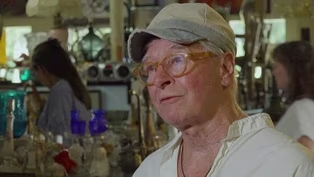
Barry Courtney | Searching for History
Video has Closed Captions
Clip: S10 Ep2 | 6m 16s | Barry Courtney, a vintage shop owner in Tallahassee, talks about his love of antiques. (6m 16s)
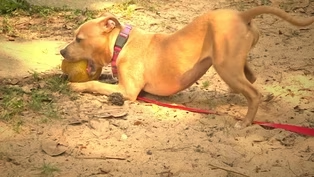
The Happy Foster Feedback Loop
Video has Closed Captions
Clip: S10 Ep2 | 6m 50s | You make a dog happy, the dog makes you happy! This is the Happy Foster Feedback Loop. (6m 50s)
Providing Support for PBS.org
Learn Moreabout PBS online sponsorship













Support for PBS provided by:
Local Routes is a local public television program presented by WFSU