
Future of Higher Education Panel; Rodney Priestley, Ph.D.
6/25/2022 | 27m 5sVideo has Closed Captions
Future of Higher Education Panel; Rodney Priestley, Ph.D.
Steve Adubato welcomes a panel of leaders to examine higher education’s post-pandemic recovery and the challenges and opportunities created by COVID-19. Guests Include: Michele Siekerka Marjorie Perry Brian Bridges Rodney Priestley, PhD, Dean of the Graduate School, Princeton University joins Steve Adubato to examine new technologies and research being conducted at Princeton.
Problems playing video? | Closed Captioning Feedback
Problems playing video? | Closed Captioning Feedback
Think Tank with Steve Adubato is a local public television program presented by NJ PBS
Future of Higher Education Panel; Rodney Priestley, Ph.D.
6/25/2022 | 27m 5sVideo has Closed Captions
Steve Adubato welcomes a panel of leaders to examine higher education’s post-pandemic recovery and the challenges and opportunities created by COVID-19. Guests Include: Michele Siekerka Marjorie Perry Brian Bridges Rodney Priestley, PhD, Dean of the Graduate School, Princeton University joins Steve Adubato to examine new technologies and research being conducted at Princeton.
Problems playing video? | Closed Captioning Feedback
How to Watch Think Tank with Steve Adubato
Think Tank with Steve Adubato is available to stream on pbs.org and the free PBS App, available on iPhone, Apple TV, Android TV, Android smartphones, Amazon Fire TV, Amazon Fire Tablet, Roku, Samsung Smart TV, and Vizio.
Providing Support for PBS.org
Learn Moreabout PBS online sponsorship- [Narrator] Funding for this edition of Think Tank with Steve Adubato has been provided by New Jersey Institute of Technology.
NJIT makes industry ready professionals in all STEM fields.
Operating Engineers, local 825.
Choose New Jersey.
IBEW Local 102.
Lighting the path, leading the way.
Eastern Atlantic States Regional Council of Carpenters.
The New Jersey Economic Development Authority.
The Port Authority of New York and New Jersey.
Moving the region through air, land, rail, and sea.
Holy Name.
This place is different.
And by NJM Insurance Group.
Serving New Jersey'’s drivers, homeowners and business owners for more than 100 years.
Promotional support provided by NJBIZ, providing business news for New Jersey for more than 30 years, online, in print, and in person.
And by New Jersey Globe.
[MOTIVATIONAL MUSIC] - Hi, this is Steve Adubato, everything you wanted or needed to know about higher education not just in New Jersey but across the nation.
The panel that you're about to meet they'll tell you because they are living it every day.
We have our good friend, Marjorie Perry, who's President and CEO of MZM Construction Management and a trustee of our production company, the Caucus Educational Corporation.
Michele Siekerka.
You know Michele from being with us in a lot of other stuff.
She's the President and CEO of the New Jersey Business and Industry Association.
And we're honored to also have Dr. Brian Bridges, New Jersey Secretary of Higher Education.
Good to have you all with us.
- Good to see you Steve.
- Great to be here.
- Secretary, let me ask you this, the state of higher education, New Jersey, give us your assessment particularly as we go into May 2022 this will be seen later.
How are we doing in higher ed particularly dealing with COVID and beyond?
- Sure, well, thank you Steve for the invitation and being here.
The state of higher education in New Jersey is strong.
The Murphy Administration has invested over 150 million in new additional funding in higher education during his term in office and we're working to make college more affordable through initiatives like our Community College Opportunity Grant and our Garden State Guarantee which is launching this fall.
So we are happy to say that students have more opportunity to attend college and university in New Jersey than they ever had before.
And our institutions have been buoyed a bit by the federal investments through the coronavirus relief packages as well as the Higher Education Relief Fund and Emergency Relief Fund and so they're coming outta the pandemic and looking to try to strengthen their position and bring more students back to campus.
- Appreciate that.
Michele, I ask you before go to Marjorie.
Is there any part of what the secretary said that you see differently in terms of the higher ed environment in New Jersey?
- I wouldn't say differently.
I'd say that we've had our eye on affordability and attractability to keep our next generation worker here in the state of New Jersey and we see strides in that direction.
I will say that we see good collaboration between business, academia, as well as bringing in our students.
And when we talk about academia, we talk about K-16 and beyond.
We're proud to be in a partnership with the New Jersey Community College Consortium with an 8.5 million grant on career pathways and high demand jobs.
I want us to come back though to that issue about what we're doing to focus specifically on in-demand jobs 'cause I think that's a critical point for us right now.
- We're gonna come back to that but Marjorie let me ask you, there's a lot of issues here and let everyone know what MZM Construction & Management is then I'll come back to my question.
Let everyone know Marjorie.
- We are a construction, an engineering company that works on very high profile projects throughout the United States of America primarily the East Coast, infrastructure project, airports, hotels, et cetera, But Marjorie, let me ask you this, and I won't personalize this other than the fact that I know that we're not alone in this, I very much wanted our children to go to New Jersey institutions of higher learning.
I'm a Rutgers grad, Montclair State undergraduate.
I did my graduate work blah, blah, blah, blah, blah at Rutgers.
That didn't happen, two at Fordham, one about to go to college and let's just say it's likely he's not gonna wind up in a New Jersey school.
The so-called brain drain.
Even for those of us who are bullish on New Jersey, we're losing too many of our kids, young adults to institutions of higher learning in other states.
Am I exaggerating that Marjorie Perry?
- No, no.
The issue that we have with our higher education today is that we have great schools, there's no question about that.
I'm a graduate of Kean University and NJIT.
Oh, did I drop Harvard in there?
No, but, anyway.
- No, no.
Yeah, you did that last time.
Check out our last interview with Marjorie where she brags about Harvard.
Go ahead, go ahead.
- Things have changed now.
I just had a parent that called the other day who Delaware State is offering their kid to come to Delaware University and offered them $20,000.
I could only get $6,000 out of one of our state schools here.
That's where we're going to start seeing the brain drain.
So, what I did was move some of my scholarship dollars over to save this kid to stay in the state of New Jersey.
He was out-- - One at a time, Marjorie, that's not policy.
That's great that you did that, but what do we need to change Marjorie?
And I'll come back to Michele in a sec.
- I think that someone like Dr. Bridges, Michele, people like myself, other CEOs of universities, we have to sit down and do a think tank among ourselves, businesses, industry, what we need.
Michele and I were on a board last week about labor shortage.
A lot of kids don't wanna go do, they don't care if you're giving them free college, they are not interested in going to school right now.
So you have a tripod of issues coming at the same time.
If my son can get $80,000 over at Delaware State, he's gonna go there.
Talk to someone last night, their kid is getting more money to go to Drexel.
So we have to come up with some kind of policy effectively so Dr. Bridges can go back to the administration and say, "Hey, listen, if we wanna keep and retain, these are some of the new ideas we need to come up with and be adaptive and be clear about that."
- Michele, I'll come back to you.
Dr. Bridges, this isn't the first time you've heard this, and you're not responsible for all of it, you can't pull this off by yourself, but, if all other universities and colleges and other places around the country are offering, they're just saying, "Come on, show me the money."
Okay, New Jersey is not doing that, can't do that, but you were just saying that the funding levels have gone up, but those who say it's very hard to compete.
Go ahead, secretary.
- Well, thank you for the opportunity to address this issue around out-migration 'cause it's technically a bit overstated and-- - It is.
- It is a bit overstated.
And actually I testified in front of the assembly for our budget hearing yesterday.
And this came up, this is a regular topic of conversation.
And when you look at the out-migration issue it's a complex matter that have several factors in at play.
One, the incredible quality of K-12 schools in New Jersey makes our students prime targets for offers from around the country.
Two, we have a high income state where there are several families who can't afford to send their kids out-of-state and when these kids come from privilege they often wanna go and venture out and do something different like go to Harvard, or go to other other schools in other places.
And then third-- - For Harvard, they don't need anymore.
- No, they don't need anymore.
But then third also the nation is experiencing a decline in secondary school enrollments leading to increased competition for students as has been pointed out already.
So when you look at all those factors, and then when you look at the data over the last 50 years, over the last 50 years, Steve, year in, year out, no matter what the state has tried, the percentage of students leaving the state stays around 30%, around a third of the students who graduate from high school every year leave the state to go elsewhere.
And when you talk to a lot of folks who come back, there's a lot of anecdotal evidence that a lot of these out-migrants come back to New Jersey to live.
And so when we're competing against states like Pennsylvania and New York, which have more than twice, in some instances three times the number of institutions that we have in New Jersey, New Jersey will always be a place that is prime target for other institutions to recruit.
- Michele, the secretary says a lot of them come back and you've been on with us in the past talking about the economics of the brain drain.
A lot of them, respectfully secretary, a lot of them don't come back and they spend their money and they settle with their families and they have jobs other places and "we lose them."
Go ahead, Michele.
- Yeah, two points.
Yeah, 18 to 34 year olds are still the largest out-migration population from the state of New Jersey.
And so embedded in that are those that go to that are beyond even the college experience so we need to focus on them 'cause that's our future workforce.
Attractability, we launched a branding campaign right before COVID unfortunately so it didn't get legs, but this state is not visible when it comes to higher ed as a brand.
And I could tell you, Steve, unfortunately my kids were the same as yours.
I couldn't get them to look at New Jersey schools because New Jersey schools weren't pitching them like everybody out-of-state was.
I go to the mailbox every day, 50, and I have twins, so 50, 100 applications are falling out and brochures all from out-of-state.
And I'm like, "Where's Rutgers?
Where's Kean?
Where are those state schools pitching my kids?"
And so we realized NJBIA led in our education equation report.
The number one recommendation, let's brand this state.
'Cause when you ask those students what they want, they want exactly what the state can deliver, right?
They want competitive.
- We have the goods.
- We have the goods.
- The schools can compete.
- We can compete, right?
So let's do it.
Let's get our gloves on and let's compete.
Let's get that visibility lifted up to these kids and say why you should stay here and why you have a great opportunity staying here.
- I know you wanna jump back in, but a lot of the discussion about, I have to say this, making higher ed institutions in Jersey, I don't like using this word we're in public broadcasting, but no seriously, sexier.
Because when my kid's like, I ask her, "Why that's school?"
"Well, there's something about their basketball, the students, I see their logo everywhere.
Seems like everyone's talking about."
I'm thinking, "What?"
And I'm trying to pitch.
Go ahead, secretary, jump back in and I'll come to you Marjorie.
- No, I was just gonna say that to the points that have been made thus far, there is quite a bit of the capacity issue is something that we have to be mindful of as well.
90% of the students who attend our public institutions actually are from New Jersey so our institutions are bursting.
Prior to COVID, our institutions were bursting and accommodating, enrolling mostly New Jersey students.
- The don't have a capacity, Secretary Bridges?
- I think a lot of them, If you were to talk to leaders a lot of them wouldn't have the capacity especially housing, traditional aged students to bring them more than to campus, a lot of them wouldn't have the capacity.
- Marjorie, go ahead.
- Can I say something Dr. Bridge?
- You can say anything you want.
- I'm the Chair of the Board for the foundation for NJIT.
One of the biggest issue we have is getting funding from the state so we could keep our state, our kids in these schools.
And we get such a small percentage now from the state, just from our allocated dollars.
So, I'm always looking at, what else can we do to raise money?
I'm looking more at our black and brown children who you know is falling off at a faster rate than any other group to even wanna think about going to college.
Where does the state say we have to start increasing support dollars to the university?
That's all your state schools across the board.
And that's a real big pain point for us.
I mean, we're out hustling all day every day to raise-- - But, Marjorie respectfully.
Sorry to interrupt Marjorie.
But Secretary Bridges started this program.
I'm a fan of the term separate realities, it comes from Dr. Richard Carlson in his book, "Don't Sweat the Small Stuff."
I said, what are separate realities?
Well, Secretary Bridges was saying that the Murphy administration is spending more in higher ed, it's significant and you're saying we're out there begging it's not enough.
- Well, we haven't seen it yet so maybe it's coming.
- But secretary they're separate realities.
- Yes, we've increased operating aid to institutions and actually with our new outcomes based allocation funding formula NJIT will see an increase.
Now, if you're looking for a 200 million dollar increase, that's probably not gonna happen.
- Why not Dr Bridges, why not?
That'd be great.
- Listen.
- Well, you know, the state has a whole-- - It sounds like Marjorie's lobbying right here on public television.
- Yes, she is.
- All right, secretary.
- The state has lots of obligations.
But I will say that we've invested significantly in our students and New Jersey actually awards more student aid dollars per student than any other state in the country.
- Okay.
All right, so let's shift gears.
There are a significant number of students, and this is not debatable, I don't believe, a significant number of students who start college in New Jersey, and across the nation but in New Jersey, that do not finish.
Michele, are we seeing a significant amount of that A and B, does it make the trades or non-traditional for less than four year institutions more attractive because it makes more sense for more younger people, please, Michele.
- Yeah, so let me say, I believe in lifelong learning, but I have really come to understand it does not need to be the usual trajectory of straight up K-16 like the way I came up, okay?
I'm an attorney by trade so I believe in lifelong learning.
What we can do to address the affordability aspects is recognize, earn, and learn, ergo the brand.
Learn more, earn more, be more in the state of New Jersey, that's the branding campaign we're getting to go with to say to students, stack credentials along the way, let's look at how we give academic credit as well as credentials for life experience.
- What does that mean?
Credentials for?
Give us an example Michele.
- Skills, skills.
So I took a six week course in how to build this widget and I passed the test.
I now have a certificate that says I know how to build that widget.
Guess what?
That certificate has a value to it.
Now, if I can get academic credit for that certificate in addition to additional academic credit for my life experience for the four years I've been working with that certificate, I got a leg up, all right?
Affordability.
Let's get our act together on transfer credits.
I mean, this is something that-- - What does that mean?
- Oh my gosh, a student goes from one school to another and they have to retake psych 101 because the curriculum does not line up exactly as it did-- - Where's the logic in that?
- maybe from an out-of-state school or even a community.
Well, that's my...
I'm only stating the challenge that we've been trying to bring a solution to.
And I know it's a very difficult solution to get to but this is the type of think tank as Marjorie said, I think we pick five priorities that address affordability 'cause guess what?
If that kid is retaking a course for the value and cost, that's right.
And you know what?
They're already a transfer student which means they might be behind, so guess what?
Their momentum is dying at the same time.
We see students who drop out and wanna get back and if they can't get credit for those credits they already have, they're inclined not to come back because they can't afford it and they won't take the time.
- I'm gonna give the secretary chance to respond.
Secretary, I hope you don't regret agreeing to do the program.
Please Secretary Bridges.
- I appreciate these opportunities to clarify things.
So, with our affordability agenda, with the Community College Opportunity Grant and the Garden State Guarantee we're reducing financial barriers and obstacles for students to enroll and realize that college is a feasibility for them.
If you are from the lowest income categories below $65,000, you'd qualify to get your tuition and fees free at a two year and a four year institution if you take advantage of both.
But then also Michele just touched on something that we're launching this year.
In the governor's proposed budget is a program we're calling some college, no degree initiative which is designed-- - What's it called?
- Some college, no degree.
- Go ahead.
- There are almost a million people in New Jersey with some college credit but no degree, they started college and never completed, that's almost 15% of the adult workforce.
And what we wanna do, 80% of those people start at a community college, we wanna reengage them this year, we wanna track them down, identify them, provide them personalized re-enrollment supports, and one of the things we wanna do is to shorten their time to degree by awarding credit for work experience through prior learning assessments, exactly what Michele just talked about.
- Got it.
Michele...
Excuse me, Marjorie, I'm gonna give you 30 seconds if you could.
The trades and higher education 'cause that's a world you know very well, please.
- As far as I'm concerned Michele was dead on which she just said, we have to start looking at alternative pathways to a degree, and we have to bring the trades in, we have to have them with some skill set because theory and practicum is not lining up that's why we have a work shortage that we have today.
So if somehow we can continue to combine that and ship-shape the curriculum we'll be good to go.
I think that'll be a great opportunity for our kids.
- Marjorie, thank you, Michele thank you, Mr. Secretary, thank you.
The future of higher education.
Let's just say this is a topic worthy of discussion.
That's all I'm gonna say.
(laughs) So thanks to all of you.
Stay with us folks, we'll be right back.
To watch more Think Tank with Steve Adubato, find us online and follow us on social media.
- We are honored now to be joined by Dr. Rod Priestley, Dean of the Graduate School of Princeton University and Professor of Chemical and Biological Engineering.
Good to see you, Professor.
- Great to see you too, Steve.
Delighted to be here.
- You got it.
I'm gonna jump right into this.
You have been involved in innovation research, hold several patents, right?
- Correct.
- One of them is around a water purification system.
Talk to us about what that is because Newsweek made a big deal about it because it is a big deal.
Please, Dr. Priestley.
- Great, what we developed in my lab was a new material that allows you to purify water from impaired sources, not utilizing electricity, but utilizing sunlight.
So you can think of it like a big sponge.
When you bring this sponge in contact with an impaired water source it absorbs only pure water and filters out all of the impurities, say all of the leads, all of the nitrates, all of the bacteria.
Then when you take this sponge and you expose it to sunlight, it squeezes out all of that pure water.
So now you have access to pure water.
And the beauty again about this technology is that you can run it off a sustainable energy source, and it's also modular.
So you can scale it up but you can also use it as point of source.
- Have you always been fascinated by science, biology, engineering, et cetera?
Have you always been fascinated by it?
- I have.
When I think about my earliest moments in school, in elementary school, I can recall being fascinated by science and in particular chemistry.
And I remember when I was in high school, my high school chemistry teacher, Ms. Harrison, who I remember very fondly of, used to write handwritten notes and send them home to my mother and say that Rod should go into chemistry.
I never thought I would.
And surprisingly I did.
And not chemistry itself, but chemical engineering, which really merged my interest in chemistry as well as kind of the quantitative sciences.
- Where'd you grow up?
- Houston, Texas.
- Wonderful.
So try this one.
I'm curious about the connection between academia research, innovation, and entrepreneurship.
Complicated, I know, please share.
- Excellent.
Look, when I think about this, this is about Princeton fulfilling its informal model and being in the nation's service and in the service of humanity.
Academic institutions like Princeton have been beacons of knowledge generation, but we have a responsibility to make sure that that knowledge that we develop makes it out into the real world and have an impact.
And so when you speak about this complex connection between research, innovation, and entrepreneurship, what we're trying to do is bring our research that we do here on campus closer to the communities that we are part of.
And one of the ways we can think about doing that, and one of the quickest ways we can think about doing that, is through something called academic entrepreneurship.
- Academic entrepreneurship, go ahead.
- Yes, this is where our faculty and our students who develop the technology, who develop the ideas, are part of the creation of a new company that brings that technology to the marketplace.
- So I'm gonna follow up on this.
The impact of what you're describing, this kind of innovation, entrepreneurship, creativity, research, the impact on the quote, New Jersey economy.
Can you quantify it or clarify it, please?
- Definitely.
Let's think about it this way.
When a faculty member or a Princeton student creates a new company, that new company we hope becomes local in New Jersey.
And in fact, we've developed spaces within the region in which Princeton faculty can create these companies.
Not only does the student, who's trained at Princeton, stay in New Jersey and create this company, but they then hire locally and they bring in talent to help build these companies to further develop the technology.
And so when you think about this connection, it is seamless.
We go from research to innovation to entrepreneurship.
That leads to the creation of new ventures, new startups, and talent.
We have to then recruit talent to actually coming to work at those startups.
And so thereby you can see the connection to academic entrepreneurship and economic development, job creation, et cetera.
- Dr. Priestley, what is I-Corps?
- Yes, I-Corps is actually a federally mandated program that's run by the National Science Foundation which is one of the largest funding arms for the American government.
And so I-Corps is the National Science Foundation's program to help faculty and students decide whether or not the technology and the research that they are developing actually has commercial opportunity.
And if it does have commercial opportunity, then the National Science Foundation supports Princeton faculty and their students to actually create startups.
And so again, when you think about something like the National Science Foundation which has a storied history of supporting basic fundamental research, they also have a vested interest in seeing that research have an impact on society.
And I-Corps is step one in which NSF actually brings faculty together and allow them to do customer discovery, business market development on their research, to see whether or not there is in fact a research or commercial opportunity.
- Dr., do you sense, we just did a, had this discussion on the future of higher education with folks from different perspectives including the Secretary of Higher Education, but I'm curious about this.
Do you believe that more and more institutions of higher learning, Princeton just being one of them, a special unique one, but one of many, that are looking at what they do and how they do it in dramatically different ways so that what they do and how they do it has a much greater impact from a, dare I say, applied research perspective, as opposed to a purely exclusively, theoretical research perspective.
I know you know where I'm coming from.
- Yes, and I'll answer this in two parts.
The first part is yes, institutions like Princeton, are thinking about how their research can have a greater impact.
And a lot of this is driven by our students.
A lot of this is driven by our faculty.
They wanna see a closer connection to the work that they're doing in the labs and the impact that it can have on society.
The other point that I'll make is that academic institutions, even if they're doing fundamental research, the impact and implications are there.
It just may not be so clear and say, or immediate, within say two to five years, but academic research, whether or not translational or foundational, sets the basis for future technologies.
Those future technologies can be a few years away.
Or those future technologies can be 30 years away.
Things that we are not even thinking about yet, but the groundwork has to be laid via basic academic research - Well said.
You've joined us for the first time, Dr. Priestley.
I hope it will not be a last.
Dr. Rod Priestley is a Dean of the Graduate School at Princeton University and also Professor of Chemical and Biological Engineering.
Professor, thank you so much.
We appreciate it.
- Thank you for having me.
- I'm Steve Adubato, we thank you so much for watching.
We'll see you next time.
- [Narrator] Think Tank with Steve Adubato has been a production of the Caucus Educational Corporation.
Funding has been provided by New Jersey Institute of Technology.
Operating Engineers, local 825.
Choose New Jersey.
IBEW Local 102.
Eastern Atlantic States Regional Council of Carpenters.
The New Jersey Economic Development Authority.
The Port Authority of New York and New Jersey.
Holy Name.
And by NJM Insurance Group.
Promotional support provided by NJBIZ And by New Jersey Globe.
- Hello, I'’m Dr. Luke Eyerman, a family medicine specialist at Holy Name.
When was your last visit to your primary care doctor?
Throughout the pandemic, many patients have put off their annual physicals and screenings, but preventative healthcare is critical for early detection of illnesses and to avoid future health problems.
Your doctor can also help you develop a wellness plan to achieve your personal health goals.
Your health can'’t wait.
Be proactive and talk to your primary care doctor today about scheduling your annual physical.
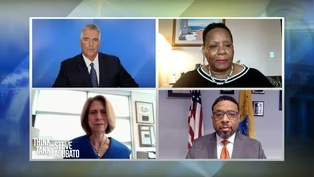
Video has Closed Captions
Clip: 6/25/2022 | 18m 25s | Future of Higher Education (18m 25s)
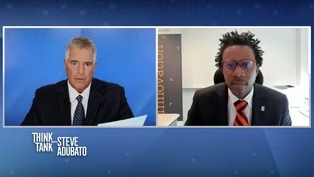
New Technology and Research at Princeton University
Video has Closed Captions
Clip: 6/25/2022 | 8m 17s | New Technology and Research at Princeton University (8m 17s)
Providing Support for PBS.org
Learn Moreabout PBS online sponsorship
- News and Public Affairs

Top journalists deliver compelling original analysis of the hour's headlines.

- News and Public Affairs

FRONTLINE is investigative journalism that questions, explains and changes our world.












Support for PBS provided by:
Think Tank with Steve Adubato is a local public television program presented by NJ PBS