Utah Insight
Future of the Death Penalty
Season 3 Episode 10 | 26m 37sVideo has Closed Captions
What is the future of the death penalty in Utah? We discuss it with people on both sides.
While efforts to abolish the death penalty in Utah may have failed in the state legislature this year, political insiders don't believe the issue is settled. We talk with people on both sides including lawmakers, human rights activists, and families of victims to gauge public sentiment on the topic. Plus, what could changes to Utah law mean for those already on death row?
Problems playing video? | Closed Captioning Feedback
Problems playing video? | Closed Captioning Feedback
Utah Insight is a local public television program presented by PBS Utah
Utah Insight
Future of the Death Penalty
Season 3 Episode 10 | 26m 37sVideo has Closed Captions
While efforts to abolish the death penalty in Utah may have failed in the state legislature this year, political insiders don't believe the issue is settled. We talk with people on both sides including lawmakers, human rights activists, and families of victims to gauge public sentiment on the topic. Plus, what could changes to Utah law mean for those already on death row?
Problems playing video? | Closed Captioning Feedback
How to Watch Utah Insight
Utah Insight is available to stream on pbs.org and the free PBS App, available on iPhone, Apple TV, Android TV, Android smartphones, Amazon Fire TV, Amazon Fire Tablet, Roku, Samsung Smart TV, and Vizio.
All Episodes Now Streaming
Hosted by Jason Perry, each week’s guests feature Utah’s top journalists, lawmakers and policy experts.Providing Support for PBS.org
Learn Moreabout PBS online sponsorship(upbeat music) - [Announcer] Funding for "Utah Insight" is made possible by viewers like you, thank you.
- [Announcer] Tonight on "Utah Insight," abolishing the death penalty.
- Because it takes so long, it re-victimize the family.
There are so many hearings, it's not working the way it was meant to work.
- [Announcer] Some state lawmakers want to take the costly sentence off the table for good.
- And we had that hope that that's the one thing, like if we don't fight for death, and we're not fighting hard enough, because they didn't deserve what they went through.
- [Announcer] Others fight back, saying it provides justice and closure.
We hear from both sides on this controversial punishment.
(upbeat music) - Welcome to "Utah Insight."
I'm RaeAnn Christensen.
Some say it's the just punishment, others say it's not working.
For the third time, in recent years, the death penalty has been challenged by some Utah legislators.
This year House Bill 147 failed before the House Law Enforcement and Criminal Justice committee in a five to six vote, but support to abolish the death penalty in Utah seems to be growing.
Joining us in the studio tonight to talk about the future of the death penalty here in this state, we have Andrew Peterson, assistant attorney with the Utah Attorney General's Office, Marina Lowe, policy lead on the death penalty for the American Civil Liberties Union, or ACLU of Utah, and Representative Lowry Snow with the Utah House of Representatives, representing Washington County.
Thank you so much for being here to talk about this very controversial topic.
Representative Snow, you were one of the bill sponsors this year.
Tell me, why did you decide to take on this tough issue?
- I was actually the chief bill sponsor, and there's probably several reasons why I decided to, but to a large extent, I became involved in becoming acquainted with Sharon Weeks, who was a victim related to Brenda Lafferty, as a sister, who spent some time with me, and detailed the experience of her and her family, with the death penalty, and how it affected their lives, and that led me to do some research into how effective this punishment was, and discovered that it's really problematic, and there are quite a few failures, in terms of this bringing about the justice that, in the case of that family, was promised.
- Andrew, what were your thoughts when the bill got shut down?
- Well, I was pleased that it was.
I think this topic deserves quite a lot of discussion.
It is a big topic with people of good will, on both sides of it, but one thing that often concerns me in these conversations, is that there is a great deal of misinformation that's used to justify keeping or repealing the death penalty, and I am always very concerned that policymakers be given the best information that's available, and I think, in this instance, the vote came out in favor of keeping the death penalty, once the committee heard accurate and reliable information.
- Many supporting the bill say executions are expensive, the appeals process takes too long, there's a lot there.
Marina, how did you feel when the bill failed?
- Well, I guess I would disagree, both in terms of the sentiment I felt.
I obviously was disappointed in that result, and I believe that it came out that way, not because of the information presented in committee, but for political reasons.
You know, I think, increasingly, we see across the country, and in the State of Utah as well, an understanding and a realization that the death penalty is a failure, that there are other alternatives that work better, both to ensure justice, and that are swift, and save resources for the state, and accomplish the very same things that the death penalty was meant to accomplish, but do so in a way that is more fair and humane, I think, to all involved.
- The Innocence Project says it's identified at least 18 people in the US serving time on death row, that were later proven innocent, and exonerated by DNA testing.
Andrew, is the risk the government could kill an innocent person worth this punishment?
- Yes, and I say that very carefully, and understanding that that might sound callous, but there has never been a confirmed case of an innocent person executed in the United States, in the modern era.
The system that we have in place is very, very robust.
People on death row are given paid counsel, they're given mountainous resources to litigate their cases, and these cases are scrutinized really extensively, and in Utah specifically, there's never been anybody on Utah's death row, in the modern era, who had any credible claim of innocence, and so, given that we are as careful as we are, I, of course, cannot guarantee that no innocent person could ever slip through, and be executed, but our system is very, very good, and it hasn't happened, and nobody on Utah's death row currently is innocent.
- How do you feel about that, Marina, with 18 people in the US that were later exonerated?
- Well, actually I think that number is incorrect.
I think it's over 160 people in the United States who have been exonerated in the United States off of death row.
The number 18 is specific to Utah.
There have been 18 specific exonerations in this state, and while it is true that there is nobody on death row who has been exonerated, there are individuals currently on death row right now, who do have credible innocence claims.
There are cases being litigated, as we speak, on that issue.
So, I do take issue with the fact that we could feel secure and certain that there are not innocent people on death row, both in Utah and across the country.
The fact is, we're all human, we make mistakes, we know that there are problems with our criminal justice system at all levels, and that's not to point the finger at anybody, or place fault on anyone.
It's just the reality of human beings and our systems, that we have errors, and we know this for certainty with our criminal justice system, and so it stands to reason, of course, that there will be these same sort of errors when it comes to cases that end with the most significant penalty you can have, and a final penalty that can't be undone once it's administered.
- Thank you for correcting that information.
Yes, go ahead.
- I apologize for interrupting, but I think Marina would feel good about amending, the 18 factual exonerations in Utah were not death row cases.
- [RaeAnn] That's correct, sorry.
- But they were serious felonies, and I think of the 18, six were either murder or manslaughter.
So, to say that someone charged with murder or manslaughter, or any serious felony, that our system is perfect, that we don't make mistakes, is certainly not true in Utah, and it's not true across the country.
The statistic that Marina has cited, in terms of the number across the country, who have been on death row, maybe not were executed, but were certainly facing execution, and I think, also for us, to say that if we have people on death row 35 years, the fact that they haven't been executed, that supports the perfection of the system is not accurate either.
We don't know yet, whether those people will have defenses that they can raise, and as Marina points out, at least one of those is undergoing, right now, a fairly serious contest about whether they're guilty or innocent.
- Okay, last year, four county attorneys signed a petition sent to the governor and legislature, asking to abolish the death penalty.
Salt Lake County District Attorney Sim Gill says it fails to deter crime, disproportionately applies to minorities, it's expensive, makes plea negotiations coercive, and it re-traumatizes victims.
- What I hear from them is that what they want is accountability, they want assurance that this person will not be able to harm somebody else in the community, and, ultimately, they want to try to move on with their lives, because the death penalty promises a false hope, it's a fraud.
It says that we will give you a measure of justice, but we can never give a measure of justice ever, because justice would be that this incident never happened.
- "It's a fraud."
Those are some pretty powerful words from Sim Gill.
What's your reaction to hearing that, Andrew?
- Well, not everyone shares Mr. Gill's intuitions about what justice is.
Aristotle said that justice was giving each person what they deserve, and people who support the death penalty have a very strong intuition that some crimes are so beyond the pale, that only death as a punishment is sufficient.
That anything else is, by definition, unjust, that punishing someone too little is as unjust as punishing someone too much, and for certain crimes, there is no other punishment that people who believe in retribution as a feature of our criminal justice system would be satisfied with.
- You know, and here's where I would actually agree with Andrew.
I think, theoretically, a lot of people come to that same place, and feel like there are some crimes that are so heinous and so horrible that death is probably the appropriate penalty.
I think where maybe we differ is that we just don't have a system that can deliver that sort of promise without doing so much damage throughout the rest of the system, whether it's victim family members who are asked to wait 30, 40 years for that sort of justice.
That's a tremendously long time to have to wait.
That's years of trials, retrials, hearings, having to relive that experience, the uncertainty that comes with each time your case is brought before a judge, will a judge find some technicality that makes you have to start all over again?
That's a lot to ask, and so I think that a lot of people probably feel like, if somebody we could know with certainty is guilty, they could be stricken down right away, and we would know for sure that they were the right person, that it wasn't someone else, that it could be done swiftly, then I think there might be some more support for the death penalty, but the problem is the system that we have today cannot deliver that sort of result.
- Okay, and I wanna talk about the racial inequities, and Sim Gill saying it disproportionately applies to minorities, do you think that that's true, Representative Snow?
- I think there is data across the country that's accurate, and, by the way, that's not just true in the area of someone looking at a death sentence, but to a large extent, our criminal justice system suffers from that issue, and I think we're working on it in Utah.
I think we're trying to get better at it, but it's certainly an issue, and I think Mr. Gill is correct on that.
- How do you feel about that, Marina?
- Yeah, I would say the same.
I think we see that across the criminal justice system, that people of color are disproportionately impacted, and tend to be the focus of criminal justice, and the weight of the state, in that regard, to a higher degree, and we see that all across the system, and so, of course, we see that reflected in the death penalty as well.
You know, states that are more diverse than the State of Utah, I think have a death row that reflects that even more than Utah, but nevertheless, I think that's a valid point and criticism.
- I would like you weigh in, Andrew.
- Well, the United States Supreme Court has addressed this, and they found that there was not good evidence for racial inequity nationwide in the death penalty, but I would add that we don't sentence people statistically, we sentence people individually.
A capital sentencing is exquisitely individualized to the circumstances of the crime and the character of the defendant, and so the people that we have on death row in Utah are only those who deserve it, and so the statistics is sort of irrelevant to the jury, deciding, does this person deserve to live or die?
- Family members of two murder victims say they felt locked out of the process when it came to deciding the fate of the person who killed their loved ones, but their worry, stress, and anger has turned into action.
They share with "Utah Insight's," Liz Adeola, why they are speaking out about the flaws in Utah's justice system.
- What does justice look like to you?
- Justice is subjective.
It's the ethical principle that offenders are held accountable for their actions.
- Well, there never will be justice.
I mean, you can't replace the kids.
All we can do is go forward, and try to keep the death penalty intact.
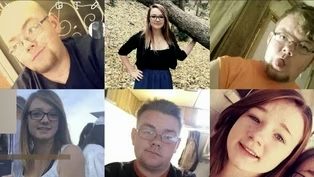
- [Narrator] It is a lifelong mission that Amanda Davis and Bill Powell now embrace in honor of the ones they've lost.
- How often do you think about what happened to Breezy and Riley?
- Every day.
I drive by the mine every day.
It's about probably a half mile, three quarter of a mile off the main road where I drive to work every day.
So I usually make a comment on the way down, on the way back, or I go to the mine, check it out and make sure everything's staying in order, and check on the flags and stuff like that.
It's kind of my job now.
- [Narrator] Maintaining this Memorial site near the Tintic Mine.
- They were humans, they were teenagers starting a life, and they didn't get that chance.
- [Narrator] In April, Jerrod William Baum was found guilty of killing the teens in 2017, but in a change of events, Baum was sentenced to life in prison, instead of the death penalty.
- Bill and I both sat every single day at trial, and to hear the testimony, to see the autopsy photos, to see what they went through, and truly fell it, relive it, after four years, it only put more salt in our wounds.
- There's always gonna be bad people, so you've gotta bring the families in, and get their input before you make your decisions.
- [Reporter] And you feel like that didn't happen in this case?
- No, not when you have the rug pulled out from under you.
- [Narrator] Bill and Amanda say months before the trial, Utah County Attorney David Leavitt gave a list of reasons why he wouldn't pursue the death penalty in this case, but to them, only one reason shown clear.
- [Reporter] What does it say about the justice system in Utah?
- It's broken.
The way the system works, it just drags everything on forever and ever, and ever, and if they're crying about the cost, the system creates the costs.
So they need to fix the system, and then that will fix the costs.
- The emotional toll that we've paid, and we're heartbroken, we're angry.
Those kids deserved every ounce of it, and it might sound morbid, but I wish he had to look at their photos to see what they went through, and then tell us that that cost wasn't worth fighting for them.
- [Narrator] Their pain turned into a push for a new Utah county attorney to be elected, and in June, voters agreed that it was time for a change.
Amanda and Bill say their supporters have become a second family.
- [Amanda] That makes me feel like what we did in our pursuit for justice to find them, now it's to remember them.
Breezy was planning to start school in Eureka with Riley.
He was just trying to get on his feet.
He had started a new job, and they'd be young adults.
Breezy wanted a child of her own.
I would like to think that she had her own family.
(sniffling) Sorry.
That they found the love that they both were looking for.
Think about that.
We'll never know.
- A really emotional story there, and this was such a heinous crime.
The family wanted the death penalty, they had it, then it was taken off the table.
Andrew, what do you think that says about our justice system?
- Well, that was an unusual case.
Most of the cases in Utah that I'm aware of, the prosecutor consults very closely with the victim's families, and the victim's families don't, of course, determine whether the death penalty will be sought, but it's atypical for a prosecutor to seek the death penalty when the family doesn't want it.
They typically will only pursue the death penalty when the family supports it.
This was an unusual case, in that the prosecutor decided to pursue the death penalty, and then changed course midstream, that caused all kinds of problems in the litigation itself, and of course, traumatized the family yet again.
I think it was an obscene gesture by the Utah County Attorney's Office.
- Speaking of traumatizing the family again and again, I know you said the Lafferty case, their sister ended up not wanting the death penalty anymore.
Do you think this family would've went through a similar thing, but now they can just put it away?
- When you say this family, the present family?
- [RaeAnn] Of Breezy and Riley, yeah.
- I can't speak for them, but I can speak for Brenda Lafferty's family, because I've had conversations, particularly with Sharon.
They went through an evolution.
They wanted the death penalty, because it was promised to them, and they were told by the prosecutors, and by the Attorney General's Office, that this was justice in this case.
One of the saddest stories Sharon told me was when her mother passed, how disappointed she was that her mother passed away before she could ever see justice delivered as it was promised.
The other thing that we don't talk about is, Marina has talked about the appeals and the cases that go on and on.
Sharon talks about the media coverage.
It's interesting, in the Lafferty case, because two brothers were charged.
Ron Lafferty received a death penalty.
Dan received two life sentences.
They never heard about Dan Lafferty, and he's still in prison serving out that sentence, and it is a death penalty.
He will die in prison, but the Ronald Lafferty, because it was a death sentence, continued to haunt that family.
The circumstances of those events would come up, the trauma they would feel every time there was a media publication, or there was an event, and of course, we saw, recently, where all of this was played out in a Hulu series as well, and Sharon went through an evolution to the point that she now is very actively opposing the death penalty, primarily because the system is broken, and could not deliver what was promised to their family, and in the meantime, they went through a lot of trauma and pain.
- Okay, if I could just add on one thing too, and speaking with Sharon, I've also had the pleasure of getting to know her over the years, and what really struck me is that she'd sort of come to this conclusion that we basically have only life without the possibility of parole, that the men who are currently serving death sentences on Utah's death row, they've all been there 20, 30 plus years.
We're not gonna ever execute these individuals.
Maybe we will, who knows?
But we certainly haven't been able to accomplish it in 20 or 30 years.
So, what is the difference?
They're essentially serving a life sentence.
So we might as well pay for a life sentence, tell victim family members they're gonna have a life sentence, so that they can understand the future that lies in front of them, instead of promising something that we don't actually deliver.
- And be able to move on in whatever way they can.
- Right.
- I know that they use the death penalty as a tool.
Prosecutors will use it as a tool to help solve the case, and, for an example, the recent Lizzy Shelley murder case, the death penalty was taken off the table if the murderer led police to her body.
Andrew, as a prosecutor yourself, how effective is this tool for law enforcement?
- I don't think it's used very often.
In my experience, prosecutors who pursue the death penalty pursue it because they think it's the appropriate sentence in that case.
The Lizzy Shelley case was special.
They wanted to find her body, and they couldn't find it.
They had searched the area where her body was found, and as a way to bring closure and peace to the family, they offered to take the death penalty off the table if the defendant would lead them to the body.
That's a very different sort of circumstance than I think what your question implies, which is whether it's appropriate to use the death penalty as a bargaining chip for, say, a guilty plea.
I don't think that happens very often.
If it does happen, this is why we have elected people in the role of county attorney, district attorney, so that they can represent the will of the people, and they can decide for themselves and their constituents, whether that's an ethical decision.
I can't say one way or another, whether that's ethical to do.
- Okay, we have about 30 to 40 seconds for each of you for final thoughts.
This is a heavy topic, and I know there's a lot to discuss, but if you wanna cover if we should do away with it, reform it, if it's broken, how do we fix it?
Andrew, do you wanna go first?
- Yes, there are some features that are broken.
It does take too long.
It takes too long.
Currently it takes too long, mostly in federal court.
The federal courts are where capital cases go to die, and if we could somehow get our federal courts to apply the law as written, and not tolerate delay tactics that criminal defense attorneys use, we would see these things go much quicker, and I will say that it is not true that we will never have another execution again.
We have at least two that could potentially be ready for execution next year or the year after.
- Okay, Marina.
- You know, I guess I would just say that, to me, the death penalty is sort of a catch-22.
We talk about, could we fix this broken system?
And the problem is, if we try to speed things up, and make it better for victim family members, so they don't have to wait so long for justice, we run up against this issue of innocence.
You know, if there isn't enough time for the courts to ferret out whether we have the right person, to make sure that when the state is bringing the power of the possibility of taking your life, to make sure that due process is observed in all cases, that takes time, and so if we shorten that timeframe, and try and fix things, then we run the risk of executing even more innocent individuals.
So, to me, we can't really fix this broken system, and so we have an alternative which works, which delivers justice, which can be done in a much more speedy fashion, and that's life without the possibility of parole.
- Okay, Representatives Snow.
- Thank you for giving us some time.
It's a difficult question, and in my time in legislature, I've worked to try to resolve situations.
This is a particularly challenging fix.
If it could have been fixed, it would have, I believe.
The reality is it doesn't work, it's incredibly expensive.
I don't think it protects the victims as the way that they're being promised, I don't think it delivers justice the way prosecutors are promising in some cases.
If you look at the statistics, there have been only seven executions since 1977, but 54 charges of death penalty that have never materialized, and led to an execution.
So, to say that it's not being used for plea bargain purposes, I don't think is accurate, given all of those issues from a policy standpoint, not to mention the expense, and how better used those resources could be for public safety, for counseling.
I think we're missing the mark.
Marina said it best, and I think it should not be lost on your audience that when someone is sentenced to life without possibility of parole, that is a death sentence, but the reality is, then we don't have the victim suffering, we don't have the ongoing expenses, and for the most part, we don't think or hear about that person serving out that time.
If I said to you there were seven people on death row right now, you might know the name of one or two, but for the most part, we don't.
Everyone knows the name of Ron Lafferty, and that's maybe a good point to leave.
I'm interested in good policy.
I'm also interested in protecting victims and victim's families, but when I realize that the system simply isn't working, isn't delivering what should be happening in government, I sought to make a change.
- Okay, thank you so much for being here.
I know that's not enough time to go through through this topic, but we do appreciate you being here, and that wraps up season three of "Utah Insight."
We wanna thank you so much for watching.
(upbeat music)
Fighting for the Death Penalty
Video has Closed Captions
Clip: S3 Ep10 | 4m 10s | Why one Utah family says they will never stop fighting to keep the death penalty legal. (4m 10s)
Future of the Death Penalty | Next Friday!
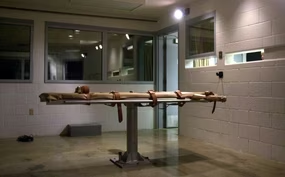
Preview: S3 Ep10 | 30s | We bring together people on both sides to discuss the future of the death penalty in Utah. (30s)
Providing Support for PBS.org
Learn Moreabout PBS online sponsorship
- News and Public Affairs

Top journalists deliver compelling original analysis of the hour's headlines.

- News and Public Affairs

FRONTLINE is investigative journalism that questions, explains and changes our world.












Support for PBS provided by:
Utah Insight is a local public television program presented by PBS Utah