Utah Insight
Future of the Great Salt Lake
Season 4 Episode 8 | 26m 44sVideo has Closed Captions
The Great Salt Lake is on the brink of collapse. Is there anything we can do to save it?
The Great Salt Lake is facing unprecedented danger. Without a continued increase in water flow to the lake, its disappearance could cause immense damage to Utah’s public health, environment, and economy. But what can we do? Learn about the lake’s decline and what can be done to reverse it as we sit down with a panel of experts to discuss this threat to the Wasatch Front and beyond.
Problems playing video? | Closed Captioning Feedback
Problems playing video? | Closed Captioning Feedback
Utah Insight is a local public television program presented by PBS Utah
Utah Insight
Future of the Great Salt Lake
Season 4 Episode 8 | 26m 44sVideo has Closed Captions
The Great Salt Lake is facing unprecedented danger. Without a continued increase in water flow to the lake, its disappearance could cause immense damage to Utah’s public health, environment, and economy. But what can we do? Learn about the lake’s decline and what can be done to reverse it as we sit down with a panel of experts to discuss this threat to the Wasatch Front and beyond.
Problems playing video? | Closed Captioning Feedback
How to Watch Utah Insight
Utah Insight is available to stream on pbs.org and the free PBS App, available on iPhone, Apple TV, Android TV, Android smartphones, Amazon Fire TV, Amazon Fire Tablet, Roku, Samsung Smart TV, and Vizio.
All Episodes Now Streaming
Hosted by Jason Perry, each week’s guests feature Utah’s top journalists, lawmakers and policy experts.Providing Support for PBS.org
Learn Moreabout PBS online sponsorship(bright music) - [Announcer] Funding for Utah Insight is made possible by viewers like you, thank you.
- [Raeann] Coming up on Utah Insight, the shrinking Great Salt Lake.
- If we let the lake die, then we are failing our state.
- [Raeann] Even with a record breaking winter and legislative dollars, scientists say the lake is still not out of the danger zone.
- This is our future, and if we wanna keep living in this state, something ought to be done.
- [Raeann] What's it going to take to save the Great Salt Lake for good?
(upbeat music) - Welcome to Utah Insight.
I'm Raeann Christensen.
Just a few short months ago, the Great Salt Lake water levels reached an all time low.
Fortunately, a record breaking winter has helped, but is it enough?
This is the view from NASA of the Great Salt Lake in June of 1985, and you can see July of '22, a much smaller Great Salt Lake, nearing historic lows.
Recent reports say that the lake has risen more than five feet from melting snow pack and runoffs since hitting record lows in November.
While that's helpful, experts say it's not where it needs to be just yet, the potential vanishing of the lake could mean extensive ramifications on Utah's public health, environment, and economy.
Joining us in the studio tonight, we have scientist Jaimi Butler, a Great Salt Lake biologist and expert who has been working on the lake for decades.
Darren Parry, chairman of the Northwestern Band of the Shoshone Nation, and Ben Abbott, associate professor of ecology in the Environmental Science and Sustainability Program at Brigham Young University.
Thank you so much for being here, an important topic to discuss.
I wanna start with Jaimi.
We're hearing the lake is not at healthy levels yet.
What do you think, this is a big question, it's gonna take for us to escape that danger zone?
- Okay, well, I think what we need to realize too, is step back and realize, that the lake is really two lakes right now.
We, you know, increased the adaptive management berm on the railroad causeway that cuts the lake in half to preserve the salt content in the south arm of Great Salt Lake.
So we have the south arm of Great Salt Lake, where all of the freshwater is flowing, and we have the north arm of Great Salt Lake, that's essentially only risen one feet, one foot in comparison to that five feet that the south arm has raised.
So we're now in acceptable salt content levels.
We're now in a place where brine shrimp and brine flies can survive.
That's what the birds eat, and that's an indicator of what the ecosystem is doing.
Is it healthy?
Are there lots of shorelines exposed for dust to blow off of?
So we're in a better position than we were last year, but we're also seeing pelicans, one of the largest colonies of American white pelicans in the world, has abandoned their colony on Gunnison Island in the north arm of Great Salt Lake, along with the gulls nesting there also.
And so we have been doing this experiment, this experiment of draining Great Salt Lake for the past couple of decades.
Also, you know, added on top of that being drought and starting to see the effects of climate change.
So we've done this experiment, we hit historic lows, we hit historic highs in salt content, and now we're seeing the results of this experiment playing out on pelicans and shorebirds and the humans that live around us.
- Okay, we're gonna talk about the pelicans a little bit more later in this show.
Ben, you co-authored a study at the beginning of this year, stating if drastic changes aren't made, the Great Salt Lake could be gone in five years.
Can you talk about that?
- Yeah, absolutely.
The decline of Great Salt Lake has accelerated since the year 2020.
And we all expected from a scientific perspective that it would really slow down because the lake's smaller, you're losing less water to evaporation and as it gets saltier, but that didn't happen.
It accelerated.
This big winter has rewound the clock by about two years, so it's given us two extra years on that timeline, you know, but thinking about how long it takes us to implement changes in policy and practice, we're still looking at a very similar timeline, you know.
- That's a little scary.
Two years is not much.
- That's right.
Two years.
And so whether it's three years or seven years or nine years, we need the change now.
Actually we needed the change 10, 20 years ago.
And so we're in a situation, where to turn around the decline of Great Salt Lake, some people have told me, you know, this is a marathon, not a sprint, but I actually think it's, we need a sprint that's followed by a marathon, as far as really dramatic action now, followed by long-term change in policy and also culture, our relationship with the lake.
- Talking about culture Darren, you have said to save the great Salt Lake, indigenous voices and knowledge needs to be included.
Can you elaborate why you feel like that?
- Yeah, thanks for having us too.
I'm among dear friends, so it's comfortable.
To Native American peoples, all things are connected.
And so, being able, our creation story started at the Great Salt Lake Antelope Island.
And so it's a, it's an important part of who the Shoshone people were and many indigenous cultures.
But that value system is how we were taught, and how we view the environment that we live in.
And so, everything that we do, every action we take, even though we may not think it has something to do with something else, that connected way of living is really who we are as a people.
I tell people every day, we stewarded that environment for thousands of years without messing it up.
Our country is less than 250 years old and look at the mess we're in today.
And it's because we haven't incorporated values with the scientific knowledge that we possess.
And until we do, we're gonna be in trouble.
- While the water levels are rising at the Great Salt Lake, there's still an immense amount of dust pollution blowing.
This video was taken in May of this year by a camera here on the University of Utah campus.
The cameras are taken care of by the University's Department of the Atmospheric Sciences and MesoWest.
The caption on YouTube says in part, strong winds can loft dust into the atmosphere and degrade air quality and deposit onto the snow pack on the Wasatch Mountains.
Now a lot of people are scared of this, the arsenic, the heavy metals.
We're breathing this and it seems like dust pollution alone seems like a significant health risk.
Jaimi, do you know the impact these pollutants are having on our residents?
- You know, I'm not a doctor and I can't really speak to, to all of those impacts, but, you know, we have bad air quality and have heard a lot about different particulate matter that stays in our air in this valley when we get inversions and you know, it's the same dangers for Great Salt Lake dust.
There's different particulates that blow off of that lake bed and big ones stay in, you know, bigger particles stay in the air for a shorter amount of time.
They can cause different problems, can clog up your lungs.
You can imagine getting anything into your sensitive lungs is bad for them, whether they have arsenic in them or not.
And then if you look at those smaller particulate matter, that PM 2.5, you know, that can stay in the air for a couple of weeks.
It's not just folks along the Wasatch front that are gonna be impacted by dust.
It's, you know, if you look at these maps, it's farms in the Cash Valley and in Morgan and in Tawilla and really all along the Wasatch front.
So it's a widespread issue that, I mean, can really even go around the globe.
- Scientists here at the U say, when storms come from the north and northwest, the pollution from the storms impact the Salt Lake Valley's west side the most.
Ben, can you talk about that a little bit?
- Yeah, you know, there, whenever we harm our home, the earth or creation, we harm ourselves.
And that has, we've learned that from sad experience over and over again, but we don't all suffer the same consequences.
And there is an issue of what we call environmental injustice, where certain groups are impacted more.
If we look at the nation as a whole, Black and Hispanic communities are bearing about a 50 to 60% higher pollution rate than white and other communities.
And so, it really emphasizes that this is a moral issue as well.
It's a technical, hydrological, biological, but also a moral issue that we need to address.
And I think it's really interesting.
Different groups might be able to insulate themselves a little bit from those impacts, but ultimately we all are in the same air shed, we all breathe the same air.
And that's what research right here in the valley has shown.
Yes, the pollutants are more acute in the west side and the south side, but when the air quality gets bad, as we saw in the video, it impacts all of us.
- Okay, and we learned that the US Environmental Protection Agency, or EPA, is working on an environmental justice study of Salt Lake City's West side.
And as you said, minority groups have long taken the brunt of the environmental burdens in the US.
Darren, I wanna talk to you.
Can you talk about the importance of the EPA recognizing this?
- Yeah, as an indigenous person and a person of color and a person that belongs to one of the minority groups, we've never been given a seat at the table.
And I think that that speaks volumes for, I think if we had, you wouldn't see indigenous and other populations suffer greater because of these things.
And so now finally, you know, there's a group that wants to speak on behalf of those people that have never had a seat at the table or never had a voice.
So it's really important that people that do have a voice and especially EPA, come to the help of those who need it the most.
And those communities that suffer at a great, at a bigger cost than any other groups.
- A group of local teens are part of a youth movement to save the Great Salt Lake.
They've written letters to state leaders and have visited the lake to learn more about its future and how it impacts the rest of Utah.
Utah Insights' Liz Adeola met with some of the students and their mentor, who is encouraging them to speak up before it's too late.
(wind blowing) (water splashes) - We can think of an era when people had the lake in their lives and they came to it with that kind of natural respect.
They didn't have to think about respect.
It was part of how they lived with the lake.
So this sand is not crystalline.
In fact, if you pick it up, it doesn't feel coarse like regular sand.
They didn't have to label it harmony.
It was part of them and they were part of it.
That's been something that has come to me often when I've been out here.
- [Liz] A question that community activist Elizabeth Weight, wants these local high school students to think about on this Earth Day.
What have we done to the Great Salt Lake?
- I'm standing on a lake that has been affected by over 20 years of drought, and recent years of real neglect by policymakers and other people who have diverted water.
- [Liz] Weight, who is a former state legislator, is now focused on teaching teens who may be Utah's future leaders about the Great Salt Lake.
- If we have the mindset of, well, somebody else will do it, then nobody else will and nothing will get done.
- Rosie Lander was one of a handful of teens from the First Unitarian Church who joined Weight on the south shore of the lake to learn of its history and possible future.
- It would be nice to see that there is something still in that water, keeping the ecosystem going.
- I'm hoping to see like change, like I heard that the water level rose up a little bit from last year, which makes me hopeful.
- [Liz] The fact that any kid would wake up early on a cloudy Saturday to learn about problems at the lake gives Weight hope.
- My purpose is to help others become active in speaking to policymakers who don't know any more than they do.
- [Liz] Especially people like Liam Mountain La Malfa.
- It certainly doesn't feel good to see the lake depleted, because it just reminds me of all the potential devastation that could come.
- [Liz] His desire to save the lake is personal.
- I know that I have asthma.
I know that a lot of people in this state have asthma and we already suffer, given the way the Salt Lake Valley creates inversions with dust and trace amounts of substances, like arsenic flying around in the air, released by the drying up of the lake.
It will just be incredibly difficult.
- If we want to see something done, then we have to do it ourselves.
And it's unreasonable to think that 15 and 16 year olds, that it should be their responsibility to fix what the older generations broke.
But that's the truth.
We have to do it.
If we don't do anything, then nothing will get fixed.
- [Liz] So they're doing what they can to grasp the severity of the problem, in hopes of taking what they've learned to state leaders and other teens to get more people involved in saving the Great Salt Lake.
- I would say you have to act now or else we're gonna have a really hard time in the future, like the youth.
This is about us, our future.
We're gonna be the people who are living here in the future and making decisions.
- [Liz] Reporting from the edge of the Great Salt Lake.
I'm Liz Adeola for Utah Insight.
- You heard Elizabeth, a former state legislator, say the lake has been affected by 20 years of drought and recent years of real neglect by policymakers.
Darren, do you think that policymakers are doing enough right now?
- The short answer is no, they're not doing enough.
And I'm certainly grateful that a couple of years ago they took a Black Hawk helicopter ride, because most of the lawmakers drove by that lake every day without realizing what the extreme crisis is.
And now that once they did, they've seen that.
And I applaud them for the work they've done.
And I don't want to be a naysayer on it, but I think we're taking small steps when leaps and bounds are really what's going to, what we're gonna need going forward.
- Residents are also neglecting the lake according to Elizabeth.
Jaimi, what do you think that residents can do better?
- We all just need to change our water ethic, right?
We need to change the way that we're using water.
We're a growing state.
There's just gonna be more people.
Our climate is changing and we need to change how, and that's hard to change, an ethic and a connection with water for a place that all of our water ends up in Great Salt Lake or doesn't end up in Great Salt Lake, as has been the case.
And I think we need to be mindful of that and understand that we are gonna have differing amounts of water depending on what our conditions are.
Maybe we had a big year and we have a little bit more water to put on crops, but I think we are gonna have to change our ethic and be more adaptive in the way that we're using water, both residentially, but also, you know, within the agricultural community.
- The teens said it was their responsibility to fix what the older generations broke.
And if they don't, that nothing's gonna be done.
Ben, what's your response to that?
- You know, I'm actually reminded of something that I've heard from both Jaimi and Darren, that we need everyone to be doing everything that they can.
This isn't going to be solved by any, you know, there's not like one person that we can go to, who magically can create more water.
This is a collective governance problem.
And I actually think what we need even more than water is trust.
And if we can turn to one another and think about living within our means, then I do believe we can solve this problem.
But we need to be clear-eyed about the challenge, because there are around 120 of these saline lakes around the world, over a hundred of them are in decline.
And no one has cracked the code on this.
You know, there are no examples we can turn to about, okay, this is how we want to solve the problem.
So it's going to take the youth, the elderly.
We'll include all of ourselves in that group and everyone in between, you know, to work on this.
- Jaimi, you mentioned this earlier, Gunnison Island is home to thousands of American white pelicans who nest and raise chicks there each spring.
But according to a recent Salt Lake Tribune article, this year, there are almost none.
The article says pelicans choose this site because of its isolation, but this year there's no fresh water, shade, and almost no food.
Until recently, there were no predators or people.
The article goes on to say, the Great Salt lakes receding water, however, has created land bridges that allow access for sharp-toothed scavengers and human trespassers.
Since at least 2017, the access has put one of the nation's largest nesting pelican colonies at risk.
Jaimi, you had talked about this earlier, that there's two different stories going on at the lake, and I don't think a lot of people are aware that one side's five feet higher, one's one foot higher.
Can you talk a little bit about that?
And is that make you a little nervous?
- Well, yeah, you know, in 2016, our water levels decreased to low enough that there was a large land bridge that went out to Gunnison Island.
Gunnison Island was protected from predators and humans, you know, have a really hard time getting out there also.
And so they lived on this disturbance free island and they traded food and fresh water for a safe place that they could, you know, have their young.
And in 2017, the Division of Wildlife and Westminster College put out cameras on the island that you would use like game cameras.
And we saw at that time when the land bridge came out, both coyotes and humans out on that island.
And so, you know, the recent news, that these pelicans have abandoned their nest.
They came here and they nested this year, and then they abandoned their nest.
I think is the culmination of, you know, 10 years of not having enough food and freshwater wetlands, of having this land bridge and this immense disturbance on a very hard island to survive.
I wouldn't wanna live on Gunnison Island.
It's very remote, it's very extreme, it can be very hot and windy or hailstorms and there's no trees, only little rocks to protect these baby pelicans.
And so I think this is really a culmination of these, you know, past couple of decades.
And I don't think that it's just gonna be pelicans that are gonna be impacted.
These small shorebirds called Phalaropes, come here all the way from Canada to refuel and to rest and to molt and they go all the way to Argentina.
And so, you know, that leaves Great Salt Lake as one of these rest stops along a hemispheric highway, not just for pelicans, but for Phalarope and not having this rest stop, it could devastate entire populations of many birds.
And I think, you know, the pelicans are just, the pelican area in the coal mine.
And I've had, you know, a lot of people tell me that same thing.
They're the first animals that are gonna be impacted, and impacts to humans, to our economy, to our health, to all of those things are gonna come after that.
- We saw sailors celebrating as they were getting back on the water with their boats.
But that is on the south side.
Ben, can you talk about what it's gonna take to get the north side comparable?
- You know, the only long term solution is to live within our means to use a sustainable amount of water.
And we estimate that that's going to require about a 30 to 50% decline in the amount of consumptive water use.
Those are big numbers and we're talking about, primarily agricultural water use.
That's around 80% of it, but there's 10%, that's the cities and urban areas, and 10%, that's industry taking water from the lake.
So that's going to be a really big change.
So again, we need to be talking about what are we gonna do for the next five years to stabilize the lake levels to bring back the north and south arm together.
Now raising that berm, I think it was a justified triage measure, right?
We were in real crisis.
The food web was collapsing in the southern arm, but nobody thought it was a long term solution.
And even if we get back up to the minimum accepted level, of 4,198 feet, about 50% of the dust sources around the lake are still going to be active.
So the goal has to be, we need to have a flourishing, healthy Great Salt Lake, so our community can be healthy.
- We've seen bipartisan support to save and protect the lake and all the animals that go with it.
But Darren, you have mentioned that Utah leaders seem unwilling to talk about climate change.
Can you talk about that?
- Well, we live in a pretty conservative state.
We live in a state that prioritizes extraction, depletion, development, ahead of taking care of the natural resources.
And so, you know, the fact that, you know, their value system's a little bit different than those of my people and how we stewarded that environment.
I mean, the listening to Ben, I'm thinking we know what to do, we have the science, but we fail to act.
So why do we fail to act?
For me, it's simple as, we fail to act because we haven't injected values with this scientific knowledge.
And until we interject those values into scientific knowledge, I think we're always gonna struggle.
- Okay, we have about a few minutes of this show, so I do wanna give you guys 30 seconds each for some final thoughts.
Do you wanna go ahead, Jaimi?
- Oh, I'm on the spot now.
Yeah, thanks for having us and I think, you know, Great Salt Lake, the air we breathe, the water we drink, and the food that we eat comes from Great Salt Lake.
And that needs to be a priority and a sustainable part of that is keeping water in Great Salt Lake for humans, for birds, and for our connection across, you know, the hemisphere and to other cultures.
I think it's imperative and would be, unimaginable to not have Great Salt Lake.
- [Raeann] Darren.
- I'm reminded of the Iroquois Nation and their leadership.
They don't make any decisions in their tribe without considering what effect that decision will have on seven generations ahead.
I think about that a lot and I think about the implications of our future if our leaders govern that way.
And so, what I see is, going forward, we're going to need to collaborate.
We're going to need all groups to be able to come together and make better decisions, and hopefully Native American peoples will be given a seat at the table, and given a voice in this matter because it matters.
- Ben.
- You know, it's been disorienting to try to understand this issue and an emotional rollercoaster, right?
Where at times you feel that catharsis when you see the water coming back up in the lake.
But also the fear looking to the future.
And I think that we need to have both hope and determination to get this done, because we can't let the lake die, right?
We simply can't.
- It's not an option.
- It's not an option.
And so we have to have that front and center.
The lake's not gonna respond to how many news pieces or how many bills we pass.
It's going to respond to how much water we get to it.
And so we need to be quantifying that and keep our eye on the ball.
- I like what you said, anyone and everyone, all ages, we all need to do something.
So I appreciate you being here and thank you for discussing this important topic.
Thank you so much for watching Utah Insight and we'll see you back here next week.
(bright music) (bright music)
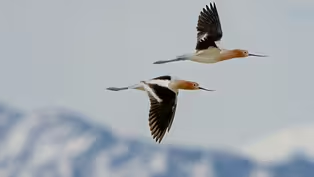
Preview: S4 Ep8 | 30s | The Great Salt Lake is on the brink of collapse. Is there anything we can do to save it? (30s)
Video has Closed Captions
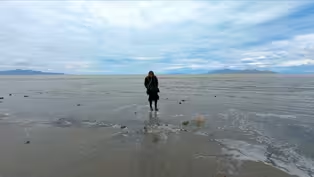
Clip: S4 Ep8 | 3m 32s | Some Utah teens are connecting to the lake's past in an effort to preserve its future. (3m 32s)
Providing Support for PBS.org
Learn Moreabout PBS online sponsorship
- News and Public Affairs

Top journalists deliver compelling original analysis of the hour's headlines.

- News and Public Affairs

FRONTLINE is investigative journalism that questions, explains and changes our world.












Support for PBS provided by:
Utah Insight is a local public television program presented by PBS Utah