
Gaby Dunn on Millennials and Personal Finance
Clip: 3/27/2019 | 14m 42sVideo has Closed Captions
Gaby Dunn, author of “Bad with Money," joins the program.
Alicia Menendez sits down with Gaby Dunn, author of “Bad with Money,” to discuss millennials and the stigma surrounding personal finances.
Problems playing video? | Closed Captioning Feedback
Problems playing video? | Closed Captioning Feedback
Gaby Dunn on Millennials and Personal Finance
Clip: 3/27/2019 | 14m 42sVideo has Closed Captions
Alicia Menendez sits down with Gaby Dunn, author of “Bad with Money,” to discuss millennials and the stigma surrounding personal finances.
Problems playing video? | Closed Captioning Feedback
How to Watch Amanpour and Company
Amanpour and Company is available to stream on pbs.org and the free PBS App, available on iPhone, Apple TV, Android TV, Android smartphones, Amazon Fire TV, Amazon Fire Tablet, Roku, Samsung Smart TV, and Vizio.
Watch Amanpour and Company on PBS
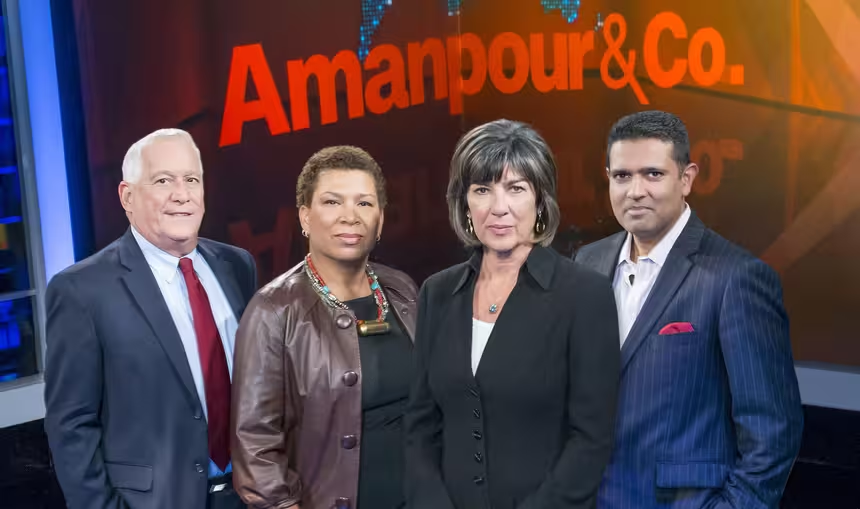
PBS and WNET, in collaboration with CNN, launched Amanpour and Company in September 2018. The series features wide-ranging, in-depth conversations with global thought leaders and cultural influencers on issues impacting the world each day, from politics, business, technology and arts, to science and sports.Providing Support for PBS.org
Learn Moreabout PBS online sponsorshipWe continue to examine the correlation between inequality and stress right now as we turn to the generation that's on track to suffer from the worst income inequality in recent memory.
And that's millennials.
Our next guest says they view the state of their bank balance as an intellectual, moral and personal failing.
Like many in the gig economy, Gabby done with several hats.
Comedian, activist, YouTuber, podcaster, and now author.
And her new book Bad with Money, tackles the stigma surrounding personal finances.
She told our Alicia Menendez that talking about money is now a greater taboo than talking about sex was Gabby, thank you so much for joining us.
Thank you for having me.
I loved the opening line of your book.
It was Here's the big secret about money.
No one knows anything.
What do you mean?
That's what I learned.
I mean, a lot of financial gurus will come at you with specifics as if they can predict the future, as if they know exactly what each person should do.
Even though, in my experience, everyone that I've talked to has individual extenuating circumstances.
And so it's just not accounted for.
You know, I think a lot of people were talking a big game, and then the housing crisis happened.
And I don't think a lot of people were giving protections or saying to people, hey, be a little wary of this because they just couldn't predict it.
But then they go on and still talk about like money as if they're very confident, but they're confident guessers.
If no one knows anything about money, then what did you think you could add to the conversation?
I wanted to be relatable rather than aspirational.
And I wanted to make people feel like there's no shame in talking about it and there's no stigma.
I always say like, I'm lucky in that my family is not going to disown me for talking about it.
My friends, you know, like my friends are going to be okay.
I'm still going to be alive.
That's my metric for like, talking about something shameful like, I'll still live, I'll still have a home, I still have my dog.
Everything will be okay.
So but for some people, that's not the case.
So I feel like if I can talk about something and I can be the person who can take on the embarrassment that I wanted to do that.
And I and it's helped a lot of people feel better about their own situations.
Even though they can't personally talk about it.
Let's talk about that.
Shame on your podcast, Bad with Money.
You open going into a coffee shop with two questions.
What were those two questions?
That was my favorite.
It was I went in and asked people, what's your favorite sex position?
Everyone was happy to answer it.
And then I said, okay, second question, How much money is in your bank account?
And everyone was like, No.
One girl answered, but everyone was like, No, no, no, that's personal.
I can't talk about that.
And what did that tell you?
That sex is cool and money is uncool?
People are like, you know, I think there's a lot of work in the sex positivity space, and there still needs to be more.
And I certainly do stuff there, too, on my YouTube channel.
But I realized that, like, my real secret was my money situation, and people would always come to me and say, Wow, you're so brave for talking about your sexuality.
You're so brave for talking about sex positivity.
And I knew, like, I felt a pit in my stomach and I knew in my heart that I was actually not brave because I wasn't talking about the real problem in my life, the real thing that made me feel insecure and made me cry all the time, which was money.
So I felt like that was the last taboo.
Generally, where do you think that that shame and taboo around money comes from?
People see money as an intellectual, moral and personal failing.
They don't see it as just this ubiquitous thing that has to be in your life.
They see it as like this personal thing that says something about their self-worth, and it says something about their intelligence.
And people judge.
I mean, people love to judge.
Even people in worst financial situations will like laugh at and judge and give it unjust advice to people in a little bit lower situation.
As soon as I started the podcast, I got a ton of emails, mostly from men being like Oh, here's what I would do if I was you.
Here's how I would be a billionaire if I was you.
And I'd be like, Right, but like, are are you like, are you?
And they'd be like, No, but here's what you should do.
I want you to read a part of the book for me, one of my favorite parts of the book.
Let's see if I have what page it's on.
It's about your bipolar diagnosis.
Oh, yes.
That was that's my favorite chapter.
Okay, so this is what I wrote here.
When I was manic.
I wanted to spend all my money because life was a breeze.
And who cared about social constructs like money?
When I was down, I desperately needed material things to make me feel better.
No matter what state I was in, I convinced myself not to look at my finances or try to sort out my bank accounts or plan for the future because it was too stressful and I was too fragile right now.
Why did you want to write about this?
I felt like it would have been a disservice not to explain the eight years of bad decisions because I. I didn't realize, you know, I was undiagnosed for a long time, so I didn't realize that my mania or my depression was contributing to my finances.
And I think a lot of people don't.
I think a lot of people go undiagnosed.
So I, I would associate, like, sadness with needing to buy something.
And then I would also, when I was manic, make all these plans and be like, I'm going to go to grad school in Japan.
So I need to buy a book about Japanese culture.
I never read that book.
Like, within two days, I would be like, what I don't want to go to grad school in Japan.
And so I think I thought it would help people to understand how mental health contributes to finances.
And maybe once they know that, they can step back and take a look at what they need to do in that in that situation.
I talked to a bipolar expert named Julie Fast who gives advice about freezing your credit cards when you feel manic or only dealing in cash or, you know, having a buddy who can say, hey, you're being kind of manic like are you sure you want to spend this money?
I just felt like it would have left out a huge part of my story if I didn't mention what was contributing.
You write about how much of our attitudes about money come from our family and from the money script that we grew up with.
What was yours?
My parents were big spenders and big into experiences My dad was an addict and an alcoholic growing up.
So my mom talks about how she would not understand where money was disappearing to issues.
A divorce and child custody attorney.
And so she would make some money and was more the breadwinner.
My dad worked in construction and and so she would be confused as to where the money was going.
And she admits she was pretty naive about it.
And then they also like what just didn't want to say no to things.
So, like, my mom would you know, I say in the book, my mom would do a lot of her work for free.
And I asked her about it and I and she said, well, there were children who needed my help.
And I said, yeah, there were children who needed your help living in your home as well.
You know, they talk about how they didn't really think ahead about a lot of things.
They didn't have a retirement.
They spent $20,000 on my bat mitzvah, which is like mind blowing.
So they just wanted things to, but it would be feast or famine.
And I had a lot of whiplash where they would say, you know, today they would buy a bunch of stuff and then tomorrow they would be like, We're poor.
And I'd be and I as a kid was like, Which is it?
So I would get some money for something.
I would be working on and then I would immediately spend it in this way of like, Oh, well, I don't know, I could die tomorrow and I don't know, you know, when like what I just can't have it.
I can't have it in my position.
And so how do you break that cycle?
Just knowing about it, like sitting down and writing out what you learned from your family and then writing out if it serves you any more, if it's something good.
You know, some of my friends, their parents were accountants or their parents open bank accounts for them when they were 15 to like interest compounded like a lot, you know, depending on your family.
Like a lot of my friends had really good situations and then I talked to some people like a lot of young people in Gen Z who their parents are millennials or Gen X and they are terrified because their parents are dodging calls from Sallie Mae or have a bunch of student loans.
And so they're learning like maybe I shouldn't, you know, go to an expensive college maybe I shouldn't take out student loans because their anxiety about money like seeps into the whole household.
US student loan debt reached nearly $1.5 trillion last year.
Where do you place that in this larger societal conversation about money?
I think it causes almost no economic mobility, which is true right now in America, and it keeps people in the class that they're in.
So even though people want to, you know, get a better education, this American dream of getting this nice education and then going off into the workforce with like a great degree, they're not finding that they can get jobs based on that.
And then they're in, you know, 40,000 $80,000 of debt.
So they're starting out their financial life in a deficit.
But I see a lot of younger people opting for community college or which is a great resource or opting to maybe not even go to school based on what they want to do.
Like a young girl I spoke to wants to be a photographer.
So she was like, I could get a job at a wedding photography place.
And build up my Instagram and I wouldn't have to spend money on college.
What is the millennial myth?
The millennial myth is this idea that the millennial generation is a monolith.
I mean, I think the depiction we see most often is like a white, upper middle class person holding an iPhone, taking a selfie, eating avocado toast at their startup job and that and like maybe that startup doesn't have health insurance.
And that is so not the the entire millennial generation.
Like, there's this thing where millennial generation is seen as the rich people in that generation, and it's not.
And then poor people are just poor.
So, for instance, like a 25 year old Latin acts like mother of two working a minimum wage job in East Texas.
That's a millennial but nobody would put that millennial on a Time magazine cover.
For instance, millennials are working hospitality, retail and service industry more often than not.
That's that makes the minimum wage a millennial issue.
Like, there's these things that we only talk about student loans as a millennial issue, which they are.
But there is a there are other millennials out there who have different concerns.
And so when we only talk about one type of millennial, it has a trickle down to policy.
And so we're ignoring one group You use these stats in your book, 2016.
Pew Research found that 25% of Americans made money on a digital earning platform like Airbnb or Lyft.
37% said it filled gaps in their employment.
So on, so forth.
In your experience, what is the reality of being a part of that gig economy?
There's a statistic that shows that I found in the book that in the past, like in the nineties and eighties, if you were doing a side hustle or something in the gig economy, you were saving up for something, a trip or some gift or a special thing.
Now the people that are in the gig economy are using it as their main income.
So that's huge.
I mean, that makes most people freelancers, more than half of young people will be freelancers by 20, 20.
So that, that's like people cobbling together an income, whereas like, you know, they don't have the steady income in the pension and stuff of the past.
And in my experience I do I still do a lot of freelance type stuff.
I mean I work as a writer.
So like if I'm in a writer's room that's a short time that's not a job that I would have for more than three months selling merch or you know, doing really or doing like I do like platforms where you can like make videos for fans for like, you know, a certain amount every video.
And so like I'm even cobbling together an income from, from multiple places.
Right.
I mean, you have a large social media presence.
And at the same time, there have been moments in your life when you're like trying to find quarters in your car.
So that you can pay for things.
That was what kicked off the podcast was I had some branded deals that came through and they're not a lot of money at the time, and they're still kind of not.
And so I would split that with my comedy partner.
Not everyone has a partner on their YouTube channel, so they would make the whole money, but I would make half and then it would be like comments because of the brand deals and because people didn't understand social media, they would say, Oh, we are a rich girl now.
I wanted to defend myself on every comment, but I couldn't.
And so I asked some questions like even they had no idea.
Like I wrote back to one girl and said, How do you think I'm making money?
And she said, YouTube pays you a salary every week.
YouTube pays you a salary for your videos.
And I was like, What?
You think I'm an employee of YouTube?
I make pennies on each ad.
I think one of the challenges of these platforms is the monetization component.
But then the other part is they can be ephemeral I mean, Vine was a thing gone, and now it's gone.
I like to tell young people when they say, I want to be a YouTuber or I want to I want to be an Instagram influencer.
I would go, No, you want to be a photographer or you want to be a model or you want to be a video editor or you want to be a producer or a director.
That's what you have to say.
Because those platforms are not going to be there.
So YouTube are not a job like Instagram influencer, not a job.
You need to say that you are a job, that you could do anywhere.
And a lot of them don't realize that.
Until I say that.
I'm sure there's someone who's watching who says, this person says no one knows anything about money.
She's bad with money herself.
Yeah, she's a YouTuber and podcaster.
Why am I listening to her?
Tell me about how to be good with money.
I think you want someone who's in the trenches who relates to you, who understands like that the reality of life, like the realities that come up.
Of course, like you have a savings and then there's and then there's a car breaking down and you're like or like, you know, a girl came to me and said, should I?
I'm making money now.
Should I start a savings account or should I go to therapy?
And me as someone who has had mental health breakdowns, who has spent all their money in a mental health breakdown, I mean, that's that's something that I can answer from experience.
You know, I took a year.
I researched this book.
So I like to say that I've cut a year off of what you need to do to learn, read the book.
You have won a year of your life.
Gaby, thank you so much.
Thank you for having me.

- News and Public Affairs

Top journalists deliver compelling original analysis of the hour's headlines.

- News and Public Affairs

FRONTLINE is investigative journalism that questions, explains and changes our world.












Support for PBS provided by: