
Gary Mendell; Nikole Hannah-Jones; Yanzhong Huang, Ph.D.
3/4/2023 | 27m 55sVideo has Closed Captions
Gary Mendell; Nikole Hannah-Jones; Yanzhong Huang, Ph.D.
Gary Mendell, CEO of Shatterproof, joins Steve to bring awareness to substance abuse; Jacqui Tricarico goes on location to the NJEA Convention where she is joined by Pulitzer Prize-winning Journalist, Nikole Hannah-Jones, to discuss "The 1619 Project"; Dr. Yanzhong Huang, Director of the Center for Global Health Studies at Seton Hall University, addresses the aftermath of COVID in China.
Problems playing video? | Closed Captioning Feedback
Problems playing video? | Closed Captioning Feedback
Think Tank with Steve Adubato is a local public television program presented by NJ PBS
Gary Mendell; Nikole Hannah-Jones; Yanzhong Huang, Ph.D.
3/4/2023 | 27m 55sVideo has Closed Captions
Gary Mendell, CEO of Shatterproof, joins Steve to bring awareness to substance abuse; Jacqui Tricarico goes on location to the NJEA Convention where she is joined by Pulitzer Prize-winning Journalist, Nikole Hannah-Jones, to discuss "The 1619 Project"; Dr. Yanzhong Huang, Director of the Center for Global Health Studies at Seton Hall University, addresses the aftermath of COVID in China.
Problems playing video? | Closed Captioning Feedback
How to Watch Think Tank with Steve Adubato
Think Tank with Steve Adubato is available to stream on pbs.org and the free PBS App, available on iPhone, Apple TV, Android TV, Android smartphones, Amazon Fire TV, Amazon Fire Tablet, Roku, Samsung Smart TV, and Vizio.
Providing Support for PBS.org
Learn Moreabout PBS online sponsorship- [Narrator] Funding for this edition of Think Tank with Steve Adubato has been provided by Horizon Blue Cross Blue Shield of New Jersey.
Here when you need us most.
The New Jersey Education Association.
Valley Bank.
Summit Health a provider of primary, specialty, and urgent care.
Robert Wood Johnson Foundation.
Working for a more a healthier, more equitable New Jersey.
Atlantic Health System.
Building healthier communities.
Johnson & Johnson.
The North Ward Center.
And by The New Jersey Economic Development Authority.
Promotional support provided by New Jersey Globe.
And by BestofNJ.com.
All New Jersey in one place.
[MOTIVATIONAL MUSIC] - Hi everyone, Steve Adubato here.
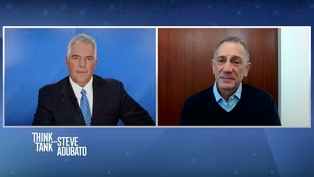
We kick off the program with Gary Mendell, Founder and Chief Executive Officer of an important organization called Shatterproof.
Gary, good to have you with us.
Thank you.
- Likewise, Steve, thanks.
A pleasure to be here.
- Shatterproof, established in 2013.
Give folks some context as to why this organization was started and why it's so personal for you.
- Sure.
My older son, Brian, in high school, became addicted to alcohol and then drugs.
And went to treatment programs, in and out, for eight years, and tragically he passed away in October, 2011.
Obviously it doesn't get much worse as a father, and I really struggled with two questions, Steve.
What could I have done differently as a father, and what could be done to spare other families of the tragedy that my family had suffered?
I took three months away from my business, traveled the country looking for answers for those two questions, and what popped out of that three months of travel were a few things.
How big this disease was, third largest cause of death in our country, that eight out of 10 of those who had this disease developed it before the age of 18.
But what really struck me, Steve, was that I discovered that all this research existed, buried in medical journals, that had proven from randomly controlled trials to be able to prevent a lot of this, a lot of our loved one from developing this disease, and for those who had it, treatment protocols that had been proven to improve outcomes for success rates comparable to other chronic illnesses.
Yet all this information was buried in the medical journals and not being implemented.
And when I asked myself why, it became clear for every major disease in this country, there was one well-funded national organization, non-profit, leading the fight to protect our families from their respective diseases, and nothing existed for addiction.
So seeing that, I left my business, spent a year and a half developing a business plan to launch a non-profit like those that we have for other diseases to get this research out there and implemented, and save lives.
- So as we put up the Shatterproof website, let me ask you this.
You've said there are three pillars, you tell our producers that there are three key pillars to the Shatterproof methodology.
What are those, Gary?
- Sure.
Transforming the treatment system in the United States, which has been outdated, left out of the health care system, bring it into the health care system, the same science-based protocols we have for any other disease, number one.
Number two, end the stigma that's associated with this disease, with those who have it, their families, the medications that treat it.
End it, like we've done with other disease states and other social issues.
And number three, provide the education that families need to be able to prevent their children growing up from developing this disease, or their loved ones if they're adults.
And for those who do develop it, and some will, how do you navigate the treatment system?
And empower them, give them resources to empower them if they want to help.
- Someone watching right now, they see a loved one, someone they care deeply about, struggling with substance abuse.
They follow up on the Shatterproof website.
- Right.
- What resources are there for them?
Or is it helping them navigate in their own community?
Because you're a national organization, but people want to access locally, if that makes any sense.
- Absolutely, makes perfect sense.
We do have resources on our website.
So if someone listening, watching us right now, has an issue in their family with someone who may have this disease, you go to the find help section on our website, and the first thing they can do is there's a section there they can go to, a resource we have called Atlas.
- Atlas.
- Atlas, A-T-L-A-S. And it's in the subsection on finding help related to treatment.
And there, any family, confidentially, completely confidential, can take a 13 question assessment that was built by us with the science of the American Society of Addiction Medicine, which is the gold standard, to determine does that loved one need what level of care?
Do they need residential?
Do they need out-patient?
Or do they not need treatment at all, they just need an intervention?
So that's the first thing.
They'll also get a recommendation based on those 13 questions, based on that level of care, let's just say it's out-patient.
Do they need an out-patient program with medications or not, based on how you answer those questions.
Do you need mental health services or not?
What additional services do you need?
And then once you have that recommendation, that's a huge start.
And then if you happen to be looking for treatment in one of ten states that we have data on on the treatment programs, you can determine which treatment programs are following evidence-based practices, and which ones are not.
And we're soon gonna be in 14 states, representing almost half the country.
14 states is a quarter of the states, but it's half the population because of the size of the states.
- And is New Jersey one of those states?
- Yes, it is.
We're already live in New Jersey today.
- We are based in New Jersey, we're New Jersey centric, but obviously the issues we're talking about are national in scope and impact.
Quick follow up on the question of public policy.
New Congress coming, split Houses, if you will, this program will be seen in 2023, and individual state legislatures, executive branches of government.
One policy change improvement that would have significant impact on the issues that we're talking about as it relates to addiction and the struggle of addiction.
Any government policy?
- Sure, we can break it up into federal and state.
There are many state policies.
Let's leave that alone for a second.
Federal, we have a bill in Congress right now that would, it's already passed the Senate.
We've been working on it for three years.
Excuse me, it's already passed the House, it's sitting in the Senate, that would require every doctor in the country who has a DEA license to prescribe controlled substances, which is essentially every doctor in the country.
- The Drug Enforcement Agency, go ahead.
- Right, if they have that license, which is essentially most doctors, they would have to have eight hours of continuing education on the basics of prevention and treatment and recovery of addiction.
Not specialty care, the basics.
And if that law were to pass the Senate and get signed by President Biden, then you'd have every doctor out there today that would have within 12 months, they would have to have that eight hours of continuing education.
And by the way, they all take continuing education anyway.
They would just take this eight hours versus something else that is optional.
And then you would have every medical school required, because who wants to graduate medical school and not be able to prescribe controlled substances?
- And it hasn't been passed.
But it passed the House, it's in the Senate.
- It's in the Senate right now, correct.
- Real quick, does it have to be passed by the House again because it's a new House?
- It does not have to be passed by the House again unless the Senate amends it and sends it back to the House.
- Gary, I want to thank you so much.
We appreciate not just you joining us, but more importantly the work you're doing every day.
- Steve, thank you.
- Thank you.
Gary Mendell is Founder and Chief Executive Officer of Shatterproof.
Gary, best to you and your family.
All the best.
- Thank you, thank you, Steve.
- You got it.
We'll be right back after this.
To watch more Think Tank with Steve Adubato, find us online and follow us on social media.
Recently, my colleague Jacqui Tricarico joined me down in Atlantic City for the New Jersey Education Association.
Jackie did a whole range of important interviews, bit this one you're not gonna wanna miss.
It's with Pulitzer prize winning journalist, Nikole Hannah-Jones.
She discusses the 1619 Project.
You don't know what 1619 means?
You don't know why the 1619 Project is so important?
This conversation with Jacqui and Nikole Hannah-Jones.
Check it out.
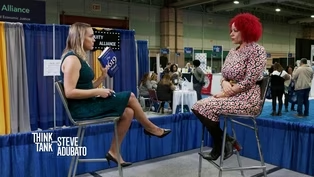
- Hi, I'm Jacqui Tricarico.
On location at the New Jersey Education Association's Annual Convention here in Atlantic City.
And I am so pleased to be joined by Pulitzer prize winning journalist, and creator of the 1619 project, Nikole Hannah-Jones.
Nikole, thanks for so much for taking the time to speak with us today.
- Thank you for talking to me.
- Well, first, can you help us understand the significance of the year 1619 here in America?
- Sure.
So 1619 is the year that the first ship carrying enslaved Africans arrived in the colony of Virginia.
So we really marked 1619 as the advent of American slavery.
- And the 1619 project, the project itself, this beautiful book that you've created with the help of a lot of other people, a lot of other journalists and poets.
Talk about the project, and how it's being incorporated into school curriculums across the United States.
- Sure.
So the 1619 project is a series of essays as well as, as you mentioned, pieces of poetry, and pros that really makes the argument that slavery is foundational to both American history, and the legacy of slavery has shaped so much of our modern society.
So, all of the essays are around something in modern America with its roots in slavery.
And so the way that educators have used it, it's just been in a myriad of ways.
It's been used in social studies to bring a kind of deeper understanding about the legacy of slavery, but also to help students understand why their communities look like they do right now.
It's been taught in English classes, and literature classes where students are learning argumentation, and using it to create their own poetry or fiction.
It's been used in art classes, and we also have an entire education network.
It's called the 1619education.org.
And there you have cohorts of teachers across the country who are engaging in their own big projects in the classroom.
- That's amazing, and of course with so much that is being praised, there is opposition, and it's one of the most banned books I heard throughout the United States.
Banned books, that's a phrase we're hearing a lot of as of recent.
Talk about just the danger of banning books.
- Absolutely.
So if we believe that we are a free society, then we know that free societies don't allow government to prohibit speech, ideas or texts simply because people in government don't like them.
But that's actually a very dangerous thing.
And you're absolutely right.
PEN America, which is a free speech group that tracks these things says we're seeing more challenges to books, more prohibitions on texts than they've seen in at least 50 years.
And so it's a sign of a very, I think, dangerous sentiment in our society.
As of course everyone knows we are very polarized right now, and I think that certain politicians have seen the banning of books as a way to, to ignite opposition, to score points politically, and to really divide Americans from each other.
So I just think we know that if we saw book bans in Cuba, or Saudi Arabia or China, we would understand that that is actually not a sign of a healthy free society.
So we need to be pushing back on those bands here in the United States as well.
- And politically, yes, but we're also seeing a lot of influence coming from parents and caregivers, right.
We're seeing these school board meetings that are becoming viral, a lot of debate about what can and can't be on the bookshelves, and their children's schools.
And you talk about in the beginning of your book being a young girl and not seeing yourself so much represented on,- - That's right.
- On those shelves in the library.
How important or how influential should parents and caregivers really be in terms of what's in schools?
Shouldn't we leave that up to the educators?
- Absolutely.
So, so one, to be clear polling shows that the majority of Americans including the majority of, of parents, oppose book bans.
And I think it is perfectly fine for an individual parent to say "I don't want my child exposed to this text."
I don't think it's okay for parents to say what every other parent child should be exposed to.
And that's where the problem is.
So, we send our children to schools to be educated by professionals for a reason because there are professionals who create curricula, there are professionals who understand what texts are proper and appropriate for students.
And I really do think we should leave that to the professional educators that we charge with educating our children.
But also, as you said, so many of these bans, and books that are being challenged, our books that speak to the experiences of marginalized children, of children of color, of trans-children, of children who might be struggling with identity, and they deserve to see themselves in the texts that are being taught.
But also all of us become more tolerant when we're learning texts about people whose identities are different than ours, and whose histories and stories are different than ours.
- Yeah.
Understanding other people helps us become better people and better human beings.
- A better society.- - Yeah, absolutely right?
- We have to stop taking such a stingy view of our fellow Americans, and actually believe that it is a good thing for our children to learn, and be challenged in their views.
- And I wanna talk about something in the book too that I saw that I know you've talked about the photo of your father from 1960, he served in the US Army.
Talk about him and just how much of an influence he's had on you and your career.
- Absolutely.
So my father was born on cotton plantation, in Greenwood, Mississippi during a time when Black Americans did not have rights of citizenship.
And I think that's important because we tend to think about this as a very distant history, and it's not a distant history.
And so I, I really began the entire book with this story of my dad flying this American flag in our front yard, and me being very conflicted as a black child about why a man who wasn't treated equally by the society would want to show that type of patriotism.
And so the book really grapples with that.
And, and it's a tribute to my dad who said, you know, black people have played a really unparalleled role in shaping our society, and fighting for liberty in our society.
And no one should be able to take that legacy from us.
- And on our programming, we often talk about democracy at our crossroads, and democracy in peril.
In your view, are we in peril?
Because I know during your talk today at the convention and what you, one of your messages to educators is that 1619 isn't just the past, it's the present.
Describe that.- - Absolutely.
Yes.
I think we are in peril.
We have a significant proportion of Americans who are willing to give up on democratic practices, who don't believe in fair elections anymore, who think that if they lose that those elections aren't fair that they don't have to concede.
I think that that's very frightening, and that all of us no matter what our political views, we don't want to be a country where every election result is challenged, where our democratic institutions are being attacked.
Because I do believe that democracy is what guarantees our freedom.
And certainly a journalist- - And you're right.
And you're referencing January 6th, right?
- That's right.
- And, and we're still feeling the repercussions from that.
Are we not as a society?- - Of course.
Right, like what, we have to question a society that leads to January 6th, and then the efforts really by one political party to downplay that we had an insurrection on our capital, and an effort to overturn a fair election in the United States.
This is something that we tend to think of as happening in other countries, but scholars of democracy say that this is a sign that our democracy is in decline.
I will say I was heartened by the results of this election we just had because it seems like, at least the majority of Americans, are saying we actually do believe in democracy.
And so democracy is living to fight another day, but how much democracy we have is ultimately determined by us.
- Right as we're taping in the beginning of November right after the midterm elections, and the results speak for themselves, I think.
And lastly, being the keynote speaker today here at the convention, what was your overall just main message to educators here in New Jersey?
- My overall, I think I had two messages.
One, it's been extremely tough to be a public school educator in the last few years.
Dealing with the pandemic, and then the anti critical race theory, a propaganda campaign, you know, threats against teachers, teachers losing their jobs, teachers being afraid that if they teach the wrong thing, they'll get in trouble.
So I just wanted to really show my appreciation as a public school graduate whose life was deeply influenced by public school educators, that, that we are on their side, and that we're so grateful for the work that they do.
And the second message was really that we have to teach these challenging histories to our students that we are actually robbing our children of necessary information that they need to understand their world, and to create the world that they want if we don't grapple honestly with our history.
And New Jersey is a state that is really through the public schools with the Amistad curriculum and other curricula trying to do that.
So I just wanted to encourage, and say how important that was both to me when I was a student, and to all of the children in the state.
- Education is power.
And if you want to learn more about the significant date year in our history, 1619 pickup Nikole Hannah-Jones book, best seller book, the 1619 project.
Thank you so much for taking the time to chat with us, Nicole, such a pleasure.
- Thank you.
To watch more Think Tank with Steve Adubato, find us online and follow us on social media.
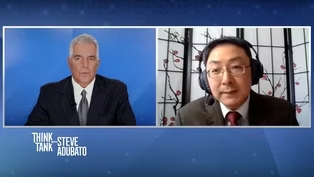
- We are now joined by Dr. Yanzhong Huang, who is Director of the Center for Global Health Studies at Seton Hall University.
Good to see you, doctor.
- Good to see you too, Steve.
- Doctor, one of your many area of expertise involves China.
More specifically, you have been talking a lot about, and it's important for us to better understand China's COVID policy.
As we go into 2023, this show will be seen then, what exactly is that policy and what impact has it had on China's population?
- Well, we are seeing a sea change in China's COVID response now.
'Cause until very recently, I mean last month, they were still sticking to the so-called zero COVID policy.
You know, basically they could not tolerate any COVID infections.
So even like a single case found in the locality could immediately trigger mass PCR testing, the close contact tracing, quarantine and even snap lockdowns.
But now, we are seeing the policy is switched to another extreme, you know.
Basically people are told you are on your own.
Right?
So now they focus on ... preventing severe cases.
Many of these measures were simply dropped, like mandatory PCR testing, the checking of health codes before accessing public venues, the home quarantine for close contacts.
You know, essentially many of those measures were dropped, and now the, uh... We are seeing a significant increase of the infections but in Beijing and other parts of China.
So the forecast is that in the first six months, or in the coming six months, we are going to see 60% of the population, talk about 850 million people, but that's more than twice the US population will be infected in the coming half a year.
- Doctor, let me do this.
I wanna follow up on that.
First of all, I wanna make it clear, Seton Hall University one of our higher ed partners, I wanna follow up in this way.
What is the significance, Dr. Huang, from your perspective in understanding, not only where China is, but what you believe in many other experts believe will be happening in China?
What is the significance for the United States and the Eastern region of the United States?
Dr. Huang, please.
- Well, I think it is worth taking a close eye on what is happening in China because we know, right, this virus does not respect territorial borders.
In this country we have according to a recent virus study, more than 90% of the population have been exposed, actually have been infected with the virus.
But, you know, this virus can mutate.
So according to some epidemiologists, in the coming months, you know, we can see that large number of immuno-compromised people, those essentially who are not exposed to the virus in China, they could harbor the virus for months, you know, so one leading epidemiologist basically say, "We can witness a billing of more opportunities for the virus to evolve."
You know, so, you know, that new variants could potentially by, again, return to the United States and infecting more people.
- But, Doctor, let me ask you this.
The CDC, the Center for Disease Control, clearly very important in dealing with this pandemic and other public health issues, has had its own approach to dealing with COVID.
The most significant difference between the CDC approach versus the approach of the Chinese government is what?
- Well, I think if we are talking about before December, right?
The big difference that he ... - The December 7th, on December 7th, the policies changed in China.
- Right.
- But up to that point, it was dramatically different, correct?
- Absolutely right.
Today the U.S. will rely on essentially vaccines, right?
To prevent and control, right?
- Yes.
- The disease outbreak.
But in China, they relied on non-pharmaceutical intervention measures like snap lockdowns, close contact tracing, quarantine.
- So I'm sorry for interrupting, doctor, but vaccines were not distributed and accepted widely in China, correct?
- Well, it's not exactly the case.
In fact, according to the government data, they have more than 90% of the population being receiving at least two doses of the vaccines.
But I'm talking about the inactivated vaccines, not the mRNA vaccines many people receive here.
But it is interesting that if you look at the certain segment of the population, like the elderly especially those aged 80 and over, right?
The vaccination rate is much lower, right?
We are talking about essentially 8 million people aged 80 and over have not received any vaccine and only about 40% of them received a booster shot.
- Let me ask you this before I let you go, doctor.
Your book is called Toxic Politics.
Why that title?
- Well, it is about China's environmental health, you know, so we know, right, the one of the major contributors, right, to the China's environmental health crisis is PM 2.5, the small particles, right?
That are actually considered very dangerous to people's health.
So in that sense, it's toxic, right?
But also I want to examine the issues from the political perspective, in terms how China handles its environmental health crisis.
And we found this politics itself, right, in a way can be toxic.
- Yeah.
And PS, the United States and China, the biggest emitters of ... put this in perspective, greenhouse gas.
- Yeah.
Actually the two countries, you know, they are the largest emitters of greenhouse gases.
And they're the largest contributors, Right?
To global warming.
- Yeah.
So, Dr Huang, I wanna thank you for joining us.
Dr. Huang is the director of the Center for Global Health Studies at Seton Hall University, higher ed partner of ours.
Thank you, Dr. Huang.
Wish you all the best.
- Thank you, Steve.
Have a good day.
- I'm Steve Adubato.
That's Dr. Huang.
We'll see you next time.
- [Narrator] Think Tank with Steve Adubato has been a production of the Caucus Educational Corporation.
Funding has been provided by Horizon Blue Cross Blue Shield of New Jersey.
The New Jersey Education Association.
Valley Bank.
Summit Health Robert Wood Johnson Foundation.
Atlantic Health System.
Johnson & Johnson.
The North Ward Center.
And by The New Jersey Economic Development Authority.
Promotional support provided by New Jersey Globe.
And by BestofNJ.com.
- I'm Tim Sullivan, CEO of the New Jersey Economic Development Authority.
Since joining the NJEDA, I've been struck by the incredible assets and resources that New Jersey has to offer.
The NJEDA is working every day to grow New Jersey's economy in a way that maximizes the values of those assets to benefit every single New Jersey resident.
This includes more support for small businesses and a focus on reclaiming New Jersey's position as a leader in the innovation economy.
Visit njeda.com to learn more about how NJEDA is building a stronger and fairer New Jersey economy.
Ending The Stigma Associated With Addiction
Video has Closed Captions
Ending The Stigma Associated With Addiction (9m 15s)
The Impact of Slavery on our Past, Present, and Future
Video has Closed Captions
The Impact of Slavery on our Past, Present, and Future (11m 13s)
Providing Support for PBS.org
Learn Moreabout PBS online sponsorship
- News and Public Affairs

Top journalists deliver compelling original analysis of the hour's headlines.

- News and Public Affairs

FRONTLINE is investigative journalism that questions, explains and changes our world.












Support for PBS provided by:
Think Tank with Steve Adubato is a local public television program presented by NJ PBS