One-on-One
Gary Myers; Nunyo Demasio
Season 2024 Episode 2705 | 27m 25sVideo has Closed Captions
Gary Myers; Nunyo Demasio
Gary Myers, author, "Once a Giant," and former NY Daily News NFL columnist, discusses the story of the 1986 NY Giants Super Bowl Champions and the physical, emotional, and financial challenges of life after the NFL. Then, Nunyo Demasio, author of "Parcells," storyteller, and podcast host, talks about Bill Parcells’ influential career in the NFL and his leadership on and off the field.
Problems playing video? | Closed Captioning Feedback
Problems playing video? | Closed Captioning Feedback
One-on-One is a local public television program presented by NJ PBS
One-on-One
Gary Myers; Nunyo Demasio
Season 2024 Episode 2705 | 27m 25sVideo has Closed Captions
Gary Myers, author, "Once a Giant," and former NY Daily News NFL columnist, discusses the story of the 1986 NY Giants Super Bowl Champions and the physical, emotional, and financial challenges of life after the NFL. Then, Nunyo Demasio, author of "Parcells," storyteller, and podcast host, talks about Bill Parcells’ influential career in the NFL and his leadership on and off the field.
Problems playing video? | Closed Captioning Feedback
How to Watch One-on-One
One-on-One is available to stream on pbs.org and the free PBS App, available on iPhone, Apple TV, Android TV, Android smartphones, Amazon Fire TV, Amazon Fire Tablet, Roku, Samsung Smart TV, and Vizio.
Providing Support for PBS.org
Learn Moreabout PBS online sponsorship- [Narrator] Funding for this edition of One-On-One with Steve Adubato has been provided by Hackensack Meridian Health.
Keep getting better.
Horizon Blue Cross Blue Shield of New Jersey.
Here when you need us most.
Robert Wood Johnson Foundation.
Working for a more a healthier, more equitable New Jersey.
The Port Authority of New York and New Jersey.
Moving the region through air, land, rail, and sea.
PSC.
Where your story is our business.
The Healthcare Foundation of New Jersey.
NJM Insurance Group.
Serving New Jersey’s drivers, homeowners and business owners for more than 100 years.
Seton Hall University.
Showing the world what great minds can do since 1856.
And by The Adler Aphasia Center.
Promotional support provided by NJ.Com.
Keeping communities informed and connected.
And by BestofNJ.com.
All New Jersey in one place.
- This is One-On-One.
- I'm an equal American just like you are.
- The way we change Presidents in this country is by voting.
- A quartet is already a jawn, it’s just The New Jawn.
- January 6th was not some sort of violent, crazy outlier.
- I don't care how good you are or how good you think you are, there is always something to learn.
- I mean what other country sends comedians over to embedded military to make them feel better.
- People call me 'cause they feel nobody's paying attention.
-_ It’s not all about memorizing and getting information, it’s what you do with that information.
- (slowly) Start talking right now.
- That's a good question, high five.
(upbeat music) - Hi everyone, Steve Adubato.
You do not have to be a New York and New Jersey Giant fan to appreciate yes, they play in the Meadowlands.
But they are the New York Giants, and we have someone who knows more about the Giants, more about football, more about sports than most people you know.
He is Gary Myers.
He's author of this book, "Once A Giant: A Story of Victory, Tragedy, and Life After Football."
Gary, in fact, has worked with New York Daily News, HBO Sports, seven books on sports.
Good to see you my friend.
How you doing, Gary?
- I'm doing great, Steve.
How you doing?
- Good.
Listen, I'm a long suffering Giant fan, right?
We are taping this, as other teams are playing in the playoffs.
It'll be seen later in 2024.
Question, once a giant, what does it mean?
- Well first of all, you can't be that long suffering.
They've won four Super Bowls.
- It's been a while, but go ahead.
- All right.
Well Once A Giant means, obviously a play off of their name, but also the fact that these guys are now in their 50's and 60's and they're once looked upon as the superheroes, you know, giants of men.
And now, at this point in their lives, facing the challenges that football has presented to them, you know both physically, emotionally, and financially.
My book really tells the story of what life is like for them after football.
- Yeah.
Let's go through some of these folks.
And by the way, let's remind folks the two Giant Super Bowls were in 1990 and what was the other year?
- Well, 1990 and 1986.
- '86.
- 2007, 2011.
- Oh yeah, I forgot.
- Yeah, forgot.
It's only like 10 years ago.
Come on.
- No it's not.
No, trust me.
- It's getting longer.
Let's go through some of these Giants.
Somebody who I've interviewed, who I've been honored to interview many times, Harry Carson.
- Yeah.
- A real leader, a terrific football player, but an even better person.
Talk about Harry Carson, particularly life after football.
- Steve, he's one of the greatest leaders in sports I've ever come across in 40 years covering the NFL.
He was the go-to guy for Bill Parcells in the locker room, that if something was going wrong, he'd go to Harry and to George Martin and Phil Simms, but mainly Harry.
He'd say Harry, go fix it.
Harry has taken that leadership, and 37 years after his championship, he really considers himself the captain for life of those Giant teams.
And he's so well respected, that even players around the league, current players and former players who played in the generation that he played, you'll still lean on him and call him for advice.
And, he's always there for them.
And, if one of these players has a problem and a teammate finds out about it, the first call is usually to Harry, who basically rounds up the troops, on text messages or calls them.
And they come in, to the aid of a teammate in need.
And I think it's just very unusual.
- And they're connected to each other in very meaningful ways, which is very rare in professional sports.
But someone who has struggled, obviously, if anyone follows the news, and you don't have to be a football fan or Giant fan, Lawrence Taylor, LT. - Right.
- Struggled with drugs and alcohol, he's been very upfront about that.
He's had arrests, he is in fact is a registered sex offender after soliciting an underage prostitute in 2011 in New York.
LT, greatest defensive football player of all time, post career, talk about Lawrence Taylor.
- Well, I'll work from the most recent backwards.
I met with him in the spring in Florida in 2022.
And Steve really, and I've known him since 1981, I've seen him several times since he retired.
He looked healthier and happier to me than at any point since he had retired.
He claims he hasn't done drugs since 1999, 1998 rather, when he got out of his last, the last time he went to rehab.
Teammates have backed that up.
Now he's had many problems since then, but not drug related.
And you know, quite frankly, I was happy to see him in the frame of mind that he was in that day because I know him as being a really good guy.
And the things, the troubles that he's caused both for himself, and more importantly for others, is inexcusable, unimaginable.
But he doesn't walk away from it, he takes responsibility for it.
And it looks to me, you know with a guy who, you know these drug addicts are always recovering, they're never cured.
And I think he's come to grips with that.
And it's day to day, and, you know, I'm just hoping for good things for him.
And not seeing his name in the news for bad reasons.
Any day that goes by and you don't see Lawrence Taylor for bad stuff in the newspaper, that's a good day for him.
- It is.
You know there's someone else, or there's a theme in the book that is so important.
For those of us who are football fans, in all candor, there are times that I actually feel guilty watching football.
And when I say that, yeah I love the sport, but when I see what has happened to so many football players, in terms of brain injuries that have destroyed, that have had a devastating impact on their lives.
One of the players you talk about here in the book, by the way, the book is "Once A Giant," the author is Gary Myers.
He's the best.
Go out and get this book, check it out.
It's Brad Benson, an offensive lineman.
- Yeah, Brad Benson was, he kind of typified the blue collar mentality of the team.
Played such a key role at left tackle.
But, his life after football has been very difficult.
He's had, you name the body part, and he's had surgery on it.
Carl Banks kids him and calls him Mr.
Potato Head because different body parts have been replaced.
But obviously it's no laughing matter.
And the players feel, you know their hearts go out to him that so many things have gone wrong for Brad since he retired.
And you know, that's many, many years ago.
He's had financial issues.
Harry Carson, who we talked about created a GoFundMe page for Brad.
And I know players are very concerned about him.
- You know, we're gonna do another segment on Bill Parcells, with one of your colleagues who wrote the book, "Parcells," you know the book.
Bill Parcells, I mean, I'm a student of leadership as you know, Gary, I'm fascinated by different styles of leadership.
In that interview about Bill Parcells, we'll talk about his leadership.
But once a Giant, Bill Parcells, to what degree is Bill Parcells, who's a very private man, to what degree is Bill Parcells, who was the head coach for the Giants these Super Bowls, to what degree is he still connected to quote "his players?"
- In many ways, and a couple of 'em even fascinating, Steve.
For a guy who had a love hate relationship with the players, - Sure did.
- because he drove them so hard.
And half the time they loved him, and half the time they hated him.
But, today the relationship is much different.
He's like a compassionate grandfather- - Bill Parcells?
- Yeah, in many ways.
- I wish we had the video from HBO of him just screaming and yelling.
- Yeah.
- You know the video, on the sidelines.
- Yeah.
- And not to mention the stuff he used to say to Phil Simms, the quarterback.
What kind of grandfather?
Seriously?
- Compassionate, to the point- - Okay, explain that to us.
- Okay, to the point.
I know it's hard to believe.
To the point that many of these players call him or send him cards on Father's Day, call him or send him cards on his birthday, every year.
Bill, and this story was so good that I couldn't hold it like from the middle of the book 'cause I wanted to draw people into it.
But over the years, he's given a total of $4 million without any expectation of being repaid to about 20 of his former players.
Now a total of $4 million, which is still a lot of money.
You know, a lot of people confuse it and say, oh, $4 million to every player.
Well he's compassionate, but not that compassionate.
But $4 million is an incredible amount of money.
Now, his feeling is that these players sacrificed so much for him and to help make them champions and to help Bill become who he is today, a Hall of Fame coach who won a couple of Super Bowls.
- An icon, a legend.
- Yeah.
And totally financially secure, to the point that he's put money away for his three daughters.
He's given money to his ex-wife.
He's put money away that he feels he needs to live the rest of his life.
And the rest he has, you know in a pile that he considers for his friends.
And it's not like any player can call him up and say Bill, I need money to build an addition onto my house.
You know, that gets rejected right away.
But, players who call him up and say I'm having trouble paying the mortgage, or I'm having trouble paying my taxes or lawyer fees, or medical bills.
Medical bills probably being the most important because the health insurance that the League supplied for them ran out after a year and a half.
Now it's five years, but back in those days, a year and a half.
And Steve, it's just so totally insufficient.
Most of the health problems these guys incur happen- - Lifetime.
- in their lives, when they're 50, mid 50's, mid 60's, when they're having knee and hip and shoulder replacements.
And if they don't have good insurance through jobs after football, this stuff is overwhelming.
So Bill is trying to help 'em out in that regard.
So if that's not a compassionate guy, who is, you know people don't know these stories, still have the image of Bill as that hard driving coach, yelling at Phil Simms on the sidelines yelling at Bill Belichick on the sidelines.
- That's right, one of his assistant coaches.
- Yeah I mean people who only have that image, have that in their mind, were shocked to learn some of these stories about Bill.
- Before I let you go, Gary let me ask you something.
- Yeah.
- For those of us who are Giant fans today, and even who there, there are superstars who we feel connected to, and as we do this program, Saquon Barkley, I'm a huge fan of Barkley's, we don't know what's gonna happen with him, so we're taping this in the latter part of January, 2024.
Here's my question, Once A Giant, for those guys who played back then, once a giant, is it still the same?
Or is it here today, gone tomorrow?
You know what I'm saying?
They're not really once a Giant anymore, that that tradition doesn't exist?
- Well yeah, I mean free agency has totally changed it.
You know, it's very rare that the player plays his entire career with the same team.
But, you know Steve, what I think once, listen, I really think Once A Giant should be required reading.
And I'm not talking about book sales.
I'm just saying I think it should be required reading for the life lesson, required reading for every player in the NFL today because of the life lessons they can learn, what's happened to these guys.
And, unless they're careful, the same thing can happen to them, both financially and physically.
- So it's also about friendship and loyalty and staying connected through tough times.
"Once A Giant," the author is Gary Myers.
Gary, thank you my friend, we appreciate it.
Wish you all the best.
- Thank you Steve.
Thanks for having me on, I appreciate it.
- You got it.
Stay with us, we'll be right back.
- [Narrator] To watch more One on One with Steve Adubato find us online and follow us on Social media.
- We are honored to welcome Nunyo Demasio, who is the author of a compelling book, a New York Times bestseller.
It's called "Parcells", that's Bill Parcells, "A Football Life".
And Bill Parcells wrote it with you.
Nunyo, great to have you with us.
- Thanks for having me.
Great to be with you.
- Now look, I did this before.
As a longtime Giant fan, as a fan of Parcells who never really wanted to be on the other end of his yelling and screaming.
Who was Bill Parcells and why does he still matter?
Not just in football, but in coaching overall, please.
- Bill Parcells was a central character in the modern NFL.
Why he still matters is just look around the league.
This is a man who retired from football in 2010.
If you look in today's NFL, he still has coaches that he's tutored in the NFL.
Of course, Bill Belichick, he's the biggest name, but it's other guys.
It's Sean Payton, who coaches the Denver Broncos.
It's Todd Bowles, who coaches the Tampa Bay Buccaneers.
It's more than that though.
Parcells had I think a dozen former assistants who became head coaches.
And it's not just quantity, it's also quality.
Tom Coughlin, he won two Super Bowls.
- That's right.
- Belichick six, et cetera.
- So I wanna be clear, Bill Parcells is a Jersey guy.
- Yes, he is.
- Through and through.
In my view, it's more important what you think, that Bill Parcells growing up in New Jersey, experiencing this Jersey thing that we like to call grit, if you will, influenced, greatly influenced his leadership style, that's my view.
Describe his leadership style and why was he in the face of so many of his players, particularly Bill Sims?
Why was he in their face and why would they put up with it?
(Nunyo laughs) - Well, Bill, his leadership style was very... it was unique.
He just wasn't somebody who yelled at you.
I think what really allowed him to turn teams around was several different reasons.
But the one thing I can think of is was he was a master manipulator.
Bill Parcells really was a psychologist, a master psychologist, master motivator.
And think about it, an NFL team has 52 players.
He customized his approach for every single player.
So, he would find out little things about the players.
He would talk to their high school coaches, even calling their parents, and he would use whatever method worked.
He would tailor his methods to each player.
- Why did he treat Lawrence Taylor, the great LT, in my view, the greatest, and I said this earlier in a segment, one of your colleagues, Gary Myers, who wrote a book on the Giants Super Bowl team and what happened after with them, listen, it's not debatable.
Lawrence Taylor, the greatest defensive player of all time.
Did he, in my view, from my understanding as a student of leadership, he treated him differently.
He did not scream and yell at LT.
He did not get in his face, wouldn't have worked.
Didn't challenge him a lot.
Because?
- That's a great point.
And that goes to the point everyone looks at Bill Parcells as a yeller, and he did yell most of the time.
But for players who it wasn't effective with, he wouldn't yell.
You didn't need to yell at a Lawrence Taylor.
So, Bill Parcells did not yell at Lawrence Taylor, but that wasn't the only one.
There were obscure players who Parcells learned, okay, yelling is not gonna work on this player.
So, let me see what else can work that maximizes their ability.
And that's what he did with Lawrence Taylor.
- Gary Myers, in an interview that I did, also talked about Bill Parcells being very generous and caring to his players later on in life.
Let's assume that that's true.
He was generous.
He gave money to them and cared about them.
Very compassionate.
But in the book, you talk a lot about, and he talks a lot about his failures in his personal life that he did not, he wasn't the father and nor was he the husband he knew he needed to be.
So, it's ironic that the Giants players wind up being family to him, but his family, family, talk about that Nunyo.
- Right.
That is, you're really capturing what one of the most fascinating things about Bill Parcells, he absolutely was a paradox.
Because that would be his main personal failing and he would be the first to say it.
And he did say it in the book.
He was very self-aware and candid.
He was an absentee father.
He had three daughters.
He didn't go to their high school graduations.
But conversely, there were so many former players who say that Parcells essentially raised them.
So, he was obsessed with football.
He regretted not spending as much time with his family.
And that's what makes him a paradox.
- In reading the book, I actually went to the index and looked for a name because early on in my career, I won't make this about me, but one of the first corporations to underwrite our programming was First Union Bank.
And at First Union Bank was Don Parcells.
- Right.
- And he actually signed off on one of the first sponsorships for this show.
- Oh wow.
- For our programming.
Absolutely.
And so, what's ironic and interesting to me is that Bill Parcells' brother, Don, had such an influence on Bill Parcells.
He was so devastated when he lost his brother, Don died way too early.
Talk about that relationship, how powerful it was, and the impact it had on Bill Parcells as a, not just as a coach, but as a man, as a human being.
- Yeah, they were extremely close.
One of my favorite chapters was when I wrote the chapter when Bill Parcells went to play a game.
It was a Monday Night Football game.
- Was that the day of the funeral?
- Yes, great memory.
His brother, I mean, it was such an emotional period.
He had to go to his brother's funeral.
He had a game Monday Night Football.
And he just had a mix of emotions and the Cowboys came back and won the game.
And the player who scored the winning touchdown had his brother's number.
And that's all Parcells was thinking about at the end of the game, "He's here with me."
So, they had a really close relationship.
- Hmm.
Switch gears.
Bill Parcells, outside of the Giants, you mentioned the Cowboys.
Bill Parcells, Dallas Cowboys, Jerry Jones.
Parcells goes there to be the coach.
And P.S.
what did he say about cooking a meal?
If you're gonna ask me to cook the meal.
- You let me shop for the groceries.
- So, he wanted to be the GM, pick the team, the meal, and cook it, be the coach.
Why did the Jerry Jones-Bill Parcells marriage not work?
- I would say that it didn't work in terms of, he did not take the Dallas Cowboys to the Super Bowl, which was a high standard and he did not repeat that.
However, if we look at the situation closely, the Cowboys had three consecutive five and 11 seasons.
Parcells won them their first Super Bowl, excuse me, got them to their first playoffs in several seasons.
- That's right.
- So, his standard was so high.
So, he never won a Super Bowl, but he did help the franchise out.
- Well, what about the control issue?
Meaning Jerry Jones, owner of the team, clearly has a hand, we're taping this at the end of December.
You know what happened with Bill Belichick?
There's a new coach up there.
It's not about football.
To me, it's about leadership.
It's about succession, it's about control.
How much of Bill Parcells was a guy who not only was gonna cook the meal as the coach, but he was gonna make sure that he was the general manager.
And if not, he didn't want any part of it.
Meaning he was a control guy, was he not?
- Absolutely.
Parcells was a control freak.
He would say to future potential owners, "I'm not for everyone.
"I want to do it my way."
So, you had to, that was part of the package.
He was an autocrat.
When he came in, he had to do it his way and he would always say, "If it didn't work, just fire me."
- Just fire me.
Because he, did he care?
Again, in a lot of the leadership work, I do, I quote the great Colin Powell, there's a chapter I wrote in a previous book and Colin Powell said to me in an interview, "Hey Steve, sometimes great leaders piss people off "because they make decisions "that are best for the team, best for the organization.
"If you don't like it, that's okay.
"'Cause I'm not here for you to like me or be popular."
Did Bill Parcells care if he pissed people off, A, and B, did he really wanna be liked?
- No, not at all.
And some players thought he enjoyed it.
- What?
- Kevin Mawae used to hide from Bill Parcells at the Jets training facility.
This is a 300 pound human being, a giant.
And he literally would hide from Parcells at the Jets training facility because he would say, like one time he just said hello to Bill Parcells just crossing paths with him in the hallway and Parcells just ripped into him.
He's like, "Don't worry about how I'm doing.
"Just make sure you block your guy on Sunday."
So, he just didn't care.
It was about, you know, getting things done.
But ironically, a lot of players who didn't like playing for Parcells, they said that when they retire, there was not a day that went by without them thinking of Parcells, thinking about the life lessons, sayings that he would say to, that they would say to their children.
So, it shows you the impact that he had for a coach that was hard to play for, - Could Bill Parcells in 2024 with the culture of the NFL being what it is, culture of sports being what it is, social media being what it is, could Bill Parcells ever be a successful coach these days?
- That's a great question.
- Being Bill Parcells the way he was.
- Right.
That's a great question.
I think that it would be more difficult, but the thing about Parcells was he would always adjust to the situation.
He was an autocrat, but he was a flexible autocrat, if that's not contradictory.
So, I think he would've made some adjustments, but it would've been a challenge to do things the way he did back in the day.
He even said one time that, hey, if he would've been arrested for some of the things he made his players go through with all the rules now that they have with practice and that sort of thing.
- Would the NFL be what it is without Bill Parcells?
- No, absolutely not.
You know, I don't mean to be hyperbolic, but would the US be what it is without, you know, influential presidents like Teddy Roosevelt.
Bill Parcells didn't speak softly.
He actually spoke loudly and carried a big stick.
But his influence is really spread throughout the NFL and he really shaped a lot of players' careers, coaches' careers, and his legacy still lasts to this day.
Dan Campbell, who was... - Yep, Detroit.
- Yeah.
He took his team to the NFC Championship.
He still uses a lot of Bill Parcells's methods.
- So listen, you don't have to be a Giant fan to appreciate Bill Parcells, his impact on the game.
The book is "Parcells: A Football Life" by Nunyo Demasio and Bill Parcells.
Nunyo, I cannot thank you enough for this interview, but also this book, I learned so much.
- Thank you so much, Steve.
- You taught me a lot about him.
Nunyo, thank you so much.
All the best.
- Thank you.
Appreciate you having me.
- You got it.
- Take care.
- I'm Steve Adubato.
That is Nunyo, who told us a lot about a great coach.
We'll see you next time.
- [Narrator] One-On-One with Steve Adubato has been a production of the Caucus Educational Corporation.
Celebrating 30 years in public broadcasting.
Funding has been provided by Hackensack Meridian Health.
Horizon Blue Cross Blue Shield of New Jersey.
Robert Wood Johnson Foundation.
The Port Authority of New York and New Jersey.
PSC.
The Healthcare Foundation of New Jersey.
NJM Insurance Group.
Seton Hall University.
And by The Adler Aphasia Center.
Promotional support provided by NJ.Com.
And by BestofNJ.com.
- (Narrator) Life is full of changes.
At Hackensack Meridian Medical Group, we're ready for them.
If you have a cold or chronic illness, our five star doctors can treat any ailment.
Whether you're starting recess or retiring, we're prepared with pediatric and adult specialists.
And if you just moved here, we are in your neighborhood.
You now have access to a health team thousand strong.
So no matter what or when, we're ready.
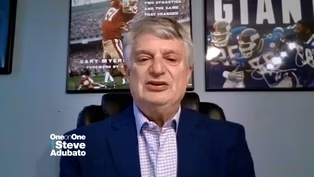
Author Gary Myers Talks Life & Retirement After the NFL
Video has Closed Captions
Clip: S2024 Ep2705 | 12m 36s | Author Gary Myers Talks Life & Retirement After the NFL (12m 36s)
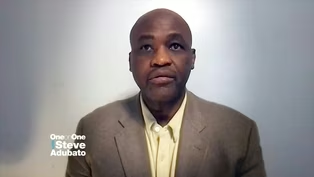
Author Nunyo Demasio Highlights Bill Parcells' Career
Video has Closed Captions
Clip: S2024 Ep2705 | 13m 32s | Author Nunyo Demasio Highlights Bill Parcells' Career (13m 32s)
Providing Support for PBS.org
Learn Moreabout PBS online sponsorship
- News and Public Affairs

Top journalists deliver compelling original analysis of the hour's headlines.

- News and Public Affairs

FRONTLINE is investigative journalism that questions, explains and changes our world.












Support for PBS provided by:
One-on-One is a local public television program presented by NJ PBS