
George Clinton and Maurice “Pirahnahead” Herd on recording funk music at United Sound Systems Recording Studio
Clip: Season 10 Episode 48 | 9m 40sVideo has Closed Captions
Funk musician George Clinton reflects on Detroit’s influence on his career.
Contributor Cecelia Sharpe of 90.9 WRCJ sits down for a conversation with Dr. Funkenstein — George Clinton — and fellow funk artist and producer Maurice "Pirahnahead" Herd at the Detroit Opera House. Clinton reflects on his love for Detroit, and he and Herd talk about recording in Detroit at United Sound Systems Recording Studios.
Problems playing video? | Closed Captioning Feedback
Problems playing video? | Closed Captioning Feedback
One Detroit is a local public television program presented by Detroit PBS
George Clinton and Maurice “Pirahnahead” Herd on recording funk music at United Sound Systems Recording Studio
Clip: Season 10 Episode 48 | 9m 40sVideo has Closed Captions
Contributor Cecelia Sharpe of 90.9 WRCJ sits down for a conversation with Dr. Funkenstein — George Clinton — and fellow funk artist and producer Maurice "Pirahnahead" Herd at the Detroit Opera House. Clinton reflects on his love for Detroit, and he and Herd talk about recording in Detroit at United Sound Systems Recording Studios.
Problems playing video? | Closed Captioning Feedback
Where to Watch One Detroit
One Detroit is available to stream on pbs.org and the PBS app.
Providing Support for PBS.org
Learn Moreabout PBS online sponsorshipHi, I'm Cecilia Sharpe.
One story that stood out to me reflected on the rich history of United Sound Systems recording Studios in Detroit.
Funk legend George Clinton and Grammy Award winning producer Maurice Piranha had heard spoke about their time at the iconic studio.
During the conversation, I showed them four albums that Clinton recorded at United Sound.
They shared incredible backstories and behind the scenes moments.
The trip down memory lane gave even more context about the magic of United Sound Studios and the funky music created there.
you made United Sound your home for about 20 years.
Studio A became the P-Funk lab.
Yeah.
What made United Sound Studios so special that you stayed there so long?
I know the sound.
I mean, just the sound in the history of the people that recorded it prior to us.
I mean, they went back to the 40s and stuff.
They did radio commercials.
So they were pretty much the sound of radio throughout the country.
You didn't know it, but that was the studio did most of the commercials.
But everything between here and Chicago, General Motors, Fords, everybody did their commercials there.
So it had a relationship to radio that people didn't even know.
Not only that, Motown recorded their prior to their own studio, and when they couldn't get into the studio, United was that choice.
And it had the same kind of vibe as Motown.
Had a little more bottom, though, but it had the same, especially when we came there and with Bootsy.
Bootsy had a bass that had the string each spring on the bass had his own output.
United.
We had a special sound that we that no matter what we did.
I mean, you can just walk in there and not thinking something was anything.
And when you finish like Atomic Dog, that was a track being played backwards.
I just got on this thought talking.
And next thing I know, it had that magic on it that no other place could do.
Piranha, I want to get your take.
What was your intro into United Sound?
And I was it was around 80 to 83.
I was, you know, dinking around on the east side, you know, learning to play with cats in the neighborhood.
You know, we were staying out of trouble because there was a lot of trouble that you get into on the East side.
And Bootsy had this group called God Mama.
It was a lady named Cynthia Gurdy, Cynthia and Tony, and she grabbed us.
It's like, I'm gonna take you to see the studio.
And she was working for Don Davis at the time, and we went over there and I think it was it was Greg Water.
Jim Vinnie who said, Georgia isn't here yet?
So Don was like, yeah, just going down there and just check the studio out.
He was showing us around and things like that.
I think you and Chong came in after that was just like, wait a minute.
I just met this guy who owns a bank and runs a music business, and Doctor Frankenstein want to You realize you could do whatever in a studio.
I mean, like whatever you want to do.
You know what I mean?
How y'all used to do them claps.
Oh, yeah.
Live class.
Live clap live clap.
And they thought it was machine.
And we would do it for ten minutes.
I mean you now days you can do two four bars.
Two bars.
You did looping digitally?
No.
Back then you had to do it.
Flashlights.
You had to do it for like seven minutes.
And hands are tired.
You got to maintain the energy.
So only certain people could do it again.
Yeah.
You can't get Miss One because it sounds as because.
And that's what the flashlight was the beginning of it.
Yeah.
I want to jump into showing you an album.
You take it and tell me your united sound memory.
I noticed that also the hand clappers did get credit on these albums.
Oh, yeah?
Yeah, we gave handclaps credit.
Yeah.
you know.
So I was into R&B deejays at the time, Mothership connection.
I was trying to do an album with one story line all the way through.
We did it on Motor Booty Affair.
Most of the songs relate to the same story.
We got thrown off track on this one because some of the tracks sounded so good.
We had to put them in there.
Anyway.
And well, of course the roof off the sucker.
And what was good about that?
We were able to get it on here.
If we take off to the roof off the mother sucker, Seeger said, we'll put it on.
If you take the roof off the mother, say.
And once we did that, it was all over.
Yeah.
Biggest memory from this album.
Clones of Doctor Funk and Stein.
Wow, this is a good one.
I got on a plane in Dallas, Texas, and when I got off, I had to get on a train.
It was the first day they used the trains to go from one terminal to the next.
Yeah.
When I got on there, there was a book on the seat of the train and it said the clones faces, two faces, one face in the same person.
I thought the book come with the train.
You know, it was the first day of the train.
It just makes sense.
That saw them and was talking about Steve Swanson.
And this doctor was cloning salamanders, taking one and making hundreds of them, that you will be able to eventually one day be able to clone people and blah, blah, blah.
But then I realized I'm like, it's serious.
And so when I got to Portland, Oregon.
I went to the library because, you know, I'm trying to find different concepts and it sounds interesting.
I go to the library and that's it.
Was there anything on cloning that was that?
They told me.
She said due to the freedom of information, we're not allowed to give books of books on those.
It was taboo at the time.
So that of course, you say taboo.
You really got me going down.
But, you know, she said, you can you can actually get a book called chariot of the gods or the Isle of Doctor Monroe.
I got cherry of the gods and the whole album is this.
Wow.
That's what.
So the concept was based upon stuff that you read.
That was science fiction.
Science fiction?
Yeah.
Okay, this of all these.
Now, that's that's the way we dressed in school when I was at school.
Tailor made suits.
The tailor made suits, you know, all of that?
Just slick.
A friend of mine was.
He was trying to show how much he could be deep with us, and he was just getting with us.
So he just wrote on a note intellect.
And it had a nice ring to it.
But what does it mean?
He said some entity reaching his maximum potential as opposed to something and that's as opposed to placebo.
He said sounds good.
So that became the key versus the placebo syndrome.
Flashlight is the weird one, because that was Bernie playing bass on the synthesizer as opposed to Bootsy playing bass.
That was the first time that had happened.
First time that happened happened like that.
And how about I did that right?
That was my friend's ball mitzvah.
I remember this bar mitzvah.
He was like.
And it just came back in that moment.
You think it's crazy?
It's just.
Okay.
That fit that.
And down the street.
Went to school together and his mother, George Myron come in for soup and sandwiches.
Your mom is like, I didn't know what a bomb was, but that was his.
I said, okay.
So when I finally said it in the magazine, maybe a couple of years ago, it went viral.
Last one.
Okay.
Yeah, this is a good one because, see, this is 1982 83.
Wow.
This was the first one that I did on my own name.
No, man.
So I did this record under George Clinton the first time.
The first time I used my name period.
On the record, we put our first touch that radio.
People loved it.
Back.
So immediately we Tommy Dog took off without even saying anything.
Yes, that went crazy and it was all over.
To this day, it's still like that.
One of the first people to play that was the likes of Fine Mojo.
And when we heard it, you know, it was like, yo, what was that?
You know, that that whole thing, I mean, and it was such a jam because of the backwards drum thing in there.
What was going on with that?
Yeah, the tape was on backwards, was put in effect on it, and I'm into my own.
I was getting high at the time, didn't know when I was doing I busted that starts rapping, you know like thinking they was trying to record without me.
They went about to miss your spot.
What about the Mrs.. When once I got it, I didn't know what to talk about.
So this is a story of famous dogs.
For the dog that takes his tail would be busy.
I'm trying to think of something to say.
Yeah, and I must.
I feel like that.
And I did it just like that.
And they left it like that and sing harmony around it.
Wow.
But you know what I mean.
It was just like one of these things, man.
Y'all had such a magic.
All recorded at United Sound Studio.
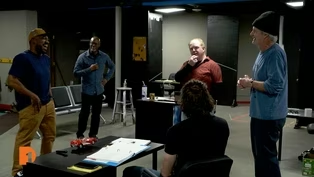
Jeff Daniels directs Detroit car culture comedy "The Classic King" at The Purple Rose Theatre
Video has Closed Captions
Clip: S10 Ep48 | 7m 15s | The play followed the employees of a struggling used car dealership. (7m 15s)
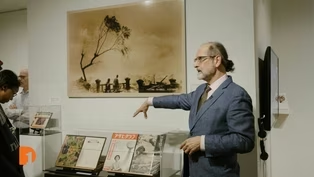
Oakland University art exhibition reflects on atomic bombings in Japan
Video has Closed Captions
Clip: S10 Ep48 | 7m 15s | The exhibition features the experiences of survivors of the Hiroshima and Nagasaki atomic bombings. (7m 15s)
Providing Support for PBS.org
Learn Moreabout PBS online sponsorship New Episode
- News and Public Affairs

Top journalists deliver compelling original analysis of the hour's headlines.

- News and Public Affairs

Today's top journalists discuss Washington's current political events and public affairs.





 New Episode



 New Episode
Support for PBS provided by:
One Detroit is a local public television program presented by Detroit PBS