Jay's Chicago
Good Deed Doers
Season 2022 Episode 5 | 26m 59sVideo has Closed Captions
A youth aviation program inspired by Black pilots. A running nun on a mission. And more.
Jay meets local world-changers. A local pilot creates an aviation program in a Chicago high school, inspired by great Black fliers. A group home worker exposed to COVID quarantines with her residents to continue caring for them. A young nun gives up Olympic dreams, but still uses running to support her West Side community. And a volunteer army of 3D printer owners makes thousands of face shields.
Problems playing video? | Closed Captioning Feedback
Problems playing video? | Closed Captioning Feedback
Jay's Chicago is a local public television program presented by WTTW
Jay's Chicago
Good Deed Doers
Season 2022 Episode 5 | 26m 59sVideo has Closed Captions
Jay meets local world-changers. A local pilot creates an aviation program in a Chicago high school, inspired by great Black fliers. A group home worker exposed to COVID quarantines with her residents to continue caring for them. A young nun gives up Olympic dreams, but still uses running to support her West Side community. And a volunteer army of 3D printer owners makes thousands of face shields.
Problems playing video? | Closed Captioning Feedback
How to Watch Jay's Chicago
Jay's Chicago is available to stream on pbs.org and the free PBS App, available on iPhone, Apple TV, Android TV, Android smartphones, Amazon Fire TV, Amazon Fire Tablet, Roku, Samsung Smart TV, and Vizio.
Providing Support for PBS.org
Learn Moreabout PBS online sponsorship(upbeat jazz music) - At the end of "The Wizard of Oz," the Tin Man gets his heart, and the Wizard says that will make him a "Good deed doer," but of course it takes more than heart to solve the problems of the world.
It takes vision and hard work and money and time.
In the next half hour, five stories of genuine good deed doers, people making a real difference in the world.
An aviation program in a Chicago high school offered for free by a local pilot, young nuns help a struggling neighborhood.
One of them was an elite athlete, her running now supports their work.
A group home manager exposed to COVID decides to quarantine with the residents so she can continue to care for them.
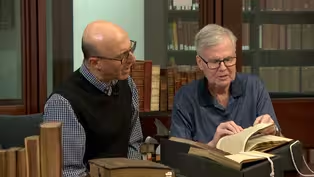
3D printer owners crank out thousands of face shields to help protect healthcare workers, and a man with a passion for rare books donates his valuable collection when he learns he is dying of cancer.
Stick around, that's right now on "Jay's Chicago."
(whimsical jazz music) (whistling) Hi, I'm Jay Shefsky.
First up, a Chicago man with such passion for the historic contributions of black aviators that he creates, for free, an aviation program in a Chicago high school.
(thoughtful music) - Before I came here to Dunbar, I was going to be on the basketball team, but once I heard about aviation, I basically turned that down.
- [Jay] 14-year-old Zaire Horton wants to be a pilot on private jets.
But six months ago, he had never considered a career in aviation.
He never dreamed he would learn to restore this vintage airplane, let alone train to, one day, fly it.
Zaire is one of three students in a new aviation program at Dunbar Vocational High School on Chicago's South Side.
Students at Dunbar can learn to be chefs, medical assistants, auto mechanics, and more.
Principal Gerald Morrow says he's thrilled with the new opportunity this offers his students.
- We are extremely proud of the aviation program.
There is a buzz on the South Side of Chicago where we've actually been recruiting students.
When we had our last teen summit, this room was packed with eighth graders.
They are intrigued how someone 14 years old who looks like them actually has flown an airplane.
- [Jay] This is not the first time Dunbar has taught aviation.
From the 1950s through the 90s, students at Dunbar and several other Chicago high schools could become licensed aircraft mechanics.
- Was a really successful program, a lot of the early African-American mechanics at United Airlines started here in the vocational schools.
- [Jay] Umberto Ricco is a pilot and aircraft mechanic himself.
He created this program just four months before we visited, and it is his gift to the school.
Umberto not only donates his time but all the necessary tools, including this flight simulator.
He's also brought along his personal collection of vintage aircraft.
- I'm not a rich person.
I'm an aircraft mechanic.
So like a lot of Americans, I live beyond my means, right?
But I couldn't help myself, you know?
- [Jay] Why?
Well, Umberto has been passionate about airplanes since he was a kid, but now he's a man on a mission, to tell the world about a mostly forgotten chapter of aviation history, one that happened here in Chicago.
Like many of us, he'd heard of Bessie Coleman, the Chicagoan who was the first African-American woman to hold a pilot's license, but when he dug further, he was amazed at what he found.
- [Umberto] A lot of the history, most of the important history in aviation for African-Americans, started in Chicago.
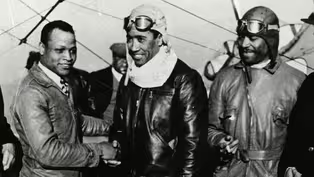
- [Jay] During the 1930s, a group of black aviators led by Cornelius Coffey, Willa Brown, and John Robinson were responsible for many firsts in aviation.
They created the first Black-owned airport in south suburban Robbins.
They opened the Coffey School of Aeronautics to train African-American pilots and mechanics, but the classes were integrated to make a point.
- Every 10 students that I took, I had one white student and one girl student in that unit.
What I was trying to do is to prove to our government that we not only could teach white students and they could fly together, see they always told you that you couldn't integrate them.
I said, "You could."
- [Jay] And they founded the National Airmen's Association to promote the idea of African-Americans being trained to serve as fighter pilots in World War II.
Umberto wanted to tell the world.
So he created a kind of mobile museum to share what he'd learned, and after a few years of telling people about the history, he created the aviation program at Dunbar.
And it's no coincidence that Dunbar is the high school he's chosen, because not only was there once an aviation program here, that program was founded and run by Cornelius Coffey himself.
- He was teaching here.
That's what got my interest, because he was at this school, and I ain't know nothing about it.
- [Jay] But it gets better, because this plane that the students are restoring, this actual plane belonged to Cornelius Coffey.
- He bought this plane when he started the work at this school in 1953.
It was in museum condition.
We could have put it on display, but I thought an airplane, Mr. Coffey's plane, has to fly again.
So we're bringing it back to flying condition.
We're restoring it and gonna recertify it, and then we'll put it in the flying club at the school so the young people that are part of the program can then fly Mr. Coffey's plane.
- [Jay] So while the students are working toward becoming licensed aircraft mechanics, they're also learning to fly, and at age 14, they've already had their first lessons.
- [Zaire] The first time I flew, it was surreal.
Words can't really express how I felt.
It was more like a dream, but once the engine cut on, I was like, "Oh yeah, "we really about to do this thing."
(upbeat jazz music) - The COVID-19 pandemic presented all of us with challenging decisions.
This next story is about a woman who made an extraordinary and heroic choice.
- Hi, this is Apartment's 1 and 2 clients at the Herbst House.
Unfortunately, we've been quarantined for the last seven days.
I don't see this as a job.
I see this as a ministry.
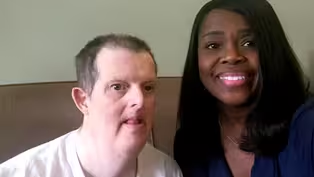
- [Jay] Linda Smith has been the director of the Herbst House for 20 years.
- You have a passion for something, you kind of do it effortlessly.
- [Jay] Herbst House is one of 17 group homes run by the nonprofit Avenues to Independence in northwest suburban Park Ridge.
- I've been trying to keep myself amused-- - [Jay] COVID-19 has presented Avenues and Linda Smith with a challenge that many institutions now face; protecting the staff and the greater community while caring for COVID positive residents.
♪ Happy birthday dear, Jimmy ♪ - [Jay] I first got to know the residents of another Avenues to Independence House in 2018.
We visited because of the remarkable degree of autonomy afforded them by the agency.
- Hi, Jay, how are ya?
- [Jay] These days, they're healthy, but feeling cooped up.
How have you had to change your lives?
- Well, I can't go to work.
I got to stay home, see?
- [Jay] Residential director, Stephen Kray, says there are several things that make COVID-19 a particular challenge for people with intellectual disabilities.
- Many of the people living in our homes are over the age of 60.
We have a lot of individuals with Down's Syndrome who are more susceptible to respiratory disease.
- [Jay] Another big challenge is staffing, because while the men of this house don't have staff around most of the time, all the other Avenues group homes have onsite care 24 hours a day in three shifts.
- There's always a risk that a staff person could be asymptomatic and come into the home and work with them and potentially infect the residents and their coworkers.
- [Jay] And that is exactly what happened here at Herbst House, which has 20 residents and eight staff members.
- Well, one of my staff called me to inform me that she had come in contact with someone who was COVID-19 positive.
- [Jay] Then six residents and five staff members tested positive, including Linda Smith, but instead of sending healthy staff in to work with the infected residents, they took an unusual step.
- We thought the ideal situation would be for one staff person to quarantine in place with the individuals in the home.
That way, no other staff are exposed to them, and the whole crew of staff aren't coming and going through the community potentially infecting others in the community or their family members.
- [Jay] They asked the most senior person first, Linda Smith.
- [Stephen] Linda didn't hesitate.
She volunteered to do it and just incredibly selfless and really a inspirational and heroic act.
- [Jay] Linda is 53, and she has some prior health issues.
- I do have an underlying condition of asthma.
Actually, hold on one second.
Can you give me one second.
Actually, what happened was I had a son who passed away from asthma 17 years ago.
- [Jay] Still Linda Smith chose to spend 24 hours a day living with the COVID-positive residents.
- It is my job to take care of the clients, and when he said, "Would you do it?"
It was like, okay, this is my chance to really stand firm to what I believe.
- [Jay] And Linda has one other compelling motivation.
Her sister had intellectual disabilities and was institutionalized away from the family while Linda was growing up.
- If God can take time for me, I can definitely take time for them.
So I definitely want to give them everything that God gives me, and I want to give them love all the time.
I want them to feel my love for them every day, because I want them to know at all times, they are truly loved.
They are truly, excuse me, they are truly loved.
- I'm happy to report that Linda Smith and all of the residents with COVID made full recoveries, and Herbst House had no more infections after that initial outbreak.
And by the way, Linda Smith received time and a half hazard pay 24 hours a day during her quarantine.
(upbeat jazz music) These days, most communities of Roman Catholic nuns are elderly, but on the West Side of Chicago, a group of mostly millennial sisters devote their lives to serving God by serving this struggling neighborhood.
One of those sisters has a surprising talent that she uses to support their work.
(whimsical orchestra music) Sometimes, we just can't predict what life will throw at us.
When Sister Stephanie Baliga started college, she never could have imagined that one day, she'd be wearing a nun's habit and rushing to get ready for a neighborhood food pantry.
Back then, her priority wasn't Jesus, it was running.
- I started running when I was nine and running became my life.
It was how I defined myself and who I was.
- [Jay] At the University of Illinois, Stephanie was the sixth fastest freshmen in the nation.
She was training five hours a day, but as a sophomore, she fractured her foot and couldn't run for 12 weeks.
- As soon as you had five hours of free time, you really start thinking about lots of things, which eventually led me to pray and led me to really ask God, who am I and what am I doing?
- [Jay] The answer she heard was clear, dedicate your life completely to God.
- I didn't even know what that meant, and I eventually figured out that that usually means you become a nun.
All right, good morning!
- [Jay] Even now, it can be pretty tough to keep up with Sister Stephanie.
That's especially true on Tuesday mornings.
There's an open food pantry and breakfast for the neighborhood.
- Good morning.
- Thank you, baby.
- [Jay] The religious community that Sister Stephanie joined almost 10 years ago is the Mission of Our Lady of the Angels in the West Humboldt Park neighborhood on the West Side.
Many people know Our Lady of the Angels for its tragic history.
In 1958, a horrific fire tore through the school killing 92 students and three nuns and injuring many more.
When Stephanie first visited here in 2010 as part of her own process of discernment, the mission was still pretty new.
It was founded by Father Bob Lombardo, who had been recruited by Cardinal Francis George to create an urban mission in the buildings of this former parish.
- Well right now, this area has many, many non-Catholics living in it, and yet, there are still people that have great need.
As we like to say, we do what we do because we're Catholic, not because the people we serve are Catholic.
- [Jay] And the Our Lady of the Angels mission is drawing young people to religious life.
10 sisters and one religious brother have joined Father Bob.
The average age is just 31.
While the population of nuns in the U.S. is aging and shrinking quickly, the number of new nuns is growing.
When I think about nuns, I usually think about old ladies.
- Yeah, yeah, they're pretty jazzy.
They're nice, they're spunky.
- [Jay] And did you know Sister Stephanie, who was just out here, she was gonna be an Olympic runner.
- The way she run, I can believe it.
- That explains the energy, right?
(laughs) I'm like how much coffee does that lady drink?
(group laughs) - [Jay] And Sister Stephanie is still running, but her goal isn't the Olympics.
It's raising money for the mission.
Each year, she trains a group of mission volunteers and supporters to run the Chicago Marathon.
- So all the money that we raised for the 103 people that are running the Chicago Marathon are gonna be used to help renovate Our Lady of Angels School to be our new community center for the neighborhood.
- [Jay] This is serious work you're doing, and yet, I mean, you seem to have a lot of fun.
- Yeah, we have a great time here.
It's a grand time.
Yeah, no, my life is super fun.
People ask me what I do for fun.
I'm like, "Live my life."
Like, I don't even know.
I don't have an answer to that question.
I don't really do free time.
I don't really do casual activities.
I do life, and this is my life, and it's really fun.
So, (laughs) so that's what I got.
(upbeat jazz music) - In the early days of the COVID-19 pandemic, many healthcare institutions did not have the protective gear they needed to keep their staff safe.
Then a group of people in the Chicago area decided to take it upon themselves to make a serious dent in the shortage of one item, face shields.
(computer motor runs) This is a 3D printer.
It's making a face shield.
So is this one and this one.
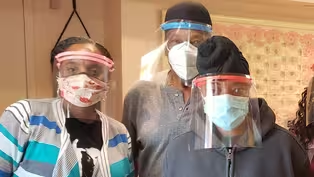
In homes throughout the Western suburbs, people are using their 3D printers to make a lot of face shields for healthcare workers.
They're not the first to do this, but the scale and organization of this project is what makes it remarkable.
- The whole thing started when I was listening to a piece on Chicago Tonight.
- [Jay] The operation is run by Oak Park residents, Rob and Susan Parks.
The Chicago Tonight story was about an engineer making face shields for a hospital.
- And it posted the necessary files on the WTTW website.
- And it posted the necessary files on the WTTW website.
I got the files and in about three hours, I made a headset frame.
Susan had some page protector material.
- [Jay] The 3D printers just make the headset.
The shield is a standard heavy duty page protector.
Now it so happens that Rob and Susan have a neighbor who is an ICU nurse at Gottlieb Hospital.
Rob showed her the prototype back in mid-March of 2020, and she showed it to her bosses.
- The intensivist and the manager, together, said, "Immediately order 72."
Basically all the nurses and the intensivists, some of the respiratory therapists.
- That threw me into a bit of a panic actually, because it took me three hours to print that first one.
- [Jay] Rob and Susan used an email list for local school parents to put out a call for people with 3D printers.
- And inside of a day, I had 20 people signed up to print.
(inspiring piano music) - [Jay] Rob dubbed them the Noble Army.
After they delivered that first order, they easily found other institutions that needed face shields.
Soon, there were 40 people cranking out more than 200 face shield frames a day.
That kind of volume requires a lot of organization.
Rob and Susan both have business backgrounds, and their home has become the hub of this socially distant factory.
The makers deliver new frames to this basket on Rob and Susan's porch.
- Sometimes we get 300 in a day, and we have to disinfect them.
We dry them.
We three hole punch the transparencies for them.
This is 14 for a nursing home, and it includes the frames, it includes the transparencies, and it includes all the instructions that they need.
(thoughtful piano music) - [Jay] In the first two months, the Noble Army delivered nearly 8,000 face shields for free to more than 125 institutions throughout the Chicago area.
The cost per unit is about a dollar, they say.
The materials have been partially covered by donations, and all the labor is donated.
- So there's obviously a really hidden but very powerful force in the community that was like waiting to be tapped.
All these people, they want to find a way to help.
I haven't met a lot of them face to face, but I love these people.
- [Susan] I will be glad when what we do is not necessary anymore, because that means people will not need the type of protection, but while it's there, we will fill the need.
- [Jay] And given the number of face shields they delivered, there is a very good chance that the Noble Army saved lives.
(upbeat jazz music) Most of us, I think, hope to leave some kind of mark on the world.
This next story is about a man who found one way to have an impact when he learned he had a tough and incurable cancer.
- There are actually certain advantages to knowing that you have a limited life span left.
When you're told, well, it's gonna be measured in months rather than years, it gives you an opportunity to make arrangements for things like the collection.
(inspiring orchestral music) - [Jay] Bob Connors began collecting rare books about five years ago.
He acquired some 400 volumes, many from the earliest days of books.
- Let's start with this one, okay.
- Okay.
[Jay] And then just six months before we met Bob, he learned he had incurable cancer.
- [Bob] This book is my favorite book.
It's the oldest book.
- [Jay] This edition of St. Augustine's Confessions was printed in 1475, only about 20 years after the Gutenberg Bible.
- [Bob] But there's also these illuminations.
After it was printed, they came back in and added these-- - [Jay] Soon after he learned he had cancer, Bob decided to offer the collection to The University of Chicago, because he credits the university with inspiring his collecting.
- When I retired, I told myself I was gonna do two things.
I was gonna travel and study.
- [Jay] That was 10 years earlier when Bob was 60.
The travel took Bob and his wife and daughters around the world.
He studied in, what The University of Chicago calls, its basic program, in-depth classes in the Great Books of Western Civilization, and as Bob dove into the ideas, he became especially fascinated by the books themselves.
- Books are an opening to an intellectual and a magical world.
All these great stories and great ideas are embodied in these books.
- [Jay] Bob bought rare additions, the books he was studying in the basic program.
He started with the Victorian era writer, Thomas Hardy, and collected nearly all of Hardy's works.
As his studies moved back in time, it was the oldest books that captivated him, because of the way they made knowledge more accessible.
- Before that when you had to be in a monastery or in a library to get access to these texts, and that's why I'm so happy that they found a really good home.
- Elizabeth Frengel is the curator of rare books at The University of Chicago library.
- This collection is very remarkable for its collection of books that represent the history of early printing, and we call those incunabula, and it comes from the Latin word meaning, from the cradle.
- [Jay] Incunabula are books printed before 1501.
- His collection includes 12 incunabula titles, and that increased our holdings here at The University of Chicago Library significantly.
- [Jay] Bob's collection has been appraised at nearly half a million dollars, but Elizabeth Frengel says it takes more than money to assemble this significant a collection in just five years.
She says, Bob has become extremely knowledgeable about book history.
- Another value with these old books, by the way.
Okay, notice these little scribblings in the margins.
- [Jay] what are those?
- [Bob] Scribblings, but they're-- - [Jay] You mean by readers?
- [Bob] Yes, but scholars will come in just to read the marginalia.
They want to know how scholars back then interpreted these books.
- [Jay] Despite the monetary value of the collection, Bob says he preferred to donate it as a whole rather than sell it off in pieces.
- [Bob] I mean, one of the things, again, about knowing you have a limited time left, one of the things you think about is legacy.
What mark have I left in the world?
What will live beyond me?
And this collection will.
This is a very important part of my legacy that I'm very proud of, frankly.
These books, which have survived, in some cases, 500 years, they'll be around for another 500 years, and scholars will still want to come in and look at the actual books.
(upbeat jazz music) - You can watch any of these stories again along with 15 years worth of other stories on our website, wttw.com/jayschicago, and while you're there, tell us what you thought of the show.
I'm Jay Shefsky, thanks for watching.
(whimsical jazz music) (man whistling)
Cancer Diagnosis Leads to Donation of Rare Book Collection
Video has Closed Captions
Clip: S2022 Ep5 | 4m 49s | A cancer diagnosis leads a Chicago man to donate his valuable rare book collection. (4m 49s)
Video has Closed Captions
Clip: S2022 Ep5 | 6m 3s | Inspired by Black aviators, a training program returns to a Chicago high school. (6m 3s)
A "Noble Army" Protects Health Workers
Video has Closed Captions
Clip: S2022 Ep5 | 3m 53s | In the early days of COVID-19, 3D printer owners produced thousands of free face shields. (3m 53s)
A Selfless Act for Her Clients
Video has Closed Captions
Clip: S2022 Ep5 | 4m 26s | Linda Smith made a choice during the pandemic that many of us would find hard to imagine. (4m 26s)
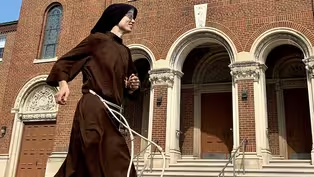
Sister Stephanie is Still Running
Video has Closed Captions
Clip: S2022 Ep5 | 4m 1s | Why did Sister Stephanie Baliga give up her Olympic dreams to become a nun? (4m 1s)
Providing Support for PBS.org
Learn Moreabout PBS online sponsorship













Support for PBS provided by:
Jay's Chicago is a local public television program presented by WTTW