We Are Here
Goodfellas Cycling
10/17/2024 | 26m 46sVideo has Closed Captions
Cycling is more than just a sport; it's a pathway to life, health, and brotherhood.
The Goodfellas Cycling Club believes that cycling is more than just a sport; it's a pathway to life, health, and brotherhood.
Problems playing video? | Closed Captioning Feedback
Problems playing video? | Closed Captioning Feedback
We Are Here is a local public television program presented by WHUT
We Are Here
Goodfellas Cycling
10/17/2024 | 26m 46sVideo has Closed Captions
The Goodfellas Cycling Club believes that cycling is more than just a sport; it's a pathway to life, health, and brotherhood.
Problems playing video? | Closed Captioning Feedback
How to Watch We Are Here
We Are Here is available to stream on pbs.org and the free PBS App, available on iPhone, Apple TV, Android TV, Android smartphones, Amazon Fire TV, Amazon Fire Tablet, Roku, Samsung Smart TV, and Vizio.
Providing Support for PBS.org
Learn Moreabout PBS online sponsorship>> Oh, so you ever seen a flock of birds, right?
You notice the formation that they're in?
That formation is by natural design.
The bird at the front of the formation, uh, takes on the brunt of the air.
But if that bird was alone, there would be resistance.
It creates this turbulence.
What protects against that is when you have other birds at the flank.
It's the same thing in cycling.
>> And all of a sudden, like, we were like, we're actually pretty good.
And you're just like, yeah, we're going to be called the Good Fellas.
>> You know, we're fathers were husbands were, you know, community men, we're servants, we're employees, we're entrepreneurs.
We are a lot to a lot of people.
Being able to just be on the bike, in many cases with nature, and able just to unlock your mind and let the thoughts come and go, and knowing that you can't react to them, you can't respond to them, you can't take notes.
You just got to be there.
>> If you work as a team, you rotate.
Somebody else who's well rested, who was sitting in the center of the pot now takes the lead.
It's a metaphor for life.
>> When I say it's a brotherhood, it is, you know, a cycling team way secondary to, you know, a network of fellas who are there to support each other.
The only way you elevate in cycling is if you do it with a team.
>> I'm going to shield you.
When I'm tired, I need you to take over.
>> We're here, and we're excited to see what that means to, uh, to the category shifts that will happen.
>> A lot of the guys in the club, me included, we're busy.
You know, we're fathers, we're husbands, we're, you know, community men, we're servants, we're employees, we're entrepreneurs.
Um, so for a lot of us, we are a lot to a lot of people.
And being able to just be on the bike, I don't got to talk to you or talk to you.
We're both riding.
I've got to handle this text or call and deal with the toddlers.
You're just on the bike, in many cases with nature and able just to unlock your mind and let the thoughts come and go knowing that you can't react to them.
You can't respond to them.
You can't take notes.
You just got to be there.
Life is complex.
Um, you know, I can decide if I want to just, you know, brute force, work my way through life.
Get the bag, get the girl.
Keep it to myself.
Not share game, not uplift, not be uplifted.
The only way you elevate cycling is if you do it with a team.
>> You know, the nation was hit with COVID, and then when they said gyms is closed, I was like, I need an outlet.
So I just literally was like, all right, well, I rode a bike when I was like five, six years old.
I was like, let me pick up a bike and start, you know, getting my exercise on.
So just started writing, you know, post it on social media.
Sooner than you know it, like people be like, hey, I bought a bike, too.
The only thing I knew about biking was like Armstrong.
But besides that, it was just the training wheels, back in the day, or me and my brothers back in the days, just getting on bikes.
But we didn't think anything of it.
It was just like, alright, let's get up.
You know, let's exercise, ride the trail, and then all of a sudden, like, you're like, we're actually pretty good.
As far as just like speed, distance wise, it's just like, you know what, let's just form a club.
Uh, and then we just kind of started, like, reaching out to other people, like, hey, we're meeting up at this time and then sooner than you know it, it was like, maybe 10 to, like, 15 people, and, um, you're just like, yeah, we're going to be called the Good Fellas.
And then we just started building after that.
>> So when I came in mid 2020...
...I came to Fairwood Park in Bowie, Maryland, and I just saw 50 or 60 people rolling out on bikes and I said, what in the world is going on here?
And um, and I said, you know, I got a bike.
So I had a little hybrid bike, came on out.
Checked to see what's going on.
Um, and then, you know, I met with these guys, they call themselves the Good Fellas, right?
It was K.K., it was Tony, Moe, Romano.
Um, Ebo.
Uh, Sean, Mike Fair.
I mean, this was a whole bunch of guys, probably about 12 guys.
Um, and I said, all right, well, I'm going to ride with them.
I got dropped.
I just got dropped.
It was like -- it was a menace.
You know, I was out there, I thought I was doing something because I was on the trails.
It was like, you know, oh, man, I'm flying, I'm about 13 miles an hour, man, I'm flying.
They're like, yeah, we're gonna ride the roads.
I'm like, okay, yeah, I figured I could do that.
Turn on 193.
Man, those guys are shoo, shoo, shoo.
I heard their bikes.
I was like, I didn't know bikes make sounds like that.
You know what I'm saying?
I was just like, what's going on?
And everybody had the curved handlebars, you know, like [speaks indistinctly] I had the straight handlebars and everything.
And, um, and so then I came back, you know, way after, everybody had their slippers on, their bikes were put away.
Here I am rolling up my hybrid and I just started inquiring.
I was like, all right, who are you guys?
What are these bikes that you're riding?
And, you know, how'd you get to be what you are?
And then, um, one of the gentlemen was like, you know, we got an extra kit for you.
And and they gave me a kit.
And, um, and then one of the guys was like, who is this guy in the picture, because I had never seen it before.
And he was like, yeah, that's Taalib.
That's our new member.
And so, uh, and the rest is history, right?
It's like you just build those relationships and just grow.
So now I'm now I'm the president.
Go figure.
You know, two years later, I'm the president, and it's an incredible privilege.
>> In the early days of the sport, cycling was segregated Due to years of discrimination and exclusionary practices, today's cycling competitions lack black cyclists.
The Good Fellas aim to inspire black cyclists to ride bikes and compete at a higher level.
>> How you feeling?
All right, let's get it.
Let's get it.
Y'all looking like a podium right now.
>> I'd say one of the main drivers of actually founding the club formally wasn't cycling.
Cycling was the excuse or the conduit to get together.
It was really the desire that most of the fellas in the club had for fellowship and continue to have.
When I say it's a brotherhood, it is, you know, a cycling team way secondary to, you know, a network of fellas who are there to support each other.
And we use cycling to hold each other accountable and challenge each other to be greater and get smarter and more patient.
And in many ways, cycling is a metaphor for life, right?
Like you can go very, very hard or, you know, very, very slow.
You have different seasons.
But mastering how to deal with the sprints and the endurance and, you know, the consistency requires and the technicality and working with other people, it forces you to really lean in and figure out how you want to navigate the sport, which is analogous to life in many ways.
>> I'm the oldest one out here.
So I'm not here for the competitive side of it.
[ Laughter ] I'm truly out here for the brotherhood of it, you know, been knowing Craig for what, 20 years now.
I hit it off with Taalib really good when we first met.
All the brothers have been excellent, and I look at every opportunity as a learning opportunity.
You know, just where it is today, we're talking about... What's the name of that book we were talking about?
>> Oh, "Hour Zero."
>> "Hour Zero."
You know, every chance I come out here, I learned something different about how old you are.
You still look forward to learning.
Hey, man, this is a good group that just shares a lot, you know, through the chat lines.
Every time we meet in person, a little fellowship, you know, every down there I have to ride, I really enjoy it.
>> My first interaction with Taalib was primarily him giving me advice on how to manage my work and manage my energy.
So personal development.
How to be just a solid gentleman.
It makes you rise to the occasion in a similar fashion and telling us about the competition.
It's the outlet, right?
Ride our bikes, have fun, but also it's more than that.
It's a brotherhood.
So to ride, it's not just about riding It's how you do it.
You feel like you genuinely care how you're doing.
[ Speaking indistinctly ] >> You know, and we just sort of before it's, um, you know, men are -- regardless of color.
Men are always asked to lead, to kind of put your emotions to the side for a bit.
Uh, accomplish goals.
The whole notion of status and what makes a man a man in our society.
Um, there's good and bad.
The good part is men should drive to be leaders, to be an example, to have integrity and honesty.
But I don't think they should do that at the detriment of having genuine relationships, having genuine empathy, uh, genuine understanding, genuine emotion.
Right.
And brotherhood is important because if done right, you get both of those, right?
You say, yep, bro, you got to step it up in your game.
And the brothers say, I'm weak, I need help.
And you put your arm around the brother and say, I will walk with you.
That's brotherhood.
How's your family?
How's your mom?
Uh, I heard you had a birthday this week.
I heard your dad was in the hospital.
I heard you're looking for an opportunity.
I heard you got promoted.
I heard that you got a raise, right?
It's kind of like catch up on life before we get on the bikes.
So you have that portion of it.
And then we have another portion where it's just like -- And it's not -- It's very organic, but it's like, hey, bro, you know your chain needs cleaning.
Let me get that.
Let me show you how.
Uh, hey, bro, you may -- when you're cycling, I noticed that your leg bows out a little bit.
Tuck your knees in.
Did you get fitted yet?
I got a guy who can get you fitted because I want to make sure that you stay healthy.
I think you could deliver more power in that way.
Right.
So it's like unsolicited communications of true love for brother.
I want to make sure you're taken care of in life.
I want to make sure you're taken care of in health, on your bike.
Hey, I didn't see you last week.
You all right?
Let's catch lunch sometime.
And it's all genuine.
That's what I see before we bring it all together.
And then I say a prayer before we go.
And then when we come back, we spend longer after the ride talking than we do before the round.
Right.
And there are times where the park police have to come and say, hey, okay, turn on the lights here.
It's time to go.
So... >> I'm always trying to find ways to, you know, engineer, um, connections with people who I know can uplift me.
And, you know, we ride fast, we ride 20 or so miles an hour, but we also ride long.
So on any given Saturday or Sunday, I might be out for 4 or 5 hours with these guys.
Right.
And I'm riding multiple times a week.
So, you know, we've engineered a community where by definition of what the sport is and how long we're on two wheels, I've got to spend time with these guys, right?
They might not be my closest friends, but I'm rubbing off.
I'm noticing.
I'm picking up on things.
I'm seeing how they integrate their family and seeing how they push through challenges.
So what we really needed was a group of people who wanted what we're doing for each other.
Um, uplifting prayer, vulnerability, shared space, affirmations, accountability, um, and spending more time right?
We could have done this at the club, could have done this, um, you know, in the streets.
But we're choosing to do it in a constructive way.
And, um, just knowing that everyone that I ride with has made a time a financial and energy investment in the sport, it challenges me to continue doing the same, and I found that it makes all aspects of our lives better.
>> So you ever seen a flock of birds?
You notice the formation that they're in.
That formation is by natural design.
What happens is the bird at the front of the formation, uh, takes on the brunt of the air.
But if that bird was alone, there would be resistance.
But then directly behind them there would be these things called eddies.
And that's when the air comes back, slams back together, and then it creates this turbulence.
And that turbulence drags the bird back.
Same thing with a bike.
Same thing with a car.
So what protects against that is when you have other birds at the flank.
When the air comes forward, it pushes out.
Because now you have birds at the flank and you have less turbulence in the back.
The more birds you have, the lower the turbulence in the back.
And that's just at the edges, In the middle you have birds who are flying with no wind resistance at all.
So they're protected from the wind as they move forward, so they actually expend less energy than the front bird and the birds on the side.
It's the same thing in cycling.
>> The front cyclist takes all the wind.
You have side cyclists that help, usually the front and the sides of the strongest and everyone else is protected.
Now, if you work as a team, you rotate so that the strong bird takes a breath.
The strong cyclist takes a breath.
Somebody else who is well rested, who was sitting in the center of the peloton, now takes the lead.
It's a metaphor for life.
You go out front, you survey what's going on in the world, and then you let your brothers know this is what's going on.
This is the wind speed, et cetera, et cetera.
I'm going to shield you, and I'm tired.
I need you to take over.
And then you're like, of course, because you're protecting me, right?
So then that experience, it just builds trust, trust with other conversations because you know that the people around you are going to shield you from the wind.
>> It's just definitely a lifestyle, not a hobby.
I think anyone who is willing to try and tolerate the sport, will see all aspects of their life enhance.
You will get smarter, you will get stronger.
You will get more sophisticated.
You will get more strategic.
You will be more mentally, spiritually and physically in tune.
And the same isn't true for all sports.
Look at what football is doing to our brains.
And you know, basketball, the chances of you really making it to that level and using that as something that enhances your health in the long run, just given how strenuous the sport is, the chances are slim.
So when I think about the future of the sport, I think about access, I think about wellness.
You know what it actually would mean to get a bunch of people in the hood really riding, right?
I mean, if you can get somebody a bike, you're not limited to your zip code anymore, and you can go out there and really, really explore the world around you.
You can explore the world of nature around you with a mechanical device that you can tune and maintain and upkeep, um, with limited cost once you get it.
Um, so yeah, regarding the future of the sport, I would love to see all people, all black people across the world, across geographies, access it because it can truly make your holistic life enhanced.
Even the idea of a GOAT, greatest of all time, go through anything, look at all the goats.
Many of them were black, right?
So what excites me about cycling is I know that when we enter the sport, when we enter anything right, we open that door, we change it, the category changes, it gets more swaggy, it's more competitive, it's more fun, and we bring more character, our culture to it.
I love the things that, uh, the boys, the Legion boys out west are doing, Justin and Corey Williams, they are changing the category once again and really helping us to think differently about cycling.
So I'm not worried about what the naysayers say.
We're here, all right?
I'm excited about the future because we're just tapping into the sport.
And, you know, on one end it can be disappointing or demoralizing to turn on the Tour de France and see in the field of, you know, 100 plus riders, you know, close to 200 riders won one black person who, by the way, is like the leader of his team.
And, um, you know, you could put him anywhere, um, on a stronger team and you'd see his performance, um, you know, enhance immediately.
It could be demoralizing to look at that and say, oh, we're not welcome here.
We're not gonna do well here.
There are not enough of us.
I see the opportunity.
And I know that we're in the early days.
Um, and it might be one this year, two next year, seven next year.
You know, we're not gonna necessarily take over the sport, but we're here, and I'm excited to see what that means to, uh, to the category shifts that will happen.
♪ This is what you're waiting for ♪ >> That's what I'm trying to see, if I can get a GoPro.
>> [ Speaking indistinctly ] [ Laughter ] >> This was fun.
This was fun, man.
>> If you want to ride with us, man, get you a bike.
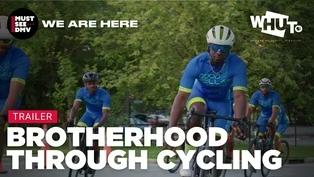
Preview: 10/17/2024 | 51s | Cycling is more than just a sport; it's a pathway to life, health, and brotherhood. (51s)
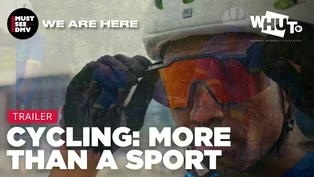
Preview: 10/17/2024 | 31s | Cycling is more than just a sport; it's a pathway to life, health, and brotherhood. (31s)
Providing Support for PBS.org
Learn Moreabout PBS online sponsorship













Support for PBS provided by:
We Are Here is a local public television program presented by WHUT