
Gospel History/New Bethel Baptist Church
Season 49 Episode 26 | 26m 46sVideo has Closed Captions
Gospel History/New Bethel Baptist Church | Episode 4926
We are dedicating the entire show to gospel music for our series on the black church in Detroit. Stephen talks with the pastor of New Bethel Baptist church, where Aretha Franklin sang in the choir. Plus, the founder of Detroit’s Hallelujah singers shares how gospel music changed his life. And, a look at the evolution of the gospel sound. Episode 4926
Problems playing video? | Closed Captioning Feedback
Problems playing video? | Closed Captioning Feedback
American Black Journal is a local public television program presented by Detroit PBS
Gospel History/New Bethel Baptist Church
Season 49 Episode 26 | 26m 46sVideo has Closed Captions
We are dedicating the entire show to gospel music for our series on the black church in Detroit. Stephen talks with the pastor of New Bethel Baptist church, where Aretha Franklin sang in the choir. Plus, the founder of Detroit’s Hallelujah singers shares how gospel music changed his life. And, a look at the evolution of the gospel sound. Episode 4926
Problems playing video? | Closed Captioning Feedback
How to Watch American Black Journal
American Black Journal is available to stream on pbs.org and the free PBS App, available on iPhone, Apple TV, Android TV, Android smartphones, Amazon Fire TV, Amazon Fire Tablet, Roku, Samsung Smart TV, and Vizio.
Providing Support for PBS.org
Learn Moreabout PBS online sponsorshipWe got a really great show coming up for you on American Black Journal.
We're dedicating the entire show to gospel music for our series on the black church in Detroit.
I'm gonna talk with the pastor of New Bethel Baptist church, where none other than Aretha Franklin was once a voice in the choir.
Plus, the founder of Detroit's Hallelujah singers is gonna share how gospel music changed his life.
And we'll look at the evolution of the gospel sound.
We have a really great show for you ahead.
Stay where you are.
American Black Journal starts right now.
Announcer 1: From Delta faucets to Behr paint, Masco corporation is proud to deliver products that enhance the way consumers all over the world experience and enjoy their living spaces.
Masco, serving Michigan communities since 1929.
Announcer 2: Support also provided by the Cynthia and Edsel Ford fund for journalism at Detroit public TV.
Announcer 1: The DTE Foundation proudly supports 50 years of American Black Journal in covering African-American history, culture, and politics.
The DTE foundation and American Black Journal partners in presenting African-American perspectives about our communities and in our world.
Announcer 2: Also brought to you by Triple A, Nissan Foundation, Ally, Inpact at Home, UAW solidarity forever, and viewers like you.
Thank you.
♪♪ Welcome to American Black Journal.
I'm Stephen Henderson, your host, and as always, I'm really glad you've joined us.
Today, we are continuing our year long series on the black church in Detroit.
Produced in partnership with the Ecumenical Theological seminary, and with the Charles H. Wright museum of African-American history.
Since June is black music month, we're taking a closer look at gospel music in Detroit.
Our city has long been a really important stop on the gospel circuit.
And a lot of gospel artists have their roots right here in the city.
First up, producer Marcus Green went to the iHeart radio studios to learn more about the evolution of gospel music, from WMXD gospel radio host, and university of Michigan Dearborn professor, Dr. Deborah Smith Pollard.
It reflects the message that the church is about.
Which is God loves us, Jesus Christ died for us.
Salvation is for all of us.
And his mercy and grace is what gets us through even when we've not been so good.
Okay, and even when we're facing tough times.
Now the other part of it is that, the music reflects the creativity of our committee.
♪ Lord I thank you, I thank you for this ♪ ♪ Lord I thank you, I thank you for that ♪ ♪ Right about now its two o' clock in the morning ♪ Chicago is of course called the birthplace of it because that's where Thomas Dorsey, Mahalia Jackson, and so many others came together.
Or they were situated there.
♪ I've been falling and rising all these years ♪ ♪ But you know my soul But when the convention, the national convention of gospel choirs and courses started in the 1930s.
The third year after they were formed, they were here in Detroit.
And Detroit embraced it.
It goes back to even as early as the 1800s.
The 19th century as well.
We had basically a split in the black church.
To this day, there are churches that are like, well, okay, this is kind of a lot.
We can have the softer kind.
The more, you know, the quieter kind, but not that kind where people are clapping and playing tambourines and moving a lot.
They don't want that kind.
So you know, this idea that every church, black church does everything the same way, no that's not true.
♪ Oh happy days ♪ Oh happy days ♪ Oh happy days ♪ Oh happy days ♪ When Jesus walked When Edwin Hawkins brought in "Oh Happy Days," oh my goodness.
Oh my goodness.
He had an interview in a book with Dr. Bobby Jones, and he talks about how people came from the church and said, "People are dancing to your song in clubs.
How dare you?
That's not sacred."
And of course, again, today, it seems to be quite traditional.
So then we moved on to Kirk Franklin and trust me, in a minute there's gonna be somebody else.
'Cause we have trap gospel.
Trap gospel?
Oh no, they can't go together.
Well, because the music comes from the community, okay?
It's not born in church.
Let's just even say, we think about Twinkie Clark and "You Brought The Sunshine."
She wasn't supposed to be listening to secular music but she loves Stevie wonder.
She heard reggae, she included reggae with that one.
That song just, to this day, is one of the most beloved songs we have.
So it reflects the gospel.
She says, you know, what?
Won't he open doors for you?
I'm talking about Jesus.
I mean, that part of the lyrics in there still reflects the message.
But the sound, the instrumentation changes over time.
♪ La la la la la ♪ La la la la la Lets party.
♪ He took me high Some people like, we want to sing quietly.
to sound, let's just say, more European.
And then there are others that we wanna be ourselves.
And so there was that split.
So there is, I want to say, yeah, there continues to be that kind of a dichotomy.
And then even layers within the dichotomy.
Just because some people think that a choir sound is what we should reflect.
To show that we have, to them, evolved, okay?
And to other people, it's like, we want to sing the way that it reflects who we are.
And we have a range of sound.
In my first book, "When The Church Becomes Your Party," the last chapter is about Christian rap, you know?
And so I talk about how, in some ways, you know, people could just step back before they say, oh, that's not what we are.
Okay, so there was an article I wrote, it's like the ladies have on all their clothes 'cause I asked these young people, what makes gospel rap different from rap?
And they said, women have on all their clothes.
Okay, this just made me fall out laughing.
I said, okay, that's gonna be part of the title.
Okay, so besides that point, certainly again, the message is in place.
The message of Jesus Christ.
♪ God is ♪ God is ♪ He is Play whatever you need, sing whatever you need to sing.
You know, as long as that message is getting out, it's still the gospel, and that's okay.
(choir singing) There's no other voice like it in the world.
None other than the queen of soul, Aretha Franklin, got her gospel start in Detroit, at New Bethel Baptist church which was pastored by her father, the Reverend C.L.
Franklin.
Throughout her life, Aretha returned to the church many times to sing, attend services, and host charitable events.
Reverend Robert Smith became New Bethel's senior pastor in 1984.
I talked with him about the church's long and storied history of gospel music.
Pastor Robert Smith welcome to American Black Journal.
God bless you.
I'm just real excited about being here with you.
I think this is very, very important part of media educational, informative, and inspiring.
Yeah, so I really want to talk to you about the role that gospel music plays, A, in your church, which has this incredibly rich history because Aretha Franklin being in the choir there as a child.
And of course, growing up in that church.
But I also just wanna talk about it more broadly, and the role that the music plays in our faith in Detroit, and in the black community.
Well, certainly if you are a student of history, you know that the slaves only made it by singing.
My grandmother taught me the same thing.
She would give me a task.
I would hate doing it.
I was standing there crying, trying to get through.
And she said, "Listen, get your song.
If it's just in your heart, even if it doesn't come from your lips, sing that song and you'll be through before you know it."
And singing is a great reliever.
It helps us to escape the agony of life in many ways.
Roy Jones said the only difference in the gospel and the blues, was that one you called on your baby, the other you called on God.
But the hope was the same.
You would find relief in doing so.
And certainly, Reverend Franklin and Ray Charles, I think, understood that better than anybody.
That it was all about relief from the everyday agonies of life.
Of course, Reverend Franklin had such an out sized role in the civil rights movement.
And I always thought that the power of the music of the church, married very easily with that idea of civil rights.
And it's that history of the music has a way of maintaining sustaining black people, that made it such an easy partner for that civil rights struggle.
Yes, most people don't understand the Baptist church of course has fallen off greatly in the last 20 years because music changed so much, and many Baptist churches are very slow to change.
I remember the struggle in the early eighties to bring in praise teams rather than deacons doing devotions.
But most people didn't understand about the deacon doing the devotion.
When I came up in church in the fifties and sixties, if you had 16 deacons, that meant 16 prayers and 16 hymns going, (hums).
And that man had to get that to do that because he was criticized by his people because he was working for the white folk.
Other blacks were picking up jobs, little hit and run jobs and go on, but their families could not advance that way.
But that black man that wanted his family to advance, be able to send a student to college, to own a home, he went to work for the white man knowing that he will never be called by his name.
I don't think you're old enough to know anything about that period of life, but I grew up in it.
But your name was uncle, your name was preacher, your name was anything but your name.
I have worked 13 public jobs at my life.
And on most of those jobs, I was never called by my name.
But those black men stayed there and took that, and took everything on.
Well, to put up with that.
To put up with that, then you got up Sunday morning, you went to church and it was the place you could release.
You couldn't do it at home or in the community, people would think you're crazy.
So those deacons got up there and you knew the song and you knew the prayer.
It was the same prayer, the same song, but it was relief.
And a lot of our young people don't understand that music changed a whole lot during the latter part of the eighties.
The mass choirs came in, and then of course, even the flavor of the music changed.
I think the Winans set a new trend when, I think it was Marvin Winan, who said, "We don't do gospel music, we don't do secular music, we do good music and let people decide."
And that's where it came to.
So tell me about music at New Bethel now.
I mean, the history there is so well-known and so influential.
What role does the music play in your ministry and for your congregation?
Well, it's a great, great challenge now.
I tried to resist, same way I did when we first started in the latter sixties, to bring in drums and guitars to the Baptist church.
I resisted until I couldn't resist.
And of course, when I opened the doors, we got a mass choir, we recorded, became the premier choirs of Birmingham, Alabama.
I had Daniel Payne college, and Miles college right at me.
Brought in those college students.
They can temporize the music.
And of course we drew a lot of people.
Now at New Bethel during the pandemic, I've spent that time renovating and modernizing for what I said I would never go from.
Charles Spurgeon said that, "One day the pulpit will become a stage, and the sanctuary would be a theater and people would come to see the best show in town."
You see the problem is, the world can always surpass us.
So I resisted for a long time the back wall lighting and, you know, all the big screens and everything.
But here's the justification.
Even God can't change a man without his attention.
So when he got ready for Moses who had divorced God and his people, and resided to the backside of the desert, he set a bush on fire that wouldn't consume.
He didn't have to do that, but he had to have Moses attention and that's the way he got it.
So I got to have the attention of people.
I buried 54 people during the pandemic.
And I thought about, I'm 70, my peers and my group that came through this 40 years with me, they're 70 and 75.
And I've been satisfied.
I have nine pastors who come out of the church in my 40 years there.
Reverend Solomon Kinloch is the most popular.
And most of the time, people that join our church between 15 and 40, they would either go to my son, and to Reverend Keith Wilson, mostly to Reverend Kinloch.
And it didn't bother me because they were still in church.
But then I thought about at 70, I have five 5, 6, 10 years at most.
And I didn't want the church to become just a museum of senior citizens trying to go on.
So I'm making that change.
We're doing music by track for a lot of this stuff when we get back so that we can play.
There's a very hot group called Bethel.
Hill Songs.
They have the up stuff.
Elevation church, stuff like that.
And we got to get in there to hold that crowd.
First to get their attention, and then to hold them.
A 2015 documentary titled, "Let's Have Some Church Detroit Style," provides an up close look at Detroit's Hallelujah singers.
They're a community choir founded and directed by Dr. E. LaQuint Weaver II.
The film by producer and director, Andrew Sacks, examines the singers' lives and follows them to a music competition in Alabama.
I spoke with Dr. Weaver about the impact of gospel music in his life.
♪ Way back in the Bible days ♪ God told Noah that it's gonna rain ♪ ♪ Noah told the people they paid him no mind ♪ ♪ They said look at Noah you out your mind ♪ ♪ Noah obeyed every word from God ♪ ♪ Got some wood and some nails and he building an ark ♪ ♪ He even got the animals two by two ♪ ♪ The ox, the camel and the kangaroo ♪ ♪ When the rain fell from the sky ♪ ♪ When the rain fell down from the sky ♪ ♪ When the rain fell down from the sky ♪ ♪ Everybody got trouble in mind ♪ Yeah, let's start with the Hallelujah singers.
Tell us about where that comes from and why you do it?
Well, Hallelujah singers now, as of this year, are 41 years of age.
We began back in the eighties and it was a smaller group consisting of my cousin, Rene, my god-sister, Dawn, and a good friend of mine, named Leon.
And plate uncle, the late Bill Davis Cosby Jr. And so we continued to sing around the city of Detroit, and we got our first record deal through Mr. Bernie Hamilton that played on "Starsky and Hutch."
He was captain Dobey.
And we recorded a couple of records and we stayed together for numerous of years, but all of them were fantastic lead singers.
So they ventured out in their own solo careers.
Some are still doing it right now today.
And I expanded the group from being a smaller group unto an ensemble.
And now, we have expanded now to more so like a choir.
And we are the Hallelujah singers.
♪ And all the dominion ♪ And the power ♪ Glory and praises ♪ They all belong to you ♪ They all belong to you For you, where does the love of gospel music start?
And how do you decide that this is what you want to do with your life?
It started at my home.
my mother sung with one of the phenomenal, I would say one of the best female gospel groups in the fifties.
I hail from the city of Birmingham, Alabama.
My mother was a member of Dorothy Love Coates, and The Original Harmonettes.
But they were just the Original Harmonettes at first, and then they became Dorothy Love Coates because of her fantastic leading ability.
So I was singing in my home, was in my home, my brother and my sister and my mother was a musician.
And we migrated from Birmingham to Detroit.
And my mom caught me singing in the kitchen one day.
I had been singing, "I've Been Bit By The Love Bug" by Donnie Simpson in the early sixties.
He had a show and it came on, and so every day it would come on.
And I was singing, "I've Been Bit By The Love Bug," and she caught me singing.
And she said, okay, after the third day, she said, "You're going downstairs and we're gonna start you singing."
And she taught me my very first solo which was "How Great Thou Art."
Well, after that, my sisters sang with a group here.
They were called The Mellow Tones, and I saw them sing at an early age.
And I was like, oh my God, these ladies are really, really singing.
I'm gonna do that.
That's what I wanna do.
And that's what I did.
You know, from that age, from the age of five on up, that's all I've enjoyed doing, giving God praise through music.
So a lot of people, of course, associate gospel music with the church.
And that's where you can regularly hear gospel music.
But for you, it goes far beyond that.
I mean, for you, it starts in your home, but also the Hallelujah singers are a community choir.
Talk about that dimension of gospel that goes beyond the church walls.
Yes, we are a community choir and we have various denominations that are part of this group.
And many of them do a lot of things in their home churches, and wherever we're needed, we go.
So we've sung for various people.
Martha Jean the queen, King of Kings, we did that for like 13 years.
We backed up and did work with the OJ.
We did work with Trace Adkins, and the list goes on.
We were on Kim's Christmas album.
And so different things that pertain to gospel or inspiration, that's what the Hallelujah singers are all about.
So I kinda handpicked them at first, and I still hand pick them now, you know, I wanna make sure that you know exactly what you're doing.
And one thing about the Hallelujah singers, they're a strong bass choir, which they all have their individual church homes, and they have pastors.
So not only do we come together, and we know exactly what we're thinking about because we have a home base.
And that's good to have in these days with our choir that you're taught about what you're singing about.
And that's basically the Hallelujah singers.
That's what we do.
We learn what we're singing about.
That way, we can minister to others That they might know he's a good God.
And what about the relationship between gospel music and other forms of music?
I always think that you can listen to any form of music in America today, and hear that gospel influence sometimes stronger than others.
But talk about how important that is to gospel itself, the way that it has influenced so much of the music world.
Well, gospel music, as I was always told, it puts joy in your heart constantly.
You can go to gospel music and if you're burdened, it lifts you up.
If you're sad, it makes you happy.
If you're going through anything you're going through, you can go to gospel music and you can get some consolation from that music.
It's been that for me.
Many of our RNB secular artists that you know, they started off with gospel music.
And you're going to hear that, it's something about the gospel, it touches your heart, it reaches, and what I love about it is that, there's never a time that you listen to it, that it doesn't satisfy you.
You know what I'm saying?
So with gospel music, like with the blues, the blues are just sad and what have you.
But if you're sad, you go to gospel music and get some consolation and it'll lift you up, you know, out of that situation that you're in.
So the gospel music is very important in all genres.
I think for me, I would say personally, it's number one.
The number one music thing that you can go to.
You know, just go to the gospel music.
It's just that good, you know.
(choir humming in unison) ♪ What a mighty God we serve (choir humming in unison) ♪ What a mighty God we serve ♪ Oh (choir humming in unison) ♪ What a mighty God we serve (choir humming in unison) So our guests had a lot more to say about gospel music, and you can see my extended conversations with Reverend Smith and Dr. Weaver at americanblackjournal.org.
That's gonna do it for us today.
Thanks for joining.
Look for more shows about the black church in Detroit each month.
Meanwhile, connect with us on Facebook and on Twitter.
We'll see you next time ♪♪ Announcer 1: From Delta faucets to bare paint, Masco corporation is proud to deliver products that enhance the way consumers all over the world experience and enjoy their living spaces.
Masco, serving Michigan communities since 1929.
Announcer 2: Support also provided by the Cynthia and Edsel Ford fund for journalism at Detroit public TV.
Announcer 1: The DTE Foundation proudly supports 50 years of American Black Journal in covering African-American history, culture, and politics.
The DTE foundation and American Black Journal partners in presenting African-American perspectives about our communities and in our world.
Announcer 2: Also brought to you by Triple A, Nissan Foundation, Ally, Inpact at home, UAW solidarity forever, and viewers like you.
Thank you.
♪♪
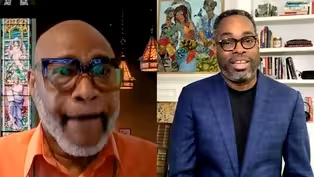
Dr. E. Laquint Weaver II Full Interview
Clip: S49 Ep26 | 9m 1s | Dr. E. Laquint Weaver II | Extended Segment (9m 1s)
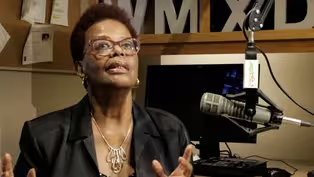
Video has Closed Captions
Clip: S49 Ep26 | 4m 50s | Gospel History | Episode 4926/Segment 1 (4m 50s)
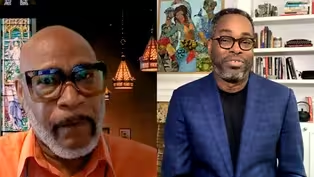
Video has Closed Captions
Clip: S49 Ep26 | 8m 23s | Hallelujah Singers | Episode 4926/Segment 3 (8m 23s)
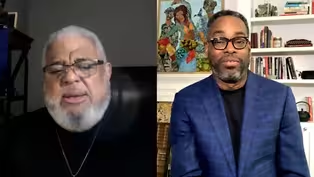
Video has Closed Captions
Clip: S49 Ep26 | 8m 33s | New Bethel Baptist Church | Episode 4926/Segment 2 (8m 33s)
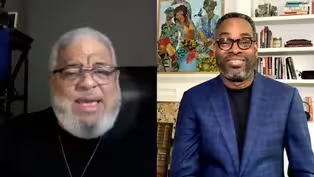
Rev. Robert Smith, Jr Full Interview
Clip: S49 Ep26 | 12m 46s | Rev. Robert Smith, Jr | Extended Segment (12m 46s)
Providing Support for PBS.org
Learn Moreabout PBS online sponsorship
- News and Public Affairs

Top journalists deliver compelling original analysis of the hour's headlines.

- News and Public Affairs

FRONTLINE is investigative journalism that questions, explains and changes our world.












Support for PBS provided by:
American Black Journal is a local public television program presented by Detroit PBS