
‘GOSPEL’ series, Carl Craig, 2024 Sphinx Competition winner
Season 52 Episode 6 | 26m 46sVideo has Closed Captions
A new PBS “GOSPEL” docuseries, techno producer Carl Craig and violinist Nathan Amaral.
Kick off Black History Month with a look at three music genres and their connection to the African American experience. “GOSPEL” producer/director Stacey Holman discusses the new PBS docuseries featuring Henry Louis Gates, Jr. Pioneering techno producer Carl Craig talks about techno’s African American roots in Detroit. Plus, a performance by 2024 Sphinx Competition Senior Division winner Nathan Am
Problems playing video? | Closed Captioning Feedback
Problems playing video? | Closed Captioning Feedback
American Black Journal is a local public television program presented by Detroit PBS
‘GOSPEL’ series, Carl Craig, 2024 Sphinx Competition winner
Season 52 Episode 6 | 26m 46sVideo has Closed Captions
Kick off Black History Month with a look at three music genres and their connection to the African American experience. “GOSPEL” producer/director Stacey Holman discusses the new PBS docuseries featuring Henry Louis Gates, Jr. Pioneering techno producer Carl Craig talks about techno’s African American roots in Detroit. Plus, a performance by 2024 Sphinx Competition Senior Division winner Nathan Am
Problems playing video? | Closed Captioning Feedback
How to Watch American Black Journal
American Black Journal is available to stream on pbs.org and the free PBS App, available on iPhone, Apple TV, Android TV, Android smartphones, Amazon Fire TV, Amazon Fire Tablet, Roku, Samsung Smart TV, and Vizio.
Providing Support for PBS.org
Learn Moreabout PBS online sponsorship- We got a great show ahead for you on "American Black Journal."
We are kicking off Black History Month with a salute to three music genres.
We're gonna preview the new PBS series on the history of gospel.
Plus, one of the pioneers of Techno is here to talk about its influence on African American music, and we'll end with a classic string performance from this year's Sphinx competition.
You don't wanna miss today's show.
"American Black Journal" starts right now.
- [Announcer] From Delta faucets to Behr paint, Masco Corporation is proud to deliver products that enhance the way consumers all over the world experience and enjoy their living spaces.
Masco, serving Michigan communities since 1929.
Support also provided by the Cynthia and Edsel Ford Fund for Journalism at Detroit Public TV.
- [Announcer] The DTE Foundation proudly supports 50 years of "American Black Journal" in covering African American history, culture, and politics.
The DTE Foundation and "American Black Journal," partners in presenting African-American perspectives about our communities and in our world, - [Announcer] Also brought to you by Nissan Foundation and viewers like you.
Thank you.
(upbeat music) - Hey, welcome to "American Black Journal."
I'm Stephen Henderson.
Noted historian and storyteller Henry Lewis Gates Jr. Has a new documentary series launching on PBS this month, and it's called "Gospel."
The series explores the rich history of Black spirituality through sermon and song.
"Gospel" can be seen right here on Detroit Public Television on Monday and Tuesday, February 12th and 13th at 9:00 PM.
Here's a preview followed by my conversation with the series producer and director, Stacey Holman.
(upbeat music) - The Black preaching tradition is deeply connected to gospel music.
Our singers preach and our preachers sing.
- God, we ask that you re-invigorate somebody.
- [Narrator] You feel it deep down in your soul.
It makes you wanna shout, it makes you wanna sing.
♪ Glorious ♪ - That's beautiful.
- Stacey Holman, it's always great to see you.
Thanks for joining us again here on "American Black Journal."
- Thank you for having me.
It's great to see you guys again and excited to be here, Stephen.
- So this is an exciting subject to talk about, and of course, the work that you've been involved in this PBS series on gospel I think is a look at something that I think of as absolutely foundational to all kinds of different parts of the Black experience, right?
We think often of gospel as relating to the Black church, which is of course where it comes from, but it powers so much else in our lives, and not just for African-Americans, this is an American foundational institution.
- That's right, Stephen.
The term gospel didn't start with Thomas A. Dorsey.
It actually goes way back with a white woman whose name completely escapes me right now.
But like anything, once it gets to the hands of Black people, we add a little hot sauce.
We add a little spice to it, and it becomes just this institution and the signature sound that we've come to know and recognize as gospel.
- So let's talk about the series.
What will viewers learn about gospel?
What do you hope they take away from this deep dive into the subject?
- Well, this is a continuation follow up to the Black church, as you said, and we've called it, our name for it was "Black Church: The Musical."
So we talked about the institution, but now it's about the sound.
We start in the great migration and we take it all the way to present day.
So for Thomas A. Dorsey to C.L.
Franklin, Aretha Franklin, the Clark sisters, Andrae Crouch, Kirk Franklin, and Chandler Mork and so on.
So they'll get a really clear understanding of just where the sound was formed, how it was formulated.
Like I said, hot sauce, cayenne pepper, whatever, you know.
So you have blues, you have jazz, you have just all these different flavors and textures.
But also too, you're gonna understand the sound of preaching in this series.
We didn't dive deep into that in the first series and really understand the sound and just really the style of preaching from hooping to reading from the scripture and you write from the text and just the different standards that people present, men and women present the word.
So it's gonna be really an exploration of the sound and really give people a better understanding and appreciation that this is a craft.
This is not something that the spirit moves.
The spirit does move, but you gotta work.
There's a lot of work that goes on behind the scenes.
- There's an awful lot of discipline I think.
And any sort of excellence like this that's not always apparent to the people who are listening.
I wanna talk about Detroit's role, of course, in this, and of course as a city that's home to one of the largest African-American populations in the country and historically has been so important.
Of course, we show up, we show up in this a lot, I feel like.
- I mean Detroit's foot, elbow, hand is all in it.
When we were doing the series, we were breaking it down in terms of parts of the country.
So in each hour, hour one is Chicago, hour two is really focused on Detroit, hour three is about LA, and hour four is about the South.
But like you said, Detroit is like also not only in two, it's in hour three, I mean, you have C.L.
Franklin, you have Aretha Franklin, you have the Clark sisters, Mattie Moss Clark, the sound.
It's definitely part of that Canaan when it comes to what the Black church is, the Black sound and the legacy of it, and just how instrumental all of these men and women were in creating.
Aretha brought the soul, C.L.
Franklin, not just only the craft of his preaching with hooping.
He also made an industry, I mean, his records, the Million Dollar Voice, every preacher we spoke to, 99.9 of them said that he was one of their favorite preachers, and a lot of them all wanted to hoop, but he's the master of it.
And even through the Clark sisters and Mattie Moss Clark, everybody really was instrumental in the foundation of it.
And Detroit, hats off to Detroit for that.
- Yeah, and at the same time, of course, gospel and its influence here in Detroit and its influence on our music also leads us to all this other music.
Motown, of course, is a really great touch point or touchstone for that.
But lots of other music as well comes out of and finds its roots in gospel.
And it's not just someone like Aretha who is using gospel as the foundation for pop music, right?
I mean, you can hear the church in so many of her songs.
It's also that the rhythm, the structure, the chord progression, and all those other kinds of things seep into other parts of the music of our nation.
And jazz and pop and soul and rock all have a lot of...
They have a lot to pay back to gospel.
- That's true.
I mean, Rosetta Tharpe is a perfect example.
We credit Chuck Berry, some folks credit Elvis Presley.
It was really Rosetta Tharpe that her guitar, that rhythm, that riff that she created, that she learned and she crafted while in the Church of God and Christ, that became rock and roll.
So it's completely, the church is a laboratory, it's the rehearsal space where you can perfect and you can hone this craft, and then you can put some of it in R&B, you can put some of it in hip hop, you can mix all of it together.
And I think that's one thing very unique about gospel is it can go across all the genres and still remain true to what the message is in many instances like Sam Cook, he's talking about, Jesus loves me, but you just switch it to baby loves me.
And you got yourself a gospel hit and you got a pop song.
So it caters to all genres.
- I also wonder if you can talk just a little about the future of gospel as it relates to the future of the church.
I mean, churches all over are having newfound challenges, making sure that new generations of Americans and especially Black Americans come up in the traditions.
What does that mean for something like gospel, which of course has gone so far beyond the church, but still finds its its initial power in the pews?
- And hour four really explores that, which is Shayla Harris' hour, who is raised in Detroit, the Michigan area.
And what we explore and really what she focused on is that there's this question of praise and worship, and there's this battle of where's gospel in the praise and worship.
You had the choir who would sing the song and the congregation to respond to it, but now you have the praise and worship team singing along with the congregation.
So I think there's this conversation or even this kind of struggle back and forth of where music is gonna be, and the where music lays in the church.
But if you look throughout history, that's always been a question from Thomas Dorsey, when he came, from Mahalia Jackson, things have shifted.
From Andrae Crouch, things shifted.
And even today with the praise and worship, things have shifted.
So I think it's just evolving, and I think everything kind of comes circle again.
- And the "Gospel" series kicks off with a special companion concert on Friday, February 9th at 10:00 PM, followed by the four hour documentary on February 12th and 13th.
Let's turn now to another form of music that has played a major role in the history of Black music.
Techno dominates the electronic music scene around the world today.
And it got its start right here in Detroit in the late 1970s and early 80s.
I sat down with one of the Techno pioneers, Grammy-nominated music producer and DJ Carl Craig to talk about the Black music experience both locally and globally.
Carl Craig, always great to see you.
Thanks for joining us on "American Black Journal."
- Thank you very much.
It's my honor.
- So I grew up here in the 70s and 80s, just like you did.
And I remember so poignantly when you and Derrick May and Kevin were making all of this new noise, right, is what my mom called it when she first heard it.
And I think even then, it was really obvious that you guys were changing music in a really fundamental way, changing the way we think about it, changing the way we move to it, changing the way it influences our lives.
And now in 2024, of course, it's this worldwide phenomenon, and it has done all of those things.
It has done all the things that I think were really obvious to us in basements here in Detroit back in the 80s.
So let's go back to that time and talk about where this comes from, and how you guys came up with the sound and the drive that is hip hop and rap and all of the things that come out of it.
- Yeah, Detroit Techno started with Juan Atkins and Rik Davis, Cybotron.
That was the beginning.
And by the time I came around, my cousin had done Technicolor with Juan, and I would play basketball in the backyard listening to Kevin and Derrick's music and listening to Jeff Mills on the radio as The Wizard.
So by the time I got in, it was already primed and well-oiled early baby machine.
So when I had the opportunity to meet Derrick, I thought he was big brother Almighty when I first met him and.
And went down to the music institute and partied down there with just this multicultural crowd of people that were coming down, people that I knew from when I went to Cass, people that I knew when I went to Cooley, people that I was meeting when I was going down to the shelter at St. Andrew's Hall, that club.
So I was seeing these amazing things that were happening on a multicultural level that was way different than anything that I had experienced before.
So I was happy, happy, happy to be a part of it, and I knew that it had to be my destiny.
- This is Black music.
And I wanna make that point partially because we're talking in Black History Month here, but also importantly because that gets lost sometimes in the discussion of these things, that this comes from a place that has this rich African-American history, and it draws on the history of Black music to create a new form of Black music.
And it's great that it is international and multicultural, and that's phenomenal the way that that's happened.
But talk about the importance of this being Black music.
- Man, it's crazy important.
Now we have a lot of influence that comes, of course, from Kraftwerk and-- - I remember that.
- 80s synth pop because we are using synthesizers and drum machines.
Someone that had said something that was real funny to me when they read an article of what Ike Turner's favorite record was, which was "Rumours" from Fleetwood Mac, it was like, what the heck is this?
And I think this is what people think about Detroit Techno is when we talk about Kraftwerk as an influence, then they get kind of confused and they want to just hijack the whole thing and say that we're only influenced by this white music.
But no, we were influenced by George Clinton, we were influenced by James Brown, we were influenced by Prince, we were influenced by Stevie Wonder and the electronic stuff that came out through Motown.
So we're heavily influenced from Black music and as Black artists that are from essentially the hood, we're making music that had as much roots to urban culture as rap music, gangster rap as any other form of, you know, we're celebrating Hip Hop 50, or celebrated Hip Hop 50.
And the thing about hip hop that has been able to be so strong over the years is because it really delved into its urban and many times its underworld culture in order to get people to be interested and stay interested in the story, like watching "Scarface" or watching any type of gangster movie.
But with Detroit Techno, we purposely didn't try to make it into some sort of gangster music because we're not gangsters.
So it's the other side, we're not nerds either.
But it's something that people would see more on a nerdy side, they would see us more like "The Big Bang Theory" maybe than they would see us as "In Living Color."
- Yeah, yeah.
And of course, the fact that it's music is important, but it fits in I think the narrative and the thread of Black creation here in Detroit, and as African-Americans, there are all kinds of things that we have come up with or perfected here that we go and then share with the world.
And I think that's an important association to make too.
This isn't just about music, this is about creation.
It is about intellectual creation.
- Yeah, definitely.
I mean, the story was written with Motown and with...
I can't remember her name.
I think her last name is Powell, the woman who was teaching all of the young Motown artists.
how to meet the Queen.
So we saw that, we might've balked at it, but we saw it because when Derrick and Juan and Kevin had that opportunity to go to London, there had to be some sort of background for them to go over and then be able to maintain this relationship that we've been able to enjoy for the last 35 years, when Derrick May made that first trip over on a one-way ticket that really got all this thing to be seen outside of Detroit, to be seen in Europe, especially outside of America.
There had to be that understanding of how to relate to these people.
And we're talking about a guy who ditched school in order to wait for the electrifying mojo to get off work in the middle of the night when he was 15 in order to give him the Cybotron tape, the Cybotron demo.
So this is not somebody who, or we aren't people who are the greatest scholars, we're people who...
I used to ditch school to play video games and go to LaGreen's's records down on Griswold.
- LaGreen's, oh my goodness.
- And here I am now.
- That's a great reference.
You have to be a certain age in this city to even remember LaGreen's.
- Yeah.
- Yeah, yeah.
So quickly, before we run out of time, what music inspires you right now?
What are you listening to?
What are you hearing that you're like, man, I love that?
- You know, in order to go to the future, I like going back to the past.
And I've been listening to a lot of Roger and Zapp, really.
I make these playlists, and whenever Zapp comes on or something that's got that big clap sound, that big George Clinton production clap sound, I get real, real interested.
But my contemporaries, guys like Jeff Mills is still making some great music, DeForrest Brown Jr who's a writer and musician from Alabama.
He'd make some really amazing stuff.
There's some great things.
So "All Black Digital," I'm doing again this year, which is my series from "All Black Vinyl" where I spotlight music From black artists for Black History month.
And I'll be playing a lot of things that I find and discover and that I know and that I didn't know.
So I hope everybody will keep an eye on that and tune in while we both educate ourselves.
- Yeah.
Finally today, the annual Sphinx Competition that celebrates Black and Latinx classical string players took place in Detroit recently.
Detroit Public Television is gonna broadcast the finals on Monday, February 19th at 9:00 PM.
We're gonna leave you now with a performance by the first place Senior Division Laureate Nathan Amaral from Brazil.
You can find out more about our guests at americanblackjournal.org.
And you can connect with us anytime on social media.
Enjoy and we'll see you next time.
(bright orchestral music) (bright orchestral music continues) (bright orchestral music continues) (bright orchestral music continues) (bright orchestral music continues) (bright orchestral music continues) - [Announcer] From Delta faucets to Behr paint, Masco Corporation is proud to deliver products that enhance the way consumers all over the world experience and enjoy their living spaces.
Masco, serving Michigan communities since 1929.
Support also provided by the Cynthia and Edsel Ford Fund for Journalism at Detroit Public TV.
- [Announcer] The DTE Foundation proudly supports 50 years of "American Black Journal" in covering African-American history, culture, and politics.
The DTE Foundation and "American Black Journal," partners in presenting African- American perspectives about our communities and in our world.
- [Announcer] Also brought to you by Nissan Foundation and viewers like you.
Thank you.
(gentle music)
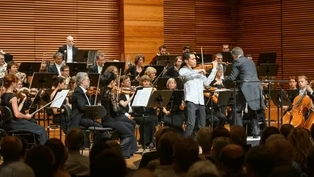
Nathan Amaral wins 2024 Sphinx Competition Senior Division
Video has Closed Captions
Clip: S52 Ep6 | 2m 48s | Watch violinist Nathan Amaral’s first-place performance at the 2024 Sphinx Competition. (2m 48s)
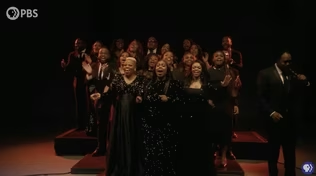
New Henry Louis Gates docuseries explores gospel’s history
Video has Closed Captions
Clip: S52 Ep6 | 10m 13s | “GOSPEL” Director Stacey Holman discusses Henry Louis Gates, Jr.’s latest PBS docuseries. (10m 13s)
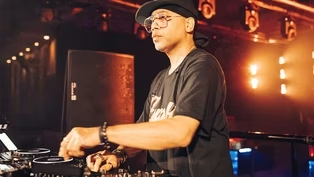
Tapping into Detroit’s techno roots with producer Carl Craig
Video has Closed Captions
Clip: S52 Ep6 | 2m 48s | Trailblazing Detroit=born techno producer Carl Craig on the Black music experience. (2m 48s)
Providing Support for PBS.org
Learn Moreabout PBS online sponsorship
- News and Public Affairs

Top journalists deliver compelling original analysis of the hour's headlines.

- News and Public Affairs

FRONTLINE is investigative journalism that questions, explains and changes our world.












Support for PBS provided by:
American Black Journal is a local public television program presented by Detroit PBS