
Gov. IL State of State and Budget Address
2/4/2022 | 26m 46sVideo has Closed Captions
Journalist discussion of Gov. J.B. Pritzker's State of State/Budget Address.
Hannah Meisel of NPR Illinois, Dave Dahl of WTAX and Peter Hancock of Capitol News Illinois discuss Gov. J.B. Pritzker's State of State/Budget Address.
Problems playing video? | Closed Captioning Feedback
Problems playing video? | Closed Captioning Feedback
CapitolView is a local public television program presented by WSIU
CapitolView is a production of WSIU Public Broadcasting.
Gov. IL State of State and Budget Address
2/4/2022 | 26m 46sVideo has Closed Captions
Hannah Meisel of NPR Illinois, Dave Dahl of WTAX and Peter Hancock of Capitol News Illinois discuss Gov. J.B. Pritzker's State of State/Budget Address.
Problems playing video? | Closed Captioning Feedback
How to Watch CapitolView
CapitolView is available to stream on pbs.org and the free PBS App, available on iPhone, Apple TV, Android TV, Android smartphones, Amazon Fire TV, Amazon Fire Tablet, Roku, Samsung Smart TV, and Vizio.
CapitolView
CapitolView is a weekly discussion of politics and government inside the Capitol, and around the state, with the Statehouse press corps. CapitolView is a production of WSIU Public Broadcasting.Providing Support for PBS.org
Learn Moreabout PBS online sponsorship(dramatic music) - Welcome to Capitol View, where we discuss the latest in state government and politics.
I'm Hannah Meisel with MPR Illinois.
Jining us this week are Dave Dahl with Springfield radio station WTAX.
Welcome, Dave.
- Hello.
- And also here is Peter Hancock of Capitol News Illinois.
Glad you're here, Peter.
- Thanks for having me, Hannah.
- Well, Governor J.
B. Pritzker gave the fourth budget address of his term in office, laying out a vision for more than 45 billion dollars in state spending.
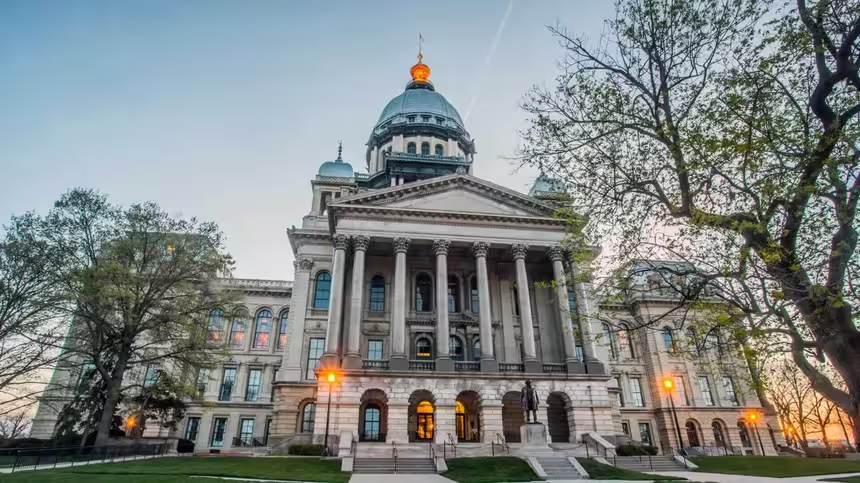
For the second year in a row, the governor was forced to give his speech from an alternative venue, this time the old state capitol in Springfield, due to a massive snowstorm that hit Illinois this week.
You know, it's kind of funny.
We know finally get our COVID numbers to a place where we could have had session, then a big stone storm hits.
And you know, after two years in a pandemic, I guess we're kind if used to the greater acts of God, but alas.
So Peter, let's talk about the top line highlights of this budget that the governor proposed.
He's pushing for increased state spending in certain areas in exchange for a moderate amount of tax relief.
- Yeah, that's right.
It's what, about a 44, 45 billion dollar general fund budget, which is actually not that much larger than the budget they passed last year.
It's even a little bit smaller than the total amount they currently expect to spend in the current fiscal year, but there are a lot of initiatives in there.
Some of them clearly election year initiatives because the governor's running for reelection, but you know, there's a lot more money for the healthcare workforce, included the required 350 million dollars in new spending on K12 education, so there were a lot of things in there like that.
But yeah, the tax relief measures includes suspending the 1% grocery tax for a year, suspending the scheduled increase in the gasoline tax, which would've been about 2.20 cents a gallon, and then property tax rebates for people who qualify for those.
So I think those are probably gonna be very popular, although some of them are controversial.
So we'll just see how much of it actually gets through the general assembly.
- Yeah, I mean, that's always the question.
But you know Dave, Democrats yesterday were fairly receptive to the budget.
Obviously it's someone of their own party.
Some progressives definitely took the time after the speech to say we need more.
We need to, for example, expand the state's earned income tax credit and also a powerful union and business groups, they're not on board with suspending what was supposed to be the automatic increase in the gas tax.
If folks remember that was chained to inflation in 2019 when lawmakers in hopes of building a big capital infrastructure program, doubled the gas tax, you know, increased it for the first time since 1990.
Which for the record, is longer than I've been alive.
So you know, what are the chances if this big powerful union operator Local 150 and business groups are against.
It didn't seem yesterday when I asked if the governor's office had any alternative plan B for that, that they had one.
- You know, politically, the governor is gonna have to work it out.
He's gonna have to work it out with the union and say hey, I almost said working people, that'd be one governor ago.
Working people don't want to spend that much on gas.
Inflation is a real hard hit these days and the people who are your constituents should just be happy that there's something for the working people to get behind, overall a highly positive tone for the speech.
I mean, the governor made Illinois sound great.
We all ought to wanna move there.
Well wait, we're already here.
Well nevertheless, you know, there's no need to hide the fact the governor is running for reelection.
A lot of it was political minded.
And as I said, where is Local 150 gonna go?
Not to the republicans, that's where.
- Yeah I mean, at one point during the speech, the governor said our food was more flavorful than other states.
And you know, I would probably agree, but also-- - Our beer is colder, our coffee is hotter.
The skies are bluer.
I mean, if I was gonna go there, I would've just gone on and continued that thread.
- It's very like (indistinct) But you know, Peter, one thing that the governor really wanted to hit, and he also used some more interesting terms of phrase.
At one point, spelunking from misery came up.
It took a little turn for the weird, but you know, he hit Republicans for always looking for the negative in Illinois' fiscal landscape, although you can't blame them.
We've had years and years and decades, frankly, of building up this narrative that Illinois' fiscal house is not in order.
And now he's claiming that it is, and that it's his administration that did it.
Obviously it's gonna be hard to change anyone's mind, Republican or not.
Your normal voter, it'd be hard to accept a new fiscal reality, but the governor is also trying to say it's not because of this federal COVID relief that did this.
It's because of what we did as Democrats.
How true is that?
- Well, I think there is a lot to it.
Illinois did receive a lot of federal aid during the pandemic, but that money was largely spent on pandemic related projects, including grants to help businesses get back on their feet, additional childcare money, those sorts of things.
And there was aid in early 2021 to replace some of the lost revenue that states had experienced during the initial height of the pandemic in the summer of 2020.
So you know, I think if you just look at money coming in from regular sources and money going out for regular spending, the budget has been pretty balanced.
This one that he proposed, it spends right about the same amount of money that the state is projecting to take in.
The credit rating agencies obviously have liked that.
They're now projecting that we're gonna end the current fiscal year with a 1.7 billion dollar surplus or ending balance as some people would call it, so that was good news.
And you know, the credit rating agencies have said the budget is looking better.
Although, you know, there are still huge pension liabilities lying out there.
You know, Illinois was in very bad financial shape for a lot of years and we're not gonna dig out of it in six months.
But you know, things are actually looking better on the balance sheet.
- Yeah, and speaking of Illinois' massive unfunded pension liability, the governor proposed spending more than what is legally required in that pension system.
You know, is that gonna help, Dave, to stabilize?
I mean, Illinois, obviously we've been on this pension ramp since the 1990s under former Governor Jim Edgar.
And we've gotten to a point where I think most people recognize it has not really lived up to the hype.
It's been painful for a while.
It could get more painful.
We've seen downturns in the market, which obviously affects how much of the pension funds are fully funded, but the governor wants to spend more.
Is that something that Republicans can get behind or is this what they call a gimmick?
- The latter.
I mean, it's almost like what they said about, and they may have said it even before.
You know, when Jesse Jackson was running for president and they could walk on water and they'll say he can't swim.
It's never gonna be enough.
It's a good start.
You know, maybe it's a good idea, but you know, it's never gonna be enough.
It's more billions than any of us can count.
So I think almost anything is gonna be seen by the Republicans as a gimmick.
Of course, they're in the super minority in the House and Senate.
We'll see if they're in the minority on election day 2022.
And it's time to either give Governor Pritzker another four years or give somebody else a chance.
- And also Dave, we were just talking about this Federal American Rescue Plan Act money.
Illinois got 8.1 million billion from that.
It's in state coffers, but we have several years to appropriate it and even longer to spend it, I believe until the end of 2025.
After this budget, the governor's office says we will have about three and a half billion left over from those ARPA funds, but it's not like it's free time with that money.
We still have this massive problem of our unemployment trust fund, which is about 5 billion dollars.
- Yeah, it wasn't-- - Sorry Dave?
- Didn't hear a lot about that on Wednesday, did we?
- No, not in the governor's speech, but in the budget briefing that reporters received before that, you know, the governor's office, enough people asked that finally the governor's people saw that like, we should actually weigh in and they said we have one, entered into negotiations with business and labor on this issue.
But two, they have committed to spending a certain significant portion of that 3.5 billion dollars to shore up the unemployment trust fund.
But you know, is that gonna be enough?
Because at the end of the day, they want to spend less than that 3.5 billion dollars.
The trust fund is more than that in the red.
And also, shoring it up would mean either cutting unemployment benefits or hiking taxes on businesses, right Dave?
- Well, and anything involving the ARP is gonna be hammered away.
It's already hammered into me, one time funds.
And it's not (indistinct) and the unemployment thing there remains a problem.
And by the way, that might give someone another chance to hammer on the IDES.
We haven't heard about them and their problems in a while, but you know, the unemployment problem, while there are fewer people applying for unemployment, it's far from going away and it's gotta be a concern for them no matter how much they won't talk about it.
- That's a good point.
Peter, let's talk about where the budget would spend more.
You know, we've obviously seen in the past few years, the governor has proposed spending more money on the state's child welfare agency, DCFS, which has been beleaguered truly for decades.
You know, he's also proposing to spend more on public safety violence prevention as we have seen Republicans coalesce around this message of Democrats, especially Governor J.
B. Pritzker are quote unquote weak on violence.
You know, what else are we seeing here that the governor wants to spend more money on?
- Well, there's one area that I think is really interesting that hasn't gotten a lot of attention yet, and that is the healthcare workforce.
There are a number of things in there to try and get more nurses, more healthcare workers out into the field.
That workforce was really hammered during the pandemic because you'll remember there were periods of time when hospitals were not performing elective surgery because they had so many COVID patients.
Well, all those people like anesthetists and operating room personnel and ICU personnel, surgical recovery personnel, a lot of them lost their jobs or had to move somewhere else.
And so he's putting up forth a couple of efforts.
One is putting more money in scholarships.
One is sending more money to hospitals and clinics to raise wages and paid bonuses.
There's all also a thing in there, and this gets really kind of technical.
They want to completely revamp the way Medicaid reimburses nursing homes.
And there's about 500 million dollars in there to change the nursing home reimbursement rate structure.
And a lot of that is geared toward increasing staffing at nursing homes.
Illinois has a pretty bad track record in terms of nursing home staffing, so he wants to get more certified nursing assistants and other kinds of healthcare workers into nursing homes, and doing that by changing the rate structure so that they are incentivized to increase their staffing.
That is actually gonna be very controversial.
And I think Hannah, you may have written about this.
There is one association of mainly for-profit nursing homes that is dead set against this.
They've introduced their own competing bill and that bill has a lot of very influential sponsors with it, so we'll see where that goes.
But I think this is really one of the hallmarks of this budget is trying to rebuild the healthcare workforce in Illinois.
- Yeah I mean, that shouldn't be underestimated.
Like you said, I think we forget about those first few months of the pandemic where yeah, I know several people in healthcare who either were put on furlough or lost their jobs completely, or you know, just in the case of a certain surgeon friend, didn't go to work for weeks because there just wasn't, no one knew what was going on and you know, it wasn't to the point yet of where hospitals could repurpose folks.
And you know, we have seen, when you look at the governor, when you look at the state's COVID data, you see a consistent reduction in the number of staffed ICU beds that are available, no matter where we are in the surges.
You know, we're now coming off of our fifth surge, but the number of ICU beds that are available, which depends on staffing, has consistently been on the decline.
And that means that we've had to call in folks.
We've had to call on the army and national guard and use the state staffing contract for travel nurses.
And it's been very, very tough, but you know, Dave, also the proposed budget wants to spend more on this evidence based funding formula.
If folks remember in 2017, the state kind of overhauled how it would fund schools after decades of, maybe decades is quite charitable, but you know, many years of Illinois being at the almost dead last on how much the state is spending on students actually in the classroom.
So would this be enough to catch up on what is truly needed?
Cos I know that we've seen warning signs in the past couple of years that Illinois' EBF formula isn't maybe quite living up to its promises.
- Yeah, I thought we were gonna quit hearing about it after it passed, but now almost annually it's well, are we gonna get there or should we think about not doing it or oh, it's big accomplishment that we did it.
I think it's kind of a shame that after all we heard about how the formula was going to change that it does bear mentioning that yeah, we were supposed to do, yay.
I think that it's gotta be a problem for these guys too.
- Yeah and Peter, I mean, is this also a political liability for the governor?
I mean, if we remember, Republicans in the past couple years have hit him on the idea, I think both in the campaign and up till last year where the governor has wanted to eliminate this private school tax credit, I think it's only a 75 million dollar program, so pretty small potatoes.
In fact, I think he proposed again making it much smaller in last year's budget when things were not looking good.
- Yeah, these tax credits.
I mean the governor has a point.
It's a backdoor way of using public money to fund private religious schools.
And the governor I think is just kind of philosophically opposed to that.
And if you could stop...
It's like a tax expenditure essentially.
You're forgoing tax revenue in exchange for people giving money to private and religious schools.
And I think he believes that if you took that money back, there would be more money for public schools.
But the fact of the matter is, one of the taxes that people complain about most is property taxes.
Property taxes in Illinois are very high and you're never going to fix that unless you fix the way schools are funded because about two thirds of your property tax bills goes to your local school district.
So unless they're willing to tackle that and come up with some more fair and equitable way of funding schools with more uniform per pupil spending and more state participation rather than relying on local property taxes, you're never gonna get that kind of tax reform.
- Yeah, you know-- - It just that seems like that gimmick you mentioned, the public money for private school vouchers.
It was a gimmick put on by the last governor and now this group can't undo it.
And you know, I agree with both of you about that.
- I guess what-- - [Peter] Tax breaks are very difficult to kill.
- Very true, and you know, also...
If a private school is working for a child, is working for a family, it's really hard to take that away once that kid is in the pipeline, going to that school.
So that's difficult too.
I guess more my point was like, republicans who obviously really like that program and maybe are more likely to use that, I really don't know the data on that, they could conflate the two and hammer away at the governor defending schools or whatever.
But I think it's a larger conversation about school funding.
It kind of gets to what we saw in 2020 when the governor's proposal on the graduated income tax failed.
Now, in the 1990s when Dawn Clark Netsch ran for governor against Jim Edgar, she had proposed this tax swap where instead of spending so much on property taxes, you would maybe spend more in your income tax, but then the state kind of redistributes that money in a more fair and equitable way.
Obviously that's hard when you have not a lot of trust in state government and you know, I think that was put to the test in 2020 and we saw that flame out pretty badly.
Dave, you know, the governor still does believe that the graduated income tax is something that should be pursued.
It's still his philosophical belief and still the belief of a lot of his allies for sure.
But if this budget is so good, the question does have to be asked, was that graduated income tax necessary, or is it still?
I the eyes of the governor, how does he justify it?
- You know, I think the governor wishes he still had it, whether he'll tell you that in those words or not, and he might not, who knows.
You know the Republicans are gonna certainly use it against him.
They still think that the Democrats would not hold to a promise that it would be some way to just outright jack up the rates on everybody.
And that the tears of it would would bleed down to that almost everyone is a quote unquote rich person and able to pay the higher tier.
So you know, most of me thinks that we may as well just stop talking about it, it's not gonna happen.
They're not gonna take another run at it because it's a kryptonite, it's the third rail, it's everything bad.
You know, the governor drew away a bloody stump, nobody wants it.
At least that's how it's gonna be portrayed, whether it's truly a good thing or not.
So on the one hand, we're not gonna stop hearing about it.
On the other hand, we ought to just stop talking about it because I think the governor got a clear message that it's not gonna fly.
And I think also it's a failure of the governor's messaging, the anti forces on that got way out in front.
And I thought well, you know, any day now we're gonna hear the governor's side of it.
And we really never did and so it was just a bad thing.
That's all we heard about.
And you know, it went down in flames.
- Yeah, I mean, speaking of the governor's messaging, he's been up on TV for a couple weeks now with ads that tout his fiscal responsibility and putting Illinois' fiscal house back in order.
At the same time, like we talked about earlier in the show, Peter, the governor is trying to send a message with these about a billion dollars in tax breaks.
Although you know, when it breaks down to the individual level, is it really that much to get $1 less on your hundred dollars grocery bill?
I don't know.
But do you think that one, voters care about Illinois' fiscal house or being back in order again It's hard to defeat a decades old narrative and two, I mean, are these tax relief measures gonna be enough for people to, you know, I doubt that people are gonna change their minds on Governor Pritzker, but maybe motivate more Democrats out to the polls?
- Yeah, they are largely cosmetic.
The grocery tax doesn't amount to a whole lot.
Although the part of the plan is that money goes to fund local governments, cities and counties and townships.
And so the state is planning to reimburse them for the money that they would lose, which is a few hundred million dollars.
The motor fuel tax, you know, people are paying very high gas taxes right now.
So suspending that automatic increase, I don't know that people are gonna notice it.
Their prices are still going up, they just won't be going up as much.
And the property tax rebate though I think is interesting.
You can already get an income tax credit equal to 5% of your property taxes so with this on top of that, you'll also be getting a rebate check equal to another 5%.
So essentially the state is going to be paying 10% of your property taxes for one year.
I think people will, you know, that will be somewhat noticeable, but you know, it it's an election year.
And being able to say hey, I gave you some tax relief here to cushion the blow of inflation, I mean, nobody is gonna really complain about that except maybe Local 150 and the asphalt companies.
- Well, it definitely is an election year and we will see where this all goes.
I'd like to think my guests Peter Hancock and Dave Dahl.
I'm Hannah Meisel and we'll catch you again next week on Capitol View.
(dramatic music)

- News and Public Affairs

Top journalists deliver compelling original analysis of the hour's headlines.

- News and Public Affairs

FRONTLINE is investigative journalism that questions, explains and changes our world.












Support for PBS provided by:
CapitolView is a local public television program presented by WSIU
CapitolView is a production of WSIU Public Broadcasting.