
Governor Lourdes A. Leon Guerrero
Season 2025 Episode 2 | 26m 47sVideo has Closed Captions
Lourdes “Lou” Leon Guerrero recounts her days as a nurse to creating legislation as a Guam senator.
Before the world knew her as Guam's first female governor, Lourdes “Lou” Leon Guerrero served the island of Guam in many ways, from her days helping the sick as a nurse at Guam Memorial Hospital to creating legislation as a Guam senator to leading the Bank of Guam to expand its reach as President.
Problems playing video? | Closed Captioning Feedback
Problems playing video? | Closed Captioning Feedback
SAINA is a local public television program presented by PBS GUAM
This program has been made possible by the Government of Guam Education Stabilization Fund.
Governor Lourdes A. Leon Guerrero
Season 2025 Episode 2 | 26m 47sVideo has Closed Captions
Before the world knew her as Guam's first female governor, Lourdes “Lou” Leon Guerrero served the island of Guam in many ways, from her days helping the sick as a nurse at Guam Memorial Hospital to creating legislation as a Guam senator to leading the Bank of Guam to expand its reach as President.
Problems playing video? | Closed Captioning Feedback
Where to Watch SAINA
SAINA is available to stream on pbs.org and the PBS app.
Providing Support for PBS.org
Learn Moreabout PBS online sponsorshipI learned work ethic from my mom.
When I was growing up, she would tell me, to go wash the dishes and she would check those dishes after I washed them.
And if it was not clean, she would have me do it over again.
You know, it may sound lik "Hey, this is pretty trivial."
But what I learned there is do your chores right the first time.
Because if you don't, you're going to have to do it again and it's just wasting time.
And even to this day, I always say "If we do things right the first time around, we would get rid of waste and inefficiency.
And I learned a lot from washing those dishes with my mom.
My mom is your typical CHamoru matriarch.
My dad would go out and work realy hard and at the end of the day, he would hand over his paycheck to my mom.
And my mom ran the house.
My mom did the groceries.
My mom took us to school.
And so she was a very supportive loving wife and mother.
She was also your typical women have their place in the home.
And I remember being very upset because I would always be the one that I would have to clean the house on Saturday.
And I would have to do my chores before I could even go outside and play.
I would have to dust all the furniture and polish.
And then with Johnson's wax.
And then I would have to sweep the floor, mop the floors, get down on my knees and do the Johnson's wax on the floor.
And then take the squeegee, where it's like a coconut husk.
I had to get on that husk with one foot and go back and forth, back and forth til the whole living room was polished.
And then I put the furniture back in their place.
And I would feel good that I did my job and I was so proud of my job.
But my brothers would be outside playing and they would come into the house and they would track mud on my freshly, buffered, squeegee'd floor.
And my parents wouldn't do anything about it.
It's like, "Wow, that's not right."
Why do I have to do all of this?
And so I think that's where I came to learn about equality and gender equality, And so if you follow my life, I've always been very much into fairness and equity for everybody.
And also, the way they disciplined us.
We were hardly ever spanked, but we were disciplined.
To the point where all my dad had to do was look at us and we would like sit still.
Because their way of disciplining was love and their way of disciplining was talking to us and making us understand why our behavior was not what it should be.
We're very loving to our children.
And- we need to strengthen that again especially in these challenging times where kids need love and direction and attention.
My dad was a self-made man.
He grew up in a house of five kids.
He was the oldest.
And my dad was always very attentive to education.
It was very important to him.
He had wanted to go off island to learn and be educated and actually wanted to be a doctor or a lawyer.
But he did not have the financial means.
Of course, our culture is that the oldest person takes care o their parents and their family.
And so my dad stayed home and his other four siblings went off island and got their degrees and came back.
I remember when I was little and he would have to make a speech in front of people.
He would go into the bathroo and stand in front of the mirror and do the speech, or he would sit us on the bed and we would be his audience and we would tell him, "Dad, you need to smile more.
Dad, you're frowning.
You need to be a little bit calmer."
Just things like that.
And because he never really went for formal education, he wanted to make sure his children were educated and he did everything he could to make that happen.
And he realized that English is is the language that we should learn more.
We grew up speaking CHamoru.
My grandmother my grandfather.
It was CHamoru.
And so he made this rule.
I remember we were in grade school and the rule was every Sunday we could not speak CHamoru.
We would speak English to each other.
And I'll tell you that was the only time that it was quiet in our house, because we felt very awkwar speaking English to each other, because we always spoke CHamoru.
For me it was awkward to say, "Can you please pass the butter?"
Instead of saying "Can you please pass the butter?
I just got up and got the butter.
It was very awkward, but my dad made that rule.
But then he realized that it wasn't working.
We weren't speaking English.
We were hardly speaking to each other.
So he sort of gave up and he just said, "Okay, we can learn it more in school."
My dad was a very visionary, very smart man.
And his love for family, his love for the island and his love for the culture was very significant for him Right after the war, there wa the Bank of Guam from the Navy.
When the civilian took over government.
Of course, Bank of America came.
And my dad worked for Bank of America.
And my dad was always helping our people to get their loans.
But Bank of America was more a multi million financial institution.
It was much more favorable to commercial loans and not so much consumer loans.
And people would always actually come to our house and want to speak to my dad and my dad- He had these deep sense of helping our people.
He says to me, "Whatever you do, you need to make sure you give back to the community."
That's one of our values.
He always tells me that.
And so he would take risks on these loans for people that wanted to borrow money to send their kids off to school or people that want t borrow money for their wedding or for christening or for their funerals.
And these were the loans that Bank of America didn't really care about.
And this is the driving forc that made my dad quit a good job risked all his wealth and all his life experience to go and stand up the Bank of Guam.
And in the beginning, people were criticizing him and they were saying, "Oh, it's never going to happen.
It won't work."
But, you know, his commitment and his passio to help the working class people to help our small businesses and that's his legacy.
That's the legacy of the Bank of Guam.
I think my journey in politics has always been since I was growing up.
I remember my dad would bring me to the legislature because he had friends there.
And he would take me to the legislature and he would have me sit in the gallery.
And I would sit there and listen to the senators debate issues in CHamoru.
I used to go to meetings.
Democratic Party meetings during campaigns and I loved listenin to the people speaking CHamoru.
During the campaigns, we'd go to Inarajan, we'd go to Malesso, we'd go to Hågat.
And so moving on to college, I was also very involved in politics in college, was very involved in civil rights movement.
I was very involved in women's rights.
I was very involved in pro-choice situations, events and rallies and so forth.
And read a lot about fairness, equity and so forth.
So it wasn't an overnight thing that I stepped into politics.
I was involved in health care politics primarily.
In fact, I was always going around talking about health care for people, not for profit.
I worked with the Los Angeles Health Organizing Committee On the rights of, people to have accessible, affordable health care.
So coming back, I had that in me.
I was- part of my experience.
and it was actually former speaker, Ben Pangelinan, who I had a great friendship with.
And throughout our friendship, he was always saying to me, "Lou, I think you should be a senator."
And I would say "No one would vote for me.
People don't know me.
Why would I be a senator?"
And he would keep asking me.
And so one day he just went to the election commission and picked up a packet.
And it was all over in the news.
"Lou Leon Guerrero, the daughter of President Jesus Leon Guerrero of Bank of Guam just picked up a packe and she's running for senator."
And my husband comes home and he says, "Are you running for senator?"
And I said, "No."
And he goes, "Well, it's all over in the news that you're running for senator."
And I said, "No, I didn't pick up a packet."
Then I picked the phone up and asked Ben and he picked up the packet for me.
And it was sort of like, "Okay, well now it's in public."
And I sat down with my husband and I said "What do you think we should do?"
And he said, "I think you should run."
So I ran.
And it was during the whol pro-choice controversy and stuff and the bishop was out there talking about here, the people you shouldn't vote for.
My name was on there and so forth and so on.
But we campaigned hard.
And actually I came in number 7 out of 21 That was the most humbling experience.
21,000 people voted for me and I held 21,000 trust in my heart to do the best as a senator.
And to me that was a very honorable thing, that 21,000 believed in me and believed that I could help them improve the quality of life of our people.
And so I became senato and I was senator for 10 years.
When I came back with my family in 1980 and ten years later, there was this bill that banned abortion on Island.
And I have always been a very pro-choice for women's rights for women's health.
In my education, in college and not just that, but working to make sure that there is equality among all of us.
And I was going to speak in a rally and my dad called me up and my dad said.
Baby, hu tungo' ha' na gósfitma hao ni este na kosa.
Lao, håfa i bidå-mu yan håfa un nasiguru na un respetu i taotao and he basically said to me, "Whatever you say, don't say derogatory comments against the archbishop, against the leaders of the Catholic Church, against the leaders of Guam.
And that was a very strong opinion that he bestowed on me and that stayed in my mind.
And as you can see, my method of governing has never been negative.
My method of governing has alway been what can we do to help each other?
Throughout my campaigns and throughout my life, I've always respected people.
Even if I did not agree with them.
And that's the kind of values I think we as CHamoru people have, right?
Respetu.
Respect for each other.
I remember my dad would be so upset at say, a senator, but he never degraded a person.
He never disrespected people.
He was always saying to me, "Put yourself in the shoe of that other person and treat them the wa you would want to be treated."
And that's the value that I always say to my kids.
"Whenever there's an argument or a controversy, you need to sit back and think about where that person is coming from."
And I think that has really helped me in my successes.
But to this very day, I would think, "How do I think my dad would have dealt with this?"
And I would always come back to respect, dignity, honoring other people's ideas even though it may be contrary to yours.
So, yeah, my dad playe a real big influence in my life and those influence I have sent and transmitted over and transformed over to my children.
How I decided to become a nurse was when my brother Tony, who's the youngest, had a tonsillectomy a the Old Guam Memorial Hospital.
And I was there visiting him and he was in a lot of pain.
And the nurses would be right there and they would give him ice cream and be with him, make him laugh and make him feel good.
I thought, "Wow, I want to be that person."
And that was when I decided I wanted to be a nurse.
And I think at that time I was maybe 11 or 12 years old.
So I always wanted t do something in the health care because I felt that helping the sick is the mos rewarding thing a person can do in their lives.
As governor, the hardest part for me was seeing our people die from Covid.
I wish we didn't have to see 400 and some people's lives die from this pandemic, but that's what happened.
The hardest part as being governor was when I had to call the father of a 11 year old kid that died from Covid.
And he was crying to me and I felt like- To this day I still think about it.
It was the hardest thing for me to say, "I'm sorry I couldn't do any more for your boy."
And he said, "Governor you did everything you could."
And that's why, I don't really care what people said about my decisions during the pandemic, but deep down in my gut and deep down in my knowledge as a nurse and guided with science and data.
That what I did wa the right thing for our people.
And you've heard all the negative comments that were out there and Josh would say, "Governor, just shake it off.
Shake it off.
I'm supporting you.
We're going to work with you.
National Guard supported.
Everybody came to the table and supported our mission to save people's lives.
What got me through the whole difficulty is thinking people are depending on you.
And I look at my grandchildren I look at our family and friends and our people.
Our people were struggling.
There was stress.
There was anxiety.
And I just said to myself, "You cannot give up."
So I didn't read the paper.
I didn't listen to talk shows.
I never went on social media, because I knew these were where the negative comments were coming from.
And I just remained focused.
I think it was mor the inner strength of a mother, I think is what got me through.
The inner strength of how a mother becomes stronger when she protects her children I need to get our people safe.
And I knew as a nurse that we could beat this.
I read a lot about this COVID virus and it was a very scary virus.
I said to myself, "Take it a step at a time and make your priorities and address them one by one and make sure you fully address them and back it by science and data."
Every Tuesday at 2:00 the morning.
I would be in a conference call with the White House people, with experts like Dr.
Fauci, the general that gave out the vaccines, the secretary of Health and Human Services, CDC, all these experts were on a call with all of the governor of the states and territories, and they would guide us along and give us updates of what's happening.
I combined that science and data with the sensitivity and the strength of what a mother would do to protect her children.
I'll tell you nationwide, we're recognized as one of the best community that dealt with this pandemic and I have to say, it was our team.
It was the passion and the sensitivity of our people and our very structured, organized and methodical way of moving our people forward.
And I thank the people of Guam for that.
Lou Leon Guerrero is a person that just wants to sit back not talk to anybody.
And that's not an offense to my husband.
I love him.
But I just want to be in my own space and I sit back, turn on the TV and watch my favorite shows and just not think at all about anything that requires a lot of energy.
And that's my space.
And with my Diet Coke and sometimes Malibu Rum.
But I would take my blanket, put my feet up and just cuddle and watch my favorite shows that have been recorded.
I do- I walk every day, almost every day with my very good friend, Dr.
Best And I like to bake.
Jeff is really the cook.
He'll- his last name is Cook.
But he actually is the one that would cook more.
But I bake and I do it more during Christmas.
But I enjoy baking And just picking up the phone, talking to my daugther, asking how her day is and going over to visit my grandchildren and just be crazy with them, really crazy with them.
But I'm very happy that my children are successful and have their own family and lives now.
I'm a grandmother of eight kids.
Coming from two children.
I thought that's pretty prolific I think.
And so they are the ones that help support and stand me up in difficult times.
People always say, "Governor, what do you want for Christmas?"
I would say "World peace."
And my gift I think to the world would be that I was given the opportunit to rise up and lead our people.
That would be my gift.
And my gift would be to sa to our people that as a leader and as an official, we need to make sure we listen to our emotions, listen to our intelligence, and just say, "Hey, there isn't any problem that we can't solve."
any problem that we can't solve.
Once you understand the problem There will always be resolution.
Even if the resolution is you can't solve the problem.
That's a resolution.
So I guess I say to them, "Be calm, don't panic.
There will always be options and ways to resolve the struggles of life.
What brings me joy and peace now?
If I die tomorrow, I will feel okay.
Because I have raised my kids and I have taught them the values that were instilled in me by my parents and them by their parents and down the line.
And that those values are still very strong.
In my 72 years I have done good for our family and I have done good for our peole, and I have done good for our island.
That's the joy and peace in me.
Anggen ma faisen hu håfa para bei sangani hamyo put- put para en chegue pa i maolek-ta ilek-hu na i mås impottante para ta respeta i taotao-ta.
Yan para ta tungo ginen siha hafa taimanu para ta ayuda siha ya para ta fandanña ya para ta fan mås afamaolek sa eyugue mås i konfionsa yan i minetgot put i taotao-ta anggen mandanña Eyugue mås bei sangani hamyo put i familian-miyu i mangachong-miyu and todu gi che'chon-miyu maila ya ta chogue este put i minaolek i taotao-ta ya para ta na hatsa hulu mås i minaolek-ta para i famaguon-ta, ni famaguon-ñiha Si Yuos maåse.
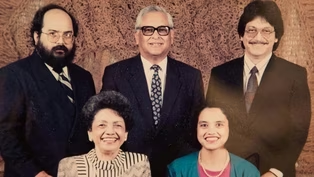
Video has Closed Captions
Preview: S2025 Ep2 | 43s | Lourdes shares an important value passed down from her father. (43s)
Providing Support for PBS.org
Learn Moreabout PBS online sponsorship












Support for PBS provided by:
SAINA is a local public television program presented by PBS GUAM
This program has been made possible by the Government of Guam Education Stabilization Fund.