State of the Arts
Grace Lynne Haynes, Artist
Clip: Season 42 Episode 4 | 6m 48sVideo has Closed Captions
We meet young art-star Grace Lynne Haynes
Artist Grace Lynne Haynes paintings of strong beautiful Black women appeared on several New Yorker covers while she was still a grad student at Rutgers University's Mason Gross School for the Arts. Her career has since exploded.
Problems playing video? | Closed Captioning Feedback
Problems playing video? | Closed Captioning Feedback
State of the Arts is a local public television program presented by NJ PBS
State of the Arts
Grace Lynne Haynes, Artist
Clip: Season 42 Episode 4 | 6m 48sVideo has Closed Captions
Artist Grace Lynne Haynes paintings of strong beautiful Black women appeared on several New Yorker covers while she was still a grad student at Rutgers University's Mason Gross School for the Arts. Her career has since exploded.
Problems playing video? | Closed Captioning Feedback
How to Watch State of the Arts
State of the Arts is available to stream on pbs.org and the free PBS App, available on iPhone, Apple TV, Android TV, Android smartphones, Amazon Fire TV, Amazon Fire Tablet, Roku, Samsung Smart TV, and Vizio.
Providing Support for PBS.org
Learn Moreabout PBS online sponsorshipHaynes: One of my favorite speeches is Sojourner Truth, "Ain't I a Woman?," where she talks about how Black women are not seen as not only human beings but we're not seen as women.
[ Music plays ] The example of womanhood is white womanhood.
And the farther you are from that, oftentimes the less worthy of protection you are seen or the less womanly you are perceived to be.
And so that's something that I always wanted to emphasize in my work -- that not only am I Black, but I am woman, and I have the right to put my womanhood first and prioritize my womanhood.
[ Music plays ] My name is Grace Lynne Haynes, and I am a visual artist.
I consider art to be a spiritual practice.
I remember when I wasn't making art, it was like my senses weren't alive.
It's like I felt Christmas again.
[ Music plays ] Over the past year, things have really started to blow up, and I've had tons of press and amazing art collaborations and opportunities and experiences.
[ Music plays ] But there's also a stress as a young and emerging artist to produce work constantly and to also feel like you don't have time to really explore your creativity.
A lot of times, the industry sees what you're doing, and they like it, and they want you to keep doing that because that's what they like.
[ Music plays ] Being in graduate school with already a certain amount of success, there's this battle that goes on where it's like I can technically just keep doing what I'm doing and be fine, or I can really challenge and push myself.
And I choose to challenge and push myself.
[ Music plays ] I'm really interested in ideas of color, specifically challenging ideas in which we historically have seen the color black as associated with negative connotations, especially in Western religion.
[ Music plays ] I wanted to show that dark is feminine.
Dark is sublime.
It's ethereal.
It's mystical.
And I want to surround it with colors.
Dark and light can coexist together in one image, and the dark can be the central point and represent the figure.
[ Music plays ] I consider the women in my paintings to be the spirits of Black women.
They aren't representational paintings.
They are spirits.
It's an energy.
Black women -- we are seen as strong.
We are seen as resilient, and we definitely are, because we have to deal with racism and sexism.
However, we are also soft.
We are also passionate.
We are also nurturing.
I believe the strong Black woman archetype has been around in the country for years now, since enslaved Africans were put on the continent.
The goal was to de-masculinize the men, which causes the woman to have to take on a more traditionally masculine role.
When you're always perceived as strong, you're not seen as deserving of protection, which leaves a lot of stress for Black women, who feel like we have to carry the world on our shoulders.
[ Music plays ] There's a universal theme that connects the women in terms of the skin tone, but each painting has a distinct woman.
And I use a different set of eyes collaged in from magazines on each of the paintings, and I don't replicate that.
[ Scissors cutting ] Now in 2021, I'm specifically focusing on young Black girls, and I'm also focusing on collectives of Black girls and activities that bring Black girls together, such as dance, because oftentimes, Black children are adult-ified or overly sexualized at a very young age.
And so I really want to address this adolescent stage in the Black experience and show that in my work and show that it's a stage that deserves to be protected.
It's a stage that is very much there.
[ Music plays ] In my work, I strive to use different materials, different fabrics, different publications, and construct my own figure that is distinct to my imagination.
[ Music plays ] I am honoring the tradition of African-American collage-making, because, historically, oil painting has been associated with Western art.
And on top of that, oil paint is also very expensive.
And so, in the past, a lot of African-American artists didn't use oil paint because of the price, because of the type of facility it takes to do oil paint.
And so they found innovation in using collage materials.
That is what Black creativity is.
It's being able to work and make amazing art from a lack, and it's also being able to make your own new genres without any strict linear rules.
And I believe that collage and gouache really allow me to play around in that form of creativity.
[ Music plays ] For me, art is almost my escape, and it's also my reality.
I believe that sometimes fantasy and reality can come together.
And sometimes you kind of have to go outside the realm of reality to show people what could possibly exist and how they can shape their identity in a new way that society hasn't shown them yet.
For me, it's such a privilege to be able to show other young women of color, little girls of color, what they can make out of their life.
Sometimes you have to see it to believe it, and that's the power of representation.
[ Music plays ]
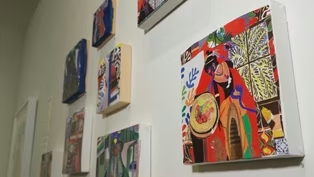
Janet Taylor Pickett: The Mattisse Series
Video has Closed Captions
Clip: S42 Ep4 | 6m 36s | Janet Picket Taylor is seen reflecting on her artistic conversation with Henri Mattisse (6m 36s)
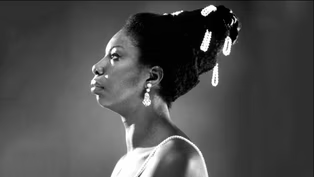
Little Girl Blue: The Nina Simone Musical
Video has Closed Captions
Clip: S42 Ep4 | 4m 43s | Little Girl Blue: The Nina Simone Musical (4m 43s)
Providing Support for PBS.org
Learn Moreabout PBS online sponsorship

- Arts and Music
The Best of the Joy of Painting with Bob Ross
A pop icon, Bob Ross offers soothing words of wisdom as he paints captivating landscapes.











Support for PBS provided by:
State of the Arts is a local public television program presented by NJ PBS