
Gray Machines
Clip: Season 1 Episode 187 | 6m 20sVideo has Closed Captions
Plans to introduce a bill that would make gray machines illegal in Kentucky
Republican State Representative Killian Timoney of Nicholasville plans to introduce a bill that would make gray machines illegal in Kentucky.
Problems playing video? | Closed Captioning Feedback
Problems playing video? | Closed Captioning Feedback
Kentucky Edition is a local public television program presented by KET
Gray Machines
Clip: Season 1 Episode 187 | 6m 20sVideo has Closed Captions
Republican State Representative Killian Timoney of Nicholasville plans to introduce a bill that would make gray machines illegal in Kentucky.
Problems playing video? | Closed Captioning Feedback
How to Watch Kentucky Edition
Kentucky Edition is available to stream on pbs.org and the free PBS App, available on iPhone, Apple TV, Android TV, Android smartphones, Amazon Fire TV, Amazon Fire Tablet, Roku, Samsung Smart TV, and Vizio.
Providing Support for PBS.org
Learn Moreabout PBS online sponsorshipIn recent weeks, we've told you about the controversy surrounding slot like gaming machines in Kentucky Republican State Representative Killian Timoney of Nicholas Ville.
Plans to introduce a bill that would make the machines illegal.
A similar measure failed to pass last year.
Today, I asked Representative Timoney about his new legislation.
I started our conversation by asking, why are they called gray machines?
These are very similar to slot machines.
They're a gambling device.
And you see them all over that.
You see them all over the bluegrass right now and convenience stores, gas stations, Chinese buffets, barber shops, gas stations.
But they are machines.
It's a gambling device.
And, you know, you put your money in and you hope to win more money than you put in.
So by definition, it is a gambling device.
But they're called gray machines because they do operate within a gray area of the law.
You know, people ask me, well, there are actually gray.
No, they're not gray.
But they do operate in that space.
The commonwealth has three legalized forms of gaming, and that's anything through the Charitable Gaming Commission, historical horse racing or horse racing in general and the lottery.
And anything outside of that is considered illegal.
These feel these machines do are they're being sold to mimic the historical horse racing slot machines and therefore people are are feeling comfortable with them and and want to keep them around.
But the element of gaming, the element of skill versus chance is the other part of the gray interpretation.
So they feel like that they are a skilled game.
Because of memory.
Right.
Because it's about.
That, the memory aspect of the game.
Yes, ma'am.
There there is a part of the game that it is a memory.
You if you follow the pattern around.
And I'm not going to make any assumptions as to what your memory skills are like, but minor, atrocious.
So I usually get to about the fourth repetition, and then it's just like, completely it's.
But that is how they get away with by saying that they're skilled because there is a memory skill part.
But people don't play that because it is incredibly challenging.
They play the slot machine part where it's your traditional what you'd see in any casino, the wheel spins and the different icons pop up.
And if they show up in a pattern, you can advance the pattern.
And that's also part of the skill.
But that doesn't happen every time.
So you can spin it 20 times and not get an opportunity to advance and employ skill.
So it is a very, very loose interpretation of the word skill, if you ask me.
So you have legislation that would eradicate gray machines throughout the Commonwealth.
And you have said before we started taping that there are possibly tens of thousands of these.
We had heard earlier numbers maybe 3500.
But that's a way underestimate.
So is there any talk about legalizing them and regulating them in any way, or should they just be eradicated from the state?
States that have them have casino commissions where people with badges and guns go and they check numbers and they have got the data to stay up on, on payouts and those types of things.
We don't have that in order for us to regulate them.
We would have to build a whole new branch of government, almost, or an agency in government and then staff it and then develop the rules to go along with it.
So it was a really, really daunting task in order to.
Get fiscal no done.
That was your fiscal not done on that kind of analysis?
No, ma'am.
I didn't go all the way that far.
It got to the point where I where we had a commissioner and we had agents and we had them regional and regional offices.
And that was enough, too.
Yes.
Why did you.
So I'm curious about where these tens of thousands of places that have these from barbershops to Chinese buffets to C stores, as we often hear, many of them mom and pop locally owned.
So we heard this argument last session.
I don't have to tell you that this is could be a big hit to those local economies and particularly those mom and pop store owners.
Your response to that?
Well, that's a really tough question because I'm a firm believer in supporting our small business owners.
You know, I truly believe that the the spirit of entrepreneurial ism is alive in Kentucky, and that's the cornerstone of capitalism.
And we need to be encouraging that and those types of things.
But at the same time, we also have asset values and we also have a set of rules that we operate if we're going to add something to the Commonwealth, something so vise driven that we have to be very cautious and we have to we have a framework that we have to run it through in order to make it work.
The three legalized forms of gaming in Kentucky ran that gantlet.
They ran the gantlet and they took they took a significant beating along the way and they continue to do so.
And this is one of the scenarios where this age, these groups, these these companies completely skirted that aspect.
Set up shop, got our small business owners during the pandemic where things were really, really tough, got them lucrative contracts, where they were generating good amounts of money and then said, okay, well, how can you remove this?
I think it's worth noting, you know, not all small business owners are going with these machines.
Some of them have are facing hard times and they're choosing to stick with their business model.
They do not want to become mini casinos on every street corner and they're being faced with this pressure.
Well, it's about foot traffic.
The profit margins in those businesses are so small, it's about it's about volume.
And if you're taking 15 or 20 or 50% of businesses, you're forcing that mom and pop that didn't want to go this route, you're forcing their hand.
And I understand economic Darwinism, but this is something that is not and I mentioned it in the Courier Journal article.
This this is not just a simple product.
We're not we're not doing something.
We're not selling something different.
This is a significant impact and it is a significant impact on values and communities.
And and we have to have that discussion on the forefront.
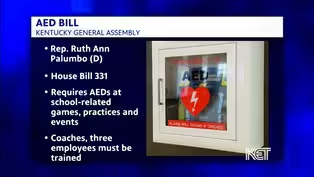
Video has Closed Captions
Clip: S1 Ep187 | 48s | A push to require defibrillators in every Kentucky middle and high school. (48s)
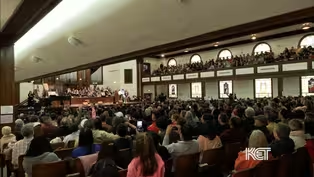
Video has Closed Captions
Clip: S1 Ep187 | 2m 55s | Thousands from near and far flock to Asbury for a student-led revival (2m 55s)
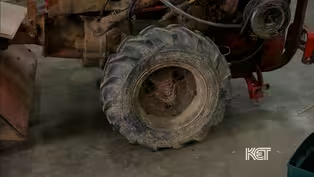
Video has Closed Captions
Clip: S1 Ep187 | 4m 29s | A new program to repair small farm equipment damaged in the Eastern Kentucky flooding. (4m 29s)
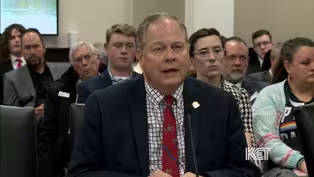
Video has Closed Captions
Clip: S1 Ep187 | 1m 29s | Senate Bill 107 would change the makeup of the Kentucky Board of Education (1m 29s)
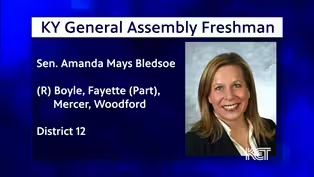
Sen. Amanda Mays Bledsoe (R) District 12
Video has Closed Captions
Clip: S1 Ep187 | 4m 5s | KY General Assembly Freshman: Sen. Amanda Mays Bledsoe (R) District 12. (4m 5s)
Providing Support for PBS.org
Learn Moreabout PBS online sponsorship
- News and Public Affairs

Top journalists deliver compelling original analysis of the hour's headlines.

- News and Public Affairs

FRONTLINE is investigative journalism that questions, explains and changes our world.












Support for PBS provided by:
Kentucky Edition is a local public television program presented by KET