
Great Performances at the Met: The Amazing Adventures of Kavalier & Clay
Season 53 Episode 10 | 2h 48m 8sVideo has Closed Captions
In this adaptation of Michael Chabon’s novel, two Jewish cousins invent an anti-fascist superhero.
In this new adaptation of Michael Chabon’s Pulitzer Prize–winning novel set shortly before the outbreak of World War II, two Jewish cousins invent an anti-fascist superhero and launch their own comic-book series, hoping to recruit America into the fight against Nazism.
Problems playing video? | Closed Captioning Feedback
Problems playing video? | Closed Captioning Feedback
Major series funding for GREAT PERFORMANCES is provided by The Joseph & Robert Cornell Memorial Foundation, the Anna-Maria and Stephen Kellen Arts Fund, the LuEsther T. Mertz Charitable Trust, Sue...
Great Performances at the Met: The Amazing Adventures of Kavalier & Clay
Season 53 Episode 10 | 2h 48m 8sVideo has Closed Captions
In this new adaptation of Michael Chabon’s Pulitzer Prize–winning novel set shortly before the outbreak of World War II, two Jewish cousins invent an anti-fascist superhero and launch their own comic-book series, hoping to recruit America into the fight against Nazism.
Problems playing video? | Closed Captioning Feedback
How to Watch Great Performances
Great Performances is available to stream on pbs.org and the free PBS App, available on iPhone, Apple TV, Android TV, Android smartphones, Amazon Fire TV, Amazon Fire Tablet, Roku, Samsung Smart TV, and Vizio.
Buy Now
Great Performances Newsletter
Subscribe to the Great Performances newsletter to keep up with the latest full episodes to stream, exclusive content, and more!Providing Support for PBS.org
Learn Moreabout PBS online sponsorship♪ ♪ ♪ ♪ ♪ ♪♪ Major funding for "Great Performances" is provided by... ...and by contributions to your PBS station from viewers like you.
Thank you.
-Hello, I'm Peter Gelb, the general manager of the Metropolitan Opera.
Thank you for joining us today for this special presentation of "The Amazing Adventures of Kavalier & Clay."
This new opera is based on Michael Chabon's Pulitzer Prize-winning novel about two cousins, Joe Kavalier, an artist refugee from Nazi-occupied Prague, and Sam Clay, a copywriter living in Brooklyn.
Together, they team up to create a hit new comic-book superhero, The Escapist, who fights fascism and frees the oppressed.
The story inspired composer Mason Bates and librettist Gene Scheer to write a sweeping opera that speaks directly to our troubled times.
Director Bartlett Sher's new production features set design and dazzling projections from the team at 59 Studios that moves us seamlessly from war-torn Europe to New York City in the 1940s to the realm of colorful comic books.
The opera showcases a winning young cast, including tenor Miles Mykkanen, baritones Andrzej Filonczyk and Edward Nelson, and mezzo-soprano Sun-Ly Pierce.
Music Director Yannick Nézet-Séguin presides over Mason's expansive score, which integrates electronic elements with the full forces of the Met Orchestra.
I hope you enjoy "The Amazing Adventures of Kavalier & Clay."
[ Applause ] [ Cheers and applause ] ♪ ♪ ♪ ♪ ♪ ♪ ♪ ♪ ♪ ♪ ♪ ♪ ♪ -♪ Don't promise ♪ ♪ ♪ ♪ ♪ ♪ ♪ ♪ ♪ ♪ ♪ ♪ ♪ ♪ ♪ ♪ ♪ ♪ ♪ ♪ ♪ ♪ ♪ ♪ ♪ ♪ ♪ [ Keys clacking rhythmically ] -♪ Empire, Empire ♪ -♪ Incorporated ♪ ♪ -♪ A coffin on a train with a corpse ♪ ♪ Yeah, yeah -- ♪ ♪ Dime by dime and dream by dream ♪ -♪ Dime by dime ♪ -♪ And dream by dream ♪ -♪ Month by month and year by year ♪ -♪ Month by month ♪ -♪ And year by year ♪ -♪ And on and on and on and on and on and on and on ♪ ♪ And on ♪ -♪ For my Empire ♪ -♪ Empire, Empire ♪ ♪ Empire Toys and Novelties Incorporated ♪ ♪ Empire, Empire ♪ -Come on, kid.
-♪ Toys and Novelties ♪ ♪ Toys and Novelties ♪ -♪ Forget us ♪ -♪ Ani ma'amin ♪ ♪ Ani ma'amin ♪ ♪ ♪ ♪ Ani ma'amin ♪ ♪ Ani ma'amin ♪ ♪ ♪ ♪ [ Chorus vocalizing ] ♪ ♪ [ Chorus vocalizing ] ♪ ♪ [ Chorus vocalizing ] ♪ ♪ [ Chorus vocalizing ] ♪ [ Chorus vocalizing ] ♪ ♪ ♪ ♪ ♪ ♪ ♪ ♪ ♪ ♪ [ Pow! ]
-Ohh!
[ Pow! ]
-Oof!
[ Thud! ]
-Ohh!
[ Clatter! ]
-Ahh!
[ Shatter! ]
-Ohh!
[ Pow! ]
-Ohh!
[ Thud! ]
-Ugh!
-Ahh!
[ Water splashes ] [ Chorus vocalizing ] ♪ [ Chorus vocalizing ] [ Cheers and applause ] ♪ -♪ Close your eyes ♪ ♪ But shall we not save those we can?
♪ ♪ [ Cheers and applause ] ♪ ♪ ♪ ♪ ♪ ♪ -[ Groaning ] -[ Screams ] ♪ ♪ ♪ [ Laughter ] -♪ Sam Clay ♪ -♪ Genius ♪ -♪ Toast of New York ♪ -♪ You got news ♪ ♪ ♪ ♪ -♪ An Albers ♪ ♪ A Hofmann ♪ ♪ Joe Kavalier ♪ ♪ The comic-book artist ♪ ♪ ♪ ♪ ♪ He knows he's mad ♪ ♪ Correct, correct ♪ ♪ What should he paint?
♪ ♪ The Ark of Miriam ♪ ♪ Perspective of a fish ♪ ♪ Correct, correct ♪ ♪ Becomes a fish ♪ ♪ Little eye aflame ♪ ♪ The wine-dark sea ♪ ♪ El ojito lo ve todo ♪ ♪ Correct, correct ♪ ♪ Joe Kavalier ♪ -No, no, no, no!
♪ -♪ Parnassus Pictures, The Escapist everywhere ♪ ♪ Big screen ♪ ♪ Big back end ♪ ♪ Big money ♪ ♪ Imagine ♪ ♪ ♪ ♪ ♪ ♪ -♪ The ship is getting closer ♪ ♪ ♪ ♪ [ Cheers and applause ] ♪ ♪ ♪ ♪ ♪ ♪ -[ Groaning ] ♪ ♪ ♪ ♪ ♪ ♪ ♪ -♪ Alone in the dark ♪ ♪ And light ♪ ♪ And light ♪ ♪ ♪ Alone in the dark ♪ ♪ ♪ [ Cheers and applause ] ♪ ♪ ♪ ♪ ♪ ♪ -♪ No, no ♪ ♪ ♪ ♪ ♪ -♪ An escape ♪ ♪ ♪ ♪ ♪ [ Crowd murmuring ] -♪ No ♪ ♪ No ♪ ♪ No ♪ -♪ Joe ♪ -♪ All gone ♪ ♪ [ Cheers and applause ] [ Instruments tuning ] [ Cheers and applause ] [ Cheers and applause ] ♪ ♪ ♪ ♪ ♪ -[ Groaning ] ♪ ♪ ♪ ♪ ♪ ♪ ♪ ♪ ♪ ♪ ♪ ♪ ♪ ♪ ♪ ♪ ♪ ♪ ♪ [ Chorus vocalizing ] ♪ ♪ -♪ Joe ♪ ♪ Joe ♪ ♪ ♪ ♪ ♪ ♪ ♪ ♪ ♪ -♪ Bum ba-da ♪ ♪ Bum-ba-da-da ♪ ♪ Bum ba-da ♪ ♪ Bum-ba-da-da ♪ ♪ Ba-dum, ba-dum ♪ [ All vocalizing ] -♪ Dick, Dick, Dick ♪ -♪ Dick Johnson ♪ -♪ Dick, Dick, Dick ♪ -♪ Dick Johnson ♪ ♪ Dick ♪ -♪ Dick, Dick, Dick, Dick ♪ ♪ Dick ♪ ♪ Dick, Dick Johnson ♪ ♪ [ Indistinct shouting ] -Get 'em, boys!
[ Indistinct shouting ] ♪ ♪ ♪ ♪ ♪ -[ Groans ] ♪ [ Groaning ] ♪ ♪ ♪ ♪ ♪ ♪ ♪ ♪ ♪ ♪ ♪ Is this really me?
♪ [ Cheers and applause ] ♪ ♪ ♪ ♪ ♪ ♪ ♪ ♪ ♪ ♪ ♪ ♪ ♪ ♪ ♪ ♪ ♪ ♪ ♪ ♪ -♪ Back and forth, up and down ♪ -♪ Back and forth ♪ -♪ Back and forth ♪ ♪ And up and down ♪ -♪ Over and over ♪ -♪ Over and over and over and over ♪ -♪ And back and forth ♪ ♪ And on and on ♪ ♪ And on and on ♪ [ Indistinct singing ] ♪ [ Screaming ] ♪ ♪ ♪ ♪ ♪ ♪ ♪ ♪ ♪ ♪ ♪ ♪ -[ Chuckles ] ♪ ♪ ♪ Joe ♪ [ Gunfire ] ♪ ♪ ♪ -♪ I have a child ♪ [ Gunshot ] -[ Groaning ] -Oh, no!
♪ ♪ ♪ ♪ ♪ ♪ ♪ ♪ ♪ ♪ ♪ ♪ ♪ ♪ ♪ ♪ ♪ ♪ ♪ -♪ Ani ma'amin ♪ [ Chorus vocalizing ] ♪ ♪ [ Chorus vocalizing ] ♪ ♪ ♪ ♪ ♪ [ Chorus vocalizing ] ♪ ♪ [ Chorus vocalizing ] ♪ ♪ [ Chorus vocalizing ] ♪ ♪ ♪ ♪ ♪ ♪ ♪ ♪ ♪ [ Cheers and applause ] [ Cheers and applause ] [ Cheers and applause ] [ Cheers and applause ] [ Cheers and applause ] [ Cheers and applause ] [ Cheers and applause ] [ Cheers and applause ] [ Cheers and applause ] [ Cheers and applause ] [ Cheers and applause ] [ Cheers and applause ] [ Cheers and applause ] [ Cheers and applause ] [ Cheers and applause ] [ Cheers and applause ] [ Cheers and applause ] [ Cheers and applause ] [ Cheers and applause ] [ Cheers and applause ] [ Cheers and applause ] [ Cheers and applause ] [ Cheers and applause ] [ Cheers and applause ] [ Cheers and applause ] -This opera has electronic sounds that build out the sound world to help conjure the three worlds.
And each world has its own very distinctive sound world.
We open in the world of Prague during the Nazi occupation, which sounds a little bit like this.
♪ So, that has this very dark, analog, synth sound world.
♪ ♪ So, those kind of sounds, on their own, sound really cool.
But the important thing is how they integrate with the orchestra.
So, important to note that when we're conjuring up this world of the Nazi occupation, there are also the sounds of Wagner tubas.
-♪ It's a new world ♪ -...conjuring the Nazis, if you can believe that.
-♪ With new rules ♪ -And, you know, when you're also bringing to life Prague during the occupation, I wanted to have this Eastern European kind of sound of plectrum strings.
We've also got a mandolin with the string orchestra.
♪ And it gives the Prague sound world a special kind of folk element.
♪ When Joe Kavalier arrives in New York, we enter a beautiful, rich, bling-bling world of New York in the '40s.
♪ So you'll hear a drum set.
You'll hear, you know, big, you know, kinda swing band sounds.
You'll hear saxophones... ♪ ...that are bringing to life, you know, the kind of rhythm and energy of New York in the 1940s.
♪ The last space is this kind of magical world of the superheroes and the comic books and the imagination.
And it is this Technicolor world of symphonic electronica, quicksilver beats, and electronica textures mixing with kind of heroic, orchestral fanfares and interludes that really take us inside the world of the imagination and of pulp art.
A place where a lot of things come together in the opera is this Escapist interlude, where we see Joe and Sam -- Kavalier and Clay -- building The Escapist.
-♪ Eluding capture with his skills ♪ ♪ Of deception and evasion ♪ -The Escapist is a superhero of the night who kind of comes outta nowhere and frees people from the bounds of fascism.
So, he's not exactly like a Superman.
He's got a little more edge.
He's sort of like "The Shadow."
And so I wanted to make sure his music had that edge of darkness, too.
-♪ The Escapist ♪ -So, the world of superheroes is kind of electroacoustic.
I call it symphonic electronica.
♪ We're gonna build this beat by beat.
Here's just the beat behind him.
[ Beat plays rhythmically ] So, we add a layer of synthesizer.
[ Synthesizer plays ] ♪ So, here's what the orchestra's doing if you kind of take away the electronica.
♪ So, if we add all that together, it sounds sort of like this.
♪ So, that beat is kind of a hip-hop beat.
You know, it's got that big backbeat element to it.
And in a big space like this, those really big beats have a cool sound.
♪ ♪ Always when you're having electronica with an orchestra, you have to remember it's about the orchestra.
The electronica is coming out of the orchestra like a giant, supernatural percussion instrument, but the orchestra itself has a world of sound, and so we have kind of heroic brass playing.
We've got these huge percussion hits.
Also, the strings are, you know, in this kind of quicksilver world, conjuring almost kind of flight and movement.
And of course the woodwinds usually are giving the sparkle on top of it.
♪ So, all that orchestration then integrates with the electronica, so we have that kind of symphonic electronica that I've been using in my non-operatic works.
♪ I've been integrating electronica into my symphonica works for like 20 years, and I really see it as an expansion of the percussion section, a kind of natural development, if you look at, like, the history of the orchestra.
Really, it came from the opera, you know, adding things like a thunder sheet or wind machine.
These are theatrical sounds that help with storytelling in addition to the rhythmic elements.
These are rhythms that can really kind of add a lot of visceral elements to a piece of music, if they're very carefully orchestrated, can really take the storytelling to a different level.
♪ And it's such a dream come true for me to bring this piece to life here at the Metropolitan Opera.
♪ -So, "The Amazing Adventures of Kavalier & Clay" tells a story of a young man who leaves war-torn Europe behind, immigrates to New York, and goes to Brooklyn to live with his cousin and becomes this amazing comic-book artist at a time when comic books were really kind of just coming to the fore.
The story is about his escape from war, but it's also a kind of voyage of discovery for him and for his cousin, who's also kind of discovering his own identity.
-How do you take this deep, powerful experience of the Holocaust -- how people process their trauma, how they sought ways for art to give people strength, to give them kind of a sense of control and power over things -- and lift it into the world of comic books?
-There are three distinct visual worlds that we needed to achieve with this design.
There's Old World Europe, which actually travels from Prague to battlefields to Auschwitz concentration camps.
There's the kind of realism of New York in the 1940s.
And then there's the comic-book world, which is obviously full of color, huge.
So a seamless collaboration between set and video and lighting was gonna be fundamental to get us through the very expansive list of places that the story goes to, but also get between them incredibly quickly.
-They also had to, in some instances, sit simultaneously on stage next to one another, but it also allows those worlds to overlap and for characters to move between them in quite kind of dynamic and cinematic ways.
♪ -The opera opens with Old World European scenes.
-The world of Prague and of the war is kind of this monochromatic, grainy world.
This is sort of stylistic representation, which it feels like it's full of danger and movement and risk and drama, but it's slightly removed from reality in some ways.
And we represent that through projection with quite sort of stark, high-contrast, graphical treatments.
It's quite noirish actually, kind of film noirish.
And it's shadowy and you're not quite sure what's happening and it also evokes a kind of sense of memory, as well.
-And then there's New York in the 1940s.
We've pushed into a much more realistic world, so we have a series of projection-mapped backgrounds, whether it's on scrims or sliding panels, and those worlds are reinforced with extremely naturalistic and quite detailed props that kind of ground us in that place.
-It's really kind of saturated color.
There's a lot of movement, dynamism, bright lights.
So, it's this kinda like real rich kind of photographic world in a way.
♪ And then the world of the comic book is, again, this kind of really colorful, exciting, kind of vibrant world, nodding to those old-fashioned printing techniques -- so, paper textures and sort of bleeding ink.
And that has a bit of nostalgia to it, but it's also kind of fantastical, as well.
We've tried to celebrate the full comic-book creation process in the projection design -- so, from the sketching to the inking to the coloring to the printing.
All of those parts of making a comic book are represented at some point or another.
-We took quite a lot of inspiration from the kind of mechanics of the way that cartoons and comics work -- so, framing and split screen and thinking about the way in which the stage can represent the comic-book page in some ways.
-So, the blend between what's physical, what's lighting, and what's projected imagery, the flexibility that that gives us to sort of open up a scene in a very comic book-like way or kind of slide across the next scene -- that really is where we start to lift some of those stories, bring them to life.
♪ -The other major thing, obviously, in all of this is Mason's music and Gene's libretto.
And, you know, the music gave us so much guidance.
It was probably the biggest inspiration in some ways as to what the tone and feel and kind of dynamic of the piece should be.
And I hope what we've done, really, is make visually manifest what the music is doing, you know?
And to kind of graft together visual ideas and musical ideas has been amazing, really.
-I personally felt a huge resonance with Joe and Sam and the ways that they think about the world and I think the really big questions that maybe the opera is asking about the meaning of making art.
-You can find great comfort from art.
You can provoke questions through art.
You can use art to draw attention to important issues.
There's no guarantee that history will be changed, but I think there is a pursuit of a better future that these characters represent.
The story of an immigrant coming to America and bringing together different cultures to create art that speaks to lots of people is a really powerful message.
-It continues to resonate with me in a world where we're struggling with who we are and struggling with how far will we go and what are the limits of power and how much can we express ourselves?
So I find the story coming around now at a deeply resonant time.
 New
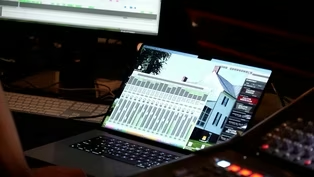
NewBringing Electronic Music to the Historic Met Opera
Video has Closed Captions
Clip: S53 Ep10 | 3m 35s | Mason Bates discusses how he creates the world of "The Escapist." (3m 35s)
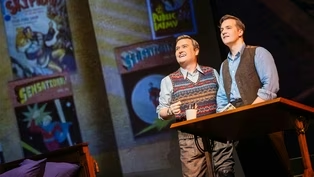
Creating The Escapist in the Kavalier & Clay Opera
Video has Closed Captions
Clip: S53 Ep10 | 1m 36s | Sam (Miles Mykkanen) and Joe (Andrzej Filończyk) create The Escapist. (1m 36s)
Providing Support for PBS.org
Learn Moreabout PBS online sponsorship

- Arts and Music
The Best of the Joy of Painting with Bob Ross
A pop icon, Bob Ross offers soothing words of wisdom as he paints captivating landscapes.











Support for PBS provided by:
Major series funding for GREAT PERFORMANCES is provided by The Joseph & Robert Cornell Memorial Foundation, the Anna-Maria and Stephen Kellen Arts Fund, the LuEsther T. Mertz Charitable Trust, Sue...