
Green Seeker: Lights Out
Clip: Season 4 Episode 19 | 7m 35sVideo has Closed Captions
A form of pollution is taking away our connection to the night sky.
A form of pollution that’s less talked about is taking away our connection to the night sky. Ninety-nine percent of Americans live with light pollution and are unable to view many of the stars and constellations seen by previous generations. In our Green Seeker series, we visited the Frosty Drew Observatory in Charlestown, where they are protecting its dark skies.
Problems playing video? | Closed Captioning Feedback
Problems playing video? | Closed Captioning Feedback
Rhode Island PBS Weekly is a local public television program presented by Ocean State Media
Green Seeker: Lights Out
Clip: Season 4 Episode 19 | 7m 35sVideo has Closed Captions
A form of pollution that’s less talked about is taking away our connection to the night sky. Ninety-nine percent of Americans live with light pollution and are unable to view many of the stars and constellations seen by previous generations. In our Green Seeker series, we visited the Frosty Drew Observatory in Charlestown, where they are protecting its dark skies.
Problems playing video? | Closed Captioning Feedback
How to Watch Rhode Island PBS Weekly
Rhode Island PBS Weekly is available to stream on pbs.org and the free PBS App, available on iPhone, Apple TV, Android TV, Android smartphones, Amazon Fire TV, Amazon Fire Tablet, Roku, Samsung Smart TV, and Vizio.
Providing Support for PBS.org
Learn Moreabout PBS online sponsorshippollution, I often think of Van Gogh, you know, his Starry Night is one of the most searched and sought after pieces of artwork.
It's incredible.
(gentle music) And I think, what would that painting look like if he had looked out and saw light pollution in France when it was, you know, inspiring him?
And all of those beautiful swirls that you see in the night sky that he created, they would've been just blobs of yellow fog.
If you wanna be inspired, like Van Gogh was inspired, where do you go in Rhode Island?
For me, I go to Charlestown.
(bright music) (waves crashing) The only place in Rhode Island that I've ever seen the Milky Way is in Charlestown.
My children went many years having never seen the Milky Way, and when they first saw it in Charlestown, when we were down at Frosty Drew, they were absolutely amazed.
- [Scott] Charlestown is this little like gem in Rhode Island.
- Hi, how are you guys tonight?
How many for?
- Once you leave the beach, the quest isn't over because now, when the sun sets, you have thousands of stars overhead that you're not gonna see pretty much anywhere else you're going.
(people chattering) (light music) - [Kimberly] Frosty Drew to me is it's like the little observatory that could Fort Island.
(light music) It gives you these fantastic views.
- [Scott] And the Milky Way is starting to become even more visible to us right now.
- It's a pretty powerful experience.
(light music continues) I think of light pollution as just too much light where it shouldn't be.
It's this idea that there is an extraordinary amount of light that is unnecessary that is directed into the wrong place, that's crowding up the sky where we cannot see the night sky any longer, we cannot see the stars that we've been able to see for generations.
There's a great deal of light pollution in Rhode Island because we're situated in the northeast, and the northeast is really densely populated.
So when you've got that dense population, what happens typically is that you've got a lot of buildings, a lot of structures, and those buildings and structures are lit up pretty heavily.
- If you went to a spot like Frosty Drew, then you can get outside of a lot of it and actually see a lot more stars.
But the majority of people living in Rhode Island, they don't see the Milky Way, they don't look up at that sky and see an inspirational view, they see light pollution.
(lively music) - I do think there's excess lights when you're walking around Providence at night, I would say there are areas to be able to fix that I think wouldn't cause a lot of problems to change.
Even things like the way say the State House is lit up at night, that could be done I think a little bit more subtly.
Making sure all of the street lights, the neighborhood lights, the city lights in general are well shielded, which means the light is being directed down.
Because when you have an unshielded light, there's a whole lot of excess light that just goes bounces right up to the sky.
It's not about removing lights, not completely, it's about lighting better, it's about lighting smarter.
And I feel like that's one thing I actually really appreciate about the topic of light pollution, I feel like it is imminently fixable.
- Of all the pollution issues that are out there, this is the one that the everyday person can really make a huge difference in with such a minimal effort.
When you come in at night, turn off your lights, just hit that switch.
(gentle music) - Charlestown's the darkest spot along the Atlantic coast between New York and Boston.
If you're flying into Rhode Island, you see the lights all around the region and then there's a dark spot along the coast, which is Charlestown.
In Charlestown, we passed a dark sky ordinance in 2012.
I think that people who've lived here for a while and experienced the dark sky are very much in favor of protecting it.
Frosty Drew Observatory is really important to protecting our dark skies because it's so easy to quantify what's being lost, and when we lose the dark sky, we will eventually lose the observatory, they won't be able to do their work because it'll be like every other place that has lost its sky.
- We'll have two telescopes set up in the courtyard too that you can go up to whenever you would like.
- Sweet, awesome, thank you.
- All right, you're welcome.
- I think people need to understand that view that exists down there.
We also have the Perseids still happening, which will radiate from the constellation, Perseus.
It requires everyone to work together to do that.
(gentle music) It's not just because it's Charlestown that it's dark, it's because everyone in Charlestown is working to keep it dark.
So the Big Dipper is these three stars make the handle and then the fourth one here makes the root of the bowl.
- Observatories, like Frosty Drew, can really provide that firsthand experience for Rhode Islanders of what absolute gems our universe has for us and how important it is to keep that link to the night sky.
Humans have been looking up at the night sky forever and we really don't know what it is we're losing when we cut off such an important part of our existence.
So having that direct access to the night sky from the ground, from here on earth, is a really important thing.
(gentle music continues)
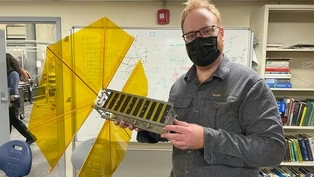
The Little Satellite That Could
Video has Closed Captions
Clip: S4 Ep19 | 8m 25s | How Brown students hitched a ride on SpaceX’s Falcon 9 rocket. (8m 25s)
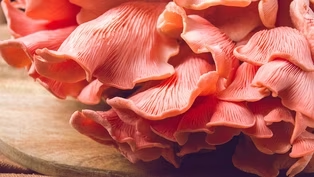
My Take: Mushrooms, Mushrooms Everywhere
Video has Closed Captions
Clip: S4 Ep19 | 5m 38s | Mushroom farmer tells you everything you need to know about edible fungi. (5m 38s)
Providing Support for PBS.org
Learn Moreabout PBS online sponsorship
- News and Public Affairs

Top journalists deliver compelling original analysis of the hour's headlines.

- News and Public Affairs

FRONTLINE is investigative journalism that questions, explains and changes our world.












Support for PBS provided by:
Rhode Island PBS Weekly is a local public television program presented by Ocean State Media