John McGivern’s Main Streets
Greendale, Wisconsin
Season 5 Episode 6 | 26m 48sVideo has Closed Captions
Greendale, Wisconsin was built to be a charming, walkable community. Still is!
Greendale, Wisconsin is a place that draws you in, whether you’re just visiting or putting down roots. Built as a planned suburb of Milwaukee by the WPA during the Great Depression, Greendale’s walkable streets and storybook charm feel like a Norman Rockwell painting brought to life. True to the city's slogan, “You just gotta see Greendale!”
Problems playing video? | Closed Captioning Feedback
Problems playing video? | Closed Captioning Feedback
John McGivern’s Main Streets is a local public television program presented by PBS Wisconsin
John McGivern’s Main Streets
Greendale, Wisconsin
Season 5 Episode 6 | 26m 48sVideo has Closed Captions
Greendale, Wisconsin is a place that draws you in, whether you’re just visiting or putting down roots. Built as a planned suburb of Milwaukee by the WPA during the Great Depression, Greendale’s walkable streets and storybook charm feel like a Norman Rockwell painting brought to life. True to the city's slogan, “You just gotta see Greendale!”
Problems playing video? | Closed Captioning Feedback
How to Watch John McGivern’s Main Streets
John McGivern’s Main Streets is available to stream on pbs.org and the free PBS App, available on iPhone, Apple TV, Android TV, Android smartphones, Amazon Fire TV, Amazon Fire Tablet, Roku, Samsung Smart TV, and Vizio.
Providing Support for PBS.org
Learn Moreabout PBS online sponsorship- John McGivern: This small village in Wisconsin has been designated as a National Historic Landmark.
- Announcer: Thanks to our underwriters.
- My father taught me that to make great bakery, you have to do it the right way.
O&H Danish bakery, where kringle traditions begin.
- Announcer: Together, doing good for 130 years.
Horicon Bank: It's the natural choice for community banking.
- There's no place like Oconomowoc.
Explore, play, shop, stay!
Visit Oconomowoc!
- Support for this program provided by Plum Media.
Elevating conferences and meetings with smooth, stress-free production.
- Announcer: Financial support has been provided by our friends at Greenfire, a construction management company, the Friends of PBS Wisconsin, and the Friends of Main Streets.
- Announcer 2: If you haven't watched every episode of John McGivern's Main Streets, you can catch up because they're all available on YouTube, where you'll also find additional content never seen on the show.
John McGivern's Main Streets, on PBS and on YouTube.
Great combination.
♪ 'Cause these are our Main Streets ♪ ♪ Something 'bout a hometown speaks to me ♪ ♪ There's nowhere else I'd rather be ♪ ♪ The heart and soul of community's right here ♪ ♪ On these Main Streets ♪ - John: If you've watched this show before, you've heard us say, "You've just gotta see Greendale."
Well, I'm excited because we are in Greendale for an entire episode.
Why?
Well, because you just gotta see it.
The thing about Greendale, when you're here, it feels like you're in the small town in the middle of Wisconsin, when, in fact, you were in the middle of a Milwaukee suburb.
Greendale is about eight miles southwest of downtown Milwaukee.
And as far as suburbs go, it's a small one.
It's 5 1/2 square miles, with a population of 15,000 people.
And the thing about this town, when you're here, you feel a sense of pride and a sense of community from all of the people that live here.
This is Greendale.
You just gotta see it.
Hi, Emmy.
- Emmy Fink: Hi, John.
Can we talk all things Greendale?
- We can.
If we're talking Greendale, we have to talk about history first, because it's got one of the most unique history stories of any episode we've ever done.
It deals with the New Deal.
FDR during the Great Depression.
- Well, let's start there, then.
President Roosevelt and his idea for something called the Resettlement Administration.
The whole point was to help struggling families find homes.
So, the initiative was, let's build these Greenbelt communities.
They really wanted them to be self-sustaining and walkable, but yet near a big city.
- John: Yeah.
And the New Deal was about getting people back to work.
So, the three communities, Greenbelt communities that were built, were constructed by local labor.
- Emmy: Love it.
- 1938, Greendale was built, the last of the Greenbelt communities.
Three hundred and sixty-six homes were built.
And in 1938, what do you think the rent was in one of these?
- Oh, gosh, I'm gonna guess less than $50 a month.
- You're right, $19.
- Nineteen dollars?
- John: Yes!
- I spend that on hairspray.
- I know!
Unfortunately, only three communities were built.
- Okay, but the good news is, what they built during the program is all still here and it's still standing.
The government was like, "Let's just sell these homes "that are already built to people who wanna live in the village."
- John: Great planning is what it was, and I can't wait to show you what makes it so special.
And we'll start right over here.
- Emmy: Oh, good, yes, yes, yes.
- If you ever run into somebody who says they live in Greendale, this is what you have to ask 'em.
"So, what section do you live in?"
Yeah, because it goes back to the planning of this community.
It was divided into four different sections.
There's an A section, a B section, a C section, and a D section.
And each section, the names of the streets all started with the same letter.
So, here I am in the B section.
I'm on Basswood.
So, in the B section, of course, there's Basswood and Badger and Berry and Bluebird and Balsam... We're in front of an original.
We're here with Colleen, who lives in this original and who was raised in this original.
- Colleen Fechtmeyer: Right.
- You've been here a while, right?
Is this the original floor plan of the house?
- Colleen: Oh, no.
- John: No.
- Colleen: This has been doubled in size because when my mom and dad moved here, my mom was having her fourth child and eventually had 11 children, so they just kept adding on and adding on and adding on.
- Can you talk about your chimney?
Because there's a few of these around the village.
- A couple hundred.
- Couple hundred.
- Only on these houses, though.
- Okay.
- It was because the chimneys were all made out of brick.
So, 30 years later, the brick started crumbling.
So, they would call this local guy, Al Emmons, who did stucco work much cheaper, and he started stuccoing them, and eventually evolved into making these beautiful designs.
- John: Yeah, what's on yours?
- It took me a long time to decide.
My high school is right up there.
Greendale's the Panthers.
So, I said, "Well, I'd like a panther."
He brings this giant panther, and then he thought of putting the baby one with it.
It was this 'cause they looked much smaller up high.
I wanted a tribute to my mom and to my dad.
My dad was 100% Irish.
- John: Yeah.
- Colleen: And then on the other side, we put a Polish crest.
- Can we talk about the way they designed this town and the neighborhoods in it?
- Colleen: So, our architect built the houses close to the road.
- John: Yeah.
- Colleen: He built the houses back to back so the yards were back to back.
That was all on purpose 'cause you get to know your neighbors.
He built almost every single original street was dead end.
At the end of every street is a pathway.
The pathways all connect to each section.
So, I can take this pathway all the way down and switch over to the B section.
Then I can be in the A section without crossing maybe one or two streets, if that.
And then, all those pathways lead to the village center where the shopping was.
There was everything you needed because the original families was middle income and not many people had cars.
You really needed everything here that you didn't have to leave.
- John: Yeah, community.
That's what it was all about.
Are there many of you left, people who were raised here and still live here?
- Colleen: Oh, yes.
- John: There are?
- Colleen: Oh, many.
But I can tell you, it was such a big deal to be able to live here.
My dad actually, he wrote, "The best thing that ever happened, we were able to move to Greendale."
- One of the best things about Greendale, all these homes that butt up to beautiful green space.
I'm on Clover Lane.
You'd think this is the front of the house.
Guess what?
It's not.
That's the back of the house that is on the street.
The back is the front, and the front is the back.
'Cause here is the front of the house that looks out to this.
Take a look.
Now, this makes sense to me.
Even as the borders of Greendale expanded, this thousand-foot stretch of Broad Street has always been the central hub of the village.
A lot of people think this is like a Norman Rockwell town.
Well, when you get to the corner of Broad Street, that guy thinks so.
It's Norman Rockwell.
Thought I'd give you a hand.
Good job, looks good.
Taking you a little while.
- First Lady Eleanor Roosevelt gets a lot of love around these parts.
And there's a famous story from one of the times that she visited here.
She noticed that deliveries of coal were being brought to homes, and they were being left right next to the laundry room where all the women were doing the laundry.
She didn't think that was a really good idea.
They decided to start building doors that contained the coal bin.
And guess what happened?
The laundry stayed cleaner.
So, the lesson for all of you: Just ask a woman.
[bright music] - John: How did this happen for you?
- Jason Cyborowski: This was a dream of mine and a passion of mine, to always open up a restaurant.
- John: Yeah.
- And so, I went to my wife, and I'm like, "This opportunity came up."
I'm like, "Let's do it."
And she knows I always wanted to do it.
And so, she said, "Let's do it."
Named it after Eleanor Roosevelt, who came here in 1938.
- We're in the kitchen at the Eleanor Room.
I'm gonna go to work, okay?
What are we making?
This is Chef Alex, by the way.
- Alexander Manthey: Hi, how's it going?
Today, we're gonna make potato röstis.
- John: Röstis.
- Alexander: Yeah.
So, röstis are a Swedish version of potato pancakes.
- John: Where do we start?
- Alex: The crowd loves 'em fried.
We don't wanna be too fancy.
We still wanna be approachable.
I wanna make food that my mom and dad will come eat.
You know, we do everything from scratch here.
You know, we don't pre-order anything.
- John: Talk about the concept of the food.
- Jason: We love going out to small plate restaurants.
And so, that's kind of what we were looking for when we did this.
- John: They look good to me.
- Alex: Yep, that's it.
Those are our potato röstis.
- John: And how beautiful is the plate?
This is great.
This is so not the potato pancake I was raised in.
Style wise, is this your style?
- Jason: This is.
If I were going to a restaurant, this is what I would have loved to see.
A real vintage 1930s, '40s vibe.
Looks kind of like a speakeasy.
- John: And the food really matches the room.
- Jason: Yeah, the food is absolutely beautiful.
I actually think the food is more beautiful than the room, but hey, there you go.
- There you go.
- All right, next, this is actually my favorite.
We're gonna do scallops with succotash.
If you cook 'em right, they're kind of considered the doughnuts of the sea.
You want 'em real nice and soft.
- The doughnuts of the sea, I didn't know that.
- Yep, that's what they're called.
- John: Has this community been kind to you, glad you're here?
- Jason: I have so many people thanking us for creating something else that's like, you know, more in that middle to high-end range.
Good food and awesome space.
- Come on.
And the smell is the best.
- Alex: The farmers that grow the food, before we even get it delivered, put a lot of work.
So, we don't wanna waste that food.
We don't make their work in vain, you know?
I like fancy, but I like when my everyday diners can enjoy food in a sensible way.
- John: Yeah.
- Jason: I want people to have awesome food, have a great time, come to an awesome place, have a great experience.
- John: It's a beautiful room and great food.
- Jason: Thank you, thank you so much.
- There are three Greenbelt communities throughout the United States.
Do you know where the other two are?
[playful music] - In addition to Greendale, the other two Greenbelt communities are Greenhills, Ohio, and Greenbelt, Maryland.
Now, "Greenbelt" refers to the natural area that surrounds an urban area.
Or, "Greenbelt" could refer to a fabulous accessory for a great white dress.
- Greendale has incredible support for its performing arts, especially its music programs.
Can I tell you, you have quite a reputation.
You know that, right?
- Tom Reifenberg: Thanks.
- John: Yeah, you've been doing this for how long?
- Tom: This is year 25.
- John: Oh, nice.
- I knew there was a ton of potential here, 'cause the Greendale School District and the community is so unique and special.
From day one, I wanted to set out to make it a destination for kids of all ability levels and get as many kids exposed to music.
And so, we've done that over the years.
- John Hoffmann: Once I really started playing, I realized, wow, this is my instrument.
- John: How long you been playing that tuba, John?
- Hoffman: Oh, I don't know, five years now.
- McGivern: Five years?
- Hoffman: Yeah.
- We don't do auditions.
- McGivern: No auditions?
- No auditions.
So, anybody that comes in that wants to be a part of the band, or the color guard, those spinning the flags and doing anything like that, they are in.
Marching band, jazz band, concert bands, pep band.
- And marching band is really how you got your reputation, yes?
- Yes, absolutely.
We've won 19 straight state championships.
- McGivern: Congratulations.
- Tom: Thank you.
- Marching band has kind of been the centerpiece of my high school career.
- Tom: And it's kids from all walks of life.
We've got football players, basketball players, cheerleaders, theater.
It's about just trying to make this a destination for kids to wanna be in and perform their best, and then good things will happen.
[tuba playing] [applause] - Britney Bobrowitz: You know, not every school district has orchestra.
Even the fact that we have an orchestra program is kind of unique.
- And do they start them in fourth grade?
- We do, which is great 'cause we just want kids to be able to see if it's their thing, right, to find their niche.
And for some of 'em, it's super cool to watch them figure out that this is their thing that they really love, and they've just found kind of a place.
- So, you've seen kids in fourth grade, and now you see them in high school, don't you?
- Yes.
- How great is that?
- Britney: I just watched some more of them graduate, and it's really cool to see, like, not only them grow as musicians, but as people.
I'm so proud of them to see that growth, for sure.
- Ami Majeskie: Theater is fleeting.
I think it's really inspiring that you get to see something live and magical, and you get to be a part of it for just that two hours.
- What you do is joyful.
- Thank you.
Is this a typical community theater, do you think?
- It's a little bit of a different caliber.
I think we hold everybody here to a very high standard because we know they can reach it.
- John: And do you choose a production because you know you know you have the talent for that show, or do you choose a show and hopefully the talent shows up?
- Ami: Well, I know we're always gonna have the talent here.
- John: You do?
- Ami: Yeah, we have artists that are professional artists, emerging artists, and local artists, so we know they're gonna come.
- John: So, the arts are alive, supported, being produced here in Greendale.
- Ami: Yes.
Greendale magic.
- John: Oh, yeah.
When you visit Greendale, you can't help but notice all of these beautiful flowers.
I want you to guess how many flowers are planted each summer in the village of Greendale.
[playful music] - The village of Greendale plants over 40,000 flowers every single year.
We're gonna call that flower power.
[bright music] - Okay, Emmy, it's Field Workshop: tinker, create, and imagine.
Erin, what's going on here?
- Erin Dummert: Kids can come in and use any materials that they can find and tinker, and they can come in, we call it kind of free-form creative play.
Literally do anything that they can conceive.
- Emmy: Oh, my gosh, this is like a child's dream.
You're the chief tinkerer.
- Erin: Yes, and I pride myself in being a lifelong tinkerer.
You know, you could just try.
You could just follow an interest, follow your curiosity, put something together, see what comes out of it.
It's a lot of mess.
So, in this space, you can see we don't worry about that.
It can be messy and that's okay.
- I'm scared right now.
- You should be.
- Just so you know.
- He's nervous.
- Okay.
Our splatter room is a space where you can get a little crazy.
I am going to introduce you to Alex.
She is our splatterer extraordinaire.
So, we will suit you up in complete covered gear.
Give you a head covering and all the works, and then we're gonna give you a canvas.
We're gonna put that up on the wall.
We've got the lights off, the black lights on, and we give you a bunch of neon paint, and you can splatter away.
- Am I handsome?
- Ready to splatter and get crazy?!
- All ready.
It's already steamy!
- Emmy: She said we could get wild.
- Erin: We have a lot of groups who come in, birthday parties, Girl Scout troops, Boy Scouts.
We even have families, reunions.
We have bachelorette parties.
We have all kinds of things, so it's really fun for all ages.
- Alex: All right, grab your paint.
- John: Okay.
- Alex: There you go.
There you go!
Yep.
[Emmy laughs] - Emmy: I like this already!
No rules, no rules!
- Alex: No!
- You got the stuff on your face already!
- Alex: And then, not only do we have paint brushes that you can splatter with.
- John: What else do we have?
- Alex: We have syringes.
- John: Oh, that's fun.
- Alex: Little high, little high.
- If splattering is what they want, they got it.
Wash your face!
- I think you did really good.
Alex, this was so fun!
- John: Thanks, you're a good teacher.
[all laugh] - We found a historic site here in Greendale that's even older than the village.
It's the Trimborn Farm.
It dates back to 1851, when this was the largest lime producer in all of Wisconsin.
Lime was used for so much.
Construction projects, fertilizing, making paper and keeping food and water safe.
Then it was turned into a dairy farm, and this building behind us, the oldest and largest stone barn in Wisconsin.
And then, it housed the WPA workers who were here building houses in Greendale.
It then became an airstrip for sky writers and crop dusters.
And now, it's a historic site.
Talk about reinventing yourself!
- John: I am in the lobby of a company that's been here since 1948.
Kinetic.
What do they do, and what have they been doing since 1948?
- Tom Sedlak: We produce a product that everybody can relate to.
We make blades for the toilet paper industry.
- So what does it take to make blades for the toilet paper, for that industry?
- Tom: You might not think of this, but a lot of the blades are finished within tenths of a thousandths of an inch.
- Longevity here?
- Jeff Midday: Oh, yeah.
I don't know what the average tenure is because, honestly, it's been so long, people are starting to retire.
If people like what they do, this is a really great place to work.
- And it takes a special kind of person to have the ability to do really hard work and have a high attention to detail.
- You have to be kind of exact, don't you?
- We have to be exact, and the strongest attribute we have about the company is the people that work here.
So, we're very proud of that.
- We're taking these shear blades, which have already bee pre-machined and they've been heat treated.
- John: And is this the last process before they're out the door?
- Jeff: This is the last process before they're out the door.
Defects are really a no-go for us, but it really comes down to our skilled operators.
Eric's been here, he's worked here pretty much his entire career.
- How you doing, man?
You want some help cleaning it?
- Eric: If you don't mind.
[all laugh] - Anything other than the toilet paper tissue industry that you guys are making blades for?
- Yeah, we make blades, shear blades and side trimmer blades for actual steel mills.
- This is a more traditional steel mill shear blade.
- What are these guys?
- Jeff: These are for cutting profiles of steel.
This is actually for notching steel.
This is actually a log saw.
If it's a knife that cuts an industrial product, we make it.
- If somebody walked in here today wanting a job here, what would you pray that their skill was?
- Tom: They need the care.
- John: Good.
- Tom: If they care, they come to work and have ambition, we can make them have a great career.
- John: It's so good, yeah.
- This is a lathe.
So, this is for turning round parts.
So, basically, we're gonna turn that round disc of steel into this, which is a trimming knife for cutting coils of steel.
- John: And how many can you make in a shift?
- Worker: Probably, like, 15.
- Fifteen?
- Yeah.
- Basically every steel mill in the world would use these knives.
- They would?
- Yep.
- Jeff: You know, the time I've been here, we've never had a challenge that we couldn't figure out.
- The business isn't made up of the machinery and equipment that you're gonna see.
It's made up of the people that come to work every day.
- That's how it should be.
- That is how it should be.
Absolutely.
- Thank you guys for coming.
Been a pleasure to show you guys our little corner of Greendale.
- I love the history of Greendale, and it's been so easy to find.
You know that there are 16 historical markers all around the village center?
This one commemorates the artist Alonzo Hauser, who sculpted this in 1939.
And what this represents is all of the working class men and women that would be moving into Greendale.
Eighty-six years old.
I hope I look that good when I'm 86.
I'm inside the Greendale Police Department.
How long you been doing this?
- Marcus Hudson: I've been on Greendale Police Department since April of 2019, so just over six years.
Here's our chief of police.
- John: Hey, chief.
- Ryan Rosenow: How are you?
- My name's John.
Good to meet you.
- Nice to meet you.
- Thanks for letting us in.
- Yeah, no problem.
- He's gonna let me ride along with him, too.
- In the back, I heard.
- John: Shut up!
[both laugh] I don't wanna ever sit back there.
Did you know Greendale before you joined?
- I knew of it.
I'd been only here a couple times, just to Southridge Mall to do some shopping and stuff like that, but otherwise... - John: Yeah.
- Not too much.
- What temperament do you need to do this?
- You have to be willing to go into bad situations and try to correct 'em and make 'em right.
And that's what I'm a big fan of, trying to help people out on their worst day.
Gonna take you into our booking room.
So, anytime we have anyone in custody, we can bring 'em in here.
Yep, this is how we do it.
We just sit right in here.
Ask 'em any questions that we have for 'em.
- I'd be like, "Can I get a cushion, please?"
- Right.
[laughs] That's where we take their photograph.
We have 'em stand on those footprints.
- Uh-oh.
- This is our training room.
- John: He looks beat up.
- Marcus: He does look beat up a little bit.
Yeah, he's hurting today.
- Officer Voit is getting his partner, who is Officer Junior.
Have you seen Junior?
Are you the only K-9 officer?
- Eric Voit: Yeah.
- You are?
- Yeah, so he's considered a dual purpose K-9 for us.
That means he'll find narcotics, tracking people.
Article finds, which is evidence, and then protection for me too.
So, if somebody were to attack me, he'll engage that person.
- John: He's good looking.
- Eric: Thank you.
- John: Yeah.
What's the most fulfilling part of doing this work?
- I would say having random people come up to you and just say thank you.
Thanks for being here.
Thanks for ensuring our safety.
- So, when you approach a stop, like, will you give a ticket usually?
How does it work?
- Depends what it is.
I like to hear their reasonings.
Usually you get some good excuses... - Do you?
- ...why they were speeding.
So, that's always fun to hear.
- So, does National Bakery give you doughnuts?
- They do sometimes.
Yeah, they're good.
They are very good, yeah.
- You can come see what life was like here in Greendale in the 1930s right here on Apple Court.
The Greendale Historical Society purchased this original and then renovated it to look just like it did in the 1930s.
But you don't have to just walk through it for 20 minutes.
You can actually rent it out.
But remember, in there, it's the 1930s.
But with Wi-Fi and A/C because, my gosh, people have to survive.
- John: What a beautiful space.
- Allison Rogers: Thank you very much.
- So, Dia y Noche means day and night?
- Yes, sir.
- And talk about the two different concepts in this one space.
- Allison: Dia, which means day, is our daytime café, which focuses on café food, our six blends of coffee.
All the different bags are designed by six different Latin American artists from all around the world.
- Who's working the counter?
- That's Maddy, our wonderful Maddy.
- Maddy, I'm John.
Good to see you.
- Maddy Schepp: I became a barista here.
I've been here for three and a half years.
- You know your craft.
- Yes, yes.
I'm just gonna grind it.
- John: Good.
What do people order a lot?
- Maddy: It's called a Chiquita Banana.
So, it's banana-flavored milk, caramely with espresso.
- John: Oh, let's do that one.
- Maddy: That one?
And this is our homemade banana oat milk.
It's a secret recipe.
- Okay.
[whispers] Tell it to me.
[Maddy laughs] - Maddy: So, I'm just home for the summer, and this is where I come back to work because I love it so much.
- John: Very nice, good job.
Yum.
To you.
- Cheers.
- On this side of the building, Noche, this was more like the nighttime restaurant, cocktails, dinner kind of vibe over here.
- Yeah.
I'm presuming it's Latino food?
- Allison: Yeah.
So, our menu rotates.
- I guess I'll take over now, okay?
He's on break.
Oh, he's back.
- Allison: We feature three different Latin American countries every time the menu changes.
- You can tell he's done that before.
- Allison: So, our executive chef, Jose, and his wife are from the Dominican, but they can do it all.
And all of our kitchen staff is from various Latin American countries.
- John: Okay.
He has a flair back there.
Did you notice?
- Allison: He does, he's the greatest.
So, yeah, he's been with us a really long time.
He's wonderful, his wife is wonderful.
- John: He knows what he's doing.
- Allison: Yes, he does.
- John: Order up!
Oh, it smells good too, huh?
- Jose: Yeah.
- John: Ally, is this the only Latino restaurant in the area?
- Allison: It's definitely the only one that's in the village of Greendale.
Greendale is really good about not stepping on each other's toes.
You know, everybody has their little niche.
So, we wanna keep a variety of things down here and not have everything be exactly the same.
- John: Yeah, this really adds something to this community.
- Allison: Yeah, it's a good place to be.
Greendale is a great community.
Cheers!
- Dia y Noche.
I love a good fajita.
- Allison: Mm-hmm.
- If you wanna experience Greendale like a true local, you must swing by Ray and Dot's Tap.
It's next to the VFW.
It might not look like a whole lot from the outside, but let me tell you, boy, does the community love it.
And the beer is cold and cheap.
Thanks, Ann!
[glasses clink] Hey, guys, where are we?
- All: Ray and Dot's!
- That's right, cheers!
Whoo!
[upbeat music] - Emmy, what'd you think of Greendale?
- I think, to see a charming place like this and know that so much of this community was built when people were struggling, it's inspiring.
- And really, it's an example of what great urban planning can do.
And it's no wonder the people who live here, people that call Greendale home, are so incredibly proud.
- I would be too.
- Yeah.
- Hey, Evan.
- Hey, John.
- Hey, Ellie.
- Hey, John.
- They live in Greendale in the A section, and Evan produced this episode, so guess what?
We made them sit there.
They love Greendale!
♪ There's nowhere I'd rather be ♪ ♪ The heart and soul of community's right here ♪ - He's like, "Shut up, John."
[both laugh] - Lois: We're gonna be drunk by the time... - I love it.
This is the last one.
- What are you waiting for?
- But they thought I was getting married to you.
Uh, hmm... [laughs] - Lois: What is it?
- What is my line?
- I love the wonder of struggle.
Have you ever wondered... - Why would that pretty girl marry that old gay guy?
- Because you're funny!
- Announcer: Thanks to our underwriters.
- My father taught me that to make great bakery, you have to do it the right way.
O&H Danish Bakery, where kringle traditions begin.
- Announcer: Together, doing good for 130 years.
Horicon Bank: It's the natural choice for community banking.
- There's no place like Oconomowoc.
Explore, play, shop, stay!
Visit Oconomowoc!
- Support for this program provided by Plum Media, elevating conferences and meetings with smooth, stress-free production.
- Announcer: Financial support has been provided by our friends at Greenfire, a construction management company, the Friends of PBS Wisconsin, and the Friends of Main Streets.
- Announcer 2: If you haven't watched every episode of John McGivern's Main Streets, you can catch up because they're all available on YouTube, where you'll also find additional content never seen on the show.
John McGivern's Main Streets on PBS and on YouTube.
Great combination.
- It's not kids moving slow you have to worry about.
It's kids moving fast.
That should be fast children.
That's-- Just saying.
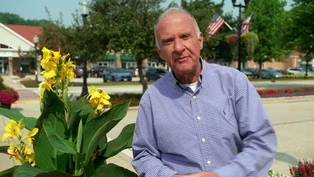
Preview - Greendale, Wisconsin
Preview: S5 Ep6 | 30s | Greendale, Wisconsin was built to be a charming, walkable community. Still is! (30s)
Providing Support for PBS.org
Learn Moreabout PBS online sponsorship












Support for PBS provided by:
John McGivern’s Main Streets is a local public television program presented by PBS Wisconsin