State of Affairs with Steve Adubato
Greg Lalevee; Dr. Daniel Varga; Elizabeth C. Matto
Season 5 Episode 12 | 27m 45sVideo has Closed Captions
Greg Lalevee; Dr. Daniel Varga; Elizabeth C. Matto
Greg Lalavee shares the importance of the Gateway Tunnel Project for the region’s economy and the long-term impact of COVID on NJ’s infrastructure; Dr. Daniel Varga talks about the vaccine resistance within the healthcare industry and the misconceptions surrounding the vaccine; Elizabeth Matto discusses the importance of civic education and the implications of the political divide on students.
Problems playing video? | Closed Captioning Feedback
Problems playing video? | Closed Captioning Feedback
State of Affairs with Steve Adubato is a local public television program presented by NJ PBS
State of Affairs with Steve Adubato
Greg Lalevee; Dr. Daniel Varga; Elizabeth C. Matto
Season 5 Episode 12 | 27m 45sVideo has Closed Captions
Greg Lalavee shares the importance of the Gateway Tunnel Project for the region’s economy and the long-term impact of COVID on NJ’s infrastructure; Dr. Daniel Varga talks about the vaccine resistance within the healthcare industry and the misconceptions surrounding the vaccine; Elizabeth Matto discusses the importance of civic education and the implications of the political divide on students.
Problems playing video? | Closed Captioning Feedback
How to Watch State of Affairs with Steve Adubato
State of Affairs with Steve Adubato is available to stream on pbs.org and the free PBS App, available on iPhone, Apple TV, Android TV, Android smartphones, Amazon Fire TV, Amazon Fire Tablet, Roku, Samsung Smart TV, and Vizio.
Providing Support for PBS.org
Learn Moreabout PBS online sponsorship- [Narrator] Funding for this edition of State of Affairs with Steve Adubato has been provided by New Jersey Sharing Network.
Summit Health a provider of primary, specialty, and urgent care.
Horizon Blue Cross Blue Shield of New Jersey.
Here when you need us most, now and always.
NJM Insurance Group.
Serving New Jersey's drivers, homeowners and business owners for more than 100 years.
The Healthcare Foundation of New Jersey.
IBEW Local 102.
Lighting the path, leading the way.
The Fidelco Group.
ADP.
And by Fedway Associates, Inc.
Promotional support provided by NJ.Com, keeping communities informed and connected.
And by The New Jersey Business & Industry Association.
[INSPRATIONAL MUSIC] - Hi, I'm Steve Adubato.
Another compelling policy driven discussion.
We kick off this program with Greg Lalevee who is a Business Manager for the International Union of Operating Engineers Local 825.
Greg, good to see my friend.
- Thanks for having me back Steve.
Good to be here.
- Well, we're having so many private conversations about leadership and the gateway project.
Let's bring it public.
Right now, the gateway project.
Tell folks, remind folks what it is?
and why it's so important, not just for the economy of this region, but the quality of life in the Region.
- Well, for everything that is the economy of this region to get the tunnels under the Hudson River done, is an extremely big deal.
The current tunnels are over a hundred years old.
They were ravaged by Super storm Sandy.
Filled with salt water, all the electronics is failing.
The structures themselves are in need of major rehab.
200,000 commuters into the city, every day.
The Northeast Corridor of Amtrak is 30% of the Nation's GDP flows between Boston and Washington.
It's a big deal to get that project done for the economics of the region.
- Let me disclose, I do a whole range of leadership coaching at 825 and I've learned a lot about the work that you and your colleagues do every day.
And I also know that the Biden Administration with the Secretary of Transportation if you will and Mayor Pete Buttigieg.
Has said some public things about the gateway project and infrastructure overall.
What is your sense Greg, as to the biggest difference between the Biden administration's approach to infrastructure projects which are obviously heavily connected to jobs and the Trump administration.
- Well, right now there's just been a total conversation about infrastructure.
When you look at the Biden administration if we want to wrap that around the Hudson Rail Tunnels.
We have now confirmed Mayor Marty Walsh of Boston is the Secretary of Labor that's on the Northeast Corridor.
Gina Raimondo the Governor of Rhode Island is the nominee to lead the Department of Commerce.
Rhode Islands on the Northeast Corridor President Biden himself rode Amtrak into Washington as a Senator.
And you're referred to Secretary of Transportation Buttigieg he was a big advocate for the South shore line which is a rail line from Chicago into South Bend right now close to the airport.
He wanted it to extend it to downtown a big proponent of projects that aren't necessarily vehicle centric.
So I mean, have to be optimistic about the possibilities for this project to move forward.
- You know Greg, the other thing I want to get out there is that we're taping in late March.
It will be seen after.
The bigger question about COVID and its long-term implications or the impact if you will, on your industry.
By the way tell everyone what the Operating Engineers do and why you matter?
And then we'll get back to COVID.
- We are about 8,000 men and women who primarily operate heavy construction equipment.
Also work in mines and quarries and repair that equipment.
We build the Nation's infrastructure the roads, the bridges, all of the water system, the gas system.
So we're involved in public policy for this reason to try to make sure that we both create good jobs create a better environment and create a good economy.
- One of the things I've learned about your organization over the years is that your folks have to be quote out there.
They have to be on the job.
They have to see what's going on and understand what's going on and make adjustments accordingly.
COVID, and now we're taping this a year plus into this pandemic.
How much can be done virtually and how much must be done out in the field?
(Greg laughs) - For us, it has to all be done out in the field.
You can't build the building and roll it into place from miles away.
You can't build the road virtually, this all gets done in place.
So, our people have been on the job since the onset of the pandemic.
- But at the same time there have been economic losses across the board.
There's no organization, including those of us in Public Broadcasting, not adversely affected by this.
How has it, dare I say, adversely affected your organization A, and B how have you pivoted 'cause you and I talk about innovation a lot.
(Greg laughs) - Well, there are what our normal budget cycles are completely disrupted.
So counties put out infrastructure packages utility authorities put out infrastructure packages.
It's well-known, what's happened to the budgets at places like New Jersey Transit and the Port Authority.
So it's been a complete disruption of the marketplace.
And yes, a downturn in what the normal work cycle is, thankfully with the American Rescue Plan we think there'll be some money going back into those budgets and restoring a lot of the projects.
But then in the Private Sector people who develop buildings are trying to figure out and the question's not answered yet.
What is the new workplace going to look like?
With hybrids of in-person and virtual work in person and virtual learning?
We don't really know what the building of the future is going to look like.
So many of the commercial type projects were basically put on pause.
I think, until that just sorts itself out.
- So is that a question, Greg?
(Steve cough) Excuse me.
A question as to, if there is less construction and commercial office buildings are less preferable and there will be this hybrid this combination of home and office.
Does that have potential to impact your industry.
- Across the board.
It could create a severe downturn in our industry.
One of the things that we're hopeful for and New Jersey has done a good job with putting out or having a budget for roadwork, having a budget on the Turnpike and the Parkway with the traffic down.
This is a great time to get in and relieve the choke points that we've seen on the roadways historically and open them up more so that traffic flows more freely.
That's an environmental concern and an economic concern.
- In the time I've left Greg, your assessment of the Murphy Administration as it relates to its interaction with Court Organized Labor.
- Well they're always in contact with us and working along with us and listening to where we're coming from on issues and why?
And we're hopeful that keeps on going.
The roadwork I just reference is the result of a conversation.
And if we look at our neighboring States they're not doing so well or as well.
In terms of what's been allocated work wise.
I spoke to a contractor just this morning who said the work is in New Jersey.
So I think that answers itself for what we're doing.
- Greg Lalevee is the Business Manager for the International Union of Operating Engineers Local 825.
They in fact do support what we do.
In terms of Public Policy Programming at the Caucus Educational Corporation.
Greg I look forward to, check this out.
Greg also talked leadership with us.
Mary Gamba and I, my Co-Anchor on Lessons in Leadership.
We talk leadership with Greg all the time check that program out as well.
Hey Greg, thanks so much for joining us.
We're actually talking back end of the NCAA's.
(Greg laughs) We will know by the time this airs who's the champion.
It will be, but Greg Lalevee and I are rooting for Sister Jean.
Can we say that correct?
- Absolutely, and not nine of the top 16 or out after two rounds.
So it's anybody's game and hope Sister Jean's crushing her rosary beads, go Loyola.
- Yeah by the way, this would be wild if Loyola won this thing.
Thank you, Greg Lalevee.
I'm Steve Adubato, we'll be right back.
(grand music) - [Announcer] To watch more State of Affairs with Steve Adubato, find us online and follow us on social media.
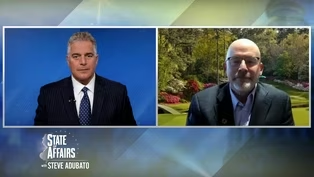
- We're now joined by Dr. Daniel Varga, who is Chief Physician Executive at Hackensack Meridian Health, a supporter of our healthcare programming.
Dan, good to have you with us.
- Good to be here with you Steve.
- Let's just confirm that you are not in New Jersey, behind you.
I'm looking at Amen Corner at the Masters.
If I'm not mistaken, correct?
- We can only hope, man.
We can only hope, been a long cold winter.
- Yeah.
We're taping at the end of March.
That looks really good.
Hey, Dan, let's do this.
You and I have had so many conversations around physician leadership and my coaching and around communication leadership, your folks, but at the same time, one of the issues that keeps coming up is the question of vaccine resistance.
A, let's get this out of the way of the physicians around you.
Give me a conservative estimate of the number of physicians who have taken the vaccine.
And those who are still resistant.
- I'd say on the physician side, we're probably 85-90% vaccinated.
I mean, I think that the doctors who've had had it available to them stepped right up, I think, you can look at the signs you can see the science, you can understand the nuance in the emergency use authorization.
So I think the doctor uptake has been really, really high - And beyond physicians.
There are nurses, there are technicians there are others, respiratory therapists.
Do the numbers go down after that in terms of those willing to take the vaccine?
- Yes.
So if we look at our team members across HMH, as an example we're at about 60% vaccinated, that's a little better than the national average, national average is around 50% couple buckets of folks.
You have to keep in mind at the, at the healthcare worker level.
The first is there are we have a very diverse community of team members.
And when you talk about physicians, nurses, physical therapists, pharmacists, environmental services worker, food service workers patient care techs, they all have a different vaccine literacy.
If you will, a different healthcare literacy even though they're working in the healthcare field and in some populations, particularly our populations of color there is a historical resistance to vaccines in general, as you might expect.
But at the same time, those are folks who are working in a healthcare environment, they're at risk.
So you would like to make sure that those folks are as well protected as possible.
And what we have found in this setting with particularly that group with disadvantaged groups who have an inherent suspicion of vaccines, is that the way we've been addressing that is one-on-one.
I mean, trusted peer, respected team leader a person of your demographic, who is a physician actually having one-on-one conversation with you found that to be far more powerful in terms of trying to overcome the resistance.
It's that concept of meeting folks where they are.
- Let me add something to that.
- That's been very positive.
- Thank you Dan, sorry for interrupting.
Let me add something to that.
Go onto our website.
Our team will put it up in post-production SteveAdubato.org.
We did an interview with HMH CEO, Bob Garrett together with Harry Carson.
Old-school Harry Carson.
One of the greatest football players of all time played for the New York football Giants, all pro Super Bowl winner.
That interview that I did with Bob Garrett and Harry Carson who is African-American, (throat clearing) who took the vaccine who talks about the vaccine and its efficacy and its safety.
Check that interview out.
It's one of many conversations along with other healthcare professionals that you need to listen to.
Dan, let's do this some misconceptions that we deal with right now.
Can we do that?
- Yeah, sure.
And you know, it actually, it gets it that right out of the gate, it starts with a population in our healthcare workers that we're really concerned about.
And that is women of childbearing years and women who are pregnant.
- Take it on, what's real, what's make believe - You know, Steve, this issue is one issue that is a true clinical decision-making conundrum.
And the other that is, is a situation where we have to overcome a lot of false information.
The first issue is for a pregnant woman, because we didn't study the vaccine in its phase one two and three clinical trials in pregnant women.
There isn't data on pregnant women right now and how it works.
Is it safe, et cetera, et cetera, et cetera.
But we do know is that women who get COVID-19 while they're pregnant, get really, really sick and all of the major obstetrical organizations, American College of OB-GYN, the reproductive endocrinology societies et cetera, all of them had said, talk to your doctor about weighing the risks and benefits, but understand this that it seems like the risks of getting COVID while you're sick, excuse me, while you're pregnant far outweigh the potential theoretical risks of vaccination.
- Let me try a couple other misconceptions, Dan.
- Yeah.
On the other side of the equation you've got the big issue of will the, particularly the mRNA vaccines, the Pfizer and the Moderna vaccines affect your fertility.
There is no data, none data to support that assertion.
And again, many of the professional societies have come out strongly against that, or letting folks know that that is not a worry.
And we, again, Steve, to using that kind of peer conversation we have had our OB-GYN physician workforce out in force talking with folks in the hospital to make sure that they understand, I'm a pregnant woman who's an OB-GYN and I'm going to take the vaccine.
- Let me try this one.
I will disclose that I in fact, had the Moderna vaccine, both shots and feel very fortunate in that regard and hope and pray that those who want the vaccine get access to the vaccine and get the vaccine as quickly as possible.
So misconceptions with the variants out there, am I quote protected to the same degree 90 plus percent against those variants as compared to the original, if you will COVID-19.
- So I think one of the things we're learning.
- And I'm not just talking about myself, talking about millions of others in the same situation.
Go ahead.
- Yeah.
I think so what we're learning and the data's not complete on this yet, is that what we believe we're seeing is that you will still even though it's not completely protected because remember the vaccines the Pfizer and Moderna vaccines were tested largely against the wild Corona virus so that we hadn't really seen the emergence of variants at that juncture.
And both of them are 95% effective against preventing the acquisition of the virus.
Then you saw the J&J vaccine come out.
It actually got studied at a time when the variants were starting to come up and it was more like 65-70% effective against preventing you getting the virus.
The remember about all three vaccines all three vaccines were almost a 100% at preventing death, serious illness and hospitalization.
What we're seeing in, in the situation we're in right now is that folks who have been vaccinated with the Pfizer and Moderna may well show up with positive tests somewhere down the line, and it may be related to a variant but we believe there's still very significant protection against the three end points we're worried the most about death, serious illness and hospitalization.
- By the way, check out Dan Varga on a regular basis and NJ spotlight news, which is on NJ PBS on WNET public television stations in our region he's on a regular basis offering insight and important information.
Dr. Varga, thank you so much for joining us.
We appreciate it.
- My pleasure, Steve, anytime.
- At the masters, we will be right back after this.
(grand music) - [Announcer] To watch more State of Affairs with Steve Adubato, find us online and follow us on social media.
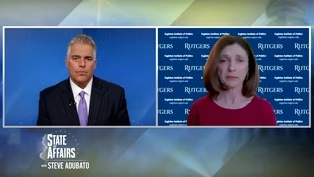
- We're now joined by Dr. Elizabeth Matto, who is Professor and Director of the Center for Youth Political Participation at the great Eagleton Institute of politics at Rutgers University.
And I'm not just saying that because they let me out of there with a master's degree a long time ago.
(laughs) Elizabeth let's do this.
I mean, you understand youth participation better than most.
Question: about January 6th.
January 6th the insurrection so much to talk about.
So meaningful, so impactful, if you will, what impact do you think it's had on younger voters or non-voters?
- Well, I think Steve and thank you for having me today.
I think like so much that has happened in the last few months, in the last few years it was a teachable moment for those of us who teach civic engagement and democracy.
I think one more example for us, how important it is that we're teaching our students to pay attention to politics and helping them understand the importance of participating in politics and teaching democracy.
I think in many ways what happened on January 6th certainly can be attributed to many, many causes.
But one that I think is really important is some real gaps in understanding about the roots and the underlying tenets of American democracy.
So if anything, I think it really underscores the importance of teaching American democracy.
- Professor, how do we get younger people to connect politics to their lives as opposed to that's politics?
- Well again, I think we're seeing so many examples, as you probably know it.
Rutgers has been teaching remotely for the last year now.
I think we have so many examples in this last year about the importance of politics the connection to politics, the connection of politics to our day-to-day lives.
You know the combination of the government's reaction to COVID-19, to the Black Lives Matter movement.
I think students have seen one example after another of how politics impacts their daily life.
And so I think we're seeing examples all over the place.
And again, I think it's really heightening the interest in American politics among young adults, among the generation that I think has already shown an inclination to be politically involved.
So I think we're seeing example after example of why politics matters and more importantly why young people matter to politics.
- Civic education, define it.
- Well, I would say civic education is fostering an inclination and a skillset among young adults to participate in the democratic process.
You know as we frequently say, knowing how to be a democratic citizen is not genetic, it needs to be taught.
And there's a growing body of literature on how to teach civic education, how to teach American democracy.
What we do know if we're gonna define it is it's multifaceted.
For sure, it's about imparting a sense of of knowledge having a good sense of democratic processes who serves in government but almost more important is having a skill set knowing how to participate in the political process having the cognitive skills, the participative skills to be engaged in American democracy and even more importantly a democratic mindset a democratic attitude, a sense that your participation matters- - Democratic with a small D. I'm sorry for interrupting.
- Absolutely, democratic with a lowercase D and certainly when it's taught it should be taught with that mindset certainly being non-partisan but being pro-democracy.
- And by the way there's an Are You Voting initiative and Are You Ready initiative, a whole range of initiatives.
Let's put up, we'll make sure we put up the website for people to find out more about those programs.
But I need to ask you this.
- Yes.
- The political divide, the polarization, the "Listen, you watch that news program.
"I watched this news program.
So my reality is different from your reality.
The implications of that level of bifurcation, if you will and separation and the "Enemy of the people" we know who said that.
What are the implications from your perspective for younger people trying to find sources of information that are credible and are not riding any horse politically or for or against anyone else?
I know that's a loaded question but here in public broadcasting we don't have quote a point of view.
- I think it's incredibly frustrating for students.
Again, I think we're seeing so many signs that young adults want to be engaged in politics.
We've been home, our students have been teaching, I've been teaching remotely, my students have been learning remotely.
They're on their laptops all the time.
So they are seeking quality, reputable reliable information.
They want to be following politics, but they recognize that they have to, you know in when digesting the news that they have to have a healthy grain of salt take it with a healthy grain of salt.
So I think it's frustrating for students.
I think Millennials and Gen Z in particular are finding the bifurcation as you mentioned, finding it frustrating, finding it difficult when there are problems that need solved and yet they're being slowed down and mired in political polarization.
So I think again, as an educator my job is not only to try to point students to reputable news organizations or to help them digest consume news critically.
I think even more importantly is our ability to teach students to talk to each other, to engage in political discussion, to do it in an honest way a candid way, but in a respectful way and a productive way.
And the classroom, even the Zoom classroom is a location to do that kind of teaching and that have that kind of political discourse.
- You know it's so interesting you talk about that because there's so much discussion about, "Hey, don't talk to anyone in your family or friends or whatever about politics, because you know what could happen."
You believe the opposite, engage each other listen to other points of view respectfully.
Even if you think someone's dead wrong.
- Absolutely, I recognize that it's very difficult to have political conversations right now, but I also recognize that we're in trouble.
American democracy is in trouble if we can't engage in discussion.
The system was set up in such a way back to Federal's paper, 10 and 51 and James Madison, the system is set up in such a way that we're going to have disagreements.
It was set up in such a way where it was going to be a pluralist society where we were going to have a diversity of views.
But the goal was that we were to exchange these views.
And out of this exchange would come compromise.
Clearly having political discussion right now is fraught with anxiety, terribly difficult.
But back to my original point is if you're not taught how to do it, we're not taught how to do it.
How will we ever do it?
- And we don't have to pick sides if you will or demonize those who see the world differently than we do.
And that is exactly what Dr. Elizabeth Matto is talking about and promoting.
And we're gonna have other folks from the Eagleton Institute on to help us put things in perspective, because that's why when you saw throughout this segment democracy at a crossroads that's why we're doing it.
Professor, thank you so much for joining us.
We appreciate it.
- Thank you very much for having me, take care.
- You got it, I'm Steve Adubato.
Thank you so much for watching.
We'll see you next time.
- [Narrator] State of Affairs with Steve Adubato Is a production of the Caucus Educational Corporation.
Funding has been provided by New Jersey Sharing Network.
Summit Health Horizon Blue Cross Blue Shield of New Jersey.
NJM Insurance Group.
The Healthcare Foundation of New Jersey.
IBEW Local 102.
The Fidelco Group.
ADP.
And by Fedway Associates, Inc.
Promotional support provided by NJ.Com, And by The New Jersey Business & Industry Association.
- Hi, I'm Joe Roth.
In New Jersey there are nearly 4,000 residents in need of a life saving organ transplant, and one person dies every three days waiting for this gift of life.
One organ and tissue donor can save eight lives and enhance the lives of over seventy-five people.
You have the power to make a difference and give hope.
For information or to become an organ and tissue donor visit www.njsharingnetwork.org, and be sure to talk with your family and friends about this life saving decision.
Addressing Vaccine Resistance Within the Healthcare Industry
Video has Closed Captions
Clip: S5 Ep12 | 9m 59s | Addressing Vaccine Resistance Within the Healthcare Industry (9m 59s)

The American Rescue Plan's Impact on the Gateway Tunnell
Video has Closed Captions
Clip: S5 Ep12 | 9m 18s | The American Rescue Plan's Impact on the Gateway Tunnell (9m 18s)
The Need of Civic Education for Students and Young Voters
Video has Closed Captions
Clip: S5 Ep12 | 9m 12s | The Need of Civic Education for Students and Young Voters (9m 12s)
Providing Support for PBS.org
Learn Moreabout PBS online sponsorship
- News and Public Affairs

Top journalists deliver compelling original analysis of the hour's headlines.

- News and Public Affairs

FRONTLINE is investigative journalism that questions, explains and changes our world.












Support for PBS provided by:
State of Affairs with Steve Adubato is a local public television program presented by NJ PBS