One-on-One
Greg Lalevee; Dr. Jonathan Lee; Syleecia Thompson
Season 2022 Episode 2475 | 27m 53sVideo has Closed Captions
Greg Lalevee; Dr. Jonathan Lee; Syleecia Thompson
Greg Lalevee talks about the importance of infrastructure for the nation’s economy, Governor Murphy’s Energy Master Plan and President Biden’s Bipartisan Infrastructure Law; Dr. Jonathan Lee shares the impact of COVID-19 on early detection for cancer; Dr. Syleecia Thompson discusses the connection between resilience and leadership and the ways to overcome COVID fatigue.
Problems playing video? | Closed Captioning Feedback
Problems playing video? | Closed Captioning Feedback
One-on-One is a local public television program presented by NJ PBS
One-on-One
Greg Lalevee; Dr. Jonathan Lee; Syleecia Thompson
Season 2022 Episode 2475 | 27m 53sVideo has Closed Captions
Greg Lalevee talks about the importance of infrastructure for the nation’s economy, Governor Murphy’s Energy Master Plan and President Biden’s Bipartisan Infrastructure Law; Dr. Jonathan Lee shares the impact of COVID-19 on early detection for cancer; Dr. Syleecia Thompson discusses the connection between resilience and leadership and the ways to overcome COVID fatigue.
Problems playing video? | Closed Captioning Feedback
How to Watch One-on-One
One-on-One is available to stream on pbs.org and the free PBS App, available on iPhone, Apple TV, Android TV, Android smartphones, Amazon Fire TV, Amazon Fire Tablet, Roku, Samsung Smart TV, and Vizio.
Providing Support for PBS.org
Learn Moreabout PBS online sponsorship- [Narrator] Funding for this edition of One-On-One with Steve Adubato has been provided by The Port Authority of New York and New Jersey.
Moving the region through air, land, rail, and sea.
IBEW Local 102.
Lighting the path, leading the way.
Eastern Atlantic States Regional Council of Carpenters.
The New Jersey Education Association.
The New Jersey Board of Public Utilities, Clean Energy program.
The New Jersey Economic Development Authority.
Valley Bank.
Choose New Jersey.
And by New Jersey Sharing Network.
Promotional support provided by CIANJ, and Commerce Magazine.
And by Jaffe Communications.
Supporting innovators and changemakers with public relations and creative services.
- This is One-On-One.
- I'm an equal American just like you are.
- The way we change presidents in this country is by voting.
- I'’m hopeful that this is the beginning to accountability.
- Life without dance is boring.
- I don't care how good you are or how good you think you are, there is always something to learn.
- I did do the finale, and guess where my trailer was?
A block away from my apartment, it couldn'’t have been better!
- People call me 'cause they feel nobody's paying attention.
-_ It'’s not all about memorizing and getting information, it'’s what you do with that information.
- (slowly) Start talking right now.
- That's a good question, high five.
(upbeat music) - Hi, everyone, I'm Steve Adubato.
Let's kick off this very important program, talking public policy, particularly around - infrastructure?
That's right.
We've got a good friend, Greg Lalevee, Business Manager at the International Union of Operating Engineers Local 825.
Good to see you, Greg.
- Good to see you too, Steve.
Thanks for having me.
- Another time, Greg and I will talk college basketball and obsession of ours but not on this show.
Hey, Greg, listen, infrastructure, not sexy, we've been through it before, Biden, the infrastructure plan, the Northeast Corridor, the Amtrak money, the Gateway, what does it really mean in terms of the economy, jobs, and our region?
- Well, there's a multiplier on infrastructure that's been consistent for decades.
It provides an economic boost to the entire region, projects are done locally.
You can't manufacture a road and ship it in.
The products are mined locally, they're made locally.
So infrastructure projects are a boost to the local economy.
You referenced Northeast Corridor, 30% of the country's GDP travels the Northeast Corridor from Boston to Washington.
So improving Amtrak's Northeast Corridor service is absolutely vital and that means the Hudson Rail Tunnels and the Portal Bridge.
- Tell everyone the International Union of Operating Engineers Local 825 is, I know that there's a significant, am I right about an anniversary, Greg?
- Yeah, we just passed our a hundred year anniversary, it was actually in 2020.
We delayed it our celebration for a year, but we had it early November of 2021.
We went through our entire history, it's an amazing history of our organization.
And you asked the question, we are 7,500 men and women who are known most for operating heavy construction equipment.
We build the nation's infrastructure and when we look back at a hundred years of projects, it's pretty astounding what we've been involved in over the years.
- Greg just gave me a book, let me disclose, because I teach a leadership academy at Local 825 and when I was leaving Greg left me a book about the history of 825 and the International Union of Operating Engineers.
I thought I knew, I did not, it is compelling.
But then also let's put up the website for 825 so people can find out more.
Greg, let's do this.
When it comes to the issue of climate change, we have a whole range of interviews, we do a lot of programming about energy policy, the Governor Murphy's quote-unquote, "Energy Master Plan."
We're actually doing an interview with the head of the BPU as we tape today, Joe Fiordaliso.
What is the governor's master plan, Energy Master Plan, A, from your perspective, and B, what concerns if any do you have about it?
- Well, the Energy Master Plan talks about moving away from fossil fuels and moving into complete electrification looking at the offshore wind and solar projects and things of that nature.
Our concerns, there are a few, one is the overall cost of the Energy Master Plan.
What will it cost the rate payers?
What will it cost the taxpayers?
That's an unanswered question that we would really like to have the answer to.
The other concern is the speed at which we think we can accomplish this electrification.
Well, the schedule is very aggressive, we're not sure that it can be met.
I think if everything is built out the way they tell us that it can get built out, we will still land about 20% short of our energy needs, and where are we going to get that from?
Neighboring states are coming up with the same calculation and we can't all get the same 20% from the same place.
So we have serious questions that we'd like to have answered as it surrounds this Energy Master Plan.
- Lemme play devil's advocate here, and by the way, would also like let everyone know that we are involved in a public awareness campaign about so-called clean energy, if you will.
But at the same time, here's the thing.
So say you're concerned about climate change and that's not say you are, you are, the governor is, the BPU, they are concerned as well, lots of environmentalist clearly.
Is there such a thing as balancing this in terms of pursuing (sighs) the aggressive fight against climate change and at the same time being sensitive to jobs, the economy and what's realistic here.
And the final part of this, Greg is in the leadership academy I mentioned before, we talk about leading with a sense of urgency, is the governor not simply leading with a sense of urgency here because climate change we're playing catch up?
- Well, we agree with being urgent and responding to climate change.
We just believe the existing technology and the existing infrastructure we have to acknowledge what's right for our economy and making sure that we have enough energy.
We've talked about bringing back manufacturing, we talk about smart development, all of that needs to be done but it needs to be done in balance.
Certainly with a change in a transfer over the timeline is what really concerns us because fossil fuels are being left at the door.
And if we look at the amount of carbon that we've reduced, as we've changed from coal to natural gas, it's significant.
So we think that we can keep natural gas as a component of our energy portfolio for the foreseeable future.
And yes, eventually it may wane and peter out, but for the timeline that's set, we believe it has a place and an absolute necessity to keep in the energy portfolio.
- It's gonna be a very interesting discussion moving forward and we'll stay on that discussion from a policy perspective.
Also when I say policy, it's not just pie in the sky policy, it's policy that impacts people's lives more directly.
Lemme ask you this, Greg, President Biden, To what degree do you... what grade do you give him, A, and B, why do you give him that grade when it comes to leading the infrastructure fight in this nation, and also given how long it's taken to get anything done down there in Washington?
- Well, to give him a grade solely on an infrastructure would be to give them an A.
He got an infrastructure bill through and he did it more or less the old fashioned way, he brought in people from both parties, had a discussion, listened to the concerns, had them exchange ideas.
You referenced some of the dysfunction in Washington and inability to get things done.
The fact that this got done was a testament to his leadership and the fact that he's listening and talking to people.
- Talk about the jobs that come out of this infrastructure that's $110 billion infrastructure initiative, 'cause sometimes the millions and trillions and billions people, huh, what does it mean?
Talk jobs.
- Well, the jobs are going to be significant.
We're going to have an opportunity to build out a lot of things.
There's $7 billion for roadwork, New Jersey generally runs at about $2 billion per year.
So infuse, another three and a half years of capital construction into the mix and that's incredible, 4.2 billion in transit, 1.1 billion in bridges, we can talk about 500 structurally deficient bridges around the State of New Jersey.
You can take a look at 495 in Hudson County built in 1929 has almost 170,000 car trips per day, that thing's in need of serious upgrade, the way it was built, the way it was engineered back in 1930, they did not anticipate this level of traffic or the beating that that bridge would take every year.
Separate and apart, Amtrak getting a large allocation- - Few seconds, Greg.
No, no, go ahead, finish your point a few seconds.
- Amtrak's going to get a large allocation to potentially complete the Gateway project.
All signs point to the Hudson Rail Tunnels being done.
There's going to be more work in this area because of this infrastructure bill than I think we could ever imagine.
- Yeah, people can talk about infrastructure in the abstract and the amount of money is being spent, but to understand the impact, particularly in the New York, New Jersey region is critical.
And Greg mentioned Amtrak, we'll be having Tony Coscia from Amtrak on to talk about that.
Hey Greg Lalevee, International Union of Operating Engineers Local 825, as always, thanks for joining us, Greg.
- Thanks, Steve, great to be here.
- You got it, stay with us.
We'll be right back right after this.
- [Narrator] To watch more One on One with Steve Adubato find us online and follow us on Social media.
- We're now joined by Dr. Jonathan Lee, who is Medical Director of Oncology Services at Holy Name.
Good to see you, Doctor.
- Thank you.
Good to be here.
- Doctor, put in perspective the impact, from your view, the most significant impact of COVID-19, as we do this program at the end of 2021, on oncology services, on people dealing with cancer-related issues.
- Well, I feel somewhat under-qualified to answer that question, but I could give you a high-level perspective on it.
If you really take a look at the, shall I say, healthcare in this country as a social construct, it doesn't exist in its isolation, which means we don't take care of our cancer patients or sick people in isolation.
There's a fabric and a structure that more or less influences how we take care of sick people, and that fabric and a structure has a pattern, and that pattern always revolves around bringing people and resources together.
For instance, you don't go a doctor every day, but when you're sick, you go to see a doctor.
Sometimes you don't go by yourself, you go with your family member to sit in on the conversation.
Sometimes you have to go to a hospital.
Grandma and Grandpa comes over to offer to babysit your children.
Your friends and family offer to bring you some food to help out, right?
But if you take a look at what our society response to COVID, in some aspects that has been diametrically opposite, right?
At the peak of COVID, some doctors basically said, "Well, I cannot see you unless you've got XYZ emergencies."
In the peak of COVID, we canceled elective surgeries.
We told people, Grandma and Grandpa, "No, stay away."
We told our friends and family, "Don't come."
If you're sick, stay by yourself, isolated.
You go to hospital, get admitted, we say, "We cannot have any visitors."
I don't know how to sort of make of that, except the fact that it is somewhat opposite of how we usually take care of sick people in this country.
- Why do you think that happened, Dr. Lee?
- I cannot comment on that.
- Is it an abundance of caution?
- I think there was a healthy caution that revolved around that response, but how that happened still puzzles me.
- And let me, I wanna be clear here, and by the way, Holy Name, one of the healthcare organizations an underwriter of what we do.
I wanna be clear here.
You are saying that when it comes to cancer care, that we cannot afford the luxury and the risks associated with "let's put that off, "let's put that off."
Because from what I've heard from many in your industry, not your industry, your profession is, your medical field is, that time is critical.
Those tests for early detection are essential, and we cannot put it off.
Dr. Lee?
- Yes, I think one of the advances in cancer care that we as a society has made over the past couple of decades is that we understood the importance of screening and early detection, okay?
And let's face it, cancer is still a very devastating diagnosis, even during the pandemic, and if you're diagnosed with it, there are these structures and machinery to help you along the process.
The issue is that one of the things that we thought we had made advances in care of cancer patients to detect them early when they're asymptomatic, cancer's small, right?
And that requires societal resources to be dedicated, such as screening programs, seeing your doctors more frequently, all right?
And I think one of the things that happened with COVID was that those aspect of that cancer care was delayed substantially.
Now, what kind of impact would that have immediately?
But I hear some anecdotal stories of patients now coming in to see doctors with lot more advanced cancer.
But at the end of the day, I think the impact will be a lot longer term.
- Doctor, precision medicine.
What exactly is it and how does it impact the treatment of cancer patients, moving forward?
- Right, precision medicine.
So the maxim of precision medicine, in my opinion, evolves round two main tenets.
Number one, that your health state, whether it be the well state or sick state, is not due to one single factor, but is due to multiple different factors that you've accumulated throughout your entire life, such as your genetics, environment, lifestyle, so forth and so on.
And second tenet is the fact that, even when you're able to measure a health state of say two different individuals, it does not mean that identical measures translate to a same health state.
It's a bit of a difficult concept, so I'm gonna sort of try to give you an analogy on this, okay?
Say if you have two cars, one is economy-base car, 1.6 liter engine, small tires, small brakes, going down the highway, 60 miles per hour.
The other car is a luxury sport sedan with 200 horsepower, turbocharged engine, big brakes, big tires, also going down the road at 60 miles an hour.
We said these are all four seat sedans going 60 miles an hour, but as you can imagine, they're performing very, very differently.
- But what does precision medicine do for us?
- So when you marry these two concepts, now you have ability to deliver precise care that a patient needs at an individual basis, which is somewhat departure from how we categorize disease states and tell people that yes, you have this diagnosis like everybody else, and we're giving you this treatment like everybody else.
- And the impact of that on cancer care is significant.
Dr. Jonathan Lee, who's Medical Director of Oncology Services at Holy Name.
Doctor, I wanna thank you so much for joining us.
- Thank you very much for your time.
- Appreciate it, I'm Steve Adubato, we'll be right back.
- [Narrator] To watch more One on One with Steve Adubato find us online and follow us on Social media.
- We are honored to be joined by Dr. Syleecia Thompson, who is Professor of Management at Berkeley College and author of a very compelling book.
It is called "The Resilience Factor: How to Face Adversity, Trauma and Tragedy Like a Superhero."
Good to see you, Doctor.
- Thank you.
Thank you for having me, Steve.
I'm so excited to be on your show.
- Well, I'm excited to have you, 'cause I'm a student of leadership.
I teach it, write about it.
We do a series on another platform that's called "Lessons in Leadership."
But I'm fascinated by the whole question of... First of all, define resilience.
You know about it personally and professionally.
And then what does that have to do with being a great leader?
- Great question.
Well, for me, the textbook definition, resilience is your ability to recover, bounce back from trauma, or tragedy, or hardship, right?
What I've found in looking through my research and just writing this book, is there are four types of resilience that we go through as people, right?
Personal resilience, okay.
Financial resilience.
I'm sure we've all been there.
(laughs) Okay.
Professional resilience, getting laid off, having to bounce back, you know, change jobs.
- Does that include by being canceled on certain series or fired by certain networks?
I just want to clarify.
- Yes.
(laughs) - Then I would be able to relate to that.
Go ahead.
- (laughing) Steve, I love you already.
If you have been fired from a show or a network, and you've recovered and bounced back with great- - How dare they?
(both laughing) - You have professional resilience.
And then the last one, I like to call spiritual resilience, because we all fight battles on a day-to-day basis.
So those are my four types of resilience.
- So this is so interesting to me.
And my sons, we have...
I have three sons, but two sons with my wife, Jennifer.
I hate when I say that, because people are like, "What, do you have eight marriages?"
No, two.
But I tell all three of our sons, and our daughter Olivia, that when you don't make the starting team, when you get rejected to a certain university or college, when you... And I'll tell them stories, that when I lost my seat in the State Legislature, I was 26.
I thought my life was over.
I could see them yawning.
Meaning, can we teach others through our experiences of rejection, failure, very public failure, how to get back on your feet, fight and fight and fight?
Why is that so hard for us to teach others?
And is it just in your DNA?
I know it's a loaded question.
It's not just about my kids, it's about everybody who struggles to try to teach resilience.
- Yeah.
And that's a great question.
Part of it is DNA, part of it is experiences.
You know, we are the sum of our experiences.
And I tell my students, you know, I'm a professor at Berkeley College, you see it- And Steve, I hate to say this.
You see the differences in generations.
So it's generational differences.
How my mom and them recovered from things.
You know, my mom could tell you stories, and you'd be like, "You went through that?"
But then the younger- - And you're a breast cancer survivor, do you share that with your students?
- Yes, I do.
I'm a breast cancer survivor.
I lost a baby at 28 weeks.
28 weeks, I had to deliver a stillborn baby, and then head back into the classroom.
And so I think you can teach resilience, but it is up to the person.
And there's so many different facets that go into it.
It's up to the person.
You can teach it, but also emotional intelligence is a big piece of it.
- Listen, Dr. Daniel Goleman, who coined the phrase emotional intelligence, I know what he thought he meant by it.
What do you mean by emotional intelligence?
- Well, it has a lot to do with self-awareness, confidence.
And I notice too, the younger generation, a lot of them, they want to be a star right away, right?
But they don't understand- I'm not saying all of them.
But they don't understand that hard work, and that... Like you said, you got laid off and fired.
(laughs) They don't understand that our journeys are so unique and it's not going to be paved with prettiness.
You know?
It's going to be some hard times, and your ability to recover, bounce back, to be resilient is there.
I feel like everybody has the resilience- - Is it in us?
Is it in us, even in- - I think so.
- I hate to do this thing about younger people, because it's such a generalization.
And I'm not going to play into the everyone gets a trophy thing, 'cause that's overblown as well.
But have we done a disservice to our children?
It's not just my family and our kids.
But always picking up for them, trying to fix things for them.
I don't want our kids to fail, because I know they'll feel bad.
That's not fair to them.
- (laughing) Right.
You're right.
You know, oftentimes I tell people, sometimes when you're failing, meaning you can fail up, right?
- Fail forward.
- Fail forward.
And failure is our ability to learn, and grow, and change.
Sometimes you have to grow through the things you go through.
I talk about that in my book.
And I tell my students this as well, because I wouldn't be the woman I am today... You know, I work on a lot of TV productions as well, I work in entertainment as an entrepreneur.
But I wouldn't be the woman I am today had I not lost a baby at 28 weeks, had I not had breast cancer, because those experiences really shaped who I am today.
Now, we don't want to say Steve, like, "No, you have to go through bad things in order to be successful."
But embrace the challenges as they come.
And you know, it's up to us as leaders and educators to help mold and teach people that they are resilient.
You have everything you need to recover, bounce back, and move forward.
- Dr. Thompson, this is the book cover.
It is "The Resilience Factor."
I wanna follow up.
I just wanna make sure everybody knows... We'll put up the graphic as to how people can find it.
And P.S., Berkeley College is one of our higher ed partners and colleagues.
But I want to follow up on this.
COVID and resilience.
There are a lot of people, not just young people, younger people, who are like, "Listen, this is horrible."
We're taping at the end of 2021.
"I got the fatigue, I can't take it."
I understand it.
But do we...
Resilience is not an option.
It is a necessity in this.
Am I overstating that?
I don't get much applause, so I'll take it.
So go ahead.
- If you were in church, I would give you some money in the church plate, okay?
- And you'd be standing, and- See, in my church, let me just say this, we're a little quiet.
Just a little too quiet.
But that's another story.
That's another topic.
Go ahead.
- I gotta bring you to my church.
- I hear you.
(Dr. Thompson laughs) COVID and resilience.
Go ahead.
- It really is about perspective, right?
So we could have just said, "Hey, the last two years have been a nightmare.
I'm just going to fold.
Why not?"
- This sucks.
It's all terrible.
- Right.
I used it as an opportunity to finish my book, to learn new skills.
I brokered some deals with some TV networks.
A matter of fact, one of my projects premieres on TV1 today.
So I use it as an opportunity.
And that's a big piece with resilience.
People don't see setbacks as comebacks or setups.
- Where'd you get this?
Listen, you say it's in everybody, Doctor, but I'm sitting there going, "No, no, no, no."
Something about your background puts you in the best position to be as tough as you are and resilient as you are.
What is it?
- I don't know.
I think it's seeing my parents.
I think it's, you know...
I went to college at 17.
That helped me.
I had to grow up fast, right?
'Cause I graduated early.
So you have to grow up fast.
I had a lot of experience.
I'm cultured.
I've been to South Africa.
I've been to parts of Europe.
I think that's a big piece, too, is I see the world differently.
I think that plays a role in... And I'm an optimist, right?
So I look at the glass half full, not half empty.
And I think it is in us, but also I'm a big proponent and advocate for therapy.
Steve, I went to therapy.
- Are we supposed to say this on the air?
I know it's a HIPAA violation.
Yeah, I don't know where I would be without it.
I can't speak for you.
- Yeah.
I think therapy really helped me.
You know, writing, journaling.
'Cause sometimes your friends, they can't help you.
(laughing) Okay?
So... - I know.
They tell you what you want to hear, and not what you need to hear.
And when they tell you, we sometimes reject it.
By the way, I'm sure there are people on and some staff that say "Really, Steve?
You've been in therapy?
No kidding.
Maybe you should get your money back from your therapist."
(both laughing) - Thank you for sharing that, Steve.
Because a lot of men don't talk about that.
And I think, you talk about leadership.
In order to be a successful and great leader, resiliency is a part of that.
But you're in tune with your emotions.
So you're okay with going to a therapist and sharing it.
- Little bit.
Yeah.
I grew up in, let's say an Italian American culture and neighborhood in Newark, where talking about your feelings and daring to say you're seeing a therapist... Let's just say it was not in the culture.
Hey listen, Dr. Thompson.
I want to thank you so much for joining us.
The book is simply called "The Resilience Factor: How to Face Adversity, Trauma and Tragedy Like a Superhero."
And I will tell you, you've been a superhero on public broadcasting right now.
Thank you so much, Doctor.
- Thank you so much.
- All the best.
I'm Steve Adubato.
That's Dr. Thompson.
She's very resilient.
See you next time.
- [Narrator] One-On-One with Steve Adubato has been a production of the Caucus Educational Corporation.
Funding has been provided by The Port Authority of New York and New Jersey.
IBEW Local 102.
Eastern Atlantic States Regional Council of Carpenters.
The New Jersey Education Association.
The New Jersey Board of Public Utilities, Clean Energy program.
The New Jersey Economic Development Authority.
Valley Bank.
Choose New Jersey.
And by New Jersey Sharing Network.
Promotional support provided by CIANJ, and Commerce Magazine.
And by Jaffe Communications.
- Hi, I'’m Joe Roth.
In New Jersey there are nearly 4,000 residents in need of a life saving organ transplant, and one person dies every three days waiting for this gift of life.
One organ and tissue donor can save eight lives and enhance the lives of over seventy-five people.
You have the power to make a difference and give hope.
For information or to become an organ and tissue donor visit www.njsharingnetwork.org, and be sure to talk with your family and friends about this life saving decision.
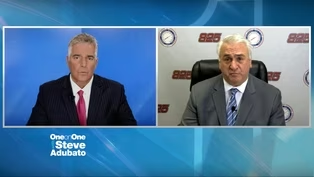
The Connection Between Infrastructure & The Nation's Economy
Video has Closed Captions
Clip: S2022 Ep2475 | 10m 5s | The Connection Between Infrastructure & The Nation's Economy (10m 5s)

COVID-19's Impact on Early Detection for Cancer
Video has Closed Captions
Clip: S2022 Ep2475 | 7m 19s | COVID-19's Impact on Early Detection for Cancer (7m 19s)

Resilience and Leadership in the Age of COVID
Video has Closed Captions
Clip: S2022 Ep2475 | 11m | Resilience and Leadership in the Age of COVID (11m)
Providing Support for PBS.org
Learn Moreabout PBS online sponsorship
- News and Public Affairs

Top journalists deliver compelling original analysis of the hour's headlines.

- News and Public Affairs

FRONTLINE is investigative journalism that questions, explains and changes our world.












Support for PBS provided by:
One-on-One is a local public television program presented by NJ PBS