
Grow, Ride, Rattle and Bighorns
Season 4 Episode 2 | 26m 47sVideo has Closed Captions
Discover a community garden, cycle Downtown, meet native snakes & hike with bighorn sheep.
Join Outdoor Nevada host John Burke as he uncovers the hidden side of Las Vegas! Visit Vegas Roots Community Garden to see urban farming in action, then join the Wednesday Night Bike Ride crew for a unique cruise through Downtown. Meet a reptile biologist to safely identify native snakes, and track bighorn sheep on a trail in Sloan Canyon.
Problems playing video? | Closed Captioning Feedback
Problems playing video? | Closed Captioning Feedback
Outdoor Nevada is a local public television program presented by Vegas PBS
Grow, Ride, Rattle and Bighorns
Season 4 Episode 2 | 26m 47sVideo has Closed Captions
Join Outdoor Nevada host John Burke as he uncovers the hidden side of Las Vegas! Visit Vegas Roots Community Garden to see urban farming in action, then join the Wednesday Night Bike Ride crew for a unique cruise through Downtown. Meet a reptile biologist to safely identify native snakes, and track bighorn sheep on a trail in Sloan Canyon.
Problems playing video? | Closed Captioning Feedback
How to Watch Outdoor Nevada
Outdoor Nevada is available to stream on pbs.org and the free PBS App, available on iPhone, Apple TV, Android TV, Android smartphones, Amazon Fire TV, Amazon Fire Tablet, Roku, Samsung Smart TV, and Vizio.
Providing Support for PBS.org
Learn Moreabout PBS online sponsorshipToday on Outdoor Nevada, we visit an urban garden rooted in positivity, follow the Las Vegas Tall Bike on a ride Downtown, hang out with some snakes and get to know the bighorn sheep.
All this today on Outdoor Nevada.
♪♪♪ Nevada: It's an adventure waiting to happen.
Waiting for you.
What do you say, you ready?
Because I am.
♪♪♪ (John Burke) Everyone knows that Las Vegas is considered a transient city.
I mean, people come in, they enjoy themselves and then they leave.
But would you believe within all this hustle and bustle there is a group that believes strongly in community and roots?
Welcome to Vegas Roots.
♪♪♪ (Roz Brooks) Vegas Roots Community Garden is literally a diamond in the desert.
We have raised beds where individuals or organizations can rent them out, and we teach them how to grow their own food.
We have a "you pick" farm, and it's just an outdoor produce department for the community.
And we also do mobile outreach, so we have a mobile farmers market called the Veggie Buck Truck that we take into the community and sell fruits and veggies.
So in a nutshell, this place is all about growing food, growing health and growing life.
-So there's what, four or five acres here?
-It's like 4.75 acres.
-And tell me about the specific plants that are here.
-So right now-- we have three seasons that we are planting in throughout the year, and this is our fall/winter season.
We have collards and mustards growing.
We have turnips, we have tomatoes.
We have basil, Swiss chard, peppers and asparagus.
We still have watermelon growing.
So although the garden started with one aloe vera plant and that's it, that was 10 years ago.
Now it is literally this thriving source of delicious food that is feeding upwards of 2,000 people a year and is really just serving the community.
It blows my mind.
One of the visions that I love seeing in the garden is little ones just running around being able to experience putting their hands in the soil.
You know, we're at a time where little kids don't want to get their hands dirty.
You know, they've taken on all the, you know, things that adults are, especially in Vegas.
We don't like the heat, the bugs, you know, none of that.
But being out here, they realize it's okay to get your hands dirty, and oh, my gosh, like they're pulling a carrot from the ground and understanding that carrots don't come from just Smith's.
Smith's gets them from a farm first.
Roz doesn't do it alone.
She has a family of helpers, each passionate about this urban garden and the community.
Meet David, the resident green thumb.
(David McClenton) We have a variety of food here, man.
We're growing three types of basil.
We have pomegranates, figs, apricots, any kind of leafy green you can imagine.
A love that is community-based, that people can come out, get a refreshing pace of life and see something about Vegas that no one really knows about.
When you think about Las Vegas, you think about the Strip, hotels, casinos, gambling, that kind of thing.
No one really thinks about gardening, farming, growing food.
Just because we're in a desert doesn't mean we have to live in a food desert.
I just want you to get this one right here.
Just smell it.
-Now did you-- oh, that's great.
That is breathtakingly good.
-This basil is intoxicating.
-There's people out there that would love to do this, but they're sort of intimidated.
They've never done that, or maybe they killed a house plant.
You're the guy.
You're here in case anybody has questions.
They should come on down and find you, right?
-Yes, indeed.
-I can vouch for you.
-Yes.
Thanks, I appreciate it.
-I really enjoyed spending time with you today.
-You as well, man.
Vegas Roots is a soul-awakening experience.
To be in the heart of this city while surrounded by nature on a functioning farm, it's amazing.
It's something we should all experience.
-Thank you.
It is an honor for you to come and hear my story and see this.
See this.
My name is Roz Brooks, and I am the founder and director of the nonprofit Together We Can, and Together We Can runs this amazing space called Vegas Roots Community Garden.
-You know, sometimes I think Las Vegas gets a bad rap.
I mean, sure it's very glitzy, there's a lot to do, but there's really this soulful underbelly if you know where to look.
Don't take my word for it, come to Vegas Roots and talk to Roz and David for yourself.
♪♪♪ It's no secret that Nevada has some of the most amazing bike trails on the entire planet.
I mean, they are second to none.
But tonight we're going to do something that really can't be compared to anything else.
It's Wednesday night, and it's time to ride.
♪♪♪ (Carlos Vivaldo) So Wednesday Nights is a-- I like to call it a community ride.
The title of it is Hump Day Ride, but little by little-- first it was like me and a handful of friends, you know, 10 or 15 people at the most, and then their friends told their friends and so on and so forth.
We just stayed consistent with it, and like we just blew up, like more and more people came out riding and riding.
It's just been amazing.
Carlos Vivaldo: Bike rider, bike mechanic, bike enthusiast.
He's also one of the Wednesday Night Ride organizers and the creator of Las Vegas' Tall Bike.
And this guy, well, he loves everything a bike is and the freedom it offers the rider.
It's a feeling Carlos wants to share.
I want to say the point is riding bikes, like get out and ride a bike.
There's no necessarily specific location we go to, there's no reason why we do it.
We're just out here riding bikes.
-I got to tell you, Carlos, you are one cool cat because you can't talk very long without saying the word community and words like teamwork come right out of your mouth.
It's really cool to see.
Tell me about this right here.
-Well, like I said, this is something that came in creation at Artistic Cruisers.
It wasn't like-- it wasn't a show bike for me.
It wasn't something that I was like yo, my bike is cooler than yours.
-How tall is it?
-It is seven feet and nine inches at the handlebars.
-That's awesome.
You got to tell me what it's like.
I don't need to get up there, you just need to tell me.
-I think you should ride it just to get the right feel of it.
-I know my limits.
What's it like being up there?
-It is like riding a bike for your very first time, that thrill you get of balancing it yourself and those butterfly feelings of cruising.
You know, that freedom you get from that bike.
It's so unique.
-I know know what you mean.
You took me right back.
I remember the very first time, like just hanging on.
-Yes, it's a lot like that.
-I got to tell you, man, this is one of the coolest things I've ever seen, and it belongs to you-- it ought to belong to you.
You two go together.
I know you got a lot going on, you're kind of loosely organizing this so I'm going to let you get to work, but we'll be seeing you down the road -All right.
Thank you.
(crowd clapping and cheering) -Well, this is down here on Fremont.
You can see all these people have assembled.
There's well over 100 people here, and the feeling here is just great.
Everybody's decorated their bikes.
They've all got their lights, and they're just going to go for a nice nighttime ride.
This happens every Wednesday, and it really is fantastic.
The feeling here is just ease, comfort and community, and you really can't ask for much more than that on a Wednesday night in Downtown Las Vegas.
-Everybody roll out!
Let's roll out!
With that, Carlos leads the group out and starts the ride.
A lot of the people that come out and ride are locals, and they're people that are here living and doing this thing in and out.
That's how I came about most of it, you know, people that are here.
They're riding bikes and live here, make things happen around town.
It was just kind of like an alternative to, you know, the club scene, the casino scene, the bar scene.
Everything that goes on in Vegas is just something extra, I guess.
The people who gather every Wednesday are here for one reason: To ride a bike.
And for Carlos, that's exactly what it comes down to, riding a bike and having a great time.
This is the craziest thing ever!
Bikes, scooters, skateboards, fat tires, little tires, all kinds of bikes out here.
There's lots of food, there's lots of music, and everybody's just having a good time.
-It's about 9 to 12 miles.
It varies, depending on the group.
The larger the group is, it's harder to, you know, keep it moving.
We try to keep it within two hours to go to somewhere and then come back to the location where we start off.
There's nothing to it.
You come out, you meet us, and we just take off all together.
You know, there's certain laws in traffic you got to follow with your bike, you know, stay on the right side of the road.
Bike lanes are obviously available.
Signals always help.
In a group is a little different, but as long as you know how to ride a bike on the street, that's basically your ticket to get on the ride.
-This is one of the coolest things I've ever done.
Going down Fremont Street, it's well lit.
There's so much to see.
Getting fresh air, getting out, doing something different, getting out of your comfort zone, an absolute blast.
-Wednesday Ride is anybody.
We have people with skateboards, rollerblades, people running with us, so it doesn't matter as long as you're out.
-Crazy, right?
Nothing like it anywhere else, and it just goes to show you that you can always have outdoor fun anywhere, anytime, even in the heart of the city.
You just got to get out and do it.
♪♪♪ Anybody who's been hiking in the desert or mountain biking is having a good time and then will find themselves thinking, well, what if I see a snake?
What do I do?
Well, thanks to guys like Jason, knowledge and education makes it better for all of us.
♪♪♪ Jason, it's so good to see you again.
How's everything?
-Good.
How are you, John?
-Great, great.
How would you describe what it is you do?
Without the fancy title, what do you do?
(Jason Jones) So basically I'm a reptile biologist for the Nevada Department of Wildlife, and what I do is I go around the entire state of Nevada, and I look for reptiles.
I often try to estimate their populations or understand more about their movements or their behaviors, their general ecology, like what eats them and what they eat, so we can better improve the way we manage those snakes or lizards or even turtles.
-And why do we care?
-That's a good question.
They're kind of the canary in the coal mine.
With climate and habitats changing, reptiles are a great indicator species to those changes, and they respond pretty quickly so populations, when they decline, usually signal something's going on in the ecosystem.
-How did you get started in this line of work?
I mean, as a kid, were you digging under rocks looking for stuff?
-Yes.
As a kid I had a lot of different salamanders, snakes, lizards and frogs, and it just kind of grew into a professional thing.
-That's interesting.
A lot of times when that happens the people look like the animals, but you don't look like a snake at all.
So what have you got today?
-So we have a number of different species.
We'll first show you the gopher snake.
This is the most likely thing you'll probably encounter here snakewise in Sloan Canyon.
-Do you ever name them?
-Yeah, this guy is named Slinky.
-Slinky?
-Yeah.
So gopher snakes, as you can tell, get really big.
This one's over four feet long.
They're usually completely harmless.
Obviously if you harass anything, any person even, you're likely to get bit.
-How do you identify the gopher snake?
-So pretty easy.
On the back tail there, you can tell it's not a rattlesnake because you have this really pointed tip.
That's really important for indicating that it's not venomous, at least here in Nevada.
All of our deadly, venomous snakes have rattles.
-Oh, interesting.
So if I see a snake and it doesn't have a rattle, chances are most likely it's not venomous.
-In Nevada, yes, you're correct.
-Interesting.
Okay.
-The other way you tell is the pattern.
Now, you're going to see some rattlesnakes that have a similar looking pattern, but these guys also don't have a flattened head.
Their head is relatively-- well, uniform with their neck.
However, these guys can do something cool where they flatten that head like that and make it a little more triangular.
But a really accented triangular head is also indicative of being a venomous snake.
-Now, is it a gopher snake because that's what they eat?
-Yes, they'll eat a lot of small mammals.
They're even known to eat other snakes like rattlesnakes, but for the most part, these guys are considered a mammal eater.
-A lot of tongue flicking in and out.
What's he doing?
-So it's really neat.
Snakes have this forked tongue which allows them to essentially catch chemicals in the air, and they take that and they have this thing that's called a Jacob's organ in their head, which essentially their tongue goes right to their brain, and they can actually take those molecules and make sense of them.
So not only can they seek prey that way, but also obviously he's checking you out and kind of getting a better understanding of who you are.
So these guys are actually a kingsnake, which means they're the king of all snakes, meaning they can eat other snakes and readily do.
It turns out a study that was done a couple years ago found I think it was like 15% of their diet may consist of rattlesnake.
-How old is this one and how big do they get?
-So this one's pretty young.
This is about a little over a year old, and they'll get about as big as our friend the gopher snake, which is a little over four feet.
-So some of these snakes can have different personalities.
Some can be a little more aggressive than others.
Is that true?
-Yes, definitely.
Some snakes, obviously you hear tales of different rattlesnakes being more aggressive than others, but it all depends on the individual.
And obviously, you know, if you're dealing with a snake population that gets harassed often, they may be a little more vigilant in terms of rattling or being defensive and displaying that kind of really aggressive posture.
Whereas other snakes may be a little more docile and allow you to walk right past them without rattling.
This is a sidewinder, and this is likely one of the more common residents, at least from a rattlesnake perspective, that you'll see here in Sloan Canyon.
This is a really big sidewinder.
They are generally really small and, you know, compared to a gopher snake or a kingsnake, this is a really small species.
But you'll notice it has a lot of segments on that tail.
-Yes, you mean the rattle?
-Yes, and that indicates it's obviously a few years old.
You can't tell the real age of a rattlesnake based on the rattles, but you can certainly tell when they're really young because they'll have a button which is essentially like kind of a "pre-rattle."
-What is his behavior when it comes to seasons and temperature?
-Sidewinders are actually really neat.
They're one of the only rattlesnake species I can think of that seem to operate when it's a lot colder than other rattlesnake species.
So these guys do a good job of ambushing their prey and just kind of sitting in the sand.
They're able to absorb a lot of that sunlight by sitting under shrubs.
-Active at night or in the day?
-You know, they'll sit and forage during the day, and at night you commonly see them crossing roads or moving across the landscape.
-He is really camouflaged, isn't he?
-He is, especially in this environment.
If we put him down, he's almost nonexistent.
-And who is his predator?
In other words, who's looking for a meal out of him?
-So a lot of ravens, coyotes, badgers, fox, a lot of those are going to attack this.
And as I previously noted, kingsnakes are common predators for rattlesnakes.
-What else you got?
-We have a Mojave rattlesnake, and this also can occur here in Sloan Canyon.
And this one, talking about misconceptions, this one's probably one that has maybe some of the most misconceptions.
You'll notice something that's called locally here a Mojave green, and that's due to this green coloration.
But they're not always green.
They're kind of a brownish color, so Mojave green is kind of a local term.
But they're known as the Mojave rattlesnake.
-What time of day are you most likely to see one?
-So really in the mornings and evenings you're most likely to see a rattlesnake.
Now, depending on the season, if it's early in the spring, you know, these guys are pretty active during the day.
They can also be active obviously in the fall when it's warmer during the day.
However, in the summer you're more likely to see them at night.
-Is this the average size for a Mojave green?
-This is a pretty decent size for a Mojave rattlesnake.
-Now, any of the snakes you've shown me today, are any of them just in Nevada or are they all in the Southwest?
-They're all pretty much in the Southwest, the snakes I've shown you today.
-You know, I'm stunned because when you first see it, it's a little startling.
But then to watch you work with it, I can almost see what it's thinking.
It's just curious about what we're doing right now, isn't it?
-Right, yes.
And the fact that I can manipulate them and move them around, we don't like pet these snakes.
They have fairly large-sized enclosures that they live in.
But in terms of human interactions, they don't get a lot so, you know, this is kind of really what a lot of snakes will do.
They just kind of try to seek a hiding spot because obviously they don't really want to interact with you.
-Wow.
You can let him go back.
I've had my fun.
I have to tell you how impressed I am with their relationship with you and everything that you're doing because you're educating people about these animals, and that could literally save lives.
So all the work that you're doing, I mean, it's huge.
It really is, and I just want to say thanks.
-Thanks, John.
-Good seeing you, man.
-Good seeing you.
Stay healthy.
-You too.
♪♪♪ You probably remember Andrew from the Bureau of Land Management.
While we walked the Sloan National Conservation Area, he educated me about Sloan's Native American history and its geological foundation.
There was one more subject Andrew is knowledgeable about, and that's one of Sloan's local residents, the bighorn sheep.
Andrew, what do you got in your hand there?
(Andrew Swan) Well, I have the pellets-- or you could say the scat of a bighorn sheep.
-What does that tell you about the bighorn sheep?
-Well, it tells me first of all that they're living in Sloan Canyon.
We have a nice little population up here in these hills, and the bighorn sheep are the largest ungulate or hoofed animal in the Mojave Desert area.
We don't really have hardly any deer here, but this is the big herbivore that lives up in the hills here.
-What does that tell you about what they've been eating?
-Well, you know, bighorns are vegetarians, and they're eating the stuff around us, these shrubs and bushes, and in a lot of ways, it's things that other ungulates couldn't eat.
They couldn't survive in the Mojave Desert.
But desert bighorns are designed to live in the Mojave Desert, and they can go with very little food and very little water for long periods of time.
-And if you break it open, what's it like?
-Well, I always think it's like sawdust, and some people get grossed out when I do this, but I just pick up the vegetarian scat and it really ends up just coming out like the dust in a barn, like the hay in a barn.
It's also a different shape than other ungulates.
There's a whole science to scat.
You can tell the difference between deer scat and bighorn scat just by the shape.
-And the color; it looks greener.
-Yes, possibly.
You know, a lot of these plants have that kind of sagey, kind of minty green color, so we might see some of that.
In terms of the shape, the bighorn scat is flatter on the ends, whereas a deer will have a point to it.
-Is that sanitary, you holding it?
-Well, I have a rule.
I only handle the scat of vegetarian animals.
It's actually a thing.
The predator scat has a lot more bacteria in it, whereas like I was saying, this ends up being really nothing but sawdust, and it would even actually smell kind of like sawdust, like a barn.
-You read this land different than I do.
I'm impressed.
-Yes.
The population up here just got finished with the rut, which is when the male bighorns compete for the females, and I actually heard them hitting their horns together about a month ago up here.
And then about two weeks ago, I saw a young female come right down the canyon and walk up to me.
She might be pregnant now, and those babies will be born in the springtime, and right away they'll have to learn what bighorn sheep are good at, which is balancing on the rocks because that's their only defense, to be high up on the mountain or on the cliff and be in a place where no animal can get to them.
-One last question.
What are you going to do with that?
-I'll probably just leave it here.
-Yeah, okay, that's a good idea.
-Yeah, I don't think I'll bring it back to my apartment.
-Let's get out of here.
Well, there you have it.
Not only do we know there are bighorn sheep in Sloan, we know they're eating well.
And if you do see scat on the trails, just leave it be.
Andrew is a professional, and just so you know, yes, he did wash his hands afterwards.
♪♪♪ Support for Outdoor Nevada comes from Jaguar Land Rover Las Vegas.
♪♪♪ Inspiring the spirit of adventure with confidence in any terrain or condition.
We're proud to help introduce a new generation of adventurers to the diverse experiences that our state has to offer.
Information at jlrlv.com.
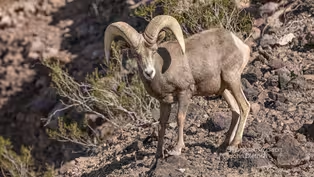
Tracking Bighorn Sheep in Sloan Canyon
Video has Closed Captions
Clip: S4 Ep2 | 3m 39s | Learn how Desert Bighorn Sheep survive in Nevada’s Mojave Desert. (3m 39s)
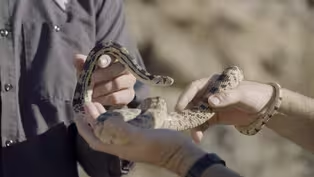
Understanding Desert Snakes with Nevada’s Reptile Biologist
Video has Closed Captions
Clip: S4 Ep2 | 8m 43s | Learn to identify Nevada’s native snakes and their role in the ecosystem with a reptile expert. (8m 43s)

Vegas Roots: An Urban Farm with Soul
Video has Closed Captions
Clip: S4 Ep2 | 5m 46s | Explore how Vegas Roots Garden grows food, community, and connection in the heart of Las Vegas. (5m 46s)

Wednesday Night Bike Ride Takes Over Downtown Las Vegas
Video has Closed Captions
Clip: S4 Ep2 | 5m 50s | A weekly night ride through Downtown Las Vegas brings bikes, lights, and community together. (5m 50s)
Providing Support for PBS.org
Learn Moreabout PBS online sponsorship












Support for PBS provided by:
Outdoor Nevada is a local public television program presented by Vegas PBS