Hello, Mr. Chuck!
Growth and Development
Season 2 Episode 9 | 27mVideo has Closed Captions
Mr. Chuck teaches kids about growth.
Mr. Chuck teaches kids about how different things grow, age and develop.
Problems playing video? | Closed Captioning Feedback
Problems playing video? | Closed Captioning Feedback
Hello, Mr. Chuck! is a local public television program presented by WKNO
Support for WKNO programming is made possible by viewers like you. Thank you!
Hello, Mr. Chuck!
Growth and Development
Season 2 Episode 9 | 27mVideo has Closed Captions
Mr. Chuck teaches kids about how different things grow, age and develop.
Problems playing video? | Closed Captioning Feedback
How to Watch Hello, Mr. Chuck!
Hello, Mr. Chuck! is available to stream on pbs.org and the free PBS App, available on iPhone, Apple TV, Android TV, Android smartphones, Amazon Fire TV, Amazon Fire Tablet, Roku, Samsung Smart TV, and Vizio.
Providing Support for PBS.org
Learn Moreabout PBS online sponsorship[birds chirping] [doorbell ringing] (children) ♪Hello!
Hello!♪ ♪Won't you be my friend?♪ ♪Hello!
Hello!♪ ♪Let's say it again.♪ ♪Hello!
Hello!♪ ♪Won't you be my friend?♪ ♪Hello!
Hello!♪ ♪Now you are my friend.♪ ♪♪♪ ♪H-E-L-L-O♪ ♪That's a word we all should know.♪ ♪H-E-L-L-O♪ ♪You can say it.♪ ♪Just say hello♪ ♪♪♪ Hey!
There's Mr. Chuck!
Well, hello, friend!
Hello, Mr. Chuck!
Oh, hello, friends!
I'd like for you to meet a couple of new friends of mine.
They're foster kittens from the Hu mane Society.
This is Ziggy.
He's three and half weeks old.
He's a very young kitten, but he's growing everyday and soon he'll be big.
This is Juliette.
She's a little bit older than Ziggy, but she's still a kitten.
Do you know what kittens grow up to be?
Cats.
That's right.
Have you ever seen a new born kitten?
When kittens are born, their eyes aren't open.
Oh, they can't walk very well.
And they can't do much of anything.
They need their mom to take care of them, to feed them, to bathe them, and to protect them.
As they get older, they learn to do things for themselves.
You know, after a time, they won't get food from their mom.
They have to find food on their own.
And hopefully, they'll have someone who loves them and cares for them to give them food.
They learn to clean themselves.
Oh, they learn to run and play.
And after awhile, they can protect themselves.
Then, when they're grown up, they won't need their mom to take care of them.
They can take care of themselves.
Some animal babies can walk from th e minute they're born.
Others are like these kittens.
They need to be cared for by their parents until they're ready to take care of themselves.
Well, a lot of how they grow up de pendsnnes on the kind of care they get from the beginning.
Whether it's from their animal moms or from people.
And if they receive the right kind of care, love, and protection, they'll grow into healthy strong adults.
No matter whether we're talking about a kitten or a human baby.
♪♪♪ ♪♪♪ (male #1) Yo u've learned to tie your shoe.
Just like the grown ups do.
Learn something new and we all grow.
♪♪♪ Can you tiwwwe it?
♪♪♪ You can button every one until the buttons are done!
♪♪♪ Ñ It's kind of fun because we all gr ow.
♪♪♪ Can you button it?
♪♪♪ You make the zipper go straight to the top!
I know it's hard at first, but we all grow.
Can you zip it?
♪♪♪ We all learn, and we all grow.
I want to be fireman.
I want to be a cheerleader.
I want to be big as my brother.
I want to be a chicken.
Bwack!
With proper care, all living things grow.
Here's a fun thing you can do to see how things grow.
Now here's what you'll need.
A Styrofoam cup, some potting soil, and some grass seeds.
The Styrofoam cup doesn't have to be new.
If you can recycle one from the trash and wash it out, it works just as well as a new one.
The first thing you do is take a marker, and draw a face on the cup.
Let me show you a funny way to make eyes.
Now you might want to practice this one on a piece of paper before you draw on the cup.
Here's a piece of paper and... these are kind of cartoon eyes.
First you draw a short, straight li ne.
Then you make a long, curved line that arches up and over like this.
♪♪♪ Now make a second one right next to the first.
♪♪♪ Try to keep them about the same si ze.
Then, put in the iris.
♪♪♪ The colored part of the eye is called the iris.
You can draw them anywhere in this area you want to.
I'm going to put them looking to one side.
You don't want a perfectly round ci rcle here.
Just draw a small crescent shape.
Like this.
And fill it in.
♪♪♪ There.
You know, you can pr??
?actics of expre?ñ?ssions by drawing the iris in different places.
Sure, try it.
It's fun.
Now, I'm going to draw eyes on my cup.
♪♪♪ There.
I think I need a nose.
♪♪♪ And a mouth.
♪♪♪ There.
That's done.
Now it's time to put in the dirt.
♪♪♪ Fill the cup almost to the top.
Like that.
♪♪♪ Then, put in the grass seeds.
♪♪♪ It doesn't take a whole lot, you kn ow.
♪♪♪ Spread them out over the dirt.
♪♪♪ Then put another thin layer of di rt over the top of the seeds.
♪♪♪ Water them a bit.
And put them in a sunny window.
Then watch each day.
Soon your grass seeds will sprout.
You'll have something that looks like this.
Oh, and don't forget to water it a couple of times a week, or they won't sprout.
Plants get their food from soil or dirt, but they also need water and sunlight to grow.
Remember, it will take a few days for the grass seeds to begin to sprout, so don't get discouraged.
Have patience.
Take care of your seeds and watch what happens.
(Mr. Chuck) What do you think lives here?
♪♪♪ Do you see any animals here?
♪♪♪ What kind of animal would live near a lake?
♪♪♪ Hiding in the tall grass is an egg.
But what kind of egg is it?
It's a??
duck egg.
Inside is a growing duckling.
After the mother duck has sat on th e egg for four w%D1T%F1D@3g2d Inside is a growing duckling.p 1éit D D starts to hatch.
First the baby duck uses its bi ll to make a crack in the egg.
♪♪♪ Then?
it uses its fos bi ll to make the crack bigger.
♪♪♪ Can you see the duckling's bill an d its foot?
♪♪♪ He's all curled up.
[chirping] He's almost out of the egg.
[chirping] When the duckling is finally out of the egg, he is very small.o He's too weak to stand or walk by himself.
Just like a human baby, it has to learn to sit up ÷6h9and stand by itself.Ñ> It takes a lot of energy to hatch out of an egg and this new litcí7wíçtle ducs re ady for its first nap.
I want to be a firefighter.
I want to be a astronaut.
I want to work on telephone wires.
I want to be a popsicle man.
But one time he went down the wrong road, and he didn't come down my road!
Hmph!
♪♪♪ (girl #1) I'm four and I can do lots of things.
♪♪♪ I can sweep the floor.
♪♪♪ Start in the corner and sweep to th e middle.
♪♪♪ You've got to pick up the dirt.
♪♪♪ First, I'll get the trashcan .
♪♪♪ I like to use this little broom an d this dust pan.
♪♪♪ Good-bye dirt.
♪♪♪ I'm four and I can do lots of things.
You can, too.
♪♪♪ Now friends, let's see if we've got any mail today.
Oh, yes we have.
And what have we got here?
Oh, here's one from Shelly Pusser I believe this is.
She not only draws a picture, but she sends us a letter.
A little note here that says, "I am four and a half years old and I go to Miss Debbie's."
"She is my babysitter."
"My name is Shelly and I decided to draw a picture of myself."
"I have blonde curly hair, brown ey es, love to talk, and love to play."
"My mom's name is Lori, my dad's na me is Tracy, and here's a sticker."
Oh, look at that sticker right down there.
That looks like a squirrel.
From Shelly Pusser.
Thank you very much, Shelly.
Very nice.
Here's another one here.
This one is from Jeanine Bowers.
And Jeanine, oh, let's see what she did here.
She not only drew a picture or three pictures there of her family.
Me, she says, and her mom and her dad and she writes me a little note.
"Dear Mr. Chuck, my name is Jeanine Bowers."
"I enjoy watching your show."
"I am nine years old."
"I am an honor roll student at Lakeview."
"My parents' names are Robert and Janie Bowers."
"I am in the third grade."
From Jeanine Bowers.
And guess what else?
She sent us a picture of herself.
There it is.
Thank you very much, Jeanine.
It's so nice to receive letters from my friends.
And here is another one.
Oh, this one's from Lashay White.
Lashay drew a very colorful picture here.
He says,"I'm six years old."
And he says he's drawn a house with a star on top.
Lashay did a beautiful job.
Don't you think so?
Take a look at that.
Look at the top - there's the st ar right on top of the house.
Lashay, I think you did a great jo b.
Must have taken a lot of time to do that.
Of course, you're such a good artist it probably didn't take very long.
Thank you, Lashay, Jeanine, and Sh elly.
You know, I like getting drawings and photos from my friends.
So if you'd like to send me a drawing or a photo of yourself just send it to... Then I'll share them with our friends right here on TV.
Just remember, I can't return them, so only send us the things you don't want to get back, okay?
[applause] ♪♪♪ Each child develops at his or her own rate.
You've heard that time and time again, but knowing that doesn't help if you as a parent are worried about your child's development.
What are some of the things you should know and look for as your child develops?
That's what we're going to learn about today on parent's corner.
Our guest is Barbara Blumenthal, a parent educator.
As concerned parents, we're very much aware of how our child is doing.
And usually in relation to our neighbor's kids or our nieces and nephews.
And we sometimes get concerned that our little Johnny isn't progressing at the same rate as someone else is.
Or perhaps a friend will tell you, "Well why isn't Johnny walking already?"
And we panic.
It's really not a good idea to panic, because Johnny is not like Jill, or Susie, or Tamika.
Johnny is Johnny.
Pediatricians give us a wide range of ages when our kids should be doing things and we need to be very aware that those ranges are large ranges.
Some children will sit without any support at six months.
Some children will take until eight months to do it and that's okay.
As long as they eventually sit.
Their gross motor skills, large motor skill development, is probably the first thing we recognize in children.
We get really excited when they start to sit.
They roll over first, and then they sit, and they crawl.
Pretty soon they're standing and walking.
And then we can't keep up with them because they're running.
And that's really exciting.
Their fine motor skills develop pretty much the same way also.
They build on each other.
First they start batting the toys with their hands, and then they touch the toy and pick it up.
And then they're switching from hand to hand.
And pretty soon they're doing pretty intricate things.
They're picking up little pieces of dust from the floor that you thought was clean and they're putting them into their mouth.
These are all skills that are building so that our children can eventually pick up a pencil and write.
They learn verbal skills, too.
When they're very little, we're concerned that they can listen, that they can hear.
And so we pay attention to whether or not they're hearing well.
And we take them to the pediatrician to be sure they can hear.
And then they respond to us and they smile when we talk to them.
And they're babbling, and pretty soon they're saying sounds that almost sound like words.
And so we get really excited and we encourage them.
And eventually they're talking in words and by the time they're two years old, some children are talking in very short sentences.
Some aren't doing it until they're three, but that's okay, as long as they're making sounds and they're understood.
They're learning other things, too.
They're learning about people, and shapes, and sizes, and objects, and textures, and all kinds of things that get them ready for the future.
What's happening in early childhood is that they're developing the building blocks for the future.
If you're concerned about your children - if you're really and truly concerned that maybe your child isn't developing appropriately, the best person to talk to is not your neighbor or your friend, but your pediatrician.
Because your pediatrician knows your child, has been observing your child, and is the expert in child development.
♪♪♪ Well friends, we've had fun today talking about growing.
You know, I feel like I've grown a lot since the show started.
I hope you do, too.
Thanks for watching.
Until next time, have a great day.
And keep growing.
So long.
♪♪♪
Video has Closed Captions
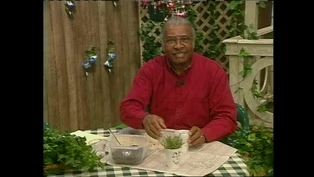
Clip: S2 Ep9 | 6m | Mr. Chuck teaches how to plant seeds in paper cups. (6m)
Providing Support for PBS.org
Learn Moreabout PBS online sponsorship

- Arts and Music
The Best of the Joy of Painting with Bob Ross
A pop icon, Bob Ross offers soothing words of wisdom as he paints captivating landscapes.













Support for PBS provided by:
Hello, Mr. Chuck! is a local public television program presented by WKNO
Support for WKNO programming is made possible by viewers like you. Thank you!