Utah Insight
Gun Violence
Season 4 Episode 4 | 26m 52sVideo has Closed Captions
Learn from experts about what can be done to stop gun violence.
Gun violence is on the rise in Utah, with a 5.6% increase in violent crime from 2019 to 2020. In Utah, one person dies from gun violence every 20 hours, and since 2010, the gun death rate has exceeded that of automobile deaths. How can we change this growing trajectory? What needs to be done to reduce gun violence in our communities? Learn from experts about what can be done to stop gun violence.
Problems playing video? | Closed Captioning Feedback
Problems playing video? | Closed Captioning Feedback
Utah Insight is a local public television program presented by PBS Utah
Utah Insight
Gun Violence
Season 4 Episode 4 | 26m 52sVideo has Closed Captions
Gun violence is on the rise in Utah, with a 5.6% increase in violent crime from 2019 to 2020. In Utah, one person dies from gun violence every 20 hours, and since 2010, the gun death rate has exceeded that of automobile deaths. How can we change this growing trajectory? What needs to be done to reduce gun violence in our communities? Learn from experts about what can be done to stop gun violence.
Problems playing video? | Closed Captioning Feedback
How to Watch Utah Insight
Utah Insight is available to stream on pbs.org and the free PBS App, available on iPhone, Apple TV, Android TV, Android smartphones, Amazon Fire TV, Amazon Fire Tablet, Roku, Samsung Smart TV, and Vizio.
All Episodes Now Streaming
Hosted by Jason Perry, each week’s guests feature Utah’s top journalists, lawmakers and policy experts.Providing Support for PBS.org
Learn Moreabout PBS online sponsorship(light music) - [Announcer] Funding for "Utah Insight" is made possible by viewers like you.
Thank you.
- [Raeann] Coming up on "Utah Insight," gun violence continues to be a major issue in Utah.
- We see more weapons related incidences on our campus since before the pandemic.
- [Raeann] Lawmakers and communities are grappling with solutions to prevent future tragedies.
- It's gonna make people think twice about bringing things that they shouldn't have into the schools.
- [Raeann] And in the wake of recent school shootings across the country, what security measures are being taken here in our state?
(light upbeat music) Welcome to "Utah Insight" I'm Raeann Christensen.
Gun violence is a growing problem in the state of Utah and is labeled as a public health crisis.
The League of Women Voters of Utah did an in-depth study this year, compiling information from different agencies.
It reports Utah's population grew 18.4% over the previous decade compared to 6.7 nationally, but the rate of gun deaths surged 26% in Utah compared to an 18% increase nationally during the same period.
In 2020, Utah had the 34th highest gun death rate in the US with 429 firearm related deaths, 339 of them from suicide.
Consistent with 2020, guns were involved in most of Utah's 2021 homicides.
That is a lot to digest there.
In joining us in the studio tonight to talk about all of this, we have Dr. Samuel Cheshier with the Black Physicians of Utah, Nancy Halden with the Gun Violence Prevention Center of Utah, and Christopher Peterson, professor at law at the University of Utah.
Thank you so much for being here.
We do have a lot to talk about.
The biggest gun violence issue here is gun suicide.
So I wanna start there.
Dr. Cheshier, what do you think are the factors contributing to the high rates of gun suicide in Utah?
- Well, the number one cause of death by suicide is by having a gun and attempting the suicide by the gun.
And the number one correlation to dying of suicide by a gun is having a gun in the first place.
So during the pandemic, which affected mental health very negatively, at the same time, much more guns were bought during this time in the country.
So in Utah, much more guns were bought combined with a huge mental health crisis the pandemic caused led to these greater numbers of suicides.
- Okay.
And Nancy, what initiatives or strategies do you think are being implemented by Utah or need to be implemented to address the root cause of gun suicide?
- I think the single best thing that's been done so far is the Safe Utah app.
And that is that all we need to do, I think we can do more than that, but I think that has had an effect here.
And we have seen the gun suicide rate flatten off in Utah.
It was going up just alarmingly steeply for a long period of time.
And it is, that curve is starting to flatten and I think that Safe Utah app has made a difference.
- It is making a difference a lot with the high school students as well, the kids.
Chris, how can consumer protection measures be strengthened in Utah to help prevent individuals at the risk of gun suicide?
- Yeah, well, I think the first thing to recognize is that one of the challenges that we have in our political system, our politics in the state of Utah and across the country, is I think a folklore that's been built up over time about what the Second Amendment of the US Constitution says about that state legislatures and Congress can do to try to promote guns safety and prevent gun violence.
And I think the thing that I'd want to emphasize is that the Second Amendment historically only said something about the right of citizens to have flintlock muskets in their homes in order to repel invasion by the British or the French.
It didn't say anything about many more modern forms of weaponry and all of the other things that we might do to try to make those weapons safer for kids at home and to prevent things like suicide and domestic violence.
And so I'd want to emphasize that the state legislature in Utah not only has the power to promote more consumer protections, protections against gun violence, but in fact, the framers of the Constitution said that we needed to have, you know, a well-regulated militia, that well-regulated part, it seems to me that we've forgotten that, we need to start experimenting with things like required gun locks, trigger locks.
We need to start thinking about whether or not there are new technologies that we can have installed and imposed on guns to protect people from getting ahold of them and using them in ways that we didn't anticipate.
And so, I don't wanna go on too long, but I think there's a broad variety of different things that the state legislature can do to try to promote that well-regulated space for gun violence that the framers of the Constitution originally contemplated.
- Okay, and back to the mental health side, Dr. Cheshier, over half of Utah's suicide victims die using a firearm.
How has the issue of gun suicide affected the mental health services and support systems here in the state?
- They stress them unbelievably, but unfortunately there's certainly not a commitment to mental health in our whole society as general and especially Utah, well, not especially Utah, but just Utah included.
I would say that we know that people who have committed suicide, their rates of utilization of the mental health system is just as bad before, just as bad after.
So they don't increase their utilization of the system.
And the problem is they don't have access to it, they can't afford it, nor do they know how to even access it.
So that's a huge problem.
- We need to expand on that for sure.
Homicides in Utah have soared over the last 10 years significantly outpacing Utah's population growth.
The CDC reports the homicide rate here in Utah is up 127% with 2020 and 2021 ranking as the two most deadly years on record.
And from every town for gun safety, Black Utahns are more likely than any other racial ethnic group to be killed by a gun, by a gun homicide, five times more likely than white Utahns, three times for the Latino population.
Back to you, Dr. Cheshier, why do you think gun homicides disproportionately impact those groups?
- They're disproportionately disenfranchised, they're disproportionately in poverty and they're disproportionately discriminated against in this country in general and in Utah.
So this has been well studied over many, many decades.
And those are the root causes of increased gun violence in the Black community.
- Do you think education is the key to fixing it?
- No, I don't.
We've tried to, it's like educating people not to be prejudiced.
It's like educating a red zone away.
It's like educating a whole area that's been disenfranchised.
You have to actively, structurally change the governments and the policy making in order to fix those sorts of things.
You know, there used to be a war against poverty in this country and it was incredibly successful for the white population.
Unfortunately, it just wasn't successful for the Black population because those rights just weren't afforded to them at that point.
- Okay.
That's not great.
So Nancy, what are the possible reasons do you think behind 2020 and '21 being the deadliest on record?
Do you think it was the pandemic?
- Absolutely.
What happened during the pandemic is people were fearful.
We hadn't experienced anything like that in our lifetimes.
And so, and when people are afraid, they often go out and buy guns.
And the gun industry has actually marketed that way towards people's fears.
And so it was very successful for those two years.
People went out in droves and bought guns.
Those people we know were primarily people who had not owned guns before, so they were not well educated in gun ownership and safe storage and the kinds of things that you would hope responsible gun owners would know.
And at the same time here in Utah, we did away with the concealed carry permitting classes.
And so a lot of those people that might have gotten trained otherwise didn't have to, and they didn't.
So again, and when you talk to, when we talked to the police about this period of time and the soaring homicide rates, they said that a lot of those guns were stolen out of cars.
So people were carrying the guns with them.
They were inexperienced, they didn't store them safely and they were stolen out of cars and they ended up being used in crime.
- Okay.
Chris, what steps do you think that need to be taken by law enforcement agencies, policymakers in Utah to address these soaring homicide rates?
- Well, homicide's obviously a complicated phenomenon.
There's a lot of different things that lead to death, homicide deaths.
One that we haven't mentioned so far though is that one of the leading forms of homicide in our country is in domestic violence.
You know, violence between a spouse or boyfriend, girlfriend, husband, wife, et cetera.
And I think that one step that we should be looking at is ways to try to get guns out of volatile domestic relationships.
You know, we have a system in place for establishing protective orders, but I think that the state legislature states around the country and Congress need to look into trying to provide better vehicles for removing guns from situations when a husband and a wife, a domestic partnership are breaking up.
That's one of the most vulnerable times for women when tensions are running high.
The couple is feeling hurt.
And if a gun is there, a simple fight, a squabble can escalate to where somebody dies.
We need to get guns better regulated and out of those situations.
- Okay, Dr. Cheshier, I would love to hear your response to this, because same with suicide.
If they have access to the gun, it's there.
That's when it's being used.
Similar with domestic violence.
- I'm glad he brought up this situation.
There are 1 million women in the United States who have been shot, right now.
And 70% of them were shot in a domestic violence situation.
So that is a huge problem.
Of course, having access to the gun allows you to use the gun and the number one correlation of dying by gun violence is the presence of a gun.
It's not mental health, which is what we tend to focus on when these sort of incidents happen.
And so that's a very important issue.
I wanted to talk about your idea of looking at the Constitution in a different way.
That's a very important point.
But we live in a system right now where the current Supreme Court interprets it as unfettered access.
And in this country, historically, we've said, well, we're gonna give broad access to guns and on the margins, figure out who shouldn't have a gun.
Whereas most societies and our Western peers, they wanna limit guns for almost everybody and figure out on the margins who actually needs a gun.
And we're actually one of the very few Western countries at least that has guns for protection.
Most people even in places like Switzerland and Iceland with higher gun rates, they don't have guns for protections, they have guns for hobby, sport, and hunting.
And 50% of the guns bought in the US are handguns for protections.
So I think it's gonna be tough to legalize ourselves out of this because historically we just aren't there.
And currently the state of the Supreme Court isn't there to increase regulations despite the fact that most people want them.
- Do you think we're gonna get there?
- Well, yeah, so there's a lot of what you're saying that I agree with.
100%.
And you know, the case that really paved the way for what you're talking about was the DC v. Heller decision back in the early 2000 odds written by Justice Scalia.
And it was a five to four decision, a very close decision.
And you know, it was the first time in over 200 years where the US Supreme Court held that there was an individual right to bear arms for self-protection.
Earlier decisions in the late 19th century, the early 20th century had a very narrow reading of the Second Amendment, but it was only a five to four decision.
But even in that case, in some of the more recent Supreme Court cases, there's a lot of dicta, language in the Supreme Court's decisions that say that that safety regulations are still permissible.
And part of that is still grounded in the well-regulated clause within the Second Amendment.
And so I agree with you, it's a problem for us.
We have a gun culture that is more enshrined in our basic laws than in virtually any other industrialized country in the world.
And that's part of the reason that we're seeing thousands and thousands of people across the country dying needlessly.
But my view is that we can't give up.
There is space in the United States Constitution quite a bit left for us to find new and insightful ways to try to promote gun safety.
And we have to keep on pushing.
Why?
Because the people that we love, the people we care about, they need us to take a leadership role in protecting their safety.
- Okay, in switching topics on this, the Granite School District reported 28 weapon-related instances this school year compared to single digit numbers before the pandemic.
That number encompasses any tip relating to the possibility of a weapon on or near school grounds, whether the tip is founded or not.
"Utah Insight"'s Liz Adeola gives us a look at the many ways district leaders are responding.
- [Officer] Ready?
I'll sit him down.
And kind of calm him down a little bit.
I'll talk to him in calm tone, take off his leash and give him his search command.
- [Liz] What happens next is we see Bolt, well do exactly what his name implies, bolt into action.
- [Officer] He's came a long ways.
He's actually listening to me.
- [Liz] Most of the time.
- [Officer] He's trained in German and Dutch and he can definitely recognize my tones.
He picks up on body language, emotions, tone, if something's serious, if it's not, if it's work time.
- [Liz] And right now Bolt is on the clock, so to speak, racing against time to find a weapon that's unloaded for the sake of this demonstration in this school library.
- [Officer] He's going around trying to find the smell that he has associated the toy with.
And once he does, then he tries to pinpoint it.
And when he does, then he just locks up.
- [Liz] Ready for his reward.
- [Officer] We're still learning each other, so I'm still learning how to be able to read him.
Good boy.
You might need a little help.
As much as he's still learning what I want him to do so it's just, it's a continuous process.
- [Liz] Like the Granite School District's ever evolving efforts to keep everyone safe at school.
- Complacency is not an option.
So if there's a tool or a resource that's available to us, we're gonna explore that with vigor and hopefully find a good balance that works for all of our schools.
- [Liz] Granite School District Spokesperson Matt Sampson says lately there's been a spike in weapons and threats of weapons being brought to school in the district.
- It's concerning 'cause we're seeing incidents like this increase.
We see more weapons related incidences on our campus since before the pandemic.
And we want to try and do what we can to try and stop this situation before it escalates or gets any worse.
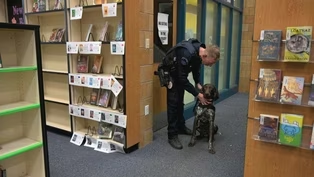
- [Liz] So far, district leaders say they've spent $50 million over the past five years on security upgrades like a touchless scanner, weapons detection system piloted first at Hunter High School and the district's first gun detection canine unit focused solely on that purpose.
- We can quickly deploy Officer Penrose and Bolt to one of our schools and have them search through that campus much quicker than it would take our officers in any type of traditional search.
- [Liz] While technology has provided a way to cut down the time it takes to communicate danger.
- Seconds can save lives.
Catapult, EMS gives an ability for a teacher in any classroom to send an alert from their phone or from their email, which would also include like their GPS location.
So say if they saw somebody suspicious, they can send that out and that's an alert that goes out through the entire school.
It then also goes to our site safety team who will evaluate that threat, but they're able to communicate with that.
They can send a text message or an email and say, I'm secure.
All of my students are in my classroom and accounted for, this is where I saw that person.
And then everybody else can respond to that message within a school and also check in and provide like GPS locations.
There's no one approach that's gonna magically solve any type of safety issue when it comes to school safety, student staff safety.
So we're looking at different strategies and different tools and resources that we can use.
- [Officer] Ha!
Good boy!
- [Liz] Even just spreading the awareness of Bolt's presence in the district.
- It's gonna make people think twice about bringing things that they shouldn't have into the schools.
Go ahead.
My whole goal is to prevent tragedy.
- [Liz] Reporting in Taylorsville, Liz Adeola for "Utah Insight."
- I also know that the odds are that it will happen here in the state of Utah someday.
And I'm probably gonna have to be the one to stand in front of those parents and look them in the eye.
And it's going to be devastating if I can't in good faith say we tried to do something.
- That was Governor Cox speaking about school shootings last year and basically saying it's when, not if.
And we do know that schools are taking proactive measures.
Nancy, do you think it's enough or do they need to do more?
- I think it's sad that we've gotten to this point where we have to have gun sniffing dogs in schools.
We have to have our kids go through metal detectors.
I spend a lot of time talking to parents and students at tabling events that we do and students are terrified by active shooter drills.
You know, there's a mental health impact on our students that I think we can't ignore about these protective measures.
And I would like to see us back it up and get those guns out of the hands of people who shouldn't have them ahead of all of that.
So I would like to see better safe storage laws.
We don't have durable safe storage laws here in Utah and that could make a really big difference.
We could do more to encourage gun owners to get biometric safes and locks and lock their guns up and keep them away from students so that students, I mean, most of those guns have been taken from the home.
- [Raeann] Absolutely.
- So it sort of falls on the parents to store those guns safely.
- Absolutely.
- I agree.
It's absurd, right, that we are having dogs sniff at our schools, security guards, policemen, more power to them, and metal detectors.
It's absolutely absurd that we accept this.
And I like what you said about the locks.
I saw a statistic out of the CDC recently that said that if just half the people who currently don't have locks on their guns or safe places to put them, had them, the gun violence rate would drop about 50%.
So they just spent $50 million more in security, that could have bought hundreds of thousands of gun locks or hundreds of thousands of gun safes- - [Nancy] Or mental health.
- Or a lot more mental health.
I agree.
- All those things I would rather see that money spent for, yeah.
- So we've been seeing in the legislature that they're mostly expanding access to guns rather than gun control.
Chris, how do you think we find that balance of keep keeping people safe versus infringing on their rights?
- Well, I don't think that the governor can say in good faith that they've done anything that is going in the right direction toward trying to keep our kids safer.
You know, back to the gun lock point, we as a country have done a lot to try to make our guns more lethal and more broadly accessible.
In comparison to the old flintlock muskets that the Second Amendment was talking about, now we have widespread assault rifles, large clips, you know, machine guns, et cetera.
But at the same time that we've had enormous advances in our technology, you know, if I wanna make a phone call on my phone, I have to have a biometric recognition, either of my face or my thumbprint every time I wanna send a text message.
But if I want to take out a gun or have a gun that's available for a child to shoot somebody, we don't have anything along those lines in terms of biometric recognition, that's an area where we could continue to have guns available as some folks in our community want, but where we could use emerging technologies to better protect children.
- Okay.
And Dr. Cheshier, I wanted to talk to you about the mental health aspect.
I know that parents and kids are scared, they're scared to go to school, parents are scared to send their kids to school.
How can we get through this?
Like I know it is scary going through a detector and having all of those things.
It's gotta be playing an impact on their mental health.
- Yeah, I mean, so logically there's two things you can do.
You can provide more mental health resources for them in school counselors and resources of that nature for them to deal with the situation.
Or the other logical thing to do is, like she said, just sort of back up on all of that and start doing more constructive things that will actually reduce the gun violence in the first place.
- Keeping guns out of unsafe hands.
We've got do a better job of that.
And you touched on the crisis intervention orders, the extreme risk protection orders.
That is a really good law that could save a lot of lives here in Utah.
It touches on the, I think the three things that people are, our two biggest problems, gun suicide and domestic violence homicide.
And it also has been very effective at heading off mass shootings.
And there's federal money for that now.
So there's really no reason 19 states have adopted that, it has a long track record.
There's in some states it's been used for 20 years.
So there's a lot of data that shows, and especially with suicides, it's a very successful law.
- I think those laws need to be implemented in the appropriate way.
For instance, there was a red flag law that should have stopped the shooter in Buffalo, but it did not.
And people look at that as a criticism against those red flag type of laws.
When in reality was a year before that, that person was actually attempting suicide and attempting to kill others.
And he got put in by the police and for whatever reason the police didn't put the red flag all in.
But the red flag law was actually quite new.
So the policemen may not have been informed.
And where it looks like they work the best is when there's specific parts of the police department that are trying to enforce those red flag laws.
There's specific programs within them.
So I would hope that the state legislator gets on board with that, but I hope that they would implement those laws in a proper way that they're actually effective.
- Yeah, there needs to be a lot of education in the system not just with the police but also with the health community about how to implement those laws and effectively.
- Okay, and we are almost out of time, but I do wanna give you 30 seconds, Nancy, to talk about what's going on with the tool on the desk.
- So I brought a prop, this used to be a gun.
We have an event this Saturday from nine until noon at Christ United Methodist Church on 33rd South.
And what we do is we take guns that are no longer wanted or being used and people feel like they might be a liability in their home.
They wanna make sure that they are not going to get into the wrong hands.
This was the barrel of a gun and it was flattened out and this was the stock of a rifle.
And we send the parts to RAWtools in Colorado and they make these beautiful garden tools.
Hope you can see the detail there.
- Thank you.
I'm glad we got that in.
And we are out of time.
It goes by so fast, especially with these deep topics.
So thank you so much for being here.
Another important topic discussed and we will see you back here next week.
(light upbeat music)
Video has Closed Captions
Clip: S4 Ep4 | 3m 41s | With gun violence increasing, Utah schools are getting creative to keep students safe. (3m 41s)
Preview: S4 Ep4 | 30s | Learn from experts about what can be done to stop gun violence. (30s)
Providing Support for PBS.org
Learn Moreabout PBS online sponsorship
- News and Public Affairs

Top journalists deliver compelling original analysis of the hour's headlines.

- News and Public Affairs

FRONTLINE is investigative journalism that questions, explains and changes our world.












Support for PBS provided by:
Utah Insight is a local public television program presented by PBS Utah