
Gun Violence/Chief White
Season 49 Episode 44 | 26m 46sVideo has Closed Captions
Gun Violence/Chief White | Episode 4944
A closer look at the increase in gun violence here in Detroit. We’ll talk with residents about how the violence has affected their lives. Plus, Stephen has a candid conversation with Detroit police Chief James White about finding solutions. Episode 4944
Problems playing video? | Closed Captioning Feedback
Problems playing video? | Closed Captioning Feedback
American Black Journal is a local public television program presented by Detroit PBS
Gun Violence/Chief White
Season 49 Episode 44 | 26m 46sVideo has Closed Captions
A closer look at the increase in gun violence here in Detroit. We’ll talk with residents about how the violence has affected their lives. Plus, Stephen has a candid conversation with Detroit police Chief James White about finding solutions. Episode 4944
Problems playing video? | Closed Captioning Feedback
How to Watch American Black Journal
American Black Journal is available to stream on pbs.org and the free PBS App, available on iPhone, Apple TV, Android TV, Android smartphones, Amazon Fire TV, Amazon Fire Tablet, Roku, Samsung Smart TV, and Vizio.
Providing Support for PBS.org
Learn Moreabout PBS online sponsorshipJust ahead on "American Black Journal," we have teamed up with Bridge Detroit to take a closer look at the increasing gun violence here in Detroit.
We're gonna talk with residents about how the violence has affected their lives, plus I'm gonna have a candid conversation with Detroit Police Chief, James White about finding solutions.
You don't wanna miss this special show.
"American Black Journal" starts right now.
(upbeat music) ANNOUNCER: From Delta faucets to Behr paint, Masco Corporation is proud to deliver products that enhance the way consumers all over the world experience and enjoy their living spaces.
Masco, serving Michigan communities since 1929.
ANNOUNCER: Support also provided by the Cynthia & Edsel Ford Fund for Journalism at Detroit Public TV.
ANNOUNCER: The DTE Foundation proudly supports 50 years of "American Black Journal," in covering African-American history, culture and politics.
The DTE Foundation and "American Black Journal," partners in presenting African-American perspectives about our communities and in our world.
ANNOUNCER: Also brought to you by AAA, Nissan Foundation, Inpact at Home, UAW, Solidarity Forever, and viewers like you.
Thank you.
(upbeat music) Welcome to "American Black Journal."
I'm Stephen Henderson.
Today, we're dedicating our entire show to a frank conversation about gun violence.
We've seen a spike in shootings over the past year and a half, not only here in Detroit, but in other major cities across America.
What's causing that increase in violent crime, and most of all, what can we do to end it?
We start with a look at how the violence is leaving a lasting mark on Detroit residents.
Bridge Detroit reporter, Bryce Huffman, and "American Black Journal" producer AJ Walker, have the story.
BRYCE: What does it mean to lose someone to gun violence?
Well, for Sherri Scott, it means never seeing her daughter Francesca again.
Frankie was the life of our family.
You know how you had that one person, and she was that one person.
She was that one.
BRYCE: Scott says everyone called her Frankie, from her neighborhood friends to her nieces and nephews.
On August 3rd, 2019, Frankie Marks took her seven kids to Rouge Park on Detroit's Westside for a day of fun and barbecuing.
A dispute broke out on the basketball courts, then shortly after, Frankie and her kids heard gunshots.
Francesca was safe, but when they started shooting, she ran to her baby to get her baby, and that's how she got shot.
BRYCE: By the time Scott learned heard her daughter had been shot, things weren't looking good.
She drove to the hospital, but it was too late.
When I got to her, she wasn't cold, and I just held her hand until her body stiffened up.
BRYCE: Frankie was 30 years old.
Scott remembers trying to tell her grandkids that Frankie, their mom, was never coming back.
It was horrible, watching these kids, seeing that they'll never see their mom, it's just horrible.
BRYCE: Scott wishes people took time to think before acting out in violence.
I don't understand why people go to the park and start shooting or even contemplate shooting anybody.
How do you do that?
I don't understand it.
There are families up there.
You go to the park to relax, you go there to enjoy your family, read a book or something.
BRYCE: Frankie was just one of 102 people to die of gun violence in 2019 in Detroit, and her family was just one of the many families in Detroit to lose someone to gun violence.
Two years later, Scott returns to Rouge Park.
There's a rally all about ending the senseless violence that took her daughter.
And the last time we did the parade, the Stop the Violence parade, was when Francesca was alive, and she was, doggone near leading the parade.
So it feels odd to be having this parade and she's not involved in it while she's alive.
Now it's because she was killed by the very thing she was marching against.
BRYCE: Detroit Police Chief, James White, attended the rally.
He says these shootings rob so many families of great people like Frankie.
It robs all of us.
It robs us of Francesca, it robs us of her opportunity to not just live, but we never know what she could've been, and it's just very tragic when you have situations like this that happen all too often in our city, where we're losing people and it's just very, very tragic.
BRYCE: For some Detroiters, that feeling of loss stays with them for a long time.
Mia Reid lost her son, Charles to gun violence back in 2011.
I can tell you that I was devastated, my daughters were devastated, my family was devastated, and I think the community that loved him was devastated.
That will not bring him back.
BRYCE: Charles Reid was 24 when he and his cousin were shot and killed in Detroit.
After a long time of grieving, Reid decided she wanted to help other grieving parents.
That's when she joined Moms Demand Action for Gun Sense in America.
Many of them can relate to the experience that I have had with gun violence.
BRYCE: Aside from being a good support group, Moms Demand Action works with organizations in various communities that are working to curb gun violence.
Reid says she wants to support those that are already doing the work.
We have volunteers that work in Lansing and in Washington, to help bring awareness to the gun violence safety bills that we need to pass in order for us to be safe.
Moms Demand Action is all about safety.
BRYCE: One piece of legislation Moms Demand Action is currently fighting for is the Red Flag Law.
The Red Flag Law, knowing that somebody that has a gun and should not have it, that is going to flag the person that is selling it to them so that they can pause for a minute, and do some background checking.
So expanded background checking.
BRYCE: Reid says she's done a lot of research on gun violence since her son was murdered.
She says communities can't fix the problem until they start at the root.
Oftentimes, people don't focus on the root cause.
Gun violence is just a symptom of the root cause, which is poverty, so when people feel desperate, when people don't have the most basic things that they need, oftentimes, they will revert to crime.
BRYCE: Dujuan Kennedy is a Detroiter who understands the root causes of gun violence.
He knows firsthand because when he was young, he shot and killed one of his friends and spent 14 years behind bars.
Now that he understands the cycle of violence he was living in, Kennedy wants other people to learn from his mistakes.
Like that's why it means something to me.
That's why it's something to me, 'cause I know why I was doing stuff.
You know what I mean?
So I know why the next person may be doing stuff, and I know if I survived something, I have a responsibility as a survivor to make sure the next person has, is warned, before they do what they do.
BRYCE: Kennedy works with Force Detroit, a local nonprofit that works to build a freer and economically just future for Black and Brown Detroiters.
Kennedy spends a lot of his time talking to people who were dealing with the same cycle of violence that he was in.
I know what I did, I know what was going through my mind, so I try to share some of the things that helped me process things, and use my best thinking in the future, so.
BRYCE: Kennedy says doing this work keeps him on the right track.
Personally, it's been helpful for me, and the people that I have relationships with, that know how I was in the past, it gives them a perspective or a point of view that they can dialogue, it's like, I'm right here.
So you can talk to me about why I've changed, why I'm not doing this.
BRYCE: He works alongside Alia Harvey Quinn, who is the executive director at Force Detroit.
She says right now, the team's looking to other cities for solutions to gun violence.
It's fascinating when you get people who have been exposed to violence, who have been shooters themselves, or community leaders, when you get them to be exposed to these programs that are in other cities, and they're publicly funded, they're supported, and then, we realize, the absolute lack of resources that we have in Detroit, the absolute lack of infrastructure.
Harvey Quinn says, other cities are finding more success than Detroit because they invest in the organizations doing this work.
Why is it important that these things are publicly funded?
When you prevent one person from continuing a high violence lifestyle, statistically, you save six lives.
BRYCE: Detroit Police expect the number of shootings to slow down as the weather gets cooler.
Meanwhile, lots of people are working hard to end the violence that is taking so many Detroiters away from their loved ones.
This summer, President Joe Biden announced a new strategy to combat the surge in violent crime.
His plan includes a zero tolerance policy for gun dealers who violate the law, and the deployment of strike teams to crack down on illegal gun trafficking.
The president is also encouraging cities to use federal pandemic relief funds for policing and for crime prevention.
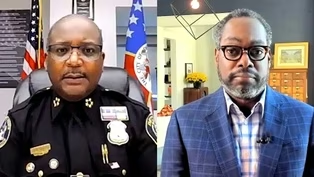
I sat down with Detroit Police Chief, James White, to talk about his efforts to reduce gun violence in Detroit.
Chief James White, welcome to "American Black Journal."
Thank you, and thank you for having me.
I should actually say welcome back to "American Black Journal," because we've had you on the program before, before you were Detroit's police chief.
Yes.
I believe we talked to you about kind of alternative methods of policing and the kind of reforms that we were implementing here in Detroit.
I wanna start this interview, though, with the gun violence that we are dealing with in the city of Detroit.
I don't need to remind anybody, I think, of just how harrowing it is.
I got up this morning, watched the news, and one of the first stories was about a couple of parents who were essentially executed in front of a young child at a gas station.
Talk to me about where we are as a city, getting a handle on gun violence and the death that follows it.
Yeah, and you know, gun violence continues to be a problem in our community.
And it's not something that is as simple as arresting your way out of it.
I mean, you know, short of having a police officer with every single person who's going to make a bad decision to use a weapon to resolve relatively simply conflict, that's the answer, right?
I mean, that's not a realistic approach.
So what we've done here, we've tried a number of different approaches, and we're gonna continue.
We implemented our five point strategy, where we focus our efforts and our attention and our resources into what we call our hot spot areas, where crime is likely to occur, and we get the officers out there at a high level, engaging proactively but responsibly and constitutionally enforcing the law.
Right, so you can do that in a number of different ways.
High visibility is the primary component to that endeavor, to have the officers visible, in hopes that people will simply see the officers and make different decisions.
The other approach is to those high offenders, those offenders who have already offended, who are likely to reoffend, those who are walking the streets with illegal weapons, those who have felony warrants out for their arrest, to engage them and get them off the street.
And then, certainly, when we look at what happened when I first returned with the baby, the two year old little Brison on the freeway, where he was caught in the crossfire, and lost his life, with adults making bad decisions who used weapons to resolve conflict.
We later learned that the vehicle wasn't even part of the conflict, just looked like the vehicle that the people were looking for.
And that poor baby lost his life, and you know, with that, we engage some other agencies, our partner agencies from around the state.
We've got about 25 police chiefs that were as outraged as I was, and agreed to partner with us on this coalition with Operation Brison where we're patrolling the freeways and we're trying to do everything we can to reduce these things, but at the end of the day, it's not just the police, it's and the police.
We need the community, we need our clergy, we need our courts, we need our prosecutor's office, we need our mental health resources, because we really, at the end of the day, we wanna change decision-making, we want people to not use a weapon to resolve a dispute.
You know, you talked about the horrible incident with two 22-year olds that were killed at a gas station, and thank God, this nine month old baby, who the mom was holding at the time, was not injured, and if not for God, I'm telling you, I just don't think that, I mean, it's just no other excuse for it, right?
I mean, it's just unbelievable.
So thank God, if any bright spot is that the baby wasn't killed.
But at the end of the day, you've got now two parents that won't see their child grow up.
You've got a child who won't see her parents, or his parents, and so, it's just awful.
And so, as we're unpacking that case, we've got a couple different things that we're looking at, but at the end of the day, again, using a weapon to resolve disputes, and that's what this is going to turn out to be, as well.
So I wanna talk just a little about the pandemic, and the possible effect it's had on gun violence.
All across the country, of course, we've seen more gun violence in the wake of the pandemic.
There's been a lot of research that suggests why that's true, but I'd love to hear you talk about how and whether you think gun violence in Detroit is different because of the pandemic.
Are we seeing the same things that are happening in other places happen here, or is our problem somewhat separate from all of that?
Yeah, you know, that's a fantastic question, and we look at that.
We have our analysts looking at that.
We're following and tracking what's happening around the country, and not unlike any other major city, we're seeing an uptick in violence, as well.
I mean, I'm happy to report, since I've returned, we have started to see a trendline that favorable for us, as it relates to gun violence, and certainly, as it relates to homicides, but we're not ready to take a victory at all.
I mean, one homicide is one too many, one mother losing their child is one mother too many, so I'm certainly not suggesting that we've turned a corner.
But we are looking at how we're impacting crime.
But to your point, you know, COVID has had just one of the most, I mean, no one knew what it was a year ago, no one knew the word, practically, right?
And so, now, we're at a place where we're looking back, just under two years ago, and looking at the trendlines in crime and then looking at them today, you have to ask yourself, what is the impact?
Well, you could argue that being sheltered in place for a year, not being able to engage, you look at some of the economics of the life we live now with the workforce, and I would argue, there are some disposable income issues that, I think that people have opportunities now to engage differently with crowds and parties and things like that.
I don't know if you track this, but I have been, during the COVID emergency, there were record gun sales in this country, and there was record ammunition sales in this country, and for a while, there, you couldn't even get ammunition for weapons, and I think people having more accessibility to weapons and whether you're talking illegal or a legal, more people buy legal weapons, they get stolen, or they get improperly secured, and someone takes them.
Now you have more illegal weapons, and the resulting bad decisions that come from having accessibility to those weapons, I do believe is driving our crime.
Now you could argue, is that because of COVID?
I think you could certainly point to some aspects of COVID that made what we're dealing with right now reality, because when you look back at pre-COVID-19, the trendlines were very different, and so, what changed?
COVID changed, and how people interacted changed.
I think that we have impulsive decision-making, I think that illegal marijuana trade is big, because even though you have these refineries popping up, the potency is different than the illegal drug trade, and the illegal marijuana, and just like any other industry, there has to be competition.
So you've got competition with the illegal drugs, or specifically, marijuana, and then, God only knows what's in that, because I do see really interesting behavior coming from folks that's on that stuff.
So it's a lot that's driving where we're at right now.
Yeah.
There is, of course, a lot of conversation, as well, about policing, and the way police interact with different parts of our community, especially the African-American community.
You're somebody who I remember having really interesting ideas and thoughts about the ways in which policing should change, the ways in which policing has an opportunity to change.
Talk about how those ideas fit into this real challenge of getting control of the gun violence in our state.
Well, I think it starts with trust, you know?
And you know, regardless of where you sit, whether you're police, non-police, there are unique ideas and concerns with every community.
Right?
I mean, our community, nor do I support defunding the police.
I mean, I just don't think that that's a realistic approach to the problems that we have in our community.
But certainly, looking at policing and holding policing accountable is, you can have that.
You can have accountability in policing, you can have responsible policing.
You know, you can have constitutional policing.
And you can have interaction and healthy interaction, but it starts with accountability, transparency.
From a leadership seat, I've gotta get out in front of these issues that come up in policing.
We're the largest policing agency in the state, and with any other, just like any other industry, you're going to have people who make decisions to not follow every rule, whether it be any industry.
I mean, media, I'm sure there's somebody that violates the policy.
The difference, though, in policing, is a violation of policy, for us, can erode credibility with the community.
And so, and that one person, that one officer, can represent 2,000 police officers with one act.
And so, when those acts happen, you have to take swift action.
You have to be accountable to your community.
You have to tell the community what happened, and what you're doing about it, and what you're gonna put in place to ensure that it doesn't happen again.
And I think, when you do that, people are reasonable enough to know that people will violate rules.
And when you're up front and transparent, and you make the corrections, you can maintain that credibility with your community.
It starts with your community, because at the end of the day, if the police agency has no credibility in the community, you won't be effective.
You need the community to be an effective policing agency and so, my ideas are nothing new.
But it just has to be constantly reinforced.
You have to have a healthy relationship with your community in times of peace, so when things happen, and not if they happen, but when they happen, you can lean on those relationships prior to conflict, to identify, really, the character of your agency, because the character of your agency is on display every single incident, and how the chief and the assistant chiefs and the deputy chiefs manage that organization.
Yeah.
So give DPD a grade, as you come into the job, in terms of how it's doing, with that kind of transparency and accountability.
We, of course, have incidents where police are engaging in misconduct.
How have we been handling those, and how have we been preventing the misconduct in the first place?
Yeah.
You know, I'm only smiling, it's a very serious question, Mr. Henderson, but I'm smiling because I've often enjoyed your interviews, and I've said to myself, there's always a tough question there.
(Stephen laughs) Here's my tough question.
That's a really great question.
At least one.
No, you know, I don't get to walk in and not take ownership of the agency.
I was here 24 years before I retired last year.
I was only gone 10 months, and then, now I'm back.
And so, here's my grade.
Here's my honest grade of the police department.
It's a B. I give it a strong B, with the goal of getting it to A.
You know, we don't always get it right, and there's opportunity for improvement.
There are things that are happening, that have happened, and we're gonna make the corrections with.
But I firmly believe, firmly believe, wearing this badge is a privilege, absolute privilege.
It's been a privilege of mine for 25 years.
It is not a right.
And so, to adhere to the rewards of that privilege, you must conduct yourself a certain way.
And if you don't, then it's my responsibility to ensure that you don't get the privilege of wearing this badge.
And so, as part of that, I have to make sure that we keep strong relationships with our community and you're part of our community.
The media's part of our community, because you touch many people with your words, and so, I have to have a healthy relationship with my media partners.
I have to have a healthy relationship with my clergy, and I have to continue to build this agency by employing the right people, by elevating the right people, and by enhancing those relationships, and driving down crime, because at the end of the day, that's what the community wants, right?
They wanna feel safe, they wanna go for a walk in their neighborhood, regardless of where they live in our community.
And they wanna walk out on their front porch.
They wanna go to their mailbox.
They wanna do everything that everyone else gets to enjoy and that's what I'll be judged on.
Are we safer today than we were before Chief White got here or do we at least feel safer?
And so, when I look at the letter grade for the agency, our interactions, the work that we're doing, I give it a B, but I don't give it a B in a negative way.
I give it a B, a B with opportunity for A, because I'm very proud of the work that the men and women have done in this agency and continue to do, but I also recognize there's room for improvement.
Yeah.
Okay, Chief James White, congratulations again- Thank you.
On being named Detroit's Police Chief, and thank you very much for being here with us on "American Black Journal."
All right, thank you for having me.
I look forward to coming back again one day soon.
Yes, we will talk with you soon.
Great.
That is going to do it for us this week.
Thanks to Bridge Detroit for partnering with us on today's show.
You can find out more about our guests at americanblackjournal.org, and you can always connect with us on Facebook and on Twitter.
Take care, and we'll see you next time.
(upbeat music) ANNOUNCER: From Delta faucets to Behr paint, Masco Corporation is proud to deliver products that enhance the way consumers all over the world experience and enjoy their living spaces.
Masco, serving Michigan communities since 1929.
ANNOUNCER: Support also provided by the Cynthia & Edsel Ford Fund for Journalism at Detroit Public TV.
ANNOUNCER: The DTE Foundation proudly supports 50 years of "American Black Journal," in covering African-American history, culture and politics.
The DTE Foundation and "American Black Journal," partners in presenting African-American perspectives about our communities and in our world.
ANNOUNCER: Also brought to you by AAA, Nissan Foundation, Inpact at Home, UAW, Solidarity Forever, and viewers like you.
Thank you.
(bright music)
Video has Closed Captions
Clip: S49 Ep44 | 14m 49s | Chief White | Episode 4944/Segment 2 (14m 49s)
Providing Support for PBS.org
Learn Moreabout PBS online sponsorship
- News and Public Affairs

Top journalists deliver compelling original analysis of the hour's headlines.

- News and Public Affairs

FRONTLINE is investigative journalism that questions, explains and changes our world.












Support for PBS provided by:
American Black Journal is a local public television program presented by Detroit PBS