VPM News Focal Point
Guns in Virginia | February 23, 2023
Season 2 Episode 1 | 26m 46sVideo has Closed Captions
Gun culture in Virginia; Controversial Red Flag laws; Women are arming themselves
Explore the history and impact of gun culture in Virginia; Controversial Red Flag laws and their impact on gun violence; Women are arming and educating themselves as members of the Strong Arms Gun Club in Hampton Roads.
Problems playing video? | Closed Captioning Feedback
Problems playing video? | Closed Captioning Feedback
VPM News Focal Point is a local public television program presented by VPM
The Estate of Mrs. Ann Lee Saunders Brown
VPM News Focal Point
Guns in Virginia | February 23, 2023
Season 2 Episode 1 | 26m 46sVideo has Closed Captions
Explore the history and impact of gun culture in Virginia; Controversial Red Flag laws and their impact on gun violence; Women are arming and educating themselves as members of the Strong Arms Gun Club in Hampton Roads.
Problems playing video? | Closed Captioning Feedback
How to Watch VPM News Focal Point
VPM News Focal Point is available to stream on pbs.org and the free PBS App, available on iPhone, Apple TV, Android TV, Android smartphones, Amazon Fire TV, Amazon Fire Tablet, Roku, Samsung Smart TV, and Vizio.
Providing Support for PBS.org
Learn Moreabout PBS online sponsorshipANGIE MILES: Gun violence poses serious threats to the safety of all Americans.
Yet our country and our state have been slow to find solutions to a problem that plagues our large cities and small towns.
Straight ahead, we'll talk about guns, including red flag laws, gun culture in Virginia, guns for self-defense, and how to stop the epidemic of mass shootings.
You're watching VPM News Focal Point.
Production funding for VPM News Focal Point is provided by The estate of Mrs. Ann Lee Saunders Brown.
And by... ♪ ♪ ANGIE MILES: Thank you for being with us for VPM News Focal Point.
I'm Angie Miles.
In this episode, we put the focus on guns.
In 2022, Virginia had 20 mass shootings leaving seven dead at a Walmart in Chesapeake and killing three student athletes at the University of Virginia.
Now we explore how Virginians hold varying views when it comes to firearms.
Are they tools of death, useful for self-defense, part of recreational culture?
How are guns impacting life in Virginia?
We begin with a report on Virginia's general assembly that ends this week.
Joining us from the Capitol is VPM state politics reporter, Ben Paviour.
Ben, could you give us an update on what's happened at the GA this year?
BEN PAVIOUR: Well, Angie, as you know, power is split between Democrats in the Senate and Republicans in the House of Delegates.
And that means there's not a lot that's getting done on the controversial topics like gun control, like abortion.
Most of the bills relating to those topics have already died.
ANGIE MILES: Ben, you mentioned gun control laws.
How did Virginia lawmakers use bills to respond to recent mass shootings in our state?
BEN PAVIOUR: Well, for Governor Glenn Youngkin and Republicans this is all part of a broader mental health crisis the state is experiencing.
Youngkin has proposed investing an extra $200 million in mental health services including things like Mobile Crisis Response Teams and I think there's some bipartisan support for that.
But Democrats say it needs to come with tighter gun control laws.
They're especially focused on a bill that would have required adults to lock their firearms in a stored lockbox.
They argue this would help prevent suicides which is now the leading cause of death for those under 18.
And it would also prevent tragedies like the one we saw in Newport News where a six year old shot their teacher.
ANGIE MILES: Ben, are there any bills that you're following that could be able to work around the gridlock and maybe actually pass?
BEN PAVIOUR: Well, Angie, I think one worth mentioning here is a Republican sponsored bill that would allow colleges and universities to access health and criminal history records of students who pose a significant threat on campus.
The sponsors say it was inspired by that tragic shooting at UVA last year, and it's picked up broad unanimous support in the legislature.
ANGIE MILES: Thank you for your insight, Ben.
And you can learn more about top bills from this year's session and dig a little more deeply into our stories at vpm.org/focalpoint.
ANGIE MILES: In 2020, more Americans than ever died of gun related injuries.
And in Virginia the death toll was nearly 1200.
As our communities try to address this gun violence epidemic, it can seem that people are at polar extremes when it comes to opinions about guns.
But as we spoke with people of Virginia, we found that just like national surveys, opinions are more complex than the extremes.
BILL BELLOWS: They serve a purpose for hunters and for sport shooters, but I don't see the need for assault weapons and high-speed mags being used outside of those applications.
BRANDON: Yeah, I feel if you have good moral standing and good ethical values, that owning a gun could be a great equalizer.
There's a lot of bad people out there that wouldn't care about laws if they had a gun, so.
SUEANNE KIMBLE: I'm a gun owner myself, so I don't think it makes people bad.
I think it's the choices and the environments that people are growing up in.
DARRELL OLDHAM: I grew up in a pretty conservative household, so safety and all that was really drilled into me for it.
It can be very concerning when I feel like people who haven't had the proper training or understanding how to use firearms can get them.
I feel like that's when it gets dangerous.
KYM UZZLE: Guns being put in the wrong hands, and I don't have a problem with people protecting their families with guns as long as you use it responsibly.
ANGIE MILES: Guns in the wrong hands have had deadly consequences.
To address this, 19 states, including Virginia, have passed Red Flag Laws.
Laws that allow police to temporarily remove firearms from people considered an immediate danger to themselves or others.
Virginia's legislature passed its Red Flag Law in 2020.
VPM's Adrienne McGibbon looks at how it's being implemented across the state.
And a warning, the story contains a discussion of violence that some may find disturbing.
LISETTE JOHNSON: I did not identify as someone who was abused or experiencing domestic violence because I felt like I was, you know, accomplished.
I owned a business.
I actually owned two businesses.
I had a big network of friends, so I didn't fit what I thought was the profile of a battered woman.
ADRIENNE MCGIBBON: After 21 years of marriage and two children, Lisette Johnson of Chesterfield told her husband she wanted a divorce.
She says, he'd verbally abused her and threatened her life.
In 2009, she'd returned home from church and- LISETTE JOHNSON: He said, "I love you too much to live without you."
And then aimed the gun at my head and started shooting.
ADRIENNE MCGIBBON: After shooting her, Lisette's husband shot and killed himself.
Today, she works with survivors of domestic abuse and is an advocate for stronger gun safety laws.
LISETTE JOHNSON: And the substantial risk order would've been exactly what I could have used.
ADRIENNE MCGIBBON: The substantial risk order commonly known as a Red Flag law prevents a person who poses a threat to themselves or others from possessing or purchasing a firearm for up to 180 days.
The state's chief medical examiner reported a gun is used in nearly two-thrids of intimate partner murders in Virginia.
And according to the Giffords Law Center while guns are used in only 5% of suicide attempts, they are responsible for half of suicide deaths.
Lisette wonders if the Red Flag law could have helped her and her family.
LISETTE JOHNSON: Had he not had a gun, things would've been different.
And good or bad, my children would've had a father that they could get some closure with.
ADRIENNE MCGIBBON: Since the law was enacted, guns were seized across Virginia through risk orders nearly 400 times.
Northern Virginia's Fairfax County accounts for nearly one-third of those risk orders.
The most in the state.
AMANDA PARIS: We, a lot of the times get called to mental health crises where someone is wanting to kill themselves by utilizing a firearm.
In those cases, our officers are obtaining an emergency substantial risk order to be able to take that firearm away from that person at the time until they can get the treatment that they might need to get their firearms back.
ADRIENNE MCGIBBON: Sergeant Amanda Paris is the department's Emergency Substantial Risk Order Coordinator.
Fairfax PD says 61% of the risk orders obtained are related to mental health concerns, and 25% are domestic violence threats.
AMANDA PARIS: I will say that I have seen people who have, the officers have obtained a substantial risk order out on them, gone through the court process and be able to successfully receive their firearms back.
ADRIENNE MCGIBBON: The law doesn't require the gun owner to seek mental health treatment, but proponents say it presents an opportunity for people to get help.
Critics of the law worry it infringes on gun owners' Second Amendment rights.
GILBERT AMBLER: Advocates on the other side are gonna say this is about sort of proactively saving lives.
I would tell you, it's really about guns and guns alone.
ADRIENNE MCGIBBON: Attorney Gilbert Ambler has defended Virginians who've faced Red Flag law orders.
He argues the law doesn't reduce danger.
GILBERT AMBLER: With the Red Flag laws, we leave the person in place.
The person who's harassing another person, who's threatening another person, who's potentially threatening themselves.
That person is still there.
All we do is we remove firearms from them.
ADRIENNE MCGIBBON: Also, substantial risk orders are a civil charge so they won't show up on someone's permanent record.
But Ambler argues that limits due process.
GILBERT AMBLER: There is no right to a court appointed attorney.
ADRIENNE MCGIBBON: While critical of Virginia's Red Flag Law, Ambler says there is one thing it gets right.
GILBERT AMBLER: This law has a lot of bad parts about it, but one of the helpful things that they did when they wrote this law was they required an independent investigation to occur.
ADRIENNE MCGIBBON: Before submitting a request to remove firearms, Virginia's police must substantiate claims of a threat.
Ambler says, if there's enough evidence, police should press criminal charges.
But advocates of the law like Lisette insist it's a valuable tool for law enforcement.
LISETTE JOHNSON: And here we have this phenomenal law that when somebody is showing signs of distress, we can make sure that they don't have the lethal means to hurt themselves or others.
ANGIE MILES: Just this month, Virginia earned federal funding that could provide nearly $5.1 million for police training and further implementation of the state's Red Flag Law.
VPM News Focal Point is interested in the points of view of Virginians.
To hear more from your Virginia neighbors, and to share your own thoughts and story ideas, find us online at vpm.org/focalpoint.
ANGIE MILES: Support for stricter gun laws tends to increase right after a publicized mass shooting.
But polling also shows that even when people want stricter gun laws, they don't necessarily believe those laws will help stop violent crime, including mass shootings.
In 2020, Virginia began tightening its gun laws.
Almost immediately, gun sales surged.
There's a persistent divide in ownership and viewpoints between urban and rural Virginians.
Nationwide, the gun ownership rate in our cities hovers around 20%, but in the country it's about 50%.
Much of that difference has to do with long-standing gun related traditions among rural families.
(ball clinks) MICHAEL CUNNINGHAM: That's it.
Oh, darn.
ANGIE MILES: Donivan Cunningham has his sights set on becoming an aerospace engineer.
MICHAEL CUNNINGHAM: That's a good one.
ANGIE MILES: When the 17 year old is not on the golf course.
DONIVAN CUNNINGHAM: I attend Smithfield High School.
I play golf on the varsity team, and I've been playing golf since I was two years old.
I'm also in Beta Club, the National Beta Club at my school, and I have been an A/B honor student my entire elementary and high school career.
(group singing) ANGIE MILES: You can also find Donivan singing in his high school choir or at his church alongside his father.
And when Michael Cunningham isn't lifting his voice in praise, he may be serving in the church security ministry.
MICHAEL CUNNINGHAM: And I look in here to make sure nobody's in here.
Nobody's done anything they shouldn't have.
ANGIE MILES: By almost any measure, Donivan and Mike Cunningham seem like pillars of the community.
(SCHOOL BOARD SPEAKER): Michael Cunningham from District three.
ANGIE MILES: Mike serves on the Isle of Wight County School Board.
Along with his fraternity brothers, Mike helps provide food for those in need, and he's a veteran of both the Army and the Marines.
MICHAEL CUNNINGHAM: I had over 31 years in the military, but I started as a E-1, a private in the Marine Corps and retired from the US Army as a lieutenant colonel.
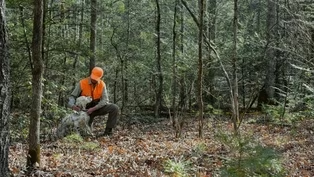
(bird call chirping) ANGIE MILES: This is one of the things the Cunninghams enjoy the most.
Like almost 300,000 Virginians and approximately 15 million Americans, Donivan and Mike are avid hunters.
MICHAEL CUNNINGHAM: While in the military, even as an officer, I ran ranges, rifle ranges and handgun ranges.
So, I've been around firearms all my life.
DONIVAN CUNNINGHAM: I see the squirrel.
MICHAEL CUNNINGHAM: You see one?
My great-grandfather, that's my mother's mother's father, got me into hunting.
My first firearm was a little 22 rifle, single action.
My grandfather had it in his closet with a sock on it.
It was kind of funny, but he said, “here son, but I'm going to teach you the safe way to hunt and respect for wildlife, also.
” I am a certified NRA firearms instructor and recently completed the Stop the Bleed course.
I took my son through the Hunter Safety Course, oh probably five years ago, and he passed that.
He did a great job with it.
The instructor who was a what we used to call game warden and a conservation police officer, he complimented Donivan for what a great job he did, but I won't hunt with anyone that's not ethical and safe, and I won't let my son do it either.
And he knows how to handle firearms safely.
He can see our orange hats, but that's okay.
ANGIE MILES: Tradition is the word that comes up most often when Mike Cunningham talks about hunting.
BILL MACILWAINE: Who wants to go find some birds?
ANGIE MILES: It's the same for Bill Macilwaine, who's a retired physician, bird hunter and trail guide.
BILL MACILWAINE: I am mostly an upland hunter, so that means I'm interested in hunting quail and grouse and woodcock primarily.
I love pointing dogs.
I've had many dogs over my hunting career.
Currently have three, two English pointers and a setter.
And I find that spending time in the woods with them is what's so special about hunting upland birds.
All right, let's hunt 'em up.
I have wonderful memories of time spent with my father in the woods.
He was a very busy medical practitioner so, we didn't get out very often.
But I can remember as a boy carrying the little gun, 410 gun that he had as a young man, and he gave that to me.
And I have had my sons use that and hopefully down the road my grandsons may get a chance to do that.
Almost every rural household has a rifle and a shotgun at least.
And if you drive through these woods out here and in this rural area, you see hunters all the time.
It's a part of their lives.
And their children grow up learning how to handle a gun safely, how to respect a firearm and how to use it in the woods.
So, it's a big part of rural America for sure.
You having a good time, old boy?
There are lots of positives with hunting, and there are lots of positive things that hunters do.
They support all kinds of conservation groups.
Quail Unlimited, the Ruffed Grouse Society, Ducks Unlimited, the Wildlife Foundation of Virginia.
And these hunters that support this, give money and time and other resources to help develop habitat.
We are so lucky in Virginia, so fortunate to have massive tracks of hunting land, the George Washington National Forest which we're in right now being one.
And it's very special to have the opportunity to hunt here.
But the support of people to improve habitat, it improves more than just species that they're hunting.
It improves it for songbirds, all sorts of other wildlife, and it keeps the forest young and active and regenerative and that helps bikers, hikers, campers and fishermen as well.
ANGIE MILES: Both Macilwaine and Cunningham emphasize that hunting gives more to wildlife and more to conservation than what it takes away.
And that constitutionally protected gun ownership need not hinder solving the larger issue of gun violence in America.
ANGIE MILES: When you hear about an atrocity like a mass shooting, do you automatically feel a connection with your identity as a firearms enthusiast?
MICHAEL CUNNINGHAM: It's completely different, because there's something wrong with someone that can walk into a church or a theater, a school and just start shooting.
And I have no, I don't know.
I don't have the answers, but I can't, I can't relate to that person, because I cannot see going anywhere and hurting anyone.
But I believe in Second Amendment rights, so, I don't believe the answer is to take all the firearms away from everybody.
I know we have to come up with some answer, but we all have to work together, and it has to include people who love firearms too.
It can't just be the people who have never gone hunting.
They don't know the positive aspects of hunting.
They just, they don't know.
They don't understand the gun culture.
BILL MACILWAINE: Good job dogs.
ANGIE MILES: Virginia's Department of Wildlife Resources relies on sales of hunting and fishing to maintain habitats.
Annual license sales have dropped by more than 50% over the past 30 years.
During the past decade, gun-related deaths in rural America have outpaced those in urban centers as suicide with firearms has become more common than homicide.
Both Mike Cunningham and Bill Macilwaine say they believe that the kind of family bonding and firearm safety education afforded by gun-related sports could actually help decrease all forms of gun violence.
Researchers look for trends, and in the case of mass shootings, The Violence Project studied nearly 200 such incidents that took place over 50 years to help determine what can stop the epidemic.
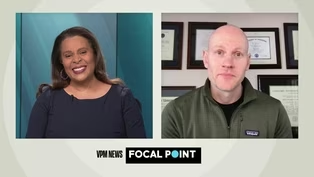
Here's an excerpt of my interview with researcher and author, James Densley.
ANGIE MILES: Mass shootings have become more frequent and more deadly in our country over the past decade, and Virginia has not been spared the trauma and the loss.
In an effort to decrease or end the epidemic of mass shootings in our country, two Minnesota-based researchers have studied 50 years of data and interviewed scores of people, including some who committed mass shootings, to find answers and hope for us all.
James Densley is one of those researchers.
He joins us now to talk about The Violence Project.
Welcome to our program, and thank you for being here.
JAMES DENSLEY: Thank you, it's a pleasure to be here.
ANGIE MILES: You say that labeling someone a monster actually takes us further away from being able to solve this problem when we just can't identify with the shooter in any shape, form, or fashion.
Could you elaborate on that a little?
JAMES DENSLEY: Many of these mass shooters feel like the world doesn't see them, and it's that then motivation to perpetrate a crime like this, which is a spectacle.
And so, we have to be much more attuned to kind of warning signs of this.
And to do that, we have to recognize the humanity in each other.
And it's hard to do that once they've perpetrated the crime.
We want to be proactive and get in front of it.
ANGIE MILES: We're looking at guns, and it is a fact that America has more guns than most any other country.
It's also true that there is a correlation between the amount of fire power a country has and the number of mass shootings.
Now the debate is it's the guns, it's the mental health, it's the guns... Is it one or the other?
JAMES DENSLEY: I think this is the key point, which is to say that it's not just either or, it can be both, and it can be all of the above.
And so America has six or seven times the share of mass shootings per population compared to other nations.
So there is something definitely going on that's uniquely American about this phenomena.
And I think access to firearms is a key component of that.
But, its important to be able to layer solutions one on top of each other because when we go into our corners and we only want one side or the other, nothing ever happens.
So what we find with firearms is there are things that can be done, like safe storage with a firearm, for instance, which can save lives, that don't infringe on anybody's Second Amendment rights.
We can put policies in place that make it more difficult for people who shouldn't have access to a firearm to get one.
And we can do that in a way that still preserves people's right to bear arms.
But we also need to layer that on top of other solutions which address mental health and other aspects of these particular crimes, because it's not a one-size-fits-all, and it's not one thing or the other.
It being able to do it all and embrace the complexity of the issue.
ANGIE MILES: Thank you for joining us on "Focal Point".
You can watch the full interview on our website.
ANGIE MILES: In the Hampton Roads area, gun violence has increased significantly in 2023 compared with previous years.
According to Gifford's Law Center, on average, someone is killed with a gun every nine hours in Virginia.
Local communities are often left to deal with the consequences.
For a firearms instructor in Eastern Virginia, his contribution to help solve the violence problem comes in the form of education.
The images in the story may be uncomfortable for some.
JOEL JONES: You got to understand, you have to defend yourself.
KEYRIS MANZANARES: Nestled in Virginia Beach is the Strong Arms Gun Club, where Joel Jones teaches gun safety, education, and training.
JOEL JONES: All right, you're going to be right here.
We're simply here to train all of our members in the ways of the Second Amendment and to be more proficient in their firearms and to help them defend themselves.
And that's in line with the national mission with the National African American Gun Association.
KEYRIS MANZANARES: Jones spent 25 years in the U.S. Navy and calls Virginia a gun enthusiast state where gun culture is embedded.
JOEL JONES: We're about that Second Amendment here in Virginia, and we're going to keep that going strong.
It's not going anywhere, especially in the Black community.
We're not going to rush anybody through.
KEYRIS MANZANARES: More specifically, Jones wants women to join his club to learn safe practices for using and being around firearms.
JOEL JONES: Have you ever shot a gun before?
So I created a goal that I wanted to have 1,000 women certified in concealed carry.
(gun firing) We're going to pull hard and let go.
It's been a great success.
Right now I'm at 302 women, and I started this in 2021, right, right after I became the instructor.
(gun firing) KEYRIS MANZANARES: Jones' concealed carry permit class consists of gun safety education.
Boom, boom!
KEYRIS MANZANARES: And practice shooting time at the local range.
(gun firing) Nikki Bynum says seeing other Black women in the room learning about firearms is empowering.
NIKKI BYNUM: The stigma is that the man has to be the one to protect, but there's a lot of single women.
JOEL JONES: Are you in immediate fear of death?
NIKKI BYNUM: So you have to be able to defend yourself at all times, I think, so I think it's great that women are, in general, are arming themselves and getting educated and taking it serious.
(gun firing) KEYRIS MANZANARES: Tonya Warren, a local realtor, decided to take Jones' class because one of her colleagues was shot and killed while on the job.
JOEL JONES: Are you prepared?
KEYRIS MANZANARES: The Hampton Roads area has been experiencing a surge of violent crime.
Data from the Gun Violence Archive shows that 2022 ended with more than 160 gun violence-related homicides across the seven core cities.
TONYA WARREN: I've never used a firearm.
However, in this climate and with the occupation that I've chosen as a realtor, I've found that it's necessary because we're living in a time where people are doing active shooting.
And as a female, I go into areas all over the Hampton Roads area, and I just want to make sure that I'm not a victim.
KEYRIS MANZANARES: Warren's husband got her a gun last year, but she was scared to use it.
Now she's practicing her skills at the range.
(gun firing) TONYA WARREN: I was intimidated, and there was some fear.
However, I realized I needed to attack this head on, so I decided that I'm going to come and get the proper training and knowledge on how to use the firearm and make sure that I'm doing it according to the law.
Invigorating.
ANGIE MILES: So far Jones has helped 334 women get their concealed carry permits.
That concludes our program.
As always, we invite you to visit our website to learn more about the stories we've shared and to provide feedback and your own story ideas.
That's vpm.org/focalpoint.
You'll also find links to our full interview about The Violence Project and an extended version of our gun culture story.
Thank you for watching.
We'll see you next time.
Production funding for VPM News Focal Point is provided by The estate of Mrs. Ann Lee Saunders Brown.
And by... ♪ ♪
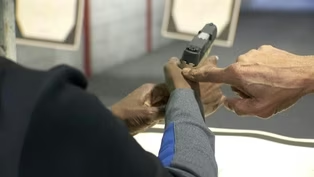
Virginia Beach gun club empowering members through education
Video has Closed Captions
Clip: S2 Ep1 | 3m 8s | Strong Arms Gun Club in Virginia Beach teaches gun safety and provides training. (3m 8s)
Video has Closed Captions
Clip: S2 Ep1 | 10m 39s | Guns are part of a generations-old culture in Virginia and elsewhere. (10m 39s)
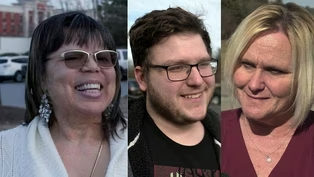
Guns in Virginia | People of Virginia
Video has Closed Captions
Clip: S2 Ep1 | 1m 6s | We asked people across the Commonwealth of Virginia to share opinions on firearms (1m 6s)
Video has Closed Captions
Clip: S2 Ep1 | 11m 22s | Author James Densley explains the causes of mass violence and offers solutions. (11m 22s)
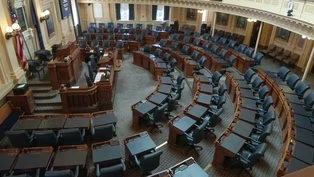
Virginia’s general assembly is divided
Video has Closed Captions
Clip: S2 Ep1 | 2m 2s | VPM News Reporter Ben Paviour brings us an update from Virginia’s General Assembly. (2m 2s)
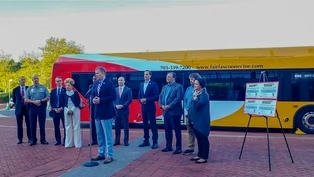
Virginia’s red flag law and How It’s Making Communities Safe
Video has Closed Captions
Clip: S2 Ep1 | 4m 41s | Virginia’s red flag law is being used to remove guns from those deemed to be a threat. (4m 41s)
Providing Support for PBS.org
Learn Moreabout PBS online sponsorship
- News and Public Affairs

Top journalists deliver compelling original analysis of the hour's headlines.

- News and Public Affairs

FRONTLINE is investigative journalism that questions, explains and changes our world.












Support for PBS provided by:
VPM News Focal Point is a local public television program presented by VPM
The Estate of Mrs. Ann Lee Saunders Brown