
Angelica Allen-McMillan; Steve Barnett; Melissa Flynn
9/3/2022 | 27m 24sVideo has Closed Captions
Angelica Allen-McMillan; Steve Barnett; Melissa Flynn
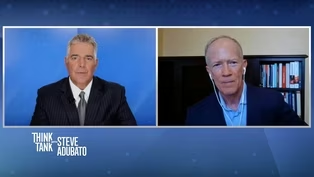
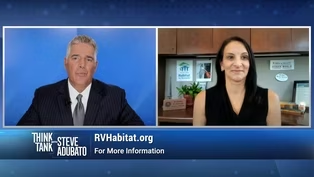
Angelica Allen-McMillan, Ed.D., Acting Commissioner, NJ Dept. of Education, joins Steve Adubato to address rumors surrounding critical race theory; Steven Barnett, Ph.D., Co-Director, National Institute for Early Education Research at Rutgers University, discusses universal preschool; Melissa Flynn, Executive Director, Raritan Valley Habitat for Humanity, examines housing costs in New Jersey.
Problems playing video? | Closed Captioning Feedback
Problems playing video? | Closed Captioning Feedback
Think Tank with Steve Adubato is a local public television program presented by NJ PBS
Angelica Allen-McMillan; Steve Barnett; Melissa Flynn
9/3/2022 | 27m 24sVideo has Closed Captions
Angelica Allen-McMillan, Ed.D., Acting Commissioner, NJ Dept. of Education, joins Steve Adubato to address rumors surrounding critical race theory; Steven Barnett, Ph.D., Co-Director, National Institute for Early Education Research at Rutgers University, discusses universal preschool; Melissa Flynn, Executive Director, Raritan Valley Habitat for Humanity, examines housing costs in New Jersey.
Problems playing video? | Closed Captioning Feedback
How to Watch Think Tank with Steve Adubato
Think Tank with Steve Adubato is available to stream on pbs.org and the free PBS App, available on iPhone, Apple TV, Android TV, Android smartphones, Amazon Fire TV, Amazon Fire Tablet, Roku, Samsung Smart TV, and Vizio.
Providing Support for PBS.org
Learn Moreabout PBS online sponsorship- [Narrator] Funding for this edition of Think Tank with Steve Adubato has been provided by The New Jersey Education Association.
PNC, Grow Up Great.
The Turrell Fund, supporting Reimagine Childcare.
IBEW Local 102.
Lighting the path, leading the way.
Englewood Health.
Johnson & Johnson.
MD Advantage Insurance Company.
The New Jersey Economic Development Authority.
And by Choose New Jersey.
Promotional support provided by Northjersey.com and Local IQ.
Part of the USA Today Network.
And by New Jersey Monthly, the magazine of the Garden State.
Available at newsstands.
[MOTIVATIONAL MUSIC] - Hi everyone, I'm Steve Adubato.
We are honored to welcome Dr. Angelica Allen-McMillan, acting Commissioner Department of Education, the great state of New Jersey.
Good to see you, Commissioner.
- It's a pleasure to be with you.
- You told me something before we got on the air we have to disclose, get out of the way.
Is it a fact that when you were getting your doctorate at Seton Hall University, that I was your professor in that program?
- True, indeed.
- And in spite of that, and the poor evaluation you gave me, you're still with me now.
- Oh, absolutely.
(both laugh) - It's not about me, it's about you.
Okay, so let's talk education.
So right out of the box, talk to us about what you believe to be the most pressing issues as we enter the new school year in September, the most pressing educational issues for the children of our public schools in the great state of New Jersey, please, Commissioner.
- Absolutely, and again, thank you for having me.
It is truly my pleasure to be with you.
I like to begin by focusing on the overall health and wellbeing of our school communities.
It is paramount that we attend to, not only the academic needs, but the social and emotional needs of our students and educators.
So as we shift from the pandemic of COVID-19 to an endemic state, we wanna ensure that we have provided the appropriate level of resources.
That will help schools not only properly staff, but have the materials and resources available to target the needs that arise in their particular communities.
- Commissioner, again, we've talked about our own children in public schools, and our daughter in public schools right now.
And like any parent, concerned deeply about learning loss.
To what degree can we truly assess the quote, unquote, "learning loss," beyond the emotional, social, psychological issues, but the actual learning loss of our children?
Is there any real way to assess that?
- So yes, there is a way to assess it, but the reality is that it does take time to assess that loss.
What we have done at the State Department of Education is to implement the Start Strong Assessment in the fall.
And so what that does, it allows us to administer a 45-minute assessment that checks on prior-year standard mastery, if you will, in knowledge.
As we put forth the standards for school districts to craft their curricular around, we know that there are priority standards that are most important to move students forward.
So this real-time data allows teachers to have that information, because we also know about the summer slide for some.
And over the summer, some students may not retain as much as they would have if school was year-round.
But with that said, it gives teachers and parents information in real-time to begin to adjust curricula, and to provide proper supports.
- Commissioner, you've seen the reports, I've seen them, you're much closer to it than anyone.
The number of teachers retiring, the difficulty attracting teachers these days; how serious is it?
And B, what can the state actually do to turn that tide around?
- Yes, so speaking to the severity of it, I wanna begin by stating that we have had some longstanding challenges in particular disciplines: science, and more specifically physics.
Also, as it relates to bilingual education educators and special educators, to name a few.
But now we are also learning that the pool of applicants is shrinking for many of our school districts, as we are decentralized in the state of New Jersey with over 600 school districts, the data varies.
And for us, it is anecdotal, because we don't collect it, but we are aware of a shift.
And we can go back to the number of individuals enrolling in our educator preparation programs, that is also declining.
It's not at the levels that it was, but we haven't had a bottoming out of it.
But I do wanna acknowledge that we do have many individuals entering into our profession through the Alternate Route Program.
- Real quickly, if you could, Alternate Route is you're an accountant somewhere, and you say, "You know what, I wanna teach, but I don't have a teaching certificate."
What is the Alternate Route Program, real quickly?
- Yeah, so the Alternate Route Program allows individuals with degrees, and also those who may have certification from another state, to enter the teaching profession through another set of standards and qualifications.
So it's parallel.
- Okay, shift gears, if we could.
A lot of information, misinformation, confusing around, quote, unquote, "Critical Race Theory."
I was watching Bill Maher the other day, don't judge me, just watching Bill Maher.
And he said something interesting.
He said, "What about a kid who goes home, a white kid, a five-year-old kindergarten kid who says, 'Mommy, am I a racist?'"
And the point of his monologue was to imply, to state, that some of the so-called Critical Race Theory curricula actually sends the message to white children, of all ages, including five-year-olds in kindergarten, that they are part of the problem, and inherently racist.
A, what is Critical Race Theory, and B, is it not what Bill Maher described?
- I thank you for that question.
Critical Race Theory refers to a course that is often taught in law school.
It has become politicized, and put into the realm of K through 12 education.
We do not teach Critical Race Theory in New Jersey, I can say that emphatically.
It is not in our standards, it is not promoted at any local level, according to my knowledge.
We have county offices that have their finger on the pulse of what is occurring in school districts.
But as it relates to teaching about diversity, and some will say broadly race, we have put forward standards and supplemental material to teach about diversity in grades K-12.
As well as teaching about the contributions of individuals with disabilities, and those who identify as LGBTQ in grades 6-12.
- Okay, since you mentioned this, sex education, if you will, a lot of folks watching are saying, "Hey, Steve are you gonna ask the Commissioner about, are teachers teaching 3rd graders about those who identify as trans, those who..." You know what I'm talking about.
What exactly is the curricula, as it relates to sex education, regarding the issues that many parents are so concerned about, A, and B, what the heck is "age appropriate," please?
- Absolutely, so as a parent, and I weigh-in from both sides, right?
I am a practitioner and I am a parent.
And these standards that we're referring to, the comprehensive health and physical education standards, were put forward to the State Board of Education in June of 2020.
And that is during our normal cyclic review, right?
So with that, there was consultation with experts, and there was a public hearing, if you will, where we share the results, and give individuals opportunity to comment on the standards.
- And not a lot of people said anything.
And then, after the fact, it was like, "Oh, is that what they did?"
Go ahead.
- Yes, and people did weigh in, but we honored the voice of the experts, who said it is so important that we begin to have conversations with children about stereotypes, as it relates to gender, as young as grades K-2.
That is to promote girls being great at math, boys being great in the arts.
It is not to promote a sexualization of children, so- - But hold on one second, Commissioner, excuse me for interrupting.
Someone says, "Wait a minute, you're in a 3rd grade class, does a kid have a choice to say that they are, in fact, a boy or a girl?"
And is that promoted in the curricula?
And B, is that not confusing to the other kids?
- So I'm going to answer it from a teacher perspective, having had some of these conversations arise during instruction.
- Sure.
- Teachers respond to questions that students raise.
They respond to conversations that are had in the classroom.
Many teachers direct students back to their parents for the full breadth of the answer.
And as a professional, I am confident that that continues to happen.
What is now put before us are standards that speak with greater specificity to areas that may concern parents.
And I'm gonna say this, going back to the 1980s, there was a law signed that allows parents to opt out of lessons, where that we know content will be taught.
- Is that still there, Commissioner?
- Yes.
- Is that there?
- It's still- - They can opt out?
- Yes, absolutely, they can opt out.
- Before I interrupt you again, you got 30 seconds left, please go ahead.
- Oh, so with that, teachers take great care to ensure that they are not working to indoctrinate children.
They're working to respond to questions, and directing them back to their parents.
But school districts with the Board of Education also take responsibility by approving the curricular to be taught, and notifying parents when particular topics, that may be considered controversial, will be discussed, and give parents the right to opt out.
- P.S., as we finish this segment, the Commissioner has background teaching in East Orange and Newark.
And as you said, her own children, she has faced this as a parent as well.
Commissioner, cannot thank you enough for joining us.
We wish you, and and the team at the Department of Education, all the best on behalf of all of our children in public schools.
Thank you, Commissioner.
- My pleasure.
- You got it.
Stay with us, we'll be right back.
To watch more Think Tank with Steve Adubato, find us online and follow us on social media.
- We're once again joined by Dr. Steven Barnett, co-director of the National Institute for Early Education Research at Rutgers University.
Good to see you, Doctor.
- Thank you, good to be here.
- Thank you, and not many people know more about preschool than you do.
The State of Preschool Yearbook, what is it, first of all?
- It's an annual survey now for 20 years of all of the state preschool programs in the country, including also territories.
So we include Guam and the District of Columbia.
It provides a comprehensive look at who has access, how many kids are enrolled, how much the state's spending, there the money comes from, and all of the state policy standards that are so important for quality and outcomes.
- Let's keep it closer to home here in New Jersey.
All those other places matter, Steve, but right here in New Jersey, pre-K, how we doing, and how are we not doing?
- Well, overall, we're doing great.
New Jersey has one of the best programs in the country when it comes to quality, and we are number one when it comes to putting money behind those standards to make sure we can actually do them, right, that teachers and administrators have the resources they need to provide a high-quality preschool program.
Now, we don't have as much access as some other states.
We're number 20 when it comes to four-year-olds.
We serve about a third, or we did before the pandemic.
And we're top five for three-year-olds, where we do much better, 'cause it's really a two-year program.
- You know, Steve, the term "universal pre-K" gets thrown around a lot, but is it, quote, truly universal, end quote?
- Universal means a lot of different things to a lot of different policy makers.
(Steven laughs) There are a few places where it's really universal.
Every child in Vermont can go to preschool beginning at age three.
Every child in West Virginia, Oklahoma, can go beginning at age four.
New Jersey has a ways to go before we can make this program universal.
But we've been making steady progress.
We've put more money into this program every year for the last five years to expand.
It's about money, and also the time it takes to do it right, because we don't rush and sacrifice the quality that we need to get the outcomes.
- Do we have enough educators who are qualified and prepared to teach at that level?
- That's an important point.
The pandemic has made that even harder than it was previously.
But it's tough, and we need to take the time to grow the teacher force, to take teachers that we have who are in childcare and get them into higher education, fully qualified.
That's going to take some time.
But we know we can do that in New Jersey.
We've done it before.
- Hmm, so I wanna do this.
Our Reimagine Childcare website will come up.
We've been involved in public awareness for the past several years around access to affordable quality childcare.
Pre-K and childcare, the same thing?
- Part of the same system, and sometimes the same thing, but not always.
And I think the governor and the legislature have been smart in making investments in every year of the child's life, from birth through kindergarten and beyond, recognizing it's a system.
You have to take care of infants and toddlers.
They need supports for learning and development, and that we need to integrate.
One of the things that makes our program so good in New Jersey is that we've integrated the private sector into public pre-K at ages three and four.
So that distinction just breaks down.
- What does that mean?
- What it means is that any private childcare provider who will meet the state standards for quality can participate as a state pre-K provider and contract with the district.
That lets us move much more quickly and nimbly and integrate childcare and pre-K. - You know, Steve, the last time we talked was pre-COVID.
So your understanding, your research, your expertise in this area is so critical on so many levels.
But when it comes to COVID and vaccines for the age that we're talking about here, the pre-K/childcare range, at that very young age, to what degree are the children who need to be vaccinated, and again, the variants keep coming.
We don't know where it's going, and we don't know ultimately what level of protection you actually do have, but in the effort to promote vaccines as part of the solution, to what degree do the children who need to be getting vaccines have vaccines?
- Well, we just got vaccines for the youngest kids.
So that's just new.
A lot of parents of course have rushed out to get them.
Hopefully, parents will really stay on top of that before we get into the school year.
- Excuse me, we're taping this at the end of July.
You're going into September.
So parents have to make that decision, and I hate to complicate things, and sorry for interrupting, Steve.
- It's all right.
- Parents are like, "Yeah, the COVID thing, I'm fatigued.
"I've had enough of it, 2.5-plus years."
For these kids, it's the first time they had access to the vaccines, right?
- Right, first time they've had access, and we hope that come October, there'll be a new vaccine that will be even better that they can have access to.
And it's really important, because even if parents enroll them, they miss out when they're sick.
Their teachers get sick, and there's no one to staff the classrooms.
So we really need to stay on top of it.
- Absolutely.
Dr. Steven Barnett is one of the nation's top experts when it comes to early childhood education.
He's the co-director of the National Institute for Early Education Research at my alma matter and many others, not many other schools, but many other people graduated from the Rutgers University.
Thank you, Dr. Barnett!
- You're welcome.
Thank you, Steve.
- That's Steve Barnett.
I'm Steve Adubato.
Stay with us; we got more!
To watch more Think Tank with Steve Adubato, find us online and follow us on social media.
- We're now joined by Melissa Flynn executive director at Raritan Valley Habitat for Humanity.
Great to have you with us, Melissa.
- Thank you.
Thanks for this opportunity.
- As we put up the website for Habitat for Humanity, some may know, "Hey, Jimmy Carter built a house somewhere," but with Habitat for Humanity.
But it's a very important organization, describe what it is, and we'll talk about volunteering opportunities in just a moment.
Go ahead.
- Great, Habitat for Humanity, our mission is to bring people together to build home communities and hope, and right here at Raritan Valley Habitat for Humanity in Central Jersey, we actually go right out to local towns and we build homes for homeowners, for families who need homes.
We give a hand up, not a handout.
They partner with us in building their own home.
They receive a home at a cost in which they could afford with a 0% interest rate.
Our affiliate also is offering a repair program.
A repair program is for homeowners that currently need a little bit of assistance within their home.
We believe that everyone deserves a decent place to live and we know that a home brings stability, strength, and self-reliance.
So, our goal is to go into a home and make sure children have a safe place.
- But let me ask you this again.
The website is up right now.
What's the criteria?
And someone says, "Hey, what about me?"
But there are specific criteria for how you qualify to be a recipient for Habitat for Humanity's support, correct?
- Yes, there is.
It is offered to low and moderate income homes.
You do go through the entire application process just like you would for a mortgage.
With Habitat, you are obligated to do some sweat equity, which means you're building your own home.
You're volunteering to get this home.
It's pretty extensive qualifications, not too hard, but we do narrow it down to people that actually would qualify.
- Let me ask you this, New Jersey housing costs are absurd.
I'm sorry, I'm not supposed to do commentary, but that's not really debatable.
So, affordable housing, it's a crisis, it's a national problem, but it's really bad in New Jersey.
Does it make the need for an organization like Habitat for Humanity, even greater in a state where housing costs are so high, please?
- Absolutely, I am honored to be able to represent New Jersey.
Yes, especially with COVID, the social and the economical impact on these families has been tremendous.
Right now, there is only one in every six households that is actually paying 30% of their salary in their homes.
- Are most more than that?
Are most more than that, Melissa?
- More than that, I would say they're paying more than 50% of their income on housing right now.
- Okay, hold on one second.
When you say "housing," Melissa, are you including our pretty high property taxes as well, or is that-- - I am.
I'm talking, to pay your mortgage and your taxes, families are paying, often, over 50% of their income.
Right now, there is such a shortage for rental properties, that 31 in every 100 homes exist for low income families.
So, Habitat is really making a dent with our homeowners right now.
We are not just helping homeowners get a home.
Our affiliates are offering homeowner services which are classes.
We're about to kick off an Almost Home program where the families that don't quite qualify for a mortgage yet can come to us and we can help them.
We can help them prepare their finances, their credit, and be prepared to possibly become homeowners.
- Let me ask you, you're an not for profit.
Our production company is a not for profit but raising money is a constant requirement.
To what degree has COVID, and your organization also depends heavily on volunteers as well, which is why we'll put up the website as we speak again, how has COVID impacted your ability for Habitat for Humanity to raise money?
- So, like you said, you're a nonprofit as well.
It's a tough time right now.
Our affiliate has also lost grants that we usually qualify for.
We've found that many companies, different grants are open now to more medical or something in healthcare.
So, housing is not exactly as accessible to funds as we were in the past.
So, we do, we count on local citizens.
We count on local companies to help us out, whether it's financially or with in kind donations to help us build these homes.
We stop building if the money stops.
We only build what we can.
Currently, we are in the process of building three homes.
So, there will be three families that will benefit from Raritan Valley this year.
- And let me ask you this, Melissa, the cost of the homes, I know that it's based on a lot of factors, but is the cost less because of all the volunteers involved in building homes?
- Yes, the cost, when we sell a home, we sell it for what the homeowner can afford, not for what it costs us to build it.
We often pay much more to build the home than we would charge a homeowner.
Yeah, we do get benefits from having volunteers build the home.
It certainly saves us money compared to a a family that would go out and build their own home, yes.
It's still tough, especially with the prices of wood right now, and the fact that we are very slim with volunteers, we're just trickling back into having people feel comfortable to come out and work side by side.
- Yes, and get a message out there to everyone right now, Melissa, who may be thinking of volunteering.
They're curious about it, what's the message to them as to why-- - The message is, anyone and everyone, you do not need to know how to build a house.
We bring people out and there is something for everyone.
If it's the matter of just dusting, or straightening the tools, or working in our office.
We also have a restore.
A restore sells pre-owned or used home goods, furniture.
We are in desperate need of helpers there as well.
That helps the community furnish their home.
The funds go directly to building the houses.
Anyone can volunteer.
You could go to our website, rvhabitat.org.
Sign up there, we'll talk to you, whatever you like to do we'll make a spot for you.
- And we're talking about Somerset County, Hunterdon County, and also, Habitat is all over the place.
So, you can go to the New Jersey and the national website as well.
Melissa, I wanna thank you so much for joining us.
- Thank you so much for this opportunity.
- Habitat's pretty awesome.
I'm Steve Adubato.
Talk about awesome.
Melissa, well done.
We'll see you next time.
- [Narrator] Think Tank with Steve Adubato has been a production of the Caucus Educational Corporation.
The New Jersey Education Association.
PNC, Grow Up Great.
The Turrell Fund, supporting Reimagine Childcare.
IBEW Local 102.
Englewood Health.
Johnson & Johnson.
MD Advantage Insurance Company.
The New Jersey Economic Development Authority.
Northjersey.com and Local IQ.
Part of the USA Today Network.
♪ It only gets better ♪ ♪ When we stand together ♪ ♪ To tough through ♪ ♪ And get by ♪ ♪ Even though it's harder than ever ♪ ♪ 'Cause we're gonna make it ♪ ♪ Long as we don't break it ♪ ♪ Just do right ♪ ♪ There's no sights ♪ ♪ We must know it's part of forever ♪

Addressing Race and Gender Stereotypes in Public Schools
Video has Closed Captions
Clip: 9/3/2022 | 11m 31s | Addressing Race and Gender Stereotypes in Public Schools (11m 31s)
The Benefits of Universal Preschool
Video has Closed Captions
Clip: 9/3/2022 | 8m 15s | The Benefits of Universal Preschool (8m 15s)
Habitat for Humanity's Fight Against the Housing Crisis
Video has Closed Captions
Clip: 9/3/2022 | 8m 32s | Habitat for Humanity's Fight Against the Housing Crisis (8m 32s)
Providing Support for PBS.org
Learn Moreabout PBS online sponsorship
- News and Public Affairs

Top journalists deliver compelling original analysis of the hour's headlines.

- News and Public Affairs

FRONTLINE is investigative journalism that questions, explains and changes our world.












Support for PBS provided by:
Think Tank with Steve Adubato is a local public television program presented by NJ PBS