
Haiti Story, Digital Artist, Farm Weaver
Season 15 Episode 9 | 28m 45sVideo has Closed Captions
Immigration from Haiti; Nicole Brenny's digital art; and Laura Demuth's wool crafts.
Antonio and Paulaine Jean Louis immigrated from Haiti to Minnesota; Nicole Brenny is a digital artist and musician; and Laura Demuth is an artist who explores all aspects of wool craft, including raising sheep.
Problems playing video? | Closed Captioning Feedback
Problems playing video? | Closed Captioning Feedback
Postcards is a local public television program presented by Pioneer PBS
Production sponsorship is provided by contributions from the voters of Minnesota through a legislative appropriation from the Arts and Cultural Heritage Fund, Explore Alexandria Tourism, Shalom Hill Farm, West Central...
Support provided by:


Haiti Story, Digital Artist, Farm Weaver
Season 15 Episode 9 | 28m 45sVideo has Closed Captions
Antonio and Paulaine Jean Louis immigrated from Haiti to Minnesota; Nicole Brenny is a digital artist and musician; and Laura Demuth is an artist who explores all aspects of wool craft, including raising sheep.
Problems playing video? | Closed Captioning Feedback
How to Watch Postcards
Postcards is available to stream on pbs.org and the free PBS App, available on iPhone, Apple TV, Android TV, Android smartphones, Amazon Fire TV, Amazon Fire Tablet, Roku, Samsung Smart TV, and Vizio.
Providing Support for PBS.org
Learn Moreabout PBS online sponsorship(cheery music) - [Narrator] On this episode of "Postcards."
- And it was hard for me because the kids kept asking, "Where is Dad?
"When dad is coming back?"
- Even when I started my own business, they were like, "You're making the biggest mistake of your life," which it ended up being the best thing in the entire world for me.
- I think making your own clothing, or at least, some aspect of your own clothing, can foster an appreciation for clothing itself.
(upbeat music) - [Narrator] "Postcards" is made possible by the Minnesota Arts and Cultural Heritage Fund and the citizens of Minnesota.
Additional support provided by Margaret A. Cargill Philanthropies.
Mark and Margaret Yackel-Juleen on behalf of Shalom Hill Farms, a retreat and conference center in a prairie setting near Windom, Minnesota, on the web at shalomhillfarm.org.
Alexandria, Minnesota, a year-round destination with hundreds of lakes, trails, and attractions for memorable vacations and events, more information at explorealex.com.
The Lake Region Arts Council's Arts Calendar, an arts and cultural heritage funded digital calendar showcasing upcoming art events and opportunities for artists in west central Minnesota, on the web at lrac4calendar.org.
Playing today's new music, plus your favorite hits, 96.7 KRAM, online at 967kram.com.
(upbeat music) - One thing I remember when I have to go to school, because without money to pay for taxi, I have to walk about one hour to go to school and one hour to go back.
Walk, not drive, and I see different here, the kids have the buses and 16 years old, they have car.
I always say them to explain, you know, how life was for us, growing up in Haiti, and for them, is completely different living in the States.
(water hissing) (upbeat music) (bag rustling) (upbeat music) (Paulaine laughing) (food sizzling) One thing I like Haitian culture, my friend always joking, we don't measure nothing.
(Paulaine laughing) The other thing, how about the, when they ask for the recipe, we say, "We just put whatever feels right."
(Paulaine laughing) That's why they always love about us.
(upbeat music) (serene music) - I know a Haiti that was very enjoyable when I was a boy.
Quiet, clean, everybody will want to go there.
I grew up in Cap-Haitien.
Cap-Haitien is the touristic capital of the country.
That's where you have everything that someone that is not from Haiti will want to go.
There's a lot to enjoy in Cap-Haitien and you have all the ocean, the beach that people go to.
It was very enjoyable.
(serene music) (food sizzling) - We decide to move to United States because of my husband's job.
- If you can picture what an ambassador will do as a job, that's basically what my job is here, representing what the organization is doing in Haiti and Haiti itself.
- When I first moved to United States, it was really hard for me because I didn't have any English at all and we didn't live in the Haitian community.
One time when our kids have to go to first day of school, my husband had to move back to Haiti for a meeting and I'm the one have to bring the kid to the bus station and to go to the meeting.
They say the bus, and my understanding, I think they say, "Green bus," and the first day of school I was waiting for the green bus come, (Paulaine chuckling) and I didn't send the kid to school this time.
When I call my friend, she tried to understand what I say to figure out and I told her, "I didn't send the kids."
She say, why?
I say, "I didn't see the green bus."
She say, "No, we never, we don't have green bus.
"We, all the busses are yellow," (Paulaine laughing) and after that I said, "Okay, I have to go to school," and I went to a community college for English, my first English class.
- I went back to Haiti to keep working with Children of the Promise giving full-time.
I thought that would be very easy to come and then go get visa and come back here.
It was not that easy.
Now I end up stuck in Haiti for eight years of my life.
- And it was hard for me because the kids kept asking, "Where is Dad?
"When Dad is coming back?"
- I could obviously with the technology do video conference call with them, talk with them on video, but you get to a point where you look at videos, you see your daughter doing basketball, doing sport and you want to be there, and it was so hard, and I remember going single night crying because I could not see my kids.
It was hard.
- Finally in 2020, they send his visa in Haiti for interviewing at the embassy.
We went to Haiti with all the family.
They say we have to present at the embassy.
This is gonna take maybe a maximum one month, and after the interview, everything went closed, and my families was stuck there for five months.
- Every step was difficult.
So after five months, finally we could come back here.
- I have a college degree in Haiti, but when I graduate from, before I graduate from high school, everybody I knew in the area know I want to be a nurse.
This is what I always want to be.
My dad didn't have any education, he never got in school, but I told him I want to be a nurse.
He work hard for me to be a nurse, but unfortunately he passed away.
I couldn't go to private school to pay for the school.
I couldn't be a nurse.
When we moved to Minnesota, I went to Ridgewater this time and this time start to get all the classes for my nursing school.
So I graduate 2020 at Ridgewater for the Nurse Helping program.
Yes, I'm in nurse after 2020.
That was amazing for me, and you know my dream come true.
(upbeat music) - This is a, something that has come from Haiti, and you can see here, this is inside of the Haitian flag you have this emblem.
Then you have a palm tree here, you have bombards.
You know this, Haiti was the first black nation that fought slavery.
You can read here, "L'Union fait la force."
That is something I talk about, which is connecting people, the sense of coming together that people have.
I love Haiti.
I love what I grew up into, I love it, but between Haiti and the kids that grow up here, it's too different though.
You want to make sure that the kids, they are happy.
They have a sense, the same things that I grew up into.
I thought, well, education will be a very good thing that I grew up with.
You want to offer the best to your kids.
- I remember, I used to work at Taco Bell, my first job.
Every day after work I cry because the way people treat you.
You don't speak English, you are an immigrant.
They think, "Why you come to the United States?"
They don't understand.
I always tell people, when you have a family, you do everything you can do, especially for your kids.
(serene music) - In hard times, we need to show those kind of support.
We need to, especially with the immigration problem that is going all over, all around the world right now.
I think that we gotta be human in the way we do things.
Let the political people do the politics, but as humans, community, how do we embrace, how do we help?
- You know, when you can help someone, you just do it, and that's why God said, "Love your neighbor as you love yourself."
- I'm gonna show you guys the craziest song I ever made, (cup clicking) and it's really noisy if I can find it.
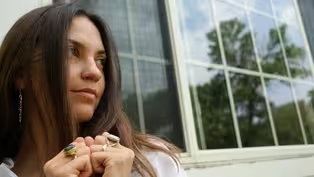
(lively tribal music) So I grew up in Foley, Minnesota, so right in central Minnesota, and ever since I was a kid I really, really, really wanted to be a singer and musician, like I always thought, like I just truly believed that I was going to do that.
I didn't really think much about like, art or creative stuff like painting or anything until later on, but it was like music, music was my thing.
I had a bed, what are those called, like the canopy beds where you can put a canopy on top.
We just had like the knob that held the canopy in place and I would take one of those and even after we got rid of that bed, I kept that knob and I'd be like, family, come.
I'm doing a concert, (Nicole laughing) (rapid drumming) and this is my favorite part.
(rapid drumming) (patriotic music) Okay, I should have played you a song where I can actually sing.
(Nicole laughing) (upbeat electronic music) ♪ Really pretty ♪ ♪ I feel the world ♪ ♪ I cannot breathe ♪ I make electronic music that's very much in the realm of pop, but it's quite experimental and a little bit industrial just 'cause I really like to experiment with sound and textures.
Yeah, and this is fun to use.
So it was a little bit tricky to hook this one up today, but I'll show you a song I made with this, if it will play.
♪ They show me ♪ ♪ Play play ♪ ♪ They show me ♪ And like I'll sample my voice, you know.
(Nicole vocalizing) Like made all the drum sounds.
(Nicole vocalizing) (energetic electronic music) I thought I was gonna move to New York and make it big, (Nicole laughing) (lively music) but I'll make a very long story short.
New York was really hard.
I did not like it and I just was like, I don't know where I belong, but I'm gonna move back to Minnesota.
From everything I learned from working at a startup, I was able to like, start my own business and have it be successful within like a month, which never happens, and then I decided, I'm gonna go to Costa Rica and have like, one of those limitless sort of vacations.
Like, I wasn't a billionaire but I was like, I finally did something.
I'm gonna go to Costa Rica to relax for one month, and that one month turned into three years.
I love the tranquility of Costa Rica.
I love being woken up by the monkeys and the birds and everything.
Grab your surfboard, put on a swimsuit, and walk to the beach and surf, like that quiet, tranquil life.
(relaxing music) Something happened with the water permits where all of a sudden one year everyone got a water permit, which meant everyone could begin construction on their properties that they had been waiting years to build.
So that led to endless amounts of construction noise, (trucks beeping) the destruction of nature, like that pure nature before my very eyes.
I just wanted to find peace and tranquility.
For months after moving back to Minnesota, I couldn't find a place because it was, COVID was making everything crazy.
I said, "I'm gonna close my eyes, point to a random dot on Zillow "and whatever house I land on, I'll buy.
"Like I don't care, I'm done.
"I'm gonna let go and let God, this is it."
So I did that, I clicked on it and I opened up my eyes and I was like, I don't understand how this is the price of this house or why this house is so perfect, but somehow I found my perfect house.
That was that, like I just paid for it and now here we are.
(Nicole laughing) (upbeat electronic music) ♪ Hold me ♪ ♪ In my morning sun ♪ For me, my creativity's not just meant for like only one realm, like music or art.
Like I wouldn't even say that I'm an artist of just visual art or just, sometimes I don't even feel like it's artistry.
I feel like it's just creation to everything that I do, whether it's like cooking, gardening, or renovating my house, it's the same exact feeling and the exact same process, which also has been transformed with like, that spiritual aspect.
There is a cat down there, he's very, very, very, very friendly.
His name is Walnut.
(thermos clanging) So this is where it all began was right here with my new style of art.
(paper riffling) ♪ Hold me ♪ ♪ In my morning sun ♪ ♪ You wanna ♪ Being an artist or a creative musician person has been maybe one of the most transformative processes of my whole entire existence as a human being.
A lot of people were like, just get a normal job.
Even when I started my own business they were like, "What are you doing?
"You're making the biggest mistake of your life," which it ended up being the best thing in the entire world for me.
I'm not working a nine to five job because I just can't.
- All right.
What's that?
- [Driver] She says, she'll show you.
- I definitely am a creature of faith and trust and surrender, like I just trust the higher order, I trust in God and I'm just like, yep, if this is where I need to be, like I don't need to know.
I don't need to understand.
I don't need to be able to like, predict what's gonna happen.
I'm just like, let's go.
(Nicole laughing) (cheery electronic music) (Nicole vocalizing) (energetic music) - I was raised in a military background and I was really troubled by that military background, and so in college I became very interested in non-violence, which led to Gandhi, which led to spinning, which I don't, you know, it's many, many iterations removed from where I started.
I just never imagined it before, and of course what I do isn't related to what Gandhi did.
He was talking about a liberation movement in India with, you know, from the British textile industry, but I work with wool and linen and so it's been far removed from that beginning.
(energetic music) I should say Steve, my husband is the shearer.
They're big and that takes a lot.
You have to really have a lot of control of the animal the whole time you're shearing.
So he's the shearer.
(energetic music) I wash the wool before I process it and get it ready for spinning.
You don't always have to do that, depending on how you want to process your yarn and what kind of yarn you're looking to make.
Because I use the yarn that I spin mostly for weaving, rather than knitting, I process the yarn in a way that it, what I use is a technique that involves combs.
So these are combs and this was the older way, there are several ways to process fleece to get it prepared for spinning.
When you comb fleece, there's a couple things that go on.
The first thing is that you maintain a parallel formation of the fibers.
They stay laying right beside each other, and when you comb fleece, you want to maintain that parallel arrangement and it makes a yarn that is really strong and it's kind of a no nonsense yarn.
It doesn't have air in it, it doesn't have fluff in it, but because those fibers are just laying right beside each other, it's a really strong fiber and it works well.
Excuse me, it's a really strong yarn and it works well for weaving, especially.
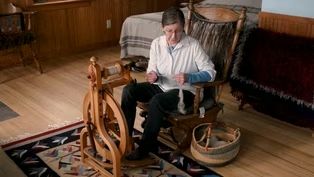
(relaxing music) (sheep bleating) (relaxing music) Spinning is a really interesting process and that it is what turns fiber into yarn.
So when I start spinning, what I'm spinning with is just called top, which is prepared fleece, and what the spinning wheel does is it simply introduce twist into that fiber, and what you end up with is yarn.
It's sort of this magic thing that happens as you introduce twist into it, and wool is uniquely suited for spinning.
(relaxing music) So spinning is the process of just turning fiber into yarn.
What's going on here is that the spinning wheel is introducing twist into the fiber, so that what is between my hands here is just fiber, but what is beyond my hand, between my hand and the spinning wheel is already yarn.
So this is all it is, is twisted fiber, and what you spin when you first start is just a single yarn.
There's only one strand here.
The yarn that a weaver puts on their loom is called the warp, and the warp is under a lot of tension and it has a lot of abrasion from the beaters and the heddles that are part of the loom, and so you want a really strong yarn, and typically weavers will not use a singles yarn for their warp yarn, which means what they're going to do is to take at least two strands of spun yarn and they'll turn the wheel in the opposite direction.
Right now, my wheel is going in a clockwise direction and then what I'll do to make a plied yarn is that I'll hold two or more strands of the spun yarn, I'll hold those two together, and I'll wrap them around each other so that becomes a two or a three ply yarn.
(relaxing music) Another textile that I've worked to learn how to make and to make is the boat rya, and they were designed for the men who would go out fishing to take with them on their boats to keep warm in the North Sea, and originally people would use just pelts for that, but it was found that in the salt air, the skin side of the pelt would become hard.
So it would sit like a board on top of you and not keep you warm, and so the boat rya was made so, it imitates a sheep fleece.
So these were really fine blankets if you want to stay warm in the north seas, this is the kind of blankets they were sent with.
(upbeat music) I think I'm drawn to the possibility that we could know a process from beginning to end.
We don't have an opportunity to do that very much in our lives.
I mean, all of the clothes that we normally wear, they come from who knows where and who knows what, what fiber is even in them.
You know, they can come from 15 different places.
They can be, you know, the fiber can be raised in one place and sent to another for processing and another for weaving and another for dying and another for cutting out and making, so our textiles are quite removed from any understanding of where they came from and they don't have a lot of meaning for us either because they're fairly abstracted from us.
We're fairly alienated from that process.
I don't want to be in the position in my life where I have to make all of the textiles my family needs.
I'm really glad, grateful to be liberated from that kind of intense labor that women used to face, but I think it's too bad that we've taken this completely out of our hands, literally out of our hands so that we don't even know what goes into providing our clothing, and so it's a way of developing a relationship with the animals or the plants or the dye materials that provide us with these things.
If we have at least the opportunity to know some of that and keep that knowledge in human hands, that seems to me to be a valid thing.
(upbeat music) A lot of the natural fibers are being replaced by polyesters or synthetic materials that are made essentially from oil.
The difficulty with that is that they're petroleum products and they don't biodegrade any more than our plastics that we, you know, buy our milk in or whatever.
They're, they don't biodegrade.
It comes pretty cheaply.
It's made pretty cheaply.
It's worn, sometimes I mean, I read like the average length of a time a person actually wears a piece of clothing is like five to seven times before it's landfilled.
(upbeat music) I think making your own clothing, or at least some aspect of your own clothing, can foster an appreciation for clothing itself and to gain some idea of the amount of labor and care and also intelligence that goes into clothing.
That was where women could really think and could really be creative, and we see it there and we've lost that, and I think that if we can come back to an understanding that that is actually a platform on which we can find expression and we can find joy, I think that it is perhaps an act of rebellion, but I also hope that it's an act of joy, (reflective music) but I would say my weaving didn't become good weaving until I started taking classes from weavers who knew what they were doing, and I started taking classes at Vesterheim and I know the, I can date what my weaving looked like before I started having relationships and friendships with other weavers and they were showing me and teaching me how to do things, my weaving vastly improved, just being around other weavers, (reflective music) and even just the joy of coming to a place where you've mastered something with your hands, your hands have the muscle memory in them and so that you can trust your hands to do that, and you can just simply watch your hands do those things.
There's a lot of joy in that, that we are just in our industrialized age and our push button age really not exposing our children to, and I would wish that we would do that.
(reflective music) (upbeat music) - [Narrator] "Postcards" is made possible by the Minnesota Arts and Cultural Heritage Fund and the citizens of Minnesota.
Additional support provided by Margaret A. Cargill Philanthropies.
Mark and Margaret Yackel-Juleen on behalf of Shalom Hill Farms, a retreat and conference center in a prairie setting near Windom, Minnesota, on the web at shalomhillfarm.org.
Alexandria, Minnesota, a year-round destination with hundreds of lakes, trails, and attractions for memorable vacations and events, more information at explorealex.com.
The Lake Region Arts Council's Arts Calendar, an arts and cultural heritage funded digital calendar showcasing upcoming art events and opportunities for artists in west central Minnesota, on the web at lrac4calendar.org.
Playing today's new music, plus your favorite hits, 96.7 KRAM, online at 967kram.com.
(lively music)
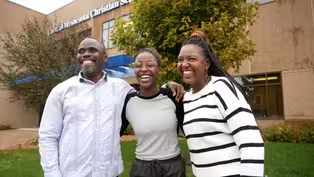
Antonio and Paulaine Jean Louis | Haiti Story
Video has Closed Captions
Clip: S15 Ep9 | 9m 32s | Antonio and Paulaine Jean Louis both grew up in Haiti. They share their journey. (9m 32s)
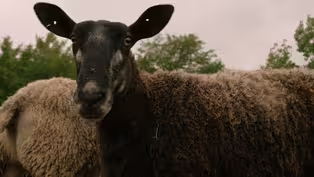
Haiti Story, Digital Artist, Farm Weaver
Preview: S15 Ep9 | 40s | Immigration from Haiti; Nicole Brenny's digital art; and Laura Demuth's wool crafts. (40s)
Video has Closed Captions
Clip: S15 Ep9 | 11m 32s | Laura Demuth is an expert weaver on a farm with her husband, Steve. (11m 32s)
Video has Closed Captions
Clip: S15 Ep9 | 8m 42s | Nicole Brenny is an electronic and experimental musician and artist from the prairie. (8m 42s)
Providing Support for PBS.org
Learn Moreabout PBS online sponsorship

- Arts and Music
The Best of the Joy of Painting with Bob Ross
A pop icon, Bob Ross offers soothing words of wisdom as he paints captivating landscapes.











Support for PBS provided by:
Postcards is a local public television program presented by Pioneer PBS
Production sponsorship is provided by contributions from the voters of Minnesota through a legislative appropriation from the Arts and Cultural Heritage Fund, Explore Alexandria Tourism, Shalom Hill Farm, West Central...