Oregon Art Beat
Hammer in hand, Oregon metalsmith Greg Wilbur elevates the ancient art of ‘raising.’
Clip: Season 11 Episode 1105 | 6m 27sVideo has Closed Captions
Hammer in hand, Oregon metalsmith Greg Wilbur elevates the ancient art of ‘raising.’
Greg Wilbur’s hand made vessels have such a humble elegance and purity of form that many people can’t tell what they’re made of. Learn how this Portland sculptor has mastered the art of raising, the ancient technique of hammering a flat piece of metal into something beautiful.
Problems playing video? | Closed Captioning Feedback
Problems playing video? | Closed Captioning Feedback
Oregon Art Beat is a local public television program presented by OPB
Oregon Art Beat
Hammer in hand, Oregon metalsmith Greg Wilbur elevates the ancient art of ‘raising.’
Clip: Season 11 Episode 1105 | 6m 27sVideo has Closed Captions
Greg Wilbur’s hand made vessels have such a humble elegance and purity of form that many people can’t tell what they’re made of. Learn how this Portland sculptor has mastered the art of raising, the ancient technique of hammering a flat piece of metal into something beautiful.
Problems playing video? | Closed Captioning Feedback
Where to Watch Oregon Art Beat
Oregon Art Beat is available to stream on pbs.org and the PBS app.
Providing Support for PBS.org
Learn Moreabout PBS online sponsorship(bright vocal music) (bright vocal music continues) - [Narrator] Greg Wilbur's vessels possess such an elegance and purity of form that sometimes people have a hard time figuring out what they're made of.
- Clay, baskets, I've heard it all.
Leather.
- You can't really quite tell what the material is, but you wanna touch it, you wanna hold it, and that touching and holding is something that Greg really capitalizes on.
(hammer pounding) (bright vocal music) - Well, what I do is a forging process.
It's called "raising" in English.
I squish, hammer, form out of flat sheets of metal.
I don't do any welding or soldering.
Everything from one piece of metal.
I've stuck with that concept for 25 years now, thinking of it as sort of a zen concept.
(bright vocal music) This was a piece of metal probably around in this area here and there, I don't know how many hammer blows, but a lot.
I would, at least a half a million, I'm sure of it.
(jazzy upbeat music) I think the reason that I'm intrigued by this is just that it seems so impossible.
- [Narrator] Raising is an ancient craft developed over thousands of years in Korea, China, and Japan.
The process is rarely practiced in the west 'cause of the devotion and physical stamina it requires to create these deceptively complex works.
- I hold the piece of metal on the stake, strike just behind where it comes in contact with the stake, and that little area, knock it down, turn it a little bit, knock it down, go around in concentric circles.
Rule of thumb is to, once you've hit an area, you don't hit it again.
And the piece has to go towards this imaginary point out in front of me.
- [Narrator] In a process called "necking over," Greg urges the metal up and around.
- And then using hammers, he will ask that metal to occupy a smaller amount of space than it occupied on the outside diameter.
So that top lip might be very, very small.
And because he's asked that metal to occupy a smaller space, it's actually thicker at the top lip than it is from the metal that he started with.
And you can feel it actually, when you hold a piece, you can actually feel the tension of that metal in the piece, there's an energy there that's transferred by every hammer blow that he puts in.
And then he does a whole series of dippers that are kind of long, tenderly pieces with small pots on the end.
- This is sort of my signature pieces, these dippers, and I really like doing them.
They're fun for me, every one's different.
(hammer pounding) (jazzy upbeat music) Well this was my first course of raising.
Once the metal is struck, it becomes pretty stiff and can become brittle.
So I would be quitting at this point.
(torch whooshing) Then there's a process called annealing, which is heated with most any type of heat source, I use a propane torch, and heat it up to around 1,000 degrees or just when you can first see some red.
And then it's cooled.
It can either be quenched or air cooled and that takes all that tension out of the metal.
And then when it's cooled, you're gonna do the process over again.
(hammer pounding) (torch whooshing) (hammer pounding) - [Narrator] Depending on its size, Greg goes through 20 to 50 cycles of hammering, annealing, and quenching to complete a piece.
In his workshop, he has a model that shows the process step-by-step from start to finished piece.
- I use this as a teaching aid.
So, this would be the very first stage of hammering, and this would be the last with this particular example.
You can fit it in there, you can see how this - maybe you can see it - it comes up and squishes back through.
- And he also does this series of wall pieces that are really interesting.
They almost are in a wreath format.
And we have one in the gallery currently that's like that.
And that's a really interesting format too, because it really plays with the negative and the positive space on a wall, which is a way that we don't usually get to see metal.
- Greg is a great example of the kind of artist who has spent a lifetime immersing himself in understanding how one particular material works.
- I guess that's what I think what art is, is you're trying to break new ground and that's what I've tried to do.
- This is a very, very specialized skill, and actually, Greg is one of the few people around today in the States who is able to make metal act this way.
So it's a very magical thing to have him here in Portland and it's a marvelous opportunity to see an ancient type craft reinterpreted in a very contemporary way.
(bright vocal music) - This is just what I've been doing for a long time, and now I'm approaching 60.
It was a little easier at 30, so I am hopefully better at it and know my limitations.
I don't know what else I'd do at this point.
(bright vocal music) (no audio)
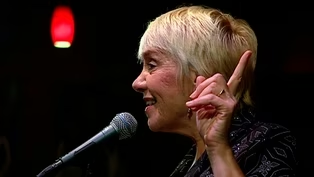
Remembering the joy and heart of Portland jazz singer Rebecca Kilgore.
Video has Closed Captions
Clip: S11 Ep1105 | 10m 49s | Jazz singer Rebecca Kilgore is remembered for her interpretations of classic songs. (10m 49s)
Providing Support for PBS.org
Learn Moreabout PBS online sponsorship New Episode
- Arts and Music

Innovative musicians from every genre perform live in the longest-running music series.
 New Episode
- Arts and Music

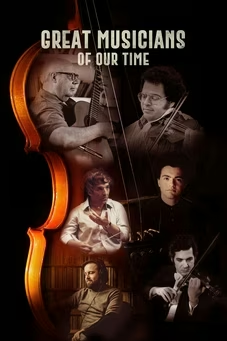
Intimate portraits of six of the most influential and celebrated classical music artists.



 New Episode




 New Episode
 New Episode
 New Episode
Support for PBS provided by:
Oregon Art Beat is a local public television program presented by OPB