Un-Wine'd
Hark Vineyards
Season 4 Episode 12 | 26m 47sVideo has Closed Captions
Tour Hark Vineyards with Aaron and Candy in Earlysville, Virginia.
Multi-career professionals Aaron and Candy Hark of Hark Vineyards in Earlysville, Virginia. tour their vineyard with host Tassie Pippert in a ATV. Recipes paired with wines: French favorite Ratatouille, Salt Encrusted Trout and Irish Stew.
Problems playing video? | Closed Captioning Feedback
Problems playing video? | Closed Captioning Feedback
Un-Wine'd is a local public television program presented by VPM
Un-Wine'd
Hark Vineyards
Season 4 Episode 12 | 26m 47sVideo has Closed Captions
Multi-career professionals Aaron and Candy Hark of Hark Vineyards in Earlysville, Virginia. tour their vineyard with host Tassie Pippert in a ATV. Recipes paired with wines: French favorite Ratatouille, Salt Encrusted Trout and Irish Stew.
Problems playing video? | Closed Captioning Feedback
How to Watch Un-Wine'd
Un-Wine'd is available to stream on pbs.org and the free PBS App, available on iPhone, Apple TV, Android TV, Android smartphones, Amazon Fire TV, Amazon Fire Tablet, Roku, Samsung Smart TV, and Vizio.
Providing Support for PBS.org
Learn Moreabout PBS online sponsorship- Hi, I'm Tassie Pippert here in the Monticello AVA at Hark Vineyards where the views are spectacular.
So go grab your glass right now.
It's time to "Un-wine'd."
- [Female Narrator] Production funding for "Un-wine'd" was made possible in part by... - [Male Narrator] The Virginia Wine Board.
Promoting the interests of vineyards and wineries in the commonwealth through research, education, and marketing.
There's a movement growing in Virginia's vineyards.
Discover more at virginiawine.org.
- [Female Narrator] And by... (upbeat jazz music) (upbeat country music) - Aaron and Candy have an amazing sight here in the Monticello AVA of Virginia.
It's a beautiful winery and they have amazing wines and they are looking at wonderful plans for the future, including a beautiful new tasting room.
Back in the kitchen, I'll have the opportunity to pair up some great foods, including this salt encrusted trout, this delicious ratatouille, and an amazing stew, this Irish stew, that I paired up with a Petit Verdot.
So don't hesitate for a second.
Grab that glass, let's head to the kitchen, really relax and "Un-wine'd."
(upbeat country music) I love French country food and one of my favorites is ratatouille and I really love it with this combination that happens to be a Bordeaux blend, but it's not classic.
So I'll tell you a little bit more about that as I taste the wine, but we're gonna start with some sauce in our pan.
Now, I have about a 12-inch pan here that I'm going to just make some sauce in, then I'm gonna line it with lots of vegetables.
So you don't have to cook the sauce in advance at all.
So first thing I'm gonna do is to put in a 28 ounce can of crushed tomatoes.
Now, always use crushed because if you use a chopped tomato in this, your sauce will be way too wet.
So the first thing we wanna do is chop up a couple of peppers, a red pepper and a yellow pepper.
So let's just cut that heart right out of it.
Now let's just add that to our sauce.
Then we'll add a nice yellow pepper.
And again, that nice, soft, flavor, it's just wonderful.
Okay, now let's take one onion.
And I like to use a relatively large onion for this because it has great flavor.
Now, at this time, I'm going to add some great garlic because you have to have that wonderful garlic flavor and you want it all through your dish.
So garlic is really going to be one of those aromatics that pulls it all together in the sauce.
Because garlic is a little bit hard, you wanna make sure those pieces are nice and small.
And then the sweetness of the garlic really adds to this sauce.
Let's plop that in.
And I love French herbs, basil, thyme, a little bit of parsley.
Just love that.
So I've minced some up here.
I've got about a quarter cup of fresh herbs all minced together and it doesn't matter what combination.
You're just gonna throw those in and then we're gonna give it a stir.
So let's just stir that through.
Now, remember, this is our wonderful sauce and it stays right here in the pan and then we'll put all of our other vegetables right overtop.
First of all, I have a yellow squash.
So what I wanna do is just give about, oh, an eighth of an inch slice, maybe 16th.
You don't want it too thick because it takes these vegetables a long time to roast when they're stacked, but we want to give some nice, kind of thin slices, about like this.
Don't read through them.
Just a little more than that.
And then we're also going to take a green squash.
You wanna make sure that your vegetables are relatively the same size.
And then the eggplant.
And I like to start at the bottom because it's just easier to hold on to the little end than it is to the bigger end as I slice.
Now, eggplant is one of those things you usually want to put a little salt on it to get the bitterness out if you're making some sort of an Italian dish, but for this particular one, we don't need to worry about that.
Everything will be seasoned just right and the little bit of oil and herbs on top will just enhance that flavor.
Don't worry if you kind of slip on that because the way that we're going to stack this, you won't see that you have half pieces of eggplant.
Now for the tomato, I really wanna use a serrated knife.
And you're gonna use the whole tomato, with the exception of the core.
And for this, I kind of like to give just slightly thicker slices because they're easier to lay out in your ratatouille.
Now let's layer this up.
And it's just a beauty when you get it done.
So I'm gonna take a squash and a zucchini and you can kind of see I'm fanning them out just a little bit.
And don't worry if your eggplant starts to turn yellow.
That's normal.
It's oxidation and it's fine.
And then tomato.
Just like this.
It's sort of like playing cards.
And then, let's take another one, and another, and another.
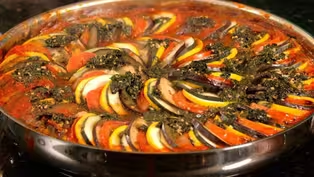
(upbeat classical music) So we have all of our vegetables all lined up and they're gorgeous.
I'm leaving just a little hole in the center so this can steam up, and as I put the foil on, it will have the opportunity to steam those vegetables a little bit as they also bake.
And then I wanna take some olive oil and, oh, maybe two tablespoons or so, and some salt and pepper.
And this is where I use that salt and pepper blend that I'm always talking about.
I have about half salt and half pepper and I'm gonna put in about a teaspoon, so a half teaspoon of salt, half teaspoon of pepper.
And if it feels too dry, if the herbs don't have any liquid on them, put in a little more olive oil.
This will give our ratatouille that little extra herb flavor.
So I have a parchment disc here.
Now, I'm going to cover the pan with aluminum foil, but it's key when you have tomatoes to cover it first with parchment because the tomato acid will eat through the aluminum foil and you don't want that foil in your food.
So just take a layer or two of parchment and just kind of lay it on top just like that.
And then let's cover it with foil.
Wrap it up tightly and then we're gonna pop this in a 400-degree oven for an hour.
This looks amazing.
And it smells even better.
So let's pour out a little bit of this wonderful wine.
Now, this really works with the herbs.
It's just delightful with the herbs.
It also is really great with vegetables and vegetarian dishes as well as tremendous meat dishes.
So anytime you're looking for a great bottle of wine with a meat dish or vegetarian, go for something that's like a Bordeaux blend.
Oh, it smells heavenly.
So good, so good.
Now, while I taste this delicious, hot ratatouille, let's go visit our friends at Hark Vineyards.
(upbeat jazz music) - [Aaron] So, we moved to Charlottesville in 2015 and for several years, it was kind of a date for us, we would go on Friday afternoons, get a glass of wine and go to a vineyard, and honestly, it was a cheap date.
We could sit out there all afternoon, enjoy a gorgeous view on a glass of wine and dream about the future.
And we said on more than one occasion, if we ever had the opportunity to do this, and in turn to kind of give this property for other people's enjoyment the same way, we were gonna do it.
And that opportunity presented itself finally in the beginning of 2015 and we got started.
- That is amazing.
That's amazing.
So what did you plant first?
- The vineyard block that you see right over here was our first plant and we call it block A.
It's about 10 acres and we did Chardonnay, Cabernet Franc, Merlot, Petit Verdot.
And we came back a year later and filled in an area we had saved for Petit Manseng.
- I love it.
I love that variety of varietals.
(group laughing) And it's perfect for here in this beautiful area.
So, what was your first bottling?
- We bottled in 2017.
- It was a 2017 vintage.
- 2017 vintage.
But yeah, we did it the next year and it was Chardonnay, was our first wine that we bottled and it remains I think our favorite wine probably that we have bottled.
We don't have much of it left at this point, but we have saved a little bit of that.
- So I saw a mention of your wine in "Food & Wine Magazine."
I was thrilled, I was excited for you, for Virginia, for everyone.
So tell me, what did that mention do for you guys?
- That mention was huge.
It was validating, I think in a word.
That Chardonnay we believe is particularly wonderful.
It has the right balance of oak, it's true to Virginia still as a Chardonnay and I think it holds its own.
In fact, we know it holds its own.
We did a blind tasting of that Chardonnay with several others among a bunch of friends and even folks in our family didn't know which Chardonnay was which, and hands down, the winner was that 2017.
We think it's just a beautiful wine and it was validating to have it recognized that way by "Food & Wine" as well.
- Well, you guys, I'd love to taste some of this.
So, what do we have here?
- So this is our 2018, I'm sorry, 2019 Petit Verdot.
- I like to taste wines as they are developing.
I just think there's something beautiful about that.
Getting that tannic structure.
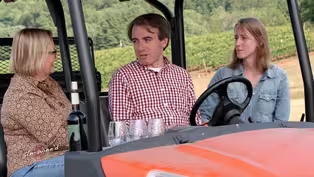
- I'll tell you, doing a tasting on the RTV here that we drive around in Cuboda.
This kind of takes it a whole new level.
Let's make sure that I can perfect my pour here.
- This just looks amazing.
I love that color.
Wow.
And it's rich, full.
- Petit Verdot is a grape that does so well in Virginia and everyone's beginning to realize that now.
Beautiful varies on the vine and a beautiful wine in the glass, frankly.
- Oh, that's really nice.
It's already balancing so beautifully.
- [Candy] You can really see where it's gonna go, yeah.
- Oh wow.
Yeah, when you get that fruit, and of course, they always say the fruit and sweet, and then, of course, the tannin and acid.
It's just right there.
- So we like to put words on our bottle that describe what we think you should taste, and of course, everybody's palate is different.
So for this one, we say dark berries, which is pretty obvious, right?
- But also, cedar.
- Plum a little bit.
- And smokey.
- Cedar and smokey.
- [Aaron] That's right.
- [Candy] And I think I really get all three of those flavors.
- I really do, too.
Yeah, yeah.
That little bit of charred wood, that smokey, yeah.
- The dark fruit aspect of Petit Verdot I think it goes beautifully with the tannins.
- That is gorgeous.
(upbeat jazz music) Well, I grew up on the river and one of our staples was trout, but I've never had fish prepared this way until one of my trips to Rome and I fell in love with salt encrusted fish.
So, in my mixer, I'm going to put in four large egg whites.
I love this because it gives a moisture and a flavor to the fish like no other.
(mixer whirring) Now, I'll wanna whip this until between soft peaks and heavy peaks appear.
Now I'm looking for between a soft and a stiff peak.
I don't want my egg whites too stiff because then they just get hard, but they don't add the flavor.
They separate from the fish.
If they're too soft, that egg white mixture runs off.
So, at this point, I have nice medium stiff egg whites and I want to just add about two and a quarter cups of salt.
(mixer whirring) Okay.
Pretty quick and easy.
Now let's get that fish.
Now, I'm just gonna run a spatula around the edges of that egg white.
Make sure that all of that salt is incorporated.
Just don't beat up your egg whites so that you lose that fluff.
Now, I wanna get my fish ready.
So I have a nice rainbow trout here and it's been cleaned well and I wanna take two strips of lemon peel and just lay right inside just like that.
And then I wanna take some fresh thyme and just stuff it.
So let's just take a cookie sheet lined with parchment paper and I want to put a nice bed of this all the way down the sheet, the length of the fish.
Make sure you take into account the tail.
I love trout.
It's a nice, sweet, light fish, and of course, it's local, so it just goes really well with lots of opportunities for wine in the Shenandoah Valley and the Monticello AVA.
Now, make sure you have about three quarters of an inch to an inch thick and then let's lay that fish right on top.
(bright flute music) Now, I want to take the rest of my egg white mixture and really cover it well.
So starting at the head, let's just get that encrusted and encased in this beautiful egg white mixture.
(bright music) If you're a little short on the tail end as I am, you can see right there, I'm just gonna take a little bit of egg white and just plop it right at the end so I'm sure that entire tail will be in the mixture.
Now let's work with our hands here to just make sure we have a nice casing all the way around our fish.
And really get in there, around that belly region where you just put in the herbs and the lemon.
Now let's pop this baby in the oven, 400 degrees for about 35 to 40 minutes.
So look at this.
Isn't it gorgeous?
So now what I wanna do is just break that salt.
I'm just gonna kind of go around the edge like this and just break it.
I don't want to hit my fish, but I kind of know where the fish begins and ends.
And then what we wanna do is just lift that off.
It's a crust, so you should be able to get right into it just like this.
And it just lifts up.
And that fish looks amazing.
Now, brush off all of the salt from right around the fish, if you can.
It's nice and moist.
And what I wanna do now is actually remove that skin from the top of the fish.
So I'm gonna take some scissors and just cut a little line from the belly portion to the back and then I just wanna take my fork and lift that skin a little bit.
Just kind of lift up.
And if you do it when it's nice and hot, you can get that skin right off.
It's gonna be so pretty.
That's about as far as I can go.
Now, what I wanna do is kind of break that crust away a little bit more here so I can get my spatula into it, and again, pull back any of that loose salt that you have so that you don't take that to your plate.
A little bit is fine, but you don't want a lot.
Then take a fish spatula and kind of get right up under your fish.
And I like to use a nice, long fish spatula because I know that that's gonna work for me.
And then just grab that tail and there we've got it set aside.
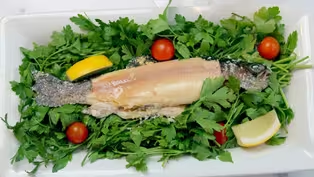
Now, I like to use a little platter of parsley and I like the parsley thick on this.
I think it just adds to the color, but of course, you don't have to do that.
Just put a little parsley on your plate and then lift that fish right over.
So let's give this a try with a little Chardonnay.
This is a wonderfully buttery Chardonnay.
Now, remember, Chardonnays can be done in stainless steel, they can be done in a combination of stainless steel and oak, or in oak.
This is just a wonderful, buttery Chardonnay.
When a wine maker chooses what they want to do with Chardonnay, they have a lot of choices.
Do they want to age it in stainless?
Do they want to age it in barrels?
Are those barrels old or new?
How much flavor does that impart?
Do they want to keep those yeast cells, the lees, sometimes you'll see sur lie, or aged on the lees, in the barrel while they're aging it?
All of these things give different flavors, different textures to the wine.
This one is absolutely incredible and I think it's gonna be wonderful with this trout.
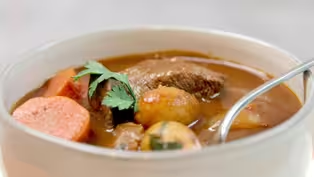
(upbeat folk music) Who doesn't love a great Irish stew?
Whether it's in the winter or on a cool evening in the summer, Irish stew is just amazing.
And you can make it with beef or with lamb, so it just depends on what you and your family enjoy.
You can change it up a little bit.
But there are some things that every Irish stew has.
First of all, great meat.
Secondly, wonderful potatoes.
Third, a lot of flavor.
And of course, fourth, a bottle of really good stout.
So, let's just heat up a little olive oil and a little bit of bacon fat in the pan.
Now, if you don't have bacon fat, that's fine.
You can just substitute a little more olive oil.
I just happen to have this, and for me, I like that little extra flavor component when I'm making Irish stew.
So, about three tablespoons all together in my pan.
And I just wanna melt that down and then I'm gonna get my beef ready.
So you're gonna chunk up your beef, whether it's a stew beef or you're using something a little leaner.
Just make sure that you chunk it well in about one to one and a half inch cubes.
Now, blot it dry because wet meat does not brown and we really want this to get a nice color on it.
So we're waiting for the pan to fully heat before we put our meat in.
So while that's happening, I just wanna take some salt and pepper and I'm gonna stir that around in the beef.
About two tablespoons mixed salt and pepper will be great.
Just give it a little coat.
Now let's take that first layer of beef and just put it in our pan.
We're trying to get the meat so that it's not completely touching.
You want a little bit of separation because if it's touching, you're gonna get a lot of moisture coming out of it and what we're trying to do here is to sear it so that the moisture is inside.
So if you can, get in half of your meat for the first round and we're just gonna toss that around.
It doesn't have to be brown on all sides, but you want the heat to hit it so that it sears in those juices of the meat.
That way, it doesn't get so dry in the stew.
Okay, once you've had that kissed by the heat on all sides, you can pull out that batch and go for batch number two.
Now let that beef rest.
We're gonna put in our onion.
So let's just stir those onions a little bit.
Now while there's still fat in the pan and it hasn't all soaked in, what I wanna do is add a little bit of flour, and at the same time, I'm going to add some tomato paste because I want that tomato paste to blend in with that flour and start to give us that myerdization effect, that toasting of the sugar in the tomato.
So you're cooking up that wonderful flour, you're cooking down that great tomato paste, and you're ending up with this orangeish paste in the bottom of the pan.
So let's take that stout and just pour it in.
The bubbles go to the bottom and they just lift up all of those ingredients, those little tidbits that are on the bottom.
That's called fond.
So let's just lift that.
Oh yeah.
As I stir it, I feel it come right up off the bottom of the pan.
And then the other ingredient I wanna add right now is some nice beef stock.
Now, if you have access to your own beef bones, you know what a rich stock that will give you.
If not, just enrich your stock with a little bit of extra bouillon, but try to get something that doesn't have a lot of extra salt in it.
So, that's ready for our vegetables.
I've got carrots here that I chunked up in one inch piece, and then, I'm gonna take a pound of little teeny tiny white potatoes.
Now, you can actually use just a regular potato and cut them into large chunks, but I love these little potatoes.
I think they're fun in the stew and they add a little different texture.
Now, you can see that that stew has become nice and thick.
It really coats that spatula.
It's just beautiful.
And the potatoes are soft, the carrots are soft.
Now, at this point, I'm going to add my beef right back in and then just a little bit of freshly chopped parsley.
That stout gives such a richness.
Now, let's simmer this for about 10 minutes and then we're ready to plate up.
(upbeat folk music) And it's Irish, so let's top it with a little green, maybe just a touch of parsley.
Let's give it a taste.
First of all, I need to pour my wine.
Now, this is a Petit Verdot.
A Petit Verdot has a lot of tannic structure, it has wonderful, deep, rich flavors about it, gorgeous color, and it's perfect with this richness of the stew.
So yummy.
Everything's really hot, but I'm gonna taste the broth.
So good.
So delicious.
This combination is unbeatable.
So whether you're having an Irish stout or a lovely, lovely glass of Petit Verdot, I hope you'll enjoy this recipe.
(upbeat jazz music) Thanks so much to my special guests today who gave me a great ride throughout their property.
I hope they and you enjoy the recipes I made today, including this salt encrusted trout, this wonderful ratatouille, and a delicious Irish stew paired up with this delightful Petit Verdot.
So for these recipes and a whole lot more, go to vpm.org/unwined.
And until next time, I'm Tassie Pippert saying go grab that glass.
It's time to "Un-wine'd."
- [Female Narrator] Production funding for "Un-wine'd" was made possible in part by... - [Male Narrator] The Virginia Wine Board.
Promoting the interest of vineyards and wineries in the commonwealth through research, education, and marketing.
There's a movement growing in Virginia's vineyards.
Discover more at virginiawine.org.
- [Female Narrator] And by... (upbeat jazz music) (bright piano music)
Video has Closed Captions
Clip: S4 Ep12 | 5m 59s | Irish Stew with Petit Verdot makes a hearty meal that can be enjoyed throughout the year. (5m 59s)
Video has Closed Captions
Clip: S4 Ep12 | 6m 55s | A hearty meal favorite, Ratatouille is French for "chunky stew." (6m 55s)
Video has Closed Captions
Clip: S4 Ep12 | 6m 45s | Easy to prepare, Salt Encrusted Trout makes for a delicious meal. (6m 45s)
Tour Hark Vineyards in Earlysville with Aaron and Candy Hark
Video has Closed Captions
Clip: S4 Ep12 | 3m 56s | Multi-career professionals Aaron and Candy Hark give an ATV tour of Hark Vineyards. (3m 56s)
Providing Support for PBS.org
Learn Moreabout PBS online sponsorship

- Food
Christopher Kimball’s Milk Street Television
Transform home cooking with the editors of Christopher Kimball’s Milk Street Magazine.







Support for PBS provided by:
Un-Wine'd is a local public television program presented by VPM