
Harris; Campbell; Dr. Guarrera & Dr. Pyrsopoulos
6/19/2021 | 26m 46sVideo has Closed Captions
Stefon Harris; Joyce Campbell; Dr. James Guarrera & Dr. Nick Pyrsopoulos
Stefon Harris shares the importance of increasing access to music and the arts; Joyce Campbell talks about about the ways COVID exacerbated food insecurity in Mercer County and the impact of the digital divide on underserved communities; Dr. Nick Pyrsopoulos and Dr. James Guarrera discuss the impact of COVID on transplantation and the importance of research collaboration.
Problems playing video? | Closed Captioning Feedback
Problems playing video? | Closed Captioning Feedback
Think Tank with Steve Adubato is a local public television program presented by NJ PBS
Harris; Campbell; Dr. Guarrera & Dr. Pyrsopoulos
6/19/2021 | 26m 46sVideo has Closed Captions
Stefon Harris shares the importance of increasing access to music and the arts; Joyce Campbell talks about about the ways COVID exacerbated food insecurity in Mercer County and the impact of the digital divide on underserved communities; Dr. Nick Pyrsopoulos and Dr. James Guarrera discuss the impact of COVID on transplantation and the importance of research collaboration.
Problems playing video? | Closed Captioning Feedback
How to Watch Think Tank with Steve Adubato
Think Tank with Steve Adubato is available to stream on pbs.org and the free PBS App, available on iPhone, Apple TV, Android TV, Android smartphones, Amazon Fire TV, Amazon Fire Tablet, Roku, Samsung Smart TV, and Vizio.
Providing Support for PBS.org
Learn Moreabout PBS online sponsorship- [Narrator] Funding for this edition of Think Tank with Steve Adubato has been provided by NJM Insurance Group.
Serving New Jersey'’s drivers, homeowners and business owners for more than 100 years.
PSE&G, committed to providing safe, reliable energy now and in the future.
New Jersey Sharing Network.
The New Jersey Economic Development Authority.
Bank of America.
The New Jersey Board of Public Utilities, Clean Energy program.
Summit Health a provider of primary, specialty, and urgent care.
The New Jersey Education Association.
And by The Healthcare Foundation of New Jersey.
Promotional support provided by The New Jersey Business & Industry Association.
And by NJBIZ, providing business news for New Jersey for more than 30 years, online, in print, and in person.
[MOTIVATIONAL MUSIC] (relaxing jazz music) - Hi, I'm Steve Adubato, welcome.
You just saw a clip of Blackout.
That is the band that is led by our guest right here, Stefon Harris, assistant professor of music at Rutgers University in Newark and Grammy nominated musician.
That's Blackout, your band and that was, in fact, at Clem's place at Rutgers named after the great late Dr. Clement Price, correct?
- That is correct, he was is certainly a hero of mine and someone that played a major role in helping mentor me and lots of other people.
- Yeah, and I've said this many times about Clem, a mentor of mine, of ours as well.
And thank you for joining us, Stefon.
Let me ask you this, and by the way, this is produced, this program is produced in collaboration with Rutgers, the State University of New Jersey and Rutgers Newark.
Stefon, your music, particularly as we tape this program at the end of April, it'll be seen later 2021.
The connection between music, empathy, the arts, and COVID, complicated, I know.
Please share.
- Absolutely, well, one of the reasons that I love music so much is that it's been an amazing force in my life and it's taught me how to listen.
It's really taught me how to perceive the world and understand that everything that I put forth is going to exist in a greater context.
And if I wanna be effective with my ideas, I have to silence the ego and learn to listen to others first.
So really, at the heart of improvisational music is the science of empathy, this idea that the first thing that happens is you learn about other people and you understand that your ideas are always impacted by others.
- Well, let me try this, devil's advocate, things go wrong, things go wrong in production on our end, happens all the time, it's one of the reasons we're running a little late on your end is we're working with technical issues, production issues, you do the same thing.
Things go wrong.
But you have- - That's right.
- And let me ask you, but in your music, and by the way, do you believe music is different than other arenas, you see that as nothing more than an opportunity?
- That's right, I actually don't think that music is very different than other arenas, and music is simply a sonic manifestation of certain leadership principles.
So the way that we operate is we're always looking to create something that's bigger than any one of us could have created on our own.
So the element of surprise, the importance of vulnerability, and being willing to let go of certainty is absolutely essential if you ever wanna create something that is going to ultimately be innovative.
- So I need to ask you this part.
When and how did you become so, and excuse this expression.
It sounds terrible saying, when did you become so chill?
I have to ask.
- It's the music.
- I wanna know the secret.
- It's the music, Steve.
I get the opportunity- - So wait a minute, Stefon, you're saying because I can't play music, because I don't know how to play an instrument, I'm in trouble?
- No, not at all, what I'm saying is, no, no, what I'm saying is the work that we're doing at Rutgers University in Newark is creating the opportunity for lots of people who've never played instruments to have access to the amazing creative force of music.
My classes are populated with students who are business majors, who are in the law school, who are science majors, they're not necessarily majoring in music, and I think the overall value proposition of art in our society is to awaken one's ability to understand the challenges that they face.
I mean, we cannot solve the challenges that we face if we can't first understand the individual parts.
- Stefon, how has COVID changed, impacted what you do, how you do it?
- Well, I would say in terms of the music industry, COVID just expedited the inevitable.
I mean, when you think about young artists and you think about the larger industry that, for many decades, has controlled a lot of the rights of artists.
COVID has allowed us and forced us, really, to really take a closer look at this digital platform and realize that we actually have the opportunity to reach a much wider audience, we have the opportunity to create lots of original content that we can own and then proliferate.
So I'm an optimist, in a lot of ways, I think it's brought us much closer together.
In my previous role, I ran a jazz program, I was a dean at- - Over at NYU, right?
- At Manhattan School of Music, I was associate dean director of that program.
- Okay.
- And when COVID hit, it was fascinating, the first thing that I implemented were weekly meetings on Zoom.
Most of my faculty were adjuncts, so we, it was very difficult to get us all together.
But as a result of the need and having access to Zoom, we actually became much more of a cohesive team because we communicated much more.
So there are many things that occurred that we needed to adjust to with regard to COVID, but being an improviser, we don't look at it as wrong, we look at it as an opportunity.
So here's this quarantine that occurred.
We accepted it, we didn't try to recreate the live experience on Zoom.
We created a totally new experience that leveraged the assets of Zoom to the benefit of our students.
And now as we move forward, we're better off for it and we're going to take what we learned and move forward into the future with it.
- Stefon, you've been in New York.
Good part of your professional career.
You come to Brick City, my hometown, born and raised, you know, so many others, some real great musicians, jazz musicians, like Sarah Vaughan, like Woody Shaw, right?
Some extraordinary artists.
What is it about Newark and jazz?
- Oh my goodness.
I mean, I am so lucky to be in the city of Newark.
This is one of the most important cities in the development of the culture of the United States.
And in the grandest sense, I mean, we're talking about, as you mentioned, Sarah Vaughan and the icon, Wayne Shorter.
So not only is there this incredible history, but there's a thriving confluence of great leadership in the city right now that understands the role that the arts can play in helping to revitalize the city.
So when you look at anchor institutions like Rutgers University and NJPAC and WBGO and the GRAMMY Museum, these are organizations that are within walking distance of one another and they're all led by real visionaries who understand that their primary function is to amplify the voices of the people.
So for me, I'm incredibly fortunate to come into a beautiful ecosystem like this that is really about celebrating the possibilities of who we are.
- Last question You born to be in music?
- I, you know, I don't know, I often say that I'm not a musician.
I often say that I have a gift which happens to manifest itself well in music.
And making a statement like that gives me permission to dream off of the bandstand.
It's one expression, I think ultimately, what I'm trying to do with my limited time on this planet is I'm trying to proliferate empathy.
And I proliferate empathy through the arts, but I do it, and when I'm in the classroom, I do it when I'm on stage, when I'm doing corporate leadership training, seminars.
It's all about helping people understand the incredible value of empathy.
- As a student of leadership, listening to you is very helpful, and I'm sure you helped a lot of other people.
Stefon, I wanna thank you for joining us, and we wish you and the family over at Rutgers Newark all the best.
Thank you.
- Thank you so much, my friend, be well.
- You got it, stay there, I'm Steve Adubato, we'll be right back.
To watch more Think Tank with Steve Adubato, find us online and follow us on social media.
- We're now joined by Joyce Campbell who is Executive Director of Trenton Area Soup Kitchen.
Joyce, thank you for joining us.
- Thank you very much for having me.
- By the way, as we put up your website throughout the entire segment because it's so important that we try to be helpful to other not-for-profits, describe the work of your organization.
- Sure, the Trenton Area Soup Kitchen, also known by many as TASK, we will be recognizing our 40th anniversary in January.
I say recognizing because celebrating hunger is not something that we really want to celebrate an anniversary of.
So TASK was founded in 1982, served its first meal January 13th, 1982.
And we have always been food first.
Our primary mission is to feed the hungry in the Trenton area, but over the years, we realized that people really need more than food to move themselves out of poverty or to create a better quality of life.
So we've added an extensive array of programs from high school education.
Work preparedness, case management, we actually even have an arts program that has been really helpful to our folks in helping them express themselves.
- Joyce, as we do this program in the spring of 2021 it'll be repeated a few times.
How much worse is the food insecurity problem crisis in your area?
- It definitely has increased in Mercer County, we have seen an increase in requests to us to prepare meals for the last year.
Our kitchen has been preparing 600 meals a day for seniors who live in low-income housing.
You know, primarily because the senior centers aren't open, they're afraid to go out.
We've had requests from other areas from other shelters and the COVID recovery center in Trenton, so that the demand has been up.
We also know that, so we're preparing about 70% more meals here between eight and 10,000 meals a week.
They don't all just stay in Trenton.
We have 16 community meals sites, some of what you've added as a result of the pandemic.
And we also have partnered with Rise, which is a pantry in Hightstown.
They've seen three fold, the amount of people we have done two drive through food distributions with them where we've purchased the food.
And because we have been so blessed by the community that then we've, we fed about 1200 households.
Each of those two times one in October and one just recently in March, because those folks who are newly hungry they're actually not coming down to Escher street in Trenton.
They want to go to a pantry and that's hard enough for them.
So we have clearly seen a very large increase in food insecurity.
- Joyce, beyond the numbers and how devastating those numbers are.
They represent people, human beings, families.
Help people understand as we put up your website What individuals/families face when they're trying to figure out where their next meal comes from or would come from or will come from or wont come from.
- Yeah, this, this has been an issue that's been around a long time, we have people who choose which bills are they gonna pay?
Which meal are they gonna eat?
Many parents who are, whose will feed their children and go hungry themselves.
And it doesn't leave them in a very good position.
So it's always a lot of, it's choice but it's not choice that they wanna make.
And obviously health problems come out as a result of not having enough food and not having good quality food.
I think that one of the things that we pride ourselves on is making sure the food is balanced.
But it's still very difficult for people and their pride.
And I, it's always been that way, but particularly for people who have never had to use the system as a result of the pandemic, really very difficult.
But there's choices every day to be made as to how the meager amount of funds they have are going to be used and food often goes first.
- Joyce, the digital divide has exacerbated the situation, how?
- We have seen this from the beginning.
We've always dealt at TASK, knowing there was a digital divide, we have a, you know, a computer lab.
We brought in people to be able to give free cell phones.
But what happened with within the pandemic?
It was even worse because everyone was like, Oh, well services are still available.
Just go on the computer and we'll do a virtual visit.
Well, for the people we serve they don't have those resources.
Some of our folks don't even have phones.
But certainly not able to just jump on a computer and have a virtual visit with a doctor.
It really, it pointed, it pointed out that divide.
I have to say the pandemic just kind of supercharged all the issues and barriers we see of people living in poverty.
We, however, I have a tremendous staff in our adult education program have managed to get about 40 of our students learning virtually so that they're learning to get their high school equivalency was not interrupted, but that's because we are we're fortunate to have had a lot of resources to help those folks.
- You know, speaking of resources, as a non-profit production company.
We only survive and hopefully thrive because of the support of the corporate community, foundation community philanthropic community, same thing is true for you.
- Oh, absolutely, actually, I'm very proud to say that 62% of our funds come from individuals.
It's, it's an, it's incredible.
We get a lot of corporation support.
We only actually have 2% of our funding from government.
And a lot of times people will say to me, Oh, that's terrible, but to be honest with you having private funding means we can really wrap the services around people that they need, that we don't.
We can help somebody so much better without kind of fitting them into a to a government program.
And that's not, that's not to down government programs and to say, we've had the good fortune of having that individual support.
- And I'm not uncomfortable saying that there are two entities that support what you do that support what we do and that's NJM, New Jersey Manufacturers and PSEG you know, corporate citizenship and corporate philanthropy is what it is and there's lots of need, there's way more need than there happens to be in terms of dollars for support.
So I know that you greatly appreciate their support.
- Oh absolutely.
- Hey, Joyce, I'm gonna thank you, you and your team for what you do every day.
We often say we're proud of what we do as a production company, to try to inform people and create greater public awareness, but that pales in comparison to what you and your colleagues do everyday.
Joyce Campbell from the Trenton Area Soup Kitchen.
I wanna thank you so much for joining us.
- Thank you very much, Steve, have a great day.
- You too, I'm Steve, Adubato, we'll be right back.
To watch more Think Tank with Steve Adubato, find us online and follow us on social media.
- We're now joined by Dr. Nick Pyrsopoulos, who is the medical director of the liver transplant program at University Hospital, and also James Guarrera, who is chief of service for surgery and surgical director of the liver transplantation initiative at University Hospital.
Good to see you, gentlemen.
- It's a pleasure, thanks for having us.
- Good to see you, Steve.
- So, one of the things that really strikes me is that your initiative around liver transplant, the scientific registry of transplant recipients, right?
Distinguished because of what having to do with the one year survival rate of those who have received a transplant because it seems to me to be incredible.
Dr. Pyrsopoulos, take it first.
- Excellent.
Thank you very much, we are really very excited because this is excellence in patient care offered in the University Hospital by the whole team.
And this signifies how important it is to care for these patients, not only during surgery, but after surgery as well.
So our one year survival rate approaches 99% which is the best in the country, and we're really very proud of this.
- And are we talking specifically about liver transplant?
- Yes, sir, it's a liver transplant.
- So, 98.7.
Right up there I believe at Harvard Medical School it's it's right in the same range.
So Dr. Guarrera, let me ask you this how many people are waiting for liver transplants as we speak right now, because we work with the New Jersey Sharing Network and organ tissue donation.
And I'm just trying to get a sense of how serious this problem is.
In terms of transplant volume in the country, they're about between eight or 9,000 liver transplants done in the country per year.
And you know, the real crux of the problem we have is that the supply of donor organs really is really minuscule compared to the demand.
There are, we had 40,000, approximately 40,000 deceased donor organs in the US last year, but in terms of waiting lists, there's large waiting lists.
I don't have the to-date numbers for you, but as I tell my patients, for you and your family member, it's either a hundred percent or 0%.
So if you're on the list, you're all in waiting for that organ.
And so the actual number, I don't know if Dr. P has a number of what the number is on the waiting list right now, but eight to 9,000 liver transplants a year in the US, and in New Jersey we average about 250 to 300 deceased donors.
And then of course, there's also living donors that can donate a part of their liver to a loved one or a friend or even a stranger.
So the need is huge and we really just need to draw attention to donation.
- Dr. Pyrsopoulos, let me come back to you because your colleague is right.
The number is one.
That one person waiting.
And by the way, let's put this in perspective Dr. Pyrsopoulos, what is it like for, I don't want to say the average patient because everyone's different, but what are most patients waiting for, people waiting for liver transplant, what are they facing?
What's their life like?
- The most important thing is extremely poor quality of life.
Unfortunately, when the liver fails there are significant consequences.
One of them is mental issues and behavioral issues.
People are not able to think straight.
They have very short memory and sometimes actually they cannot perform even simple things in life like taking a phone call.
Of course, drive is out of any concept.
Besides that, they are very (inaudible).
They turn yellow, and this comes with a stigma as well.
As you know, people with liver disease, everybody has been associated with alcohol-related issues.
And of course even if they don't suffer from something like this, they're afraid to actually get out in the community.
- Hold on one second, sorry, so I want to be clear on something.
My childhood idol growing up in baseball was Mickey Mantle, and Mickey Mantle in fact had a liver transplant, but he in fact spoke publicly about his alcoholism.
Is it fair that the vast majority of people waiting for a liver are not, I don't like to use the word alcoholics but do not have issues with alcoholism?
- Typically, alcohol is associated with liver issues, which is something better than the alcoholic, this and that and the other people.
- That's better - Yes, this is true The vast majority, actually of people now are patients with fatty liver disease.
Our new way of life style, such as sedentary life, diabetes, high cholesterol, hypertension, lack of exercise, especially with the COVID situation right now, is inducing a number of fat in the liver and number of fat content in the liver and people develop scar tissue and subsequently cirrhosis.
This is how our liver transplant waiting list is looking like nowadays.
- I'm going to bring your colleague back in.
Dr. Guarrera, your colleague mentioned COVID.
The impact of COVID 14 months as we tape this program to be seen after on liver transplantation.
- Yeah, I mean there was definitely a huge impact in the Northeast, both for our program and the New York programs early on in the pandemic when the the numbers were just astronomical and the hospitals were overwhelmed.
Really, the transplant programs, not only for liver transplant, but for other solid organs, really first of all there was just access.
Access to the OR, access to hospital, access to PPE.
Those were all gigantic issues that really made it impossible to focus on such a, while a life-saving intervention like transplant is such a complex surgical intervention.
So many programs had to pivot and try to do what we could to keep our patients that were sick and on the waiting list stable enough until the COVID settled down at some level.
The other issue became that with such a high prevalence rate, we were concerned that a lot of the organ donors might have occult COVID.
And then when we do a solid organ transplant we give people immunosuppressive medicines that reduce their immune response.
And so there were throughout the country, many reports amongst transplant professionals of fresh transplant patients, because of all the immunosuppression actually contracting COVID in the hospital because there was so much COVID going around the hospital.
So I think all programs really had to take a cautious look and really reduce their transplant activity to just those that were really going to die otherwise if they couldn't have an immediate transplant.
- We've got about a minute and a half left let me do this.
Research collaboration, Dr. P, I'm only saying that because your colleague called you that.
Dr. Pyrsopoulos real quick research collaboration means what and why is it so important?
Real quick.
- It is very important to have research actually within different departments and bring the evolution in the new landscape of medication, surgical techniques, and donor potentials.
In other words, maximizing the potential of donors by giving organs that they are not accepted, otherwise they are considered marginal so we can save more lives.
- Alright Dr. Pyrsopoulos, Dr. Guarerra, 98.7% survival rate.
It's pretty amazing.
So listen, people can find out more.
One year survival rate, I want to be clear, correct?
It's one year survival rate?
Okay.
And by the way, at University Hospital, with Dr. Shareef Elnahal, the former commissioner Department of Health, one of the institutions in health care that supports what we do.
Doctors, thank you so much for joining us, we appreciate it, and educating us.
- [Both] Thanks so much for having us.
- I'm Steve Adubato, and we thank you for your patience, for your being engaged, and frankly, being a part of what we do on every program.
Thanks so much, we'll see you next time.
- [Narrator] Think Tank with Steve Adubato has been a production of the Caucus Educational Corporation.
Funding has been provided by NJM Insurance Group.
PSE&G.
New Jersey Sharing Network.
The New Jersey Economic Development Authority.
Bank of America.
The New Jersey Board of Public Utilities, Clean Energy program.
Summit Health.
The New Jersey Education Association.
And by The Healthcare Foundation of New Jersey.
Promotional support provided by The New Jersey Business & Industry Association.
And by NJ Biz.
- Hi, I'’m Joe Roth.
In New Jersey there are nearly 4,000 residents in need of a life saving organ transplant, and one person dies every three days waiting for this gift of life.
One organ and tissue donor can save eight lives and enhance the lives of over seventy-five people.
You have the power to make a difference and give hope.
For information or to become an organ and tissue donor visit www.njsharingnetwork.org, and be sure to talk with your family and friends about this life saving decision.
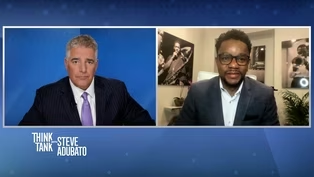
Grammy Nominee Discusses Teaching Empathy Through Music
Video has Closed Captions
Clip: 6/19/2021 | 9m 26s | Grammy Nominee Discusses Teaching Empathy Through Music (9m 26s)
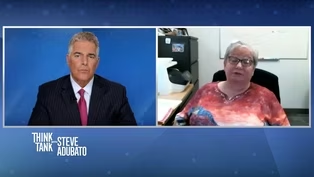
The Impact of COVID on Food Insecurity in Mercer County
Video has Closed Captions
Clip: 6/19/2021 | 8m 28s | The Impact of COVID on Food Insecurity in Mercer County (8m 28s)
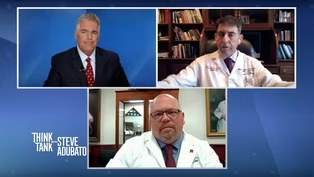
The Impact of COVID on Successful of Liver Transplantation
Video has Closed Captions
Clip: 6/19/2021 | 9m 35s | The Impact of COVID on Successful of Liver Transplantation (9m 35s)
Providing Support for PBS.org
Learn Moreabout PBS online sponsorship
- News and Public Affairs

Top journalists deliver compelling original analysis of the hour's headlines.

- News and Public Affairs

FRONTLINE is investigative journalism that questions, explains and changes our world.












Support for PBS provided by:
Think Tank with Steve Adubato is a local public television program presented by NJ PBS