One-on-One
Harry Lee; Joseph DiVincenzo; Madison Goehringer/Lakina Watson
Season 2025 Episode 2875 | 27m 12sVideo has Closed Captions
Harry Lee;Joseph DiVincenzo;Madison Goehringer/Lakina Watson
Harry Lee, President & CEO of the NJ Public Charter Schools Association, discusses the growing demand for public charter schools. Essex County Executive Joseph DiVincenzo, Jr. explores the role of public parks in enhancing quality of life. Two Lincoln Tech Graduates, Madison Goehringer, Diesel Engine Technician, and Lakina Watson, HVAC Specialist, discusses the value of technical education.
Problems playing video? | Closed Captioning Feedback
Problems playing video? | Closed Captioning Feedback
One-on-One is a local public television program presented by NJ PBS
One-on-One
Harry Lee; Joseph DiVincenzo; Madison Goehringer/Lakina Watson
Season 2025 Episode 2875 | 27m 12sVideo has Closed Captions
Harry Lee, President & CEO of the NJ Public Charter Schools Association, discusses the growing demand for public charter schools. Essex County Executive Joseph DiVincenzo, Jr. explores the role of public parks in enhancing quality of life. Two Lincoln Tech Graduates, Madison Goehringer, Diesel Engine Technician, and Lakina Watson, HVAC Specialist, discusses the value of technical education.
Problems playing video? | Closed Captioning Feedback
How to Watch One-on-One
One-on-One is available to stream on pbs.org and the free PBS App, available on iPhone, Apple TV, Android TV, Android smartphones, Amazon Fire TV, Amazon Fire Tablet, Roku, Samsung Smart TV, and Vizio.
Providing Support for PBS.org
Learn Moreabout PBS online sponsorship- [Narrator] Funding for this edition of One-On-One with Steve Adubato has been provided by RWJBarnabas Health.
Let’s be healthy together.
New Jersey Children’s Foundation.
Giving all Newark students the opportunity to achieve.
PSEG Foundation.
The Fund for New Jersey.
Eastern Atlantic States Regional Council of Carpenters.
Operating Engineers, Local 825.
New Jersey’s Board of Public Utilities.
Providing New Jersey residents tools to save money on energy costs.
The Port Authority of New York and New Jersey.
Moving the region through air, land, rail, and sea.
And by New Jersey Manufacturing Extension Program.
Promotional support provided by NJBIA.
We put business at the center.
And by NJ.Com.
Keeping communities informed and connected.
- This is One-On-One.
- I'm an equal American just like you are.
- The way we change Presidents in this country is by voting.
- A quartet is already a jawn, it’s just The New Jawn.
- January 6th was not some sort of violent, crazy outlier.
- I don't care how good you are or how good you think you are, there is always something to learn.
- I mean what other country sends comedians over to embedded military to make them feel better.
- People call me 'cause they feel nobody's paying attention.
_ It’s not all about memorizing and getting information, it’s what you do with that information.
- (slowly) Start talking right now.
- That's a good question, high five.
(upbeat music) - Hi everyone, Steve Adubato.
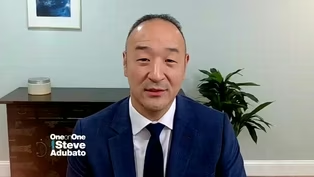
We kick off this program as part of our series, "Urban Education That Works" with Harry Lee, President and CEO of the New Jersey Public Charter School Association.
Harry, good to have you with us once again.
- Hey, Steve, great to be here.
Thank you for having me.
- Let me disclose that the Charter School Association is one of our newest underwriters focusing on urban education.
Harry, real quick, the website is up for your organization.
Describe what it is, and who you represent.
- We have in New Jersey, 84 public charter schools surveying 64,000 students throughout the state of New Jersey, and we are the statewide policy and advocacy organization that supports our schools throughout the state.
- Is it true that there are 25,000, approximately 25,000 students on waiting lists to get into public charter schools?
- In our urban communities, in the 31 former Abbot districts, there are 25,000 students on wait lists.
Statewide, there are actually 32,000 students on wait lists to get into a charter school.
- Yeah, one of the things about education policy is that terms are used.
Abbott districts.
Abbott refers to original Supreme New Jersey Supreme Court case, Abbott versus Burke, right?
Abbott versus the, who... Burke was the head of Department of Education at the time.
These are urban school districts, okay?
So Harry, help us on this.
Why do you call it a public charter school versus it's a charter school?
- Yeah, a lot of people may not know this, but charter schools are public schools.
They are tuition free, there are no tests, entrance exams, or other special requirements to get into a charter school.
- The biggest difference between a public charter school, and a district public school is what?
- Yeah, charter schools operate within the community, so they are similar to community district schools, but they are authorized by the New Jersey Department of Education, and they run on contract.
And so they run outta five year contracts.
If a charter school is not performing well, not doing right by students and families, they can be closed.
But many of the rules are very similar to district schools, student health and safety curriculum, all the mandates are the same.
- So you've been working with parents of children in public charter schools to do what?
Especially as we're... We're doing this literally two weeks, we're taping this two weeks before a gubernatorial election.
There will be a new governor in January of 2026.
He or she will have an education policy, and they will have policies directly related to charter schools.
Pick it up, Harry.
- We recently did polling for parents throughout our urban communities, and we found overwhelming support for public charter schools throughout the entire state in our cities like Newark, and Paterson, and Trenton, and Plainfield and Jersey City.
76% of Newark voters support public charter schools, and only 15% oppose them.
So that's a five to one margin.
In Trenton, we found that by a 12 to one margin, Latino voters support public charter schools, and in Paterson, 90% of Paterson voters and parents want more public school options in addition to their assigned district schools.
And so there's overwhelming support, and parents are voting with their feet, and we need to support our communities and parents.
- Okay, but here's the thing that I struggle with.
I remember my dad, who was such an advocate.
My dad was a district public school teacher in Newark for many, many years, later as a community activist, Started the first public charter school in the state of New Jersey.
Robert Treat Academy charter school.
But my dad would often say, we will not succeed in education purely through our charter schools.
There's never gonna be enough of them.
Not enough children will be in public charter schools, meaning our public district schools have to succeed.
What do you see, in an effort to avoid the public charter school, district charter school thing, how the heck do you work together so that both district schools, public schools, and public charter schools can actually both work together and not compete against each other in an unhealthy way?
- That's a great question, Steve, that we get this question often.
We do not see this as an us versus them.
We do not see this as a zero sum game.
We believe, and we've seen it in the data, and we've seen it in different communities, that public charter schools strengthen communities.
And so we have a large overcrowding issue in a lot of our cities.
In Paterson, in Trenton, in the East Ward of Newark, we know that there's overcrowding, and charter schools can provide another option to help fill those seats.
And so we've seen population growth throughout our urban communities, even post pandemic, while across the country, we've seen cities empty.
That's not the case in New Jersey.
We've seen more, and charter schools are an important part to make sure that every child gets what they need, and one size does not fit all, right?
And so we need great district schools, we need great charter schools.
- What would your message be to the next governor of the great state of New Jersey vis-a-vis education policy slash public charter schools?
- Charter schools are an important part of the public education system in New Jersey.
We have some of the best charter schools in the country in our state, for example, in Newark, we have our charter schools in Newark have outperformed the state average two years in a row in reading.
And we have the number one public education system, in the country, and that needs to be celebrated and supported.
- One quick thing before I let you go.
What are a couple of the aspects of public charter schools that make them work in our urban communities that people need to know?
Please, Harry.
- Yes, charter schools have longer school days, and longer school years.
And so that's intuitive.
When you have more time to catch kids up who may not be able to afford a private tutor, that's important.
Secondly, teacher training and development.
We have more time for professional development for our teachers.
In a traditional district, you might get that three times a year.
In charter schools, it's happening weekly.
So we're getting 30 professional development trainings.
And then lastly, I think it's really around accountability, right?
There's a culture of high expectations.
If a charter school is not performing, they can get shut down, and so that accountability aspect is really important when it comes to high quality public charter schools.
- Harry Lee is President and CEO of the New Jersey Public Charter School Association.
Harry, thank you.
We'll keep talking about quote, "Urban Education That Works" as part of this series.
Thank you, Harry, appreciate it.
- Thank you, Steve, really appreciate it.
- You got it, stay with us, we'll be right back.
- [Narrator] To watch more One on One with Steve Adubato find us online and follow us on Social media.
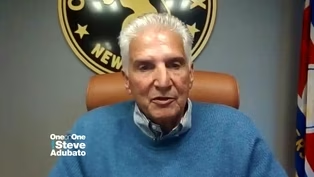
- We are honored to welcome the Honorable Essex County Executive, Joe D, Joe DiVincenzo.
Hey Joe.
How you doing?
- Great, Steve.
Thanks for having me.
This is a great, - Well, I got you two weeks before a gubernatorial election.
We're here to talk government, not politics.
For those of you, those of folks watching who don't know what a County Executive is, what is a County Executive and how much influence do you have in the county that we live in?
- Listen, we have, first of all, in the state of New Jersey, there's only five County Executives.
And Essex County's been in existence since 1978 and the fifth County Executive right here in Essex County.
What this does, it's just like you have down in Trenton.
You have a Senate assembly.
People over here we have, it's like a mayor working with his commissioners here.
And what we do is we work together as a team.
We do policy, we do work, and we work with all the 22 towns that are with us.
- Joe and I grew up in the same neighborhood.
Joe, question.
- Go ahead.
- Growing up in the North Ward of Newark, in all seriousness, going to Barringer High School, being a football star there, All-American in college.
Growing up in the quote neighborhood prepared you in what way to be the Chief Executive in the county?
In all seriousness.
- Being with your father for 40 years, that was a school within itself, - How so?
- Coming in.
Well, listen, he knew how to get things done.
Not only governmentally, but also politically.
And I was able to learn a lot from him there.
And also how to go after money.
You only go after people with money if you know they have money.
But the North Ward, no question, helped me where I am today.
Not only here, but throughout the state.
- And along those lines, and by the way, you should Google, put up the website for Essex County.
Follow up on this.
Joe, let's talk parks for a second.
One of the biggest themes in your administration, and again people can check this out, this is not about politics, it's about government, it's about getting things done.
You have built a whole range of public facilities for recreation, for sports, the Roberto Clemente Field in Branch Brook Park, so much in Branch Brook Park, in Brookdale Park.
Our daughter has played there field hockey, soccer, et cetera.
Why are the parks in Essex County such an important part of the quality of life in Essex County?
- First of all, we're a first county park system in the country.
Prior to me, with the past county exec, it was not a priority to do anything there because they were always in financial trouble.
So it was actually their fault.
But my thing being, my background being in parks and recreation, made it a priority.
'cause I know I needed our parks to get fixed up.
And what we did is we worked together as a team with all the municipalities, the 22 towns.
And we made sure we did every park.
We renovated every park, not only once but twice.
And we continue to do it.
Our biggest thing now is we have all our parks done, is putting together a strong maintenance plan, which we do have.
Look, we did three golf courses in three years.
In four years, we renovated three golf courses and they're absolutely.
- Byrne, Francis Byrne, Weequahic, and Hendricks.
- Three golf courses, beautiful golf courses.
They're all public golf courses.
I think when it comes to public golf courses, we're in the top five in the state.
- And along those lines, I'm gonna talk about collaboration and partnership.
So one of the things that's interesting, one of our, and Joe knows this, so, and we disclose this all the time, one of our largest underwriters of our programming is RWJBarnabas Health.
Go back to COVID, Joe.
You and I talked during COVID.
Essex County played a lead in terms of public health.
It continues to do that, particularly when it came to needing to get vaccine shots in arms.
A lot of that was in collaboration with other partners including RWJBarnabas Health.
Why is it important for county government and large public healthcare systems like RWJBarnabas Health to work together?
- Listen, we were in a crisis.
We have a very good health director, Maya Lorows who's very professional, but she couldn't do to herself.
She needed to contact hospitals and nursing homes and things like that to be able to get people involved and to be able to get volunteers.
But RWJ under the leadership, the new president, Mark Manigan and his team did a tremendous job.
They supplied doctors, nurses, whatever we need.
We had five vaccination sites throughout Essex County.
It's something that I'm very, very proud of.
We were able to get the vaccines in the people's arms first here in New Jersey, which I'm very proud of.
And our people did a great job.
It was a coming together.
It was a learning experience.
There's no question if something happened again, we'll be prepared.
Not that we're gonna do it perfectly, but we will be prepared knowing what we were doing through with COVID.
But the sad thing about it here in Essex County, and throughout our state of New Jersey, we lost 4,000 people towards that terrible disease.
And that's something we will remember.
But my people tell me, said Joe, we might have lost 4,000, but just think of all the lives that we saved working together, which is absolutely true.
And our people did a great job.
It wasn't myself.
It was a team that I assembled.
Listen, we worked on it every day, every day.
Every day we used to have a call at eight o'clock in the morning and we worked till that night and then the next day we talked about what we did and what we did wrong and what we need to improve.
And it went very well.
And it's something that people say, not only in New Jersey but throughout the United States, that we were probably one of the best centers providing vaccination sites throughout.
- Joe, along those lines, when I was a kid and you were throwing me footballs when you were getting ready.
I remember you used to say to me growing up, "Junior," and you always called me Junior, which is ridiculous, but that's what it is.
You said "There's no I in team."
I'm a student of leadership.
You are a leader.
What exactly does that mean, there's no I in team, - Listen, this is a big government.
I have over 3,500 people that work here.
I have great directors and division directors.
You know, to run a good government, you have to have good people in good positions.
And if I get any credit, it's that I put the people in the right positions whether it's parks, whether it's public works, whether it's job training or welfare.
We have some very strong people that are professionals in their area that I can count on.
And when something happened, like a COVID, I could call people together and we can make things happen here in Essex County.
And I'm so proud of the things that we've accomplished in the last 23 years.
No county government has done that throughout the state, and I've been involved with all the counties here.
We've done so much, which I'm very proud of.
It's not because of me, it's because of the team that I assembled here.
- I'm gonna switch from government, Joe, in the time we had left to ask you a tough political question.
We don't know who is gonna win the gubernatorial election.
You happen to be supporting Mikie Sherrill.
It's not about the election.
You are seen as a mainstream moderate Democrat who gets along with Republicans, including at the time Governor Christie to get stuff done.
Real quick, if you could, Joe, how concerned are you that sometimes the Democratic party can lean so far to the left that there are left-leaning progressives who are not the kind of Democrat you are.
Is there a place for mainstream Democrats moving forward?
- There's a place for everybody.
Listen, elections are only twice a year.
When the election is done, you've gotta be able to run government, to be able to work together.
And it doesn't matter whether you're a Democrat, Republican, or Independent.
And we've been very fortunate 'cause I've been in this county and I've been able to work with Republican governors and also Democratic governors and I am in the middle, all right.
Some of my views do go to the left but a lot go to the right.
So what I try to do is try to be in the middle and try and bring people together.
And that's what we did.
We made people believe in what we do here in Essex County.
And it's something that we all could be very proud of.
All 22 towns working cooperatively together.
That's never happened before.
- Joe D is Joe DiVincenzo, who is the Essex County Executive.
Joe, you've been County Executive starting when?
- In 2003.
Your father's the one who got me engaged in this, involved.
- He did it to me too and I will never forget.
- I learned a lot from him for 40 years.
We had our ups and downs, but we always came together as one.
- Absolutely.
Hey Joe, thank you my friend.
We'll talk soon.
- Thank you.
- I'm Steve Adubato.
That's Joe D the County Executive.
We'll be right back.
- [Narrator] To watch more One on One with Steve Adubato find us online and follow us on Social media.
- Hi, I'm Jacqui Tricarico, Senior Correspondent for "One-on-One."
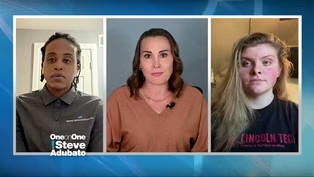
And so pleased to be joined now by two recent Lincoln Tech graduates.
We have Lakina Watson, who's an HVAC specialist, as well as Madison Goehringer, who's a diesel engine technician.
So great to have you both with us.
- Hi, how are you?
- Hey.
- Good, good.
- Thank you for having me.
- Well Lakina, I wanna start with you because I know that your grandfather actually was the one that really inspired you and pushed you to go into the trades.
Tell us about the advice that he gave you and why you wanted to follow in his footsteps.
- Well, he was actually a welder, so that was like something different to see like a Black man doing that back in the day.
So I really didn't grasp, you know, that the trades and the fields and how important it was until I got older.
Just doing retail for so long, I was like, "I have to do something different and what can I do different that I can always have a job?"
And I was like, "The trades."
And I just so happened to go to Lincoln Tech and I went to check out the HVAC program, and I loved it.
- That's awesome.
Madison, I wanna bring you in because when we're talking about these trades, right, where we're talking about construction and plumbers, electricians, it is a male-dominated industry.
I think right here in New Jersey, at least 10% or less are women in these trades.
So what was it that inspired you to wanna go into the trades?
- I actually grew up with three brothers, no sisters at all, and in high school I ended up hanging out with a group of people that were into big trucks, and that's what they drove every day and I just fell in love with it so I decided to go to Lincoln and pursue trucks.
- What were some of the biggest challenges you faced when you were at Lincoln Tech being I'm sure one of the only women in the classroom a lot of the times.
- Yeah, I was the only woman.
At Lincoln in South Plainfield, it was very nice because it was a variety of different ages in my class, and none of the teachers made me ever feel like excluded in any way possible.
And especially, when it came to the heavy lifting, it was really nice to have that help, but especially at Lincoln.
In Nashville it was more difficult because all of us were from all over the country, but it was a little more of my age group, which was nice in that way, but I didn't really find any struggles besides staying self-motivated.
- Well, Lakina, for you, how important was it to have support systems around you?
And I know there's something that you do, it's the Truck Girls, (laughs) tell us about that.
- Well, so definitely it's very important just to stay grounded.
I have like an awesome spouse, family members that just support me.
I do a lot of like outside HVAC work, I do refrigeration as well.
So I try to like do things for the community and community and things like that.
Family members, of course, there's always something, a side project that you have to just try to take on, so that's really basically it.
- Sorry, and the Truck Girls, sorry, that's you, Madison.
Tell us about that support system.
What is that network?
- So actually, when I was in Lincoln, in here in New Jersey, I was actually traveling a lot during the weekends to truck shows all over the US, which was very inspiring between Lacey Blair, Allie Chevy, all these girls on social media that helped me every day get through classes and really motivate me every day to continue to do what I was doing.
- Lakina, behind you we see an award, what is that?
- That's actually my HVAC Woman in Trades Award.
I won this, I was on the Direct Assist actually, and I was surprised from them to actually ask me to like do a speech.
So that was like pretty cool.
I was like, "Oh, I feel like I won a MTV Award up here."
(everyone laughing) So it was exciting.
I really am grateful for the experience for sure.
- Madison, going back to you, what do you think needs to change culturally really to get more women interested in wanting to pursue these careers?
- I'm not gonna lie, I have seen a lot more women pursuing it, especially in my town a lot, I do have a lot of conversations one-on-one with a lot of girls near me, trying to encourage them like to not be scared.
Like I work at a fantastic shop now where I'm not judged based on I'm a woman, there are shops out there, and I tell them all the time there will be shops that aren't, but you will find your place.
So I think that if you just keep pushing and you keep a positive mindset and you're willing to learn, then you'll go as far as you want, even beyond.
- Lakina, what's something that you've learned so far being in your field that you think is important to pass on to the next generation of young women looking to go into these fields?
- Honestly, just don't be scared.
It is male dominated, but we are taking over all the trades.
It doesn't matter if it's HVAC, it's diesel, it's electrician, it's carpentry, like we're not going anywhere and just embrace us.
And don't be scared to like put yourself out there and go the extra mile because you'll definitely be surprised where you're gonna end up.
- We've been hearing a lot about AI and AI kind of impacting so many jobs, so many careers.
Is there, Madison, is there anything that you're worried about when it comes to AI and its presence now in the fields that you and Lakina are in?
- No, I'm not worried at all.
Every day is something new and different.
Every day is something new with social media too.
So today, I was diagnosing a truck and it was completely different.
So with everything moving up in the world, I just see technicians moving up.
I see AI helping a little bit, but not fully taking over so I'm not concerned at all.
- Lakina, for you, do you see any issues for the future when it comes to AI?
- No, I don't.
I definitely agree with her as well.
I mean, I don't see AI doing a compressor.
I don't see, I don't really see that happening.
It's just so many different technical aspects in it and like different refrigerants coming out different days, so it's I don't really see that.
Actually, I'm very happy that I went into the trades for that reason, like I'm not gonna be replaced to by a robot, thank God.
(Jacqui laughing) - Well, Madison, for you, what has been the best part of this experience so far in your job, in your career while you were at Lincoln Tech?
What has really stuck with you?
- It made me get out of my comfort zone.
It made, like, Lincoln in South Plainfield was great.
I would recommend it to everybody, but Lincoln in Nashville, it got me out of New Jersey for three months, it really put my brain to the test because every week I had a test and it was something new.
But also when I went to my new job, they weren't playing around, they gave me an engine rebuild for my first job, so every day is just something new, and that has been the most accomplishing thing for me.
- Lakina, same for you, what has been just the best part of this experience so far for you?
- Definitely the learning aspect.
There's definitely always something new.
Every call is a different call, so you may do a RTU and then you may be doing a case in a supermarket.
So there's so many different things, and that's what I love about it.
It's like I learn, literally I learn something new every day, and I enjoy that.
It just helps me be a better technician.
- Well, both of your passions come through so much, and so nice to hear more about what you're doing in these trades and really paving the path for more women to get involved, so thank you so much both for joining us.
- Thank you.
- Thank you.
- Thank you.
For Steve Adubato and myself, we'll see you next time.
- [Narrator] One-On-One with Steve Adubato is a production of the Caucus Educational Corporation.
Funding has been provided by RWJBarnabas Health.
Let’s be healthy together.
New Jersey Children’s Foundation.
PSEG Foundation.
The Fund for New Jersey.
Eastern Atlantic States Regional Council of Carpenters.
Operating Engineers, Local 825.
New Jersey’s Board of Public Utilities.
The Port Authority of New York and New Jersey.
And by New Jersey Manufacturing Extension Program.
Promotional support provided by NJBIA.
And by NJ.Com.
- At the New Jersey Board of Public Utilities, affordability is always top of mind.
We offer a variety of energy assistance and other programs to help New Jersey residents reduce their energy use and save money.
The Community Solar Energy Program delivers immediate electric bill savings to all subscribers regardless of income, and our free Comfort Partners program helps qualified residents save money and make energy efficient upgrades.
We work to put affordability within reach for New Jersey residents.
The growing demand for public charter schools in NJ
Video has Closed Captions
Clip: S2025 Ep2875 | 9m 2s | The growing demand for public charter schools in NJ (9m 2s)
Two Lincoln Tech Graduates discuss the value of trades
Video has Closed Captions
Clip: S2025 Ep2875 | 9m 2s | Two Lincoln Tech Graduates discuss the value of trades and technical education (9m 2s)
Why bipartisanship is essential in effective leadership
Video has Closed Captions
Clip: S2025 Ep2875 | 10m 22s | Why bipartisanship is essential in effective leadership (10m 22s)
Providing Support for PBS.org
Learn Moreabout PBS online sponsorship
- News and Public Affairs

Top journalists deliver compelling original analysis of the hour's headlines.

- News and Public Affairs

FRONTLINE is investigative journalism that questions, explains and changes our world.












Support for PBS provided by:
One-on-One is a local public television program presented by NJ PBS