State of Affairs with Steve Adubato
Hazel Applewhite; Elizabeth Matto; Christian Fuscarino
Season 7 Episode 30 | 26m 45sVideo has Closed Captions
Hazel Applewhite; Elizabeth Matto; Christian Fuscarino
Hazel Applewhite, CEO of the Ironbound Community Corporation, examines concerns about early childhood development in urban areas; Director of the Eagleton Institute of Politics at Rutgers University-New Brunswick, Elizabeth Matto, Ph.D., discusses civil education and discourse; Christian Fuscarino, Executive Director of Garden State Equality, discusses the misconceptions about LGBTQ+ families.
Problems playing video? | Closed Captioning Feedback
Problems playing video? | Closed Captioning Feedback
State of Affairs with Steve Adubato is a local public television program presented by NJ PBS
State of Affairs with Steve Adubato
Hazel Applewhite; Elizabeth Matto; Christian Fuscarino
Season 7 Episode 30 | 26m 45sVideo has Closed Captions
Hazel Applewhite, CEO of the Ironbound Community Corporation, examines concerns about early childhood development in urban areas; Director of the Eagleton Institute of Politics at Rutgers University-New Brunswick, Elizabeth Matto, Ph.D., discusses civil education and discourse; Christian Fuscarino, Executive Director of Garden State Equality, discusses the misconceptions about LGBTQ+ families.
Problems playing video? | Closed Captioning Feedback
How to Watch State of Affairs with Steve Adubato
State of Affairs with Steve Adubato is available to stream on pbs.org and the free PBS App, available on iPhone, Apple TV, Android TV, Android smartphones, Amazon Fire TV, Amazon Fire Tablet, Roku, Samsung Smart TV, and Vizio.
Providing Support for PBS.org
Learn Moreabout PBS online sponsorship- [Narrator] Funding for this edition of State of Affairs with Steve Adubato has been provided by The Turrell Fund, a foundation serving children.
Horizon Blue Cross Blue Shield of New Jersey.
Here when you need us most.
RWJBarnabas Health.
Let’s be healthy together.
New Jersey’s Clean Energy program.
Lighting the way to a clean energy future.
The Healthcare Foundation of New Jersey.
Investors Bank.
PSEG Foundation.
Newark Board of Education.
And by The Adler Aphasia Center.
Promotional support provided by Northjersey.com and Local IQ.
Part of the USA Today Network.
And by New Jersey Globe.
[INSPRATIONAL MUSIC] - Hi everyone, Steve Adubato.
We kick off this program talking about democracy and whether we're in danger or not.
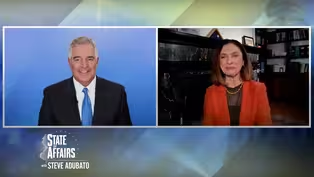
We're joined by Dr. Elizabeth Matto, who's director of the Eagleton Institute of politics at Rutgers University New Brunswick.
Doctor, good to see you.
- Good to see you.
Thanks so much for having me.
- Let me disclose that I am a proud fellow alum of Eagleton, a great institution.
- Thank you, we're proud to have you as an alum.
- Thank you, appreciate that.
Let's get right into this.
I insisted that we put the graphic Democracy in Danger up without a question mark because by any reasonable standard, we are in danger.
What is, from your perspective, and Eagleton is an institution focused on public policy, training those to go into public service, I being one of them back in the 80s.
That being said, the greatest threat to our democracy as you see it is?
- I think lack of attention to the state of our democracy.
I think my biggest concern is, you know, we've had years and years, generations almost, with young adults who really haven't had the civic education the previous generations had.
So I think what's imperative is that students have a really good sense of, not just how to participate in American democracy, critically important, but what the norms, what the values, what the attitudes of being a democratic citizen are, lower case D democratic citizen.
So I think that's my biggest concern is that there isn't necessarily a shared sense of what it means to have a liberal democracy, one that values freedom of speech, the rule of law, equality.
I think those, that's probably my greatest concern, but that's what gives me the greatest hope in that I know an institute such as Eagleton, or higher education in general, can make a difference, can make a positive difference in equipping the next generation of citizens.
- You have a new book.
- I do.
- The title and the message please.
- The new book is called "To Keeping the Republic "Thinking, Acting, and Voting Like an American Citizen".
It's coming out in the spring by Rutgers University Press, and in many ways, it's about this.
It's about this notion of American Democracy is fragile.
We shouldn't take it for granted, and it needs sustained.
But the hopeful message is that we have a role to play in sustaining our democracy.
And so really what it does is examines the various concepts, the various facets of democracy.
Not only how we think about it, how we participate in it, but even just talking to each other.
I think an under-examined skill is democratic discourse, civil discourse.
Certainly it's not frequently modeled and so it needs taught.
And here at Eagleton on campuses across the country, there's a greater effort on preparing, equipping students to have difficult conversations.
- So let's try this.
I have difficult conversations every time we have someone on who happens to be Republican; elected official, member of Congress, state legislator.
And I ask the same question every time.
People wonder, why are you asking that?
A, is Joe Biden the legitimately elected President of the United States in 2020?
Did Donald Trump lose that election?
They're like, why are we talkin' about that?
And my argument is, you can't move on to other things until you acknowledge that elections, even if there are problems with them, that you trust the results of the election, A.
And B, there's a peaceful transition of power, whether it's a governorship, presidency.
Am I over-estimating the significance of that, Doctor, in terms of democracy in danger, please?
- No, I don't think you're- - P.S.
- I don't think you're over-.
I'm sorry.
- Let me just add this.
70 to 80 percent of those who are polled, whether it's the CNN poll, a lot of other polls, Eagleton has a poll, 70-80 percent of Republicans believe that the election was stolen.
That's another reason I ask, and I apologize for interrupting, Doctor, please.
- No, not at all, and I agree with you.
And I think that goes back to your original question: Is democracy in trouble?
That's a significant concern for the longevity, the health of American democracy.
You know, that really has been the hallmark of American democracy; the legitimacy of elections.
Coming together, looking, you know, in an impartial way at the manner in which an election has been conducted, the results, and coming together to accept the results.
So I think that's a significant concern.
If those storming the capitol on January sixth thought they were expressing their grievances or expressing freedom of speech, that's a concern.
That is a misunderstanding of what American democracy is, and a core value of American democracy.
So I think that is not something that should be glossed over, that should be seen as just maybe a blip.
I think it's a significant concern and back to that's what we need to make sure we're doing with our undergraduates, with the public at large.
It's helping people understand that's not freedom of expression.
That's not protected speech by the First Amendment.
- So you're talking about young people.
- Yeah.
- Before you became the director, you're very involved in programming at Eagleton, and connecting with the young people.
- Yes.
- But also you were talking about elections.
- Yeah.
- So 2024.
I've seen polls, you've seen them as well, Doctor, who say that a higher percentage of younger people, say 20 to 30, are supportive of former President Donald Trump over Democratic President Joe Biden, who will be 86 at the end of his second term, if elected.
A, does that surprise you?
B, why do you think that is?
- Well, I think it's always important to remember we're a year out, right now, from the election.
So making sure we remember, first of all that students, not just students, a lot of people are not completely tuned in yet to the election.
I think it's not uncommon that there's disappointment among the electorate in the incumbent.
Promises that may have been offered may not have always fallen through, you know, may not have come through.
So there's always that sort of disappointment as to have the promises that a certain administration or an elected official made, have they followed through.
So it's not surprising that there's the disappointment.
I also think it's really worth remembering that millennials, Gen Z, don't necessarily have the same party loyalty that previous generations had.
You know, young adults certainly do tend to lean more progressive, but that doesn't automatically translate to voting for a democratic candidate.
- But Doctor, I'm sorry for interrupting.
We're not just talking about a Republican candidate for President.
We're talking about a Republican potential candidate for President likely to win the nomination who has four, as we speak, criminal trials going on, and may be convicted by the time the election is.
And it's not like young people don't know that.
- True.
Yeah, I mean, I won't disagree with you.
I think it's a concern and I think in many ways it's sort of an expression of, not only unease, but disappointment, even anger with American government right now.
I think more often than not, and we've seen it not just in some blips of interest in Donald Trump, in third party candidates, among young adults, I think it's much more an expression, not necessarily of hardcore support that will translate into a vote next year, but just general disappointment and disgust with American politics in general.
And I think the likelihood, I think it's a fairly- I would be surprised if by election day next year, much of that translates into strong support among young adults for Donald Trump, if Donald Trump is the Republican nominee.
I think what's more likely and a concern is that will young adults turn out in the numbers that they turned out in previous elections.
Or will they vote for a third party candidate?
- You know, Doctor Matto has this so right, because the third party candidate, we don't know who that would be, but if it's Robert Kennedy Junior, who seems to be attracting- We don't do political prognostication.
We're policy-centric - Right.
- But Robert Kennedy Junior has very clear positions on policies.
- Right.
- Research it, look it up.
- Right.
- Particularly his policies and views on vaccines.
- Right.
- Younger people drawn to him will see what that means, and I promise we'll have the Director of the Eagleton Student Politics, a great institution that I barely got out of in graduate school, at Rutgers University, Doctor Elizabeth Matto.
Thank you, Doctor, for joining us.
We appreciate it.
- Thanks so much for having me, really enjoyed it.
- You got it.
Stay with us, we'll be right back.
(grand music) - [Announcer] To watch more State of Affairs with Steve Adubato, find us online and follow us on social media.
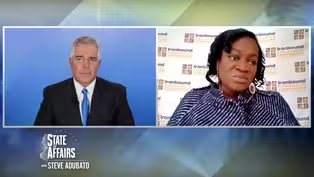
- We're now joined by Hazel Applewhite, who is the chief executive officer of Ironbound Community Corporation.
Hazel, good to see you.
- It's good to see you, Steve.
Thank you for having me on.
- Our pleasure, we'll put up the website for Ironbound Community Corporation.
Describe the organization and the people you serve.
- Sure, so the Ironbound Community Corporation, it's an agency that's been around for over 55 years.
We are located in the Ironbound section of Newark, which is also known as the East Ward.
We service the Ironbound and also the greater Newark with services such as environmental justice, youth services, early childhood, family services such as job placement, job readiness.
We have domestic violence programs where we assist victims of domestic violence throughout their journey, senior programming.
And that's kind of the services that we provide within this community.
- Let's go back to the childcare part of it, because you know that we've been involved for a long time, about four or five years now, in a public awareness effort.
Our programming is Reimagine Childcare Website will be up, information for Reimagine Childcare.
Here's the question.
How severe do you believe the childcare crisis is, particularly in the Ironbound community of Newark, A, and B, then I'm gonna ask you about one change, one improvement that needs to be made to make the situation better.
Please, how bad is the situation, Hazel?
- Sure, so when we talk about how bad the situation is, we're talking about quality childcare, right, free and affordable quality childcare for family.
What I will say, Steve, is that in order for parents to be comfortable with returning to the workforce, so going into the workforce, they need to be able to have that partnership with a provider, with a childcare provider rather, to know that their child is being serviced in a safe, quality, affordable environment.
And if that's not happening, our families are not able to go back to work.
We will have kids that are home with grandmas.
Within the Ironbound section of Newark, we serve a lot of non-English speaking families, so that child is at home with the grandmother or the babysitter.
One of the things you're not getting is access to language.
So when they're now, three years from now, four years from now going into kindergarten, right, forget about, let's step back from the social and emotional loss, right.
There's also that language loss 'cause they've not been in a setting where they're communicating with our, you know, standard language, which is English.
So at one point there, right, the language loss when they're, you know, at home, also the social and emotional loss.
If you don't have quality childcare, affordable childcare, we know at that early stages of a child's life that it's critical, right, for their learning, for their development, right.
We know that this critical time, right, can also lead the way for a child to have sufficient reading at third grade.
- We just had a legislative election in New Jersey, November the seventh.
I didn't see one campaign spot, I saw no public discourse around childcare, but it's such a high priority.
What are our, and again, there are state legislators like Senator Teresa Ruiz, check out the interview we did with her, talking about her initiatives, her efforts to increase funding for quality, affordable, accessible childcare.
Here's the question.
Why do you believe that childcare is not a higher priority issue during campaigns when people are paying more attention given the impact childcare, or the lack thereof, has on families, please?
- Yeah, you know, I have myself have tried to figure that out.
As an agency, we've tried to figure that out.
I feel like there is a lot of awareness, right?
Reimagine Child Care is bringing awareness.
We have agencies, advocacy agencies such as ACNJ that are bringing awareness, Turrell Foundation that's bringing awareness.
I think sometimes it's just not at the top of the list.
You know, Senator Teresa Ruiz has always been a champion for childcare, going back to, you know, my predecessor days.
I feel as though doing campaigns is just, it's just not a priority, unfortunately, right?
- But it is.
It's not a priority in campaigns, but it is a priority in real life, right, Hazel?
- Yes, in real life, there's real life issues, real life families.
You know, us investing into childcare at these early age sets our children up for success in the future.
- And what about, I'm sorry for interrupting, but what about families not being able to have a mom or a dad or both work because they don't have accessible...
There's an economic impact on this, please.
- So the economic impact is great, right?
When families are able to go out to work, there's financial stability, right?
There is a confidence that's built within that family.
When a family's working, the local economy does well when that child has a place that, where, you know, health factors are in place, right, faith.
When you're in housing that's safe, - That's right.
- that contributes to the well-being of that child and that child also learning.
I mean, listen, these are basic maths, right?
It's basic math - That's right.
- for the success of a child.
But you're absolutely right.
If a family cannot go out to to work, the very basic, they can't provide to their family, including that child.
- You've been listening to Hazel Applewhite, who's the chief executive officer of a terrific organization down in the Ironbound section of Newark, right below Penn Station, the Ironbound Community Corporation.
We're talking about childcare, our Reimagine Childcare initiative.
Hazel, thanks so much.
- You're welcome.
Thanks for your time.
- You got it.
Stay with us.
We'll be right back.
(grand music) - [Announcer] To watch more State of Affairs with Steve Adubato, find us online and follow us on social media.
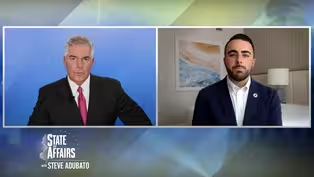
- We're joined once again by Christian Fuscarino, who is Executive Director of Garden State Equality.
Christian, good to see you.
- Nice to see you.
Thanks so much for having me back on.
- You got it.
We're taping on November the 14th.
The graphic will be up.
So let's put things in perspective.
The election that just took place in New Jersey on November the 7th.
A lot of talk about parents' rights, what parents should, should not have a right to know as regards to their, let's say, their 10-year-old.
If their 10-year-old's telling school administrators, teachers, they're confused about their gender, parents' rights folks said, "We all should know."
I'm not sure exactly what the law is or what the policies are in the Department of Education, but that's not the case, and it was a real issue.
What should parents know and not know as it relates to their 10-year-old discussing gender issues with educators?
- Well, Garden State Equality absolutely believes that parents should know if their child is LGBTQ, and that's why we encourage parents to create safe and affirming environments at home where the children feel comfortable coming out to their parents.
When we look at statistics, we know that over 40% of the entire youth homeless population identifies as LGBTQ, so there's a real problem in this country with parents kicking their children out of their home simply because of who they love or how they identify.
And at the end of the day, we wanna make sure that those students that are in those vulnerable positions are protected.
- So, okay, but how do you know that?
Who determines whether a child is potentially at risk or the reaction of the parents would not be what whomever decides it should be, so therefore, you don't tell the parents?
Who adjudicates that?
- A child knows best on how their parent is gonna respond to them knowing that they're LGBTQ, and that's why it's important for students to have the protections in place that allow them to stay in the closet at home despite being out of the closet at school where they may feel safer.
- Christian, respectfully, an 8-year-old knows that?
- Absolutely.
We're seeing kids come out of the closet younger and younger because of the level of acceptance in New Jersey.
And so, as younger people come out of the closet at school, because schools have done such a good job of creating safe and affirming learning environments, we know sometimes that their home environment is not as welcoming.
- Okay, so let's do this because this issue's not going away anytime soon.
You told our producers and you've been saying publicly that transgender rights and medical care, critically important.
Connect the two.
What's not being done for a population that is often targeted and underserved?
Please.
- Affirming healthcare is vital for lived equality.
We've done such a good job here in New Jersey being one of the most pro-equality states in the nation in the law, but still people's daily lived experiences might not be reflective of that.
And so, we've been working really hard with some of New Jersey's largest hospital systems like RWJBarnabas Health to offer all around care right here in the Garden State so members of the LGBTQ community don't have to travel into New York City or Philadelphia just to find basic care and resources.
And we're also really proud to have launched an affirming healthcare map, which lists providers all throughout the state of New Jersey where members of the LGBTQ community, specifically the transgender community, can go and find affirming resources.
- Hey, Christian, stay on the transgender community.
To what degree do you, 'cause you're very close to this, you advocate, and explain to folks, as I get to this question, explain to folks as we put up the graphic, the website for Garden State Equality, what is the organization?
- Garden State Equality is New Jersey's leading LGBTQ organization.
We lift up the diverse voices of many LGBTQ communities, and we're really proud of that diversity standpoint because the LGBTQ community is not monolithic.
Every LGBTQ person doesn't face the same issues.
And so, as a statewide org, we work really hard to make sure that everybody's concerns are heard at tables where decisions are made, at institutions of power, in their workplace, in schools, and Garden State Equality is going into our 20th year of doing that, and we're really proud of the progress we've been able to make thanks to a pro-equality legislature and a membership that stood with us for the last 20 years.
- Anti-trans rhetoric and targeting of the transgender community.
How real, and how do you know?
- Nearly half of the states in our nation right now have passed anti-trans laws within this past year, and here in the Garden State, we're really proud of a pro-equality legislature and the Murphy administration, who has gone above and beyond to let trans folks know, not only those that live here in the Garden State but those around the country, that they can come here and be safe and affirmed in the law.
And that's really important at a time when our nation needs to reckon with the rollback on LGBTQ rights we're seeing across the country because of anti-LGBTQ elected officials getting elected and put into office, both at the school board level, at the local level, and at the state level.
- Christian, let's take this nationally for a second.
So the new speaker of the house, Mike Johnson.
I was reading some of the things that he had said publicly, not what someone said he said, but what he has said, and he has been quoted in the past and saying and being very clear that if he could undo the Supreme Court decision about same-sex marriage, he would.
He would undo that.
And he also has argued in the past, publicly, you should look it up, it's not what I say he said, it's what he has said, that homosexual relationships and homosexuality and same sex marriage are at the core of destroying civilization in our nation.
Am I overstating, misquoting, and misinterpreting the Speaker of the House, second in line to power to the President after the Vice President?
I mean, am I misquoting, misstating it?
- Yeah, the speaker has made some pretty wild remarks about same-sex marriages, and when I think about my marriage, which is to a US Marine veteran and the family that we've created together, I don't see, you know, the deviance that the speaker thinks exists within same-sex marriages by any means.
But you know, the moral arc of the universe is long, but it does bend towards justice, and so, it does come to surprise to me that these individuals find themselves in leadership positions when, at the end of the day, I really think that LGBTQ equality is not a red or blue issue.
It's an American promise.
It's an ideal that many voters are getting behind and we can see that in the results of this past election here in New Jersey.
And I hope that, as we move forward, we'll continue to see voters show up to the polls in a way where we are removing these folks that have an idea where some people should be treated differently than others in the law won't be in those positions anymore.
- Last question, Christian, before I let you go.
In this last election, November 7th in New Jersey, the legislative election, all 120 seats are up, history was made, I believe in the 13th, or the 11th legislative district?
- Yes, we have our first openly LGBTQ woman that has been elected to the legislature.
We are thrilled for Luanne Peterpaul in this historic win.
We are a state that, again, is leading the nation on LGBTQ equality, but there were some years we didn't have any LGBTQ members in the legislature, and then we were lucky enough to have Don Guardian, who is an out LGBTQ legislator from the Republican party.
And now we have this historic win of Luanne Peterpaul being the first LGBTQ woman in the legislature.
So our legislature is beginning to look more like the progress we've made in the laws by having that representation there.
- And we'll have her on.
Thank you, Christian.
Appreciate it.
- Thanks so much, Steve.
Be well.
- You've got it.
I'm Steve Adubato.
That's Christian Fuscarino.
We'll see you next time.
- [Narrator] State of Affairs with Steve Adubato is a production of the Caucus Educational Corporation.
Celebrating 30 years in public broadcasting.
Funding has been provided by The Turrell Fund, a foundation serving children.
Horizon Blue Cross Blue Shield of New Jersey.
RWJBarnabas Health.
New Jersey’s Clean Energy program.
The Healthcare Foundation of New Jersey.
Investors Bank.
PSEG Foundation.
Newark Board of Education.
And by The Adler Aphasia Center.
Promotional support provided by Northjersey.com and Local IQ.
And by New Jersey Globe.
The Importance of Civil Education and Discourse
Video has Closed Captions
Clip: S7 Ep30 | 9m 52s | The Importance of Civil Education and Discourse (9m 52s)
Misconceptions About LGBTQ+ Families & Gender Affirming Care
Video has Closed Captions
Clip: S7 Ep30 | 9m 57s | Misconceptions About LGBTQ+ Families & Gender Affirming Care (9m 57s)
Why Urban Areas Are Hurting in Early Childhood Development
Video has Closed Captions
Clip: S7 Ep30 | 7m 55s | Why Urban Areas Are Hurting in Early Childhood Development (7m 55s)
Providing Support for PBS.org
Learn Moreabout PBS online sponsorship
- News and Public Affairs

Top journalists deliver compelling original analysis of the hour's headlines.

- News and Public Affairs

FRONTLINE is investigative journalism that questions, explains and changes our world.












Support for PBS provided by:
State of Affairs with Steve Adubato is a local public television program presented by NJ PBS