
Fresh Start
Season 8 Episode 1 | 26m 47sVideo has Closed Captions
Host Angela Fitzgerald visits the Urban Ecology Center in Milwaukee while sharing stories.
In the season premiere of "Wisconsin Life," host Angela Fitzgerald visits the Urban Ecology Center in Milwaukee. Located within the bustling city, the center’s programs are meant to connect people and nature. We also kick off the season with an engaging set of stories sharing the lives and passions of the people that make up our state.
Problems playing video? | Closed Captioning Feedback
Problems playing video? | Closed Captioning Feedback
Wisconsin Life is a local public television program presented by PBS Wisconsin
Funding for Wisconsin Life is provided by the Wooden Nickel Fund, Mary and Lowell Peterson, A.C.V. and Mary Elston Family, Leon Price & Lily Postel, Stanley J. Cottrill Fund, UW...
Fresh Start
Season 8 Episode 1 | 26m 47sVideo has Closed Captions
In the season premiere of "Wisconsin Life," host Angela Fitzgerald visits the Urban Ecology Center in Milwaukee. Located within the bustling city, the center’s programs are meant to connect people and nature. We also kick off the season with an engaging set of stories sharing the lives and passions of the people that make up our state.
Problems playing video? | Closed Captioning Feedback
How to Watch Wisconsin Life
Wisconsin Life is available to stream on pbs.org and the free PBS App, available on iPhone, Apple TV, Android TV, Android smartphones, Amazon Fire TV, Amazon Fire Tablet, Roku, Samsung Smart TV, and Vizio.
Providing Support for PBS.org
Learn Moreabout PBS online sponsorship- The following program is a PBS Wisconsin original production.
- Coming up on Wisconsin Life: meet a Guinness Book Yo-Yo World Record holder, a doll maker crafting one-of-a-kind creations, a drummer helping others find their rhythm, and an animated tale of a life in a bustling neighborhood.
It's all ahead on Wisconsin Life.
♪ ♪ - Funding for Wisconsin Life is provided by Lowell and Mary Peterson, Alliant Energy, Stanley J. Cottrill Fund, American Transmission Company, Focus Fund for Wisconsin Programs, and Friends of PBS Wisconsin.
- Hi, I'm Angela Fitzgerald.
We're taking an urban approach to the great outdoors as we visit the Riverside Park branch of the Urban Ecology Center.
It rests along the Milwaukee River between two communities: River West and the East Side.
The branch is one of three locations that make up the Urban Ecology Center.
A nonprofit working to make nature more accessible to all by educating folks on the value of the outdoors and its ability to make positive change.
They have youth, internship, and volunteer programs, equipment rentals, and so much more, including a significant collaboration with 60 local schools offering opportunities for students to get out into nature.
It's a thoughtful approach that extends to even the green building here designed with a rainwater collection and an observation tower with views of the Milwaukee skyline.
We'll visit that lookout and uncover more here later, but let's share our first story.
We join a doll maker in New Berlin who's using her talents to craft one-of-a-kind toys that ensures everyone feels included.
[music box melody] - I got you a very special gift.
- Yeah?
- Yeah, I can't wait for you to open it.
- Hi, Stace.
- Hi.
- You just asked me to go to your mailbox.
And there was something in there for you.
I see you looking at it patiently... - Oh, my gosh!
- ... with your dad.
[paper rustling] What happens when you say "yes," when the stars align?
You decide I am going to use my skill set.
The opportunity is there.
I think that amazing things happen.
- Oh my gosh.
[onlooker joyfully chuckles] - Onlooker: Oh my.
- It's amazing.
Look at her feet.
[joyfully] Oh my gosh.
It's amazing.
She made braces.
Oh my gosh.
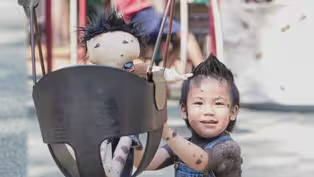
[onlooker joyfully chuckles] - My name is Amy Jandrisevits, and I am a doll maker.
I own the nonprofit 'A Doll Like Me.'
'A Doll Like Me' is a nonprofit organization that provides dolls for kids who don't see themselves on the store shelves.
Each doll is handmade and custom-made to how the child looks.
So typically, a parent or caregiver will email me.
Sometimes it's a doctor or a teacher.
So they'll send me a lot of pictures so that I can try and get, as much as possible, an accurate look at how they are.
Obviously, it's never perfect because it's a doll.
But I try my hardest to be as accurate as I can.
♪ ♪ I've probably done close to 400 dolls.
♪ ♪ It typically takes about six hours to make a doll start to finish.
I work on one at a time because I think that family deserves the courtesy of my time and my attention.
[click, whirr] When I sew for an extended period, I can get in the zone.
I can actually think about the child that it's going to go to and kind of imagine what will happen when they get it or how they'll use it.
And so, I kind of get lost in that mindset.
It's really relaxing.
So, even more than this being something that I do for people, it actually is very therapeutic for me to sit and do this.
♪ ♪ There's something really comforting in being able to hug a doll.
When I design the doll, I wanted to make it durable, and I wanted to make it something that could go into a bed with a child, that they could take in a hospital bed or take to surgery or wherever these dolls will go.
But they've gone all over the world.
They've gone to Israel and Egypt and South Africa.
England is very common, Australia, Canada, Germany.
They have gone more places than I have, actually.
[laughs] [mouse click] There's this whole group of kids who are underrepresented.
And why is that?
Why are we comfortable saying, "You know, you are beautiful.
"You're perfect inside and out.
"But yet, we're never going to design something that looks like you?"
And I think that's probably why 'A Doll Like Me' has been so successful.
People realize for the first time somebody is going to take that perfect child that you have and adapt it into a doll.
Jay, can I give your baby kisses?
I realize that I've been given this opportunity.
I honestly don't take it lightly.
But it does get very overwhelming.
- Look!
[little girl squeals with joy] - And the stories are so remarkable.
- Yeah!
- Every doll that you look at has an amazing story.
And I look at every story, and I think, "Oh my gosh, everybody should hear about this child."
- Woman: What do you think about that doll?
- She's even just like me.
- Mmm.
[kisses doll] - Every doll represents a person.
And I think that it's so validating for a child to be able to look at a doll and see their own face.
♪ ♪ Other people should look at these kids and say, "It's not the kid with the limb difference.
"It's the kid that can do all of things.
"And how great is it now that they have a doll that looks like they do?"
[laughing softly] - Wow.
- I feel like we have this obligation to each other.
We genuinely are a global community.
And I think that we owe it to each other to be good to each other.
We all have a place at the table and we all have something that we're good at.
And I do feel like it's our obligation to each other to bring that to the table, and share it.
It goes to show you, when you say "yes," what can actually happen and how your life can be kind of the vehicle through which change happens.
♪ ♪ - Next up, we travel to Madison to meet a yo-yo champion who has the world on a string.
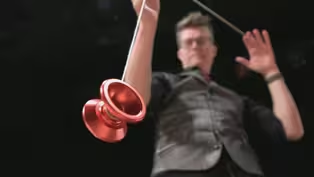
[footsteps] [unbuckling] ♪ ♪ - Mark Hayward: My favorite part about the show is [unbuckling] the feeling that I get when I can make an entire room of people laugh and have a good time.
[footsteps] [yo-yo swiveling] And that is so special and so magical.
My name is Mark Hayward.
I'm a comedy yo-yo man and world yo-yo champion.
My favorite thing about a yo-yo, strangely, is that it spins.
There's just something about that that really resonates in my brain.
You can do so many interesting things that seem not real, that are sort of separated from normal reality.
[yo-yo spinning metallically] My favorite trick is 'Darth Vader.'
It's the second most complex trick that I know.
A friend of mine taught it to me at a yo-yo party, and, yeah, those things exist.
It's a picture trick.
You make a picture with the string of Darth Vader's face, and then, of course, I get to say, "Luke, I am your father," and then people know who it is.
I've been very fortunate to get to go to a lot of places because of what I do for a living and also for a hobby.
I've gotten to tour all over the United States from coast to coast, but I've also been lucky enough that I have toured in Australia, China.
I've been to Sweden, South Africa.
I did a tour in Iceland and, of course, Canada and Mexico.
[yo-yos swing and swivel] I do have a lot of pretty great resume items.
I'm a world yo-yo champion.
I have two Guinness World Records, one for yo-yo-ing, one for spin tops.
My juggling team won the International Jugglers Association Annual Competition.
So, I'm a world juggling champion.
I'm also a spin top champion.
I haven't gotten the world title yet, but I have gotten as far as the Midwest Regional Spin Top Championship.
[spin top gyrates rapidly] Spin tops are something that almost all Americans recognize, but most people have never even seen one spun.
So, it's a rounded toy with a point.
You wind it with the string, you throw it, and it spins on the point.
[whirling] At the level that I'm at with my spin top friends, we throw the top, we generally catch it in our hand or catch it on the string and then manipulate it doing various tricks in the air.
[revolving swiftly] The newest record I have is for the furthest distance to walk the dog with a yo-yo.
[yo-yo thumps on floor] It felt so good to get that world record because I've been trying to get it for, I think it was like seven years.
So, when I got it, and they told me I got it on camera, and I had friends around me, it was the best.
When I'm at a party, the very first question people always ask when I say that I'm a professional comedy yo-yo man...
The first question is, "What?"
The next question is always, "Really?
You can make a living at that?"
And I understand people's reactions when they say that because I have that reaction, too.
I know a guy who is a professional jump roper.
I know a guy who is a professional bubble blower.
I mean, how is that possible?
But I'm a yo-yo guy.
I'm in no position to think that what they do is not a real job.
I think it's an important lesson that, if you can think of it, if you can persist, and you can be creative enough to figure it out, you can make a career out of doing anything.
♪ ♪ - I'm at the Riverside Park branch of the Urban Ecology Center, experiencing nature and learning about its significance to the communities here.
Hidden within the busy streets of Milwaukee is an outdoor sanctuary, the Urban Ecology Center.
The center has three branches and today, we're visiting Riverside Park to meet up with branch manager Megan Forseth to discover more.
So, Megan, can you tell us about the mission of the Urban Ecology Center?
- Yeah, it's an amazing mission.
It's very simple.
It's connecting people and cities to nature and each other.
How cool is that?
I don't think anything gets better than that.
- Absolutely!
- We really engage with everybody and anybody and so, of all ages, people of all backgrounds.
Any time we can get somebody outside, it's a win.
So, whether that's through our environmental education programming with school-age kiddos outside, doing more active activities through our urban adventure programming so canoes, kayaks, skis, things like that.
And then, we have our community science program, where we engage the public in scientific activities outside in the parks.
So really, there's something for everybody to come out here.
- So, no excuses if you wanna get outdoors and you want to use equipment that you don't have at home.
Come to Urban Ecology Center, become a member.
- Yeah.
- They'll hook you up.
The action here doesn't seem to slow down, especially during a pandemic.
- I feel like it almost amplified what we do and made us even more relevant than ever before.
You know, when things kinda shut down, people headed to the outdoors to heal and to thrive and to energize themselves, and we were here.
We were open.
Our parks were open.
They're always open twenty-four seven.
- Like, your community probably really appreciated the space, like having it accessible to them during that time.
- Oh, absolutely.
I think, for a lot of people, they rediscovered the parks.
They've rediscovered their neighborhood parks, more specifically, explored their backyards and their neighborhoods.
- Love that.
The Urban Ecology Center serves as a reminder to stop and enjoy the natural world around us.
- We hear over and over again, any park that you visit in the city, people go, "I had no idea I was in Milwaukee while I was doing my hike."
Whether it's along the river or Oak Leaf Circle here at Riverside Park, you know, when you're immersed underneath a hundred-year-old oak trees, it's hard to imagine that you're in, you know, Milwaukee, it's Milwaukee itself.
Yeah, and so, I just think it's the magic of being in the city but also surrounded in nature.
♪ Everybody, let's go, go... ♪ - A mission to bring people and the outdoors together.
What's not to love about that?
Now, it's time again to share someone else's Wisconsin Life.
As we head back to Madison, where a drummer is also working to bring people together, one beat at a time.
[drumming] Drumming has been a part of Yorel Lashley's life from childhood.
Born on the south side of Chicago, he soon became a world traveler following his family to Africa.
- I had been introduced to the Djembe drum from West Africa when I was in Liberia when I was about six.
And I took some lessons from a guy over there, a master drummer, and got my first taste, sort of, over the power of the sound.
But, I got back; I didn't necessarily pursue that.
I think for me, people think, "Oh, it's the instrument.
"You know, hear something, and you just fall in love."
I don't necessarily know...
I think it's also about the timing and the readiness to just employ that kind of discipline.
- Yorel didn't return to drumming for years until he started attending UW-Madison.
While he was exploring music, he also discovered another passion in his life.
- By the time I finished graduate school in '98, I was very seriously into drumming.
I was practicing, you know, five, six times a week.
And playing wherever I could.
My first job was a work-study job that I got: the South Madison Neighborhood Center, which now is Boys and Girls Club.
And then, I moved over to Wil-Mar Neighborhood Center, where I worked for years.
And that was my first experience with youth work.
And I discovered that, you know, I really enjoy young people and being sort of a teacher to them.
And I was also doing the drumming at the same time.
And I start thinking, "Well, maybe I could teach drumming."
And so, I started to essentially work backward.
- What Yorel didn't know is that it would evolve into something bigger...
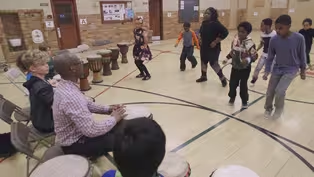
Drum Power.
Drum Power is a youth leadership program that uses West-African, Afro-Cuban, and Afro-Brazilian percussion.
And, it's not just drumming.
Dancing is a must.
- I like to move my body.
It feels good to me, and it's not necessarily hard.
And another skill, like since I know the drums, and they seem to be getting a little stale and worn out.
All right, let's put the drums down.
We're going to dance now, and then so we do that.
So... feels like having a whole other trick.
We're going right, first.
But it feels like a whole other thing is opened up.
That's super fun to me, but also a way of connecting to young people.
- It's more than just music.
It also teaches skills based on the three pillars of discipline, community, and leadership.
♪ ♪ - So, Drum Power is a program that teaches those three skills through music and in a practice way that they're always present.
We explicitly try to create an atmosphere where that can be comfortable and safe.
I expect them to always be disciplined.
That doesn't mean perfect... but that's the standard.
The standard is to use your energy for good things.
The results are going to be good things.
Positive outcome.
- Every summer Yorel hosts a Drum and Dance Camp on the campus of UW-Madison.
The three-week camp teaches children and young adults empowerment through drumming and dancing.
- Drum Power drum and dance camp is the only thing I'm willing to do that is truly about just exploration.
That is designed to be an opportunity for young people to enjoy fun, hanging out with each other, and learning together, and to learn and explore a vast array of cultural traditions that are not-- primarily non-western in focus.
But it was amazing to see that sort of develop over time and people figured-- Because I wanted it to be a nurturing place.
- While teaching music and life skills is important to Yorel, it's more than that.
It's helping them find their voice.
- It's not how tight the arrangement is... or whether they don't make mistakes.
It's the smiles and moments of triumph that I can see on their faces and sort of in their spirits and in the way they hold their bodies.
And my goal never is to train drummers.
Like, I don't care if these kids don't want to play the drums in two years.
But I do care if they have discipline, community, and leadership, and they understand what that is and how that could work for them.
Whatever the road they travel, they were able to find... ...something powerful.
Their power.
Not my power; Theirs.
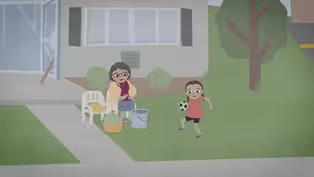
[Yorel instructs "Rabba-dab-dabba-dab-dab-dab"] [drumming powerfully in unison] - For our last story, poet Araceli Esparza shares a snapshot of life in Wisconsin, exploring community, family, and what it means to be a neighbor in this animated tale.
- Araceli Esparza: "Las Chicas y Chicos de Blossom Street" by Araceli Esparza.
Door propped open with tree sticks, hanging out on Blossom Street with one-step stoops.
Welcome to my street.
I'm Luz.
Luz Maria, if you're formal.
Our days are filled with family news, pretending and playing, and tiny jumps.
The day goes by and we dash from one playtime to the next.
Chicas y chicos are girl kids and boy kids, and everyone in between.
This is us.
[harp music] We are like little picture moments at sunset.
I live with my grandma, mi little sister Ana, a blind duck, and my tío.
- Hay!
- I like to hydro garden and I'm big on organic compost.
They call me "mija."
[warm laugh] Izzy, my best friend, is learning to do perfect cartwheels.
And like the sunshine, she almost pokes my eye.
Purple carrots, spring morning air, and washing leaves in my sister Ana's little hands, there's something new and old.
She's a fourth-generation piscadora, [cow moos] now urbana.
Next door, stuck in their room with Wi-Fi, clicking a keyboard, and swishing a finger pad.
Junior doesn't fix mofles; he fixes code, night until day.
Upstairs lives the twins, Paco y Pedro.
Free time is dress-up time, and that's when Pedro wears pink.
He banana smiles and drinks atole.
Paco prefers green tacos and ham!
When she wants to be like every boy neighbor, Ana plays the ultimate games, and double dares us to race.
She wins most of the time.
[cheering] [opening doors] With his empty cupboards, half-filled plate, [knocking on door] our neighbor, Luis, comes over for grandma's tacos de jamón y pan.
But on Sundays, he puts ketchup on his tamale!
[duck quacks] [camera shutter snaps] [harp music] Best dressed with shiny white shoes and tapping toes, Beta has two papis who swing her over puddles and carry her to pick the blooming lilacs across the street.
[bell chimes] Con los vecinos, our neighbors.
We learn to ride our bikes in the parking lot.
Together, we have a cookout and be like family.
None of us are related.
Still, we talk, argue, and laugh like familia.
"Okay, let's race," Beta says.
And her dress flutters against the wind.
Ana with holey-toed shoes makes up for time jumping over onion beds while Mago speeds up and stops short at the corner.
Her arms are ready for the Olympics.
No one told her she couldn't walk.
They told her she could fly.
[turning page] My friend Izzy gets stuck on Saturday morning meetings at the local centro comunitario.
A "stand up for your rights mami" equals tag-along girl kid.
[door opens] When she comes home, Izzy skips upstairs, finds her friends to compare drawings on tablets.
[happy laughter] The twins' place is always busy with parties.
Viernes de quinceañeras, Sabados de cumpleanos, y Domingos de Virgincita.
Paco y Pedro wonder when all the cheek pinching will ever end.
Four cheeks aren't enough.
In the next building over, Juan, his three brothers, and one sister sleep tight as pea pods in one room they call theirs.
In their dreams, they can be anyone.
He asks me, "When will the beans come up?"
Soon.
Very soon, I show him.
[plant expanding] Through the city's dusty roads, fresh air smells break through against the orange sunset.
I step off my tío's truca, and I am home.
[chickens cluck] I smile at my garden.
For me, all of them are my friends.
We have aventuras, vidas, y laughter.
Somos son de Blossom Street.
We are from Blossom Street.
[festive Latinx music] - Another great set of stories from a state with so much to share.
Find more about the Urban Ecology Center and the people featured today by visiting Wisconsin Life dot org.
Email stories@ Wisconsin Life dot org to share with us people you know or things you love about our state.
I'm Angela Fitzgerald, and this is our Wisconsin Life.
Bye.
- Funding for Wisconsin Life is provided by Lowell and Mary Peterson, Alliant Energy, Stanley J. Cottrill Fund, American Transmission Company, Focus Fund for Wisconsin Programs, and Friends of PBS Wisconsin.
Video has Closed Captions
Clip: S8 Ep1 | 4m 59s | Luz tells of her diverse family-like neighbors in this animated poem by Araceli Esparza. (4m 59s)
Video has Closed Captions
Clip: S8 Ep1 | 5m 36s | Woman creates dolls for kids who don’t see themselves on the shelf. (5m 36s)
Video has Closed Captions
Clip: S8 Ep1 | 4m 39s | Yorel Lashley founded Drum Power to connect his two passions of drumming and teaching. (4m 39s)
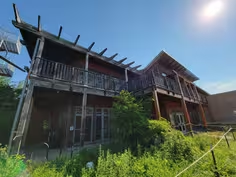
WL Host Angela Fitzgerald Visits Urban Ecology
Video has Closed Captions
Clip: S8 Ep1 | 2m 42s | Wisconsin Life Host Angela Fitzgerald explores the Urban Ecology Center. (2m 42s)
Video has Closed Captions
Clip: S8 Ep1 | 4m 34s | Mark Hayward makes a career out of spinning a yo-yo and breaks records along the way. (4m 34s)
Providing Support for PBS.org
Learn Moreabout PBS online sponsorship













Support for PBS provided by:
Wisconsin Life is a local public television program presented by PBS Wisconsin
Funding for Wisconsin Life is provided by the Wooden Nickel Fund, Mary and Lowell Peterson, A.C.V. and Mary Elston Family, Leon Price & Lily Postel, Stanley J. Cottrill Fund, UW...