VPM News Focal Point
Healing Trauma | April 28, 2022
Season 1 Episode 9 | 26m 46sVideo has Closed Captions
Explores ways people find healing after traumatic events.
An innovative form of therapy helps Virginia veterans overcome Post Traumatic Stress Disorder. A teacher says learning about the Holocaust is a powerful way to fight antisemitism and racism. The “Violins of Hope” exhibit reveals how music can bring hope and healing.
Problems playing video? | Closed Captioning Feedback
Problems playing video? | Closed Captioning Feedback
VPM News Focal Point is a local public television program presented by VPM
The Estate of Mrs. Ann Lee Saunders Brown & Dominion Energy
VPM News Focal Point
Healing Trauma | April 28, 2022
Season 1 Episode 9 | 26m 46sVideo has Closed Captions
An innovative form of therapy helps Virginia veterans overcome Post Traumatic Stress Disorder. A teacher says learning about the Holocaust is a powerful way to fight antisemitism and racism. The “Violins of Hope” exhibit reveals how music can bring hope and healing.
Problems playing video? | Closed Captioning Feedback
How to Watch VPM News Focal Point
VPM News Focal Point is available to stream on pbs.org and the free PBS App, available on iPhone, Apple TV, Android TV, Android smartphones, Amazon Fire TV, Amazon Fire Tablet, Roku, Samsung Smart TV, and Vizio.
Providing Support for PBS.org
Learn Moreabout PBS online sponsorshipANGIE MILES: Some of those who serve come home with scars that don't heal easily.
What are the options for veterans, for anyone, who is dealing with trauma?
An educator is using his classroom as a catalyst for both knowledge and empathy.
He's committed to letting lessons from the Holocaust lead to a better future.
And sometimes the ties that bind us together are strings that sing with hope.
This is VPM News Focal Point.
Production funding for VPM News Focal Point is provided by Dominion Energy, dedicated to reliably delivering clean and renewable energy throughout Virginia Dominion Energy Actions Speak Louder The estate of Mrs. Ann Lee Saunders Brown and by ♪ ♪ ANGIE MILES: Welcome to another edition of VPM News Focal Point.
I'm Angie Miles.
Today we're talking about trauma and how to heal it.
First though, a snapshot of news from around Virginia.
Arlington County has given Amazon clearance to build a 350 foot helix-shaped tower surrounded by a swirling walkable ramp.
The structure will house Amazon's Arlington headquarters and provide office space for 25,000 people.
Upon completion in 2025, the space will be open to the public on weekends.
In Richmond, legislators met this week to finalize the state budget.
They're trying to close a $3 billion gap between the House and Senate proposed spending plans.
Tax cuts are a key item of discussion.
State law requires a final budget by June 30th.
In Hampton, NASA's Langley Research Center has unveiled a new facility, boasting 40 high-tech laboratories where scientists will develop and test new Lidar instruments, which relay information about the Earth's atmosphere.
In Charlottesville, the University of Virginia's Athletics Foundation has received the largest single gift in its history, a bequest of $40 million.
A former student athlete pledged the funds anonymously.
The money will likely support the school's major athletics overhaul plan.
In Spotsylvania, local middle schoolers beefed up their cybersecurity skills at Spotsy Hacks, a free cyber camp led by Spotsylvania high school students.
Cybersecurity is one of the fastest growing job markets in the country.
ANGIE MILES: Find more local and national stories at vpm.org/focalpoint ANGIE MILES: Mental health professionals have indicated that the COVID-19 pandemic and the war in Ukraine have been trauma-triggering for many people, including veterans.
As they seek help, some veterans are finding relief in a form of therapy called EMDR.
Our Keyris Manzanares explains.
JAY SAWYER: Not everything that I did while I was in the military was peaches and cream so to speak.
There were things that I seen, things that I had done, that uh put a lot of pressure on me, unseen pressure inside that others could see but at the time I couldn't.
(engine revving) KEYRIS MANZANARES: Jay Sawyer spent 24 years serving in the US Navy, 20 of those years as a Navy SEAL.
He says the military gave him the structure he wanted but also took a toll on him mentally and physically.
(inaudible) Sawyer says since his retirement, he's been coping with post-traumatic stress disorder also known as PTSD.
JAY SAWYER: Personally, drawing into myself, being a recluse, not wanting to be around people, probably drinking a little bit more than I should have, but the biggest thing is I didn't want to be around anybody.
I didn't want to go to 7-Eleven.
KEYRIS MANZANARES: While seeking help, Sawyer met Kelly Andrews of Military Integrative Services in Virginia Beach.
She told him about EMDR.
KELLY ANDREWS: EMDR stands for Eye Movement Desensitization and Reprocessing.
KEYRIS MANZANARES: During an EMDR session, a patient revisits a traumatic event just briefly while experiencing bilateral stimulation typically achieved with eye movements.
This helps the brain to reprocess the pain and move it into long term memory.
KELLY ANDREWS: So I have an app and I would just hit start KEYRIS MANZANARES: Andrews and Sawyer simulate this in a brief demonstration.
KELLY ANDREWS: I can follow the light bar on here whether it's following somebody's fingers back and forth, following the light bar, or the buzzies in hands, or the headphones with the beeping sounds.
That bilateral stimulus essentially helps let the brain process in that natural way.
KEYRIS MANZANARES: Sawyer says EMDR therapy is like running a race.
He says it can get hard but it's also calming.
JAY SAWYER: It helps me open up to think about the things that are going on in my head.
It's at times, it can be overwhelming.
It brings up things and anxieties that I have that I've been keeping down for a long time.
(Gunshots) KEYRIS MANZANARES: Sawyer says the stigma surrounding PTSD in the military kept him away from therapy, but now he's seeing changes with EMDR.
JAY SAWYER: It was one of those things you just kept to yourself and you just didn't talk about 'cause you were worried how it was going to affect you further down the road, whether it'd be in the military or whether it'd be out on private sector.
KEYRIS MANZANARES: Andrew says EMDR is the magic wand of therapy.
Not only is it faster, but it's more successful in treating veterans because ... KELLY ANDREWS: It goes to the brain level and so veterans they don't have to tell their traumas in great detail, any kind of traumatic experience.
They don't have to tell in great detail.
They don't even have to tell me.
KEYRIS MANZANARES: Sawyer says it takes strength to seek therapy but when it betters who you are, it's worth it.
JAY SAWYER: No mission can be accomplished single-handedly.
It takes not only the people that are with you, but the people in the rear who have supported you that get you the information, get you the weapons, get you- get you to that particular point.
So it has to be a combination of people.
You cannot do anything by yourself, you can't.
So therapy is no different.
[You're all clear.]
KEYRIS MANZANARES: Reporting for VPM News Focal Point, I'm Keyris Manzanares.
ANGIE MILES: Many VA medical centers offer EMDR and other therapies to treat PTSD.
EMDR can be helpful to anyone dealing with trauma and many practitioners do offer it as a treatment option.
Now I'd like you to meet Tiffany Abdullah.
She's a licensed counselor and a certified clinical trauma professional with more than 15 years experience in the mental health field.
Thank you for joining us today.
TIFFANY ABDULLAH: Thank you for having me.
ANGIE MILES: We talk about trauma, we hear about trauma, but what is it really?
TIFFANY ABDULLAH: Yeah, so trauma is psychological distress experience following a life-altering event.
So that could be anything from war.
That could be violence in the community.
It could be a natural disaster.
It could be from a lot of different situations.
ANGIE MILES: Okay, and hopefully when people experience trauma, they have the support, they have the resources to process it in a healthy way, but if it doesn't get processed, that can become PTSD, right?
TIFFANY ABDULLAH: Certainly, so post-traumatic stress disorder can be experienced if you have witnessed, experienced or even heard of traumatic experience.
So you may notice that you have changes in your mood, your sleep patterns, your eating, there's may be difficulty in your functioning, ability to function socially and occupationally, so there may be distressing memories.
There's avoidance sometimes of triggers and things that bring to memory the actual tragic event, the traumatic event, so.
ANGIE MILES: Okay, and of course there are many different treatment options for people to deal with it with a professional.
What kinds of things help people come through trauma?
TIFFANY ABDULLAH: Yeah, so one of the things I like to do with some of my clients is what we call trauma narratives, and with children that might look like a drawing or artwork and with adults that could come in the form of storytelling, writing of a narrative, some type of poetry, something like that, so being able to tell the story is a very important practice in dealing with the trauma.
ANGIE MILES: Self-care, telling the story, getting good guidance from people-- TIFFANY ABDULLAH: Absolutely, having that support as well and finding community I think is very important as well.
ANGIE MILES: And are there people you think who may be engaged in less than healthy behaviors, maybe habitually, who are seeing the after-effects of trauma without realizing that they've been traumatized?
TIFFANY ABDULLAH: Absolutely, so there are a number of experiences that many adults have experienced as a child, and they bring that into their adulthood, not realizing that a lot of that is unresolved trauma that they haven't dealt with.
And so, if not properly dealt with and acknowledged, then they could kind of re-experience those things in their adult life.
ANGIE MILES: So things like poverty, family breakup-- TIFFANY ABDULLAH: Jail, a parent or a family member that's in prison, a caregiver that's imprisoned, being in a home that was not nurturing, all of those things could be traumatic for a child.
ANGIE MILES: But there are resources available including professionals, and thank you so much for joining us to talk about this.
TIFFANY ABDULLAH: Yes, you're welcome.
ANGIE MILES: And Ms. Abdullah has also shared with us a number of resources that can help people cope with trauma, and you can find those on our website.
KEYRIS MANZANARES: For today's People of Virginia segment, we asked how might society change if we put more collective focus on preventing and healing trauma?
What can our leaders do to help us heal?
Watch these responses.
Make sure that there is help and not just for those maybe a week or month, because trauma doesn't end that soon.
It needs continuous support.
I think there needs to be more done with how it's affecting us today versus what happened in the past.
For those of us who experience it firsthand we need the surrounding community to address that as something that affects everyone, not just the individual themselves.
KEYRIS MANZANARES: As always, we appreciate your thoughts and story ideas, and we invite you to share more on our website, Vpm.org/focalpoint.
ANGIE MILES: April 28th is Holocaust Remembrance Day, commemorating the 6 million Jewish victims of the genocide.
Despite the lessons of this painful history, anti-Semitism is on the rise in Virginia and around the world.
In 2021, anti-Semitic incidents in the US increased by 34% compared with 2020.
Our story begins at Richmond's Holocaust Memorial Cemetery with the chanting of an ancient Hebrew prayer to honor those murdered in the Holocaust.
(singing in Hebrew) ALEX KEISCH: We have a twofold mission at this oldest Holocaust Memorial site in North America to teach about the Holocaust and to remember our murdered families who perished in Europe for their faith.
Sadly, nearly one-third of all Americans and four out of 10 millennials do not know which war the Holocaust is associated with.
SHANNON TAYLOR: We must ensure that our children learn about the Holocaust.
We must as Americans be willing to acknowledge the errors so we can learn from them.
We must teach how easy it is to lose sight of another's humanity.
(indistinct charter) HASHIM DAVIS: What I love about being a history teacher is that I can tell stories, but notably telling stories for those folks that we normally don't hear about.
ANGIE MILES: Hashim Davis teaches history at Albemarle High School in Charlottesville.
The school is located just a few miles from the epicenter of the Unite the Right rally in 2017 where white supremacists and neo-Nazis marched with weapons and burning torches, shouting "Jews will not replace us."
The march turned violent, many were injured, and activist, Heather Heyer was killed.
Last November, a civil jury found white supremacists liable for conspiring to organize the racially-motivated violence ordering them to pay more than 26 million in damages.
HASHIM DAVIS: You saw hatred in action, but you saw resilience in action for those individuals who lost their lives that day.
There's no replacing that, but it's something to be celebrated because hatred is just not tolerated.
ANGIE MILES: The judgment can be seen as a step forward in a movement meant to stop the rise of anti-Semitism in our country.
However, according to an American Jewish Committee survey one in four American Jews say they were a target of anti-Semitism in the last year.
Davis believes his students can call it out when they see it largely due to the time and effort he spends in the classroom, teaching them about the Holocaust.
HASHIM DAVIS: Exposure as Elie Wiesel says, when you become a witness is as a result of you bearing witness to it.
And whether my students will ever touch a synagogue by way of visiting it, or if they will come across anybody who is Jewish, they can never say as being a student in this class, they didn't know.
ANGIE MILES: Davis uses documentary evidence to illuminate the horrors of the Holocaust for his class.
Part of a generation that often lacks awareness of these events.
A 2020 national survey by the Claims Conference found that 63% of respondents under age 41 in Virginia did not know that Nazis murdered six million Jews during the Holocaust.
Nazis also killed five million political prisoners, people with disabilities, homosexuals and Roma.
HASHIM DAVIS: Who would've used anti-Semitism and said, "It were the Jews, the Jews, the communists, they were the ones that stabbed us in the back that made us not be as glorified as we once were.
All of that happened."
ANGIE MILES: Teaching the Holocaust is mandated by the Commonwealth of Virginia.
Students must be tested on the subject as a Standard of Learning.
However, only 19 other states mandate Holocaust education for public school students.
Jennifer Goss a Holocaust education scholar says that legislative mandates are a positive step forward, but that requirements differ vastly from state to state.
JENNIFER GOSS: Mandates aren't a new conversation.
In Virginia the only official piece of legislation that discusses Holocaust education is House Bill 2409 that came about in 2009 mandating that the Virginia Department of Education ensure that every school district had access to a manual of effective practices and lessons for Holocaust education.
So there's a measure of accountability in the state of Virginia that often lacks in other states that have quote mandates but their mandates are very loose and simply say things like, "The Holocaust must be taught."
Here in Virginia we do have specific framework that not only ensures that the topic is taught but that specific components of the topic are taught.
HASHIM DAVIS: Who are the people that you're going to study about that you're going to examine?
Right?
We have placards, identity cards of actual individuals who either survived or who had perished in this event.
Who were they before the Nazis stripped them of their identity?
ANGIE MILES: Recent surveys suggest that while some youth in America can't recall specific places and dates related to the Holocaust they are connected to the stories of struggle and survival.
Dr. Roger Loria has spent the last few decades talking with students about his personal experience as a Holocaust survivor, memories that are still difficult to talk about, but that he believes are important to share.
ROGER LORIA: I didn't speak for 50 years, but when here in the US, in Richmond, I saw the burning of the churches and the killing of the Vietnamese and the gay people.
That is the first time I start talking 'cause I have been there and I want to make sure that we don't repeat this and that we don't let this happen again.
Abby Crowe is a junior at Freeman High School her interest in the Holocaust was kindled when she participated in New York Times Summer Academy last year.
ABBY CROWE: Last summer, I was lucky enough to hear Alice Ginsburg recount her life story and I wrote the piece that I'm about to read to you.
As I've gone on this exploration of the Holocaust, the one aspect that has stood out to me the most is how much love the Holocaust survivors have for the world.
When you hear directly from the source, it definitely creates an emotional response that you don't get otherwise.
And hearing firsthand really is something that's going to go away eventually.
And so in order to keep telling the stories and keep them alive, it's important to hear exactly what happened and make sure it never happens again.
JENNIFER GOSS: The reality is a lot of teachers in Virginia aren't today teaching students and drilling into students names and dates and numbers.
They're teaching the Holocaust through stories and they're teaching students the broader lessons of this topic.
ANGIE MILES: Goss says a 2020 survey by Echoes & Reflections found that teaching about the Holocaust helps students build empathy for people of many different racial, ethnic and religious backgrounds.
JENNIFER GOSS: Students that had been taught about the Holocaust were more likely to be tolerant towards others.
They were more likely to accept a diversity of viewpoints.
And so I can't tell you that every one of those students could have told us that six million people, Jewish people died during the Holocaust and five million others, but what I can tell you definitively is that those students are equipped with skills that are going to help them go out and be productive and engaged citizens in our society.
And as a Holocaust educator I think that's where the real win is.
ANGIE MILES: In 2020 Congress passed the "Never Again Education Act," a bill co-sponsored by Virginia US Representative Abigail Spanberger.
The bill provides 10 million in funding to the United States Holocaust Memorial Museum to ensure better access to Holocaust education resources for schools around the country.
ABIGAIL SPANBERGER: It's incredibly important that all of us remember where lies, conspiracies and hate can lead a society.
And so being active in ensuring that we're remembering that part of our shared history is incredibly important.
I think it's a way that we honor the victims.
It's a way that we proactively ensure we never witness something nearly as tragic or horrible ever again, but it's incredibly important that we learn from the past and remember those who lived it and those who died.
♪ Let us say ♪ Amen DOVID ASHER: Anti-Semitism is serious.
If it happened before, that means it can happen again.
ROGER LORIA: It's very important to tell the story and to tell the history.
I have gave a lecture and a young girl got up and asked me, "Dr. Loria, how do you keep the hate out of your heart?"
And I told her, "The hate eats you up."
We are now in a situation where hate is very prevalent and certain people use the hate to justify violence.
We are talking against that.
We are talking about hope, about helping people, about kindness and not about hate.
Hate never solves anything.
ANGIE MILES: At 82-years-old, Dr. Loria continues to share his story widely, hoping to prevent future hate crimes.
The Virginia Holocaust Museum has a robust set of educational resources.
You can learn more on their website.
ANGIE MILES: We close with a story about the healing power of music.
The Violins of Hope exhibit includes 50 restored violins and cellos once played by Jewish musicians during the Holocaust.
Last fall, the exhibit traveled to Roanoke, Richmond and Newport News.
Musicians from the Richmond Symphony Orchestra played those instruments in concerts raising awareness about injustice, survival, and resilience.
(gentle solemn music) ANTHONY MARQUES: Good evening.
My name is Father Anthony Marques and I am the rector of the Cathedral of the Sacred Heart.
The Cathedral of the Sacred Heart is honored to host this concert whose harmony can inspire greater solidarity and respect among all peoples.
♪ SAMUEL ASHER: It's about our family histories and memories.
Through this exhibit we honor those who we lost and we remember them and their music.
(dramatic orchestral music) ♪ ANDREW TALKOV: It allows us to learn from the past.
It also allows us to understand our present and hopefully it allows us to plan for a better future that includes everyone.
(gentle solemn music) MARY LAUDERDALE: African American history is American history.
It is not just Black people's history.
It is the country's history, same thing with Jewish history.
They're all intertwined.
(dramatic orchestral music) AVSHALOM WEINSTEIN: Unfortunately from the tens of thousands probably of instruments which were used during the war in the camps.
And the vast vast majority is gone.
And this is the sound and the music that some of those people had a chance to play.
Some of them survived, some unfortunately didn't.
SAMUEL ASHER: This exhibit is one of those things where we stand together.
And we talk about injustice, we talk about hatred and we say no we have to stop it.
We have to be a beacon of hope as in a violin of hope to bring people together and stand up for what's right.
(dramatic orchestral music) ANIGE MILES: The road to healing trauma can be long and rocky.
Today, we shared some ideas and resources to assist Virginians on the journey to individual and collective wholeness.
Thank you for watching.
We'll see you next time.
Production funding for VPM News Focal Point is provided by Dominion Energy, dedicated to reliably delivering clean and renewable energy throughout Virginia Dominion Energy Actions Speak Louder The estate of Mrs. Ann Lee Saunders Brown and by ♪ ♪ ♪
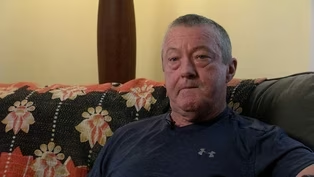
EMDR treatment is gaining traction in the veteran community
Video has Closed Captions
Clip: S1 Ep9 | 3m 52s | A seemingly simple therapy is seeing success in helping veterans recover from trauma (3m 52s)
Healing Trauma | People of Virginia
Video has Closed Captions
Clip: S1 Ep9 | 54s | Hear Virginian's thoughts on how to support to support people who experience trauma. (54s)
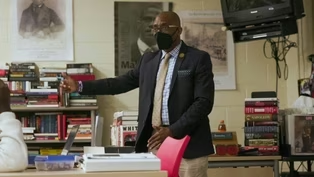
The importance of Holocaust education
Video has Closed Captions
Clip: S1 Ep9 | 10m 1s | A high school teacher says learning about the Holocaust is a powerful way to fight hate. (10m 1s)

Resources to support your mental health
Video has Closed Captions
Clip: S1 Ep9 | 3m 16s | Tiffany Abdullah, LPC, CCPT shares resources and advice for managing your mental health. (3m 16s)
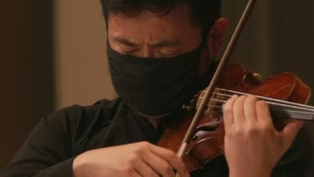
Violins from the Holocaust teach healing and hope
Video has Closed Captions
Clip: S1 Ep9 | 2m 42s | “Violins of Hope” is a traveling exhibition of violins played by Holocaust victims. (2m 42s)
Providing Support for PBS.org
Learn Moreabout PBS online sponsorship
- News and Public Affairs

Top journalists deliver compelling original analysis of the hour's headlines.

- News and Public Affairs

FRONTLINE is investigative journalism that questions, explains and changes our world.












Support for PBS provided by:
VPM News Focal Point is a local public television program presented by VPM
The Estate of Mrs. Ann Lee Saunders Brown & Dominion Energy