VPM News Focal Point
Health and Medicine | March 16, 2023
Season 2 Episode 4 | 26m 46sVideo has Closed Captions
Caring for health care workers; questions about hospice care; Chinese medicine
How mental health care for health care providers could help ease workforce shortages; While hospice care gains acceptance and popularity it raises some ethical questions; Chinese medicine offers alternative health care solutions.
Problems playing video? | Closed Captioning Feedback
Problems playing video? | Closed Captioning Feedback
VPM News Focal Point is a local public television program presented by VPM
The Estate of Mrs. Ann Lee Saunders Brown
VPM News Focal Point
Health and Medicine | March 16, 2023
Season 2 Episode 4 | 26m 46sVideo has Closed Captions
How mental health care for health care providers could help ease workforce shortages; While hospice care gains acceptance and popularity it raises some ethical questions; Chinese medicine offers alternative health care solutions.
Problems playing video? | Closed Captioning Feedback
How to Watch VPM News Focal Point
VPM News Focal Point is available to stream on pbs.org and the free PBS App, available on iPhone, Apple TV, Android TV, Android smartphones, Amazon Fire TV, Amazon Fire Tablet, Roku, Samsung Smart TV, and Vizio.
Providing Support for PBS.org
Learn Moreabout PBS online sponsorshipANGIE MILES: By almost any standard, America has an incredibly complex and often frustrating healthcare system.
We're going to take a closer look at issues that affect access and quality in ways that impact your wellbeing.
From how to address health professional burnout to the ethics of end of life decisions and the move towards alternative medicine.
Let's talk about healthcare on VPM News Focal Point.
Production funding for VPM News Focal Point is provided by The estate of Mrs. Ann Lee Saunders Brown.
And by... ♪ ♪ ANGIE MILES: This is VPM News Focal Point.
I'm Angie Miles.
The word "crisis" has been used to describe America's healthcare system for more than 50 years.
In the quest for basic, good health, Americans have endured soaring costs, unequal access to care, battles over insurance coverage, and much more.
What is the state of healthcare today?
We'll traverse Virginia to see what we can learn.
We begin with long COVID.
More than half of Virginians have had COVID-19, and nearly a third of those continue to suffer long-term effects.
VPM News producer Adrienne McGibbon introduces us to people coping with Long COVID.
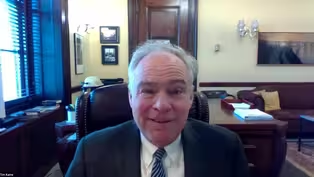
ADRIENNE McGIBBON: Senator Tim Kaine is one of the millions of Americans who've gotten COVID.
He's also part of a smaller group who suffers from lingering symptoms.
TIM KAINE: I have a very weird symptom that's never gone away which is a nerve tingling thing.
I describe it as if all my nerves were just dipped in an Alka-Seltzer.
There's just a fizzing and buzzing as I'm talking to you today.
I can feel it everywhere in my body.
ADRIENNE McGIBBON: Senator Kaine says he's dealt with these symptoms for three years.
He worries, as the pandemic turns endemic, those who are suffering will be forgotten.
TIM KAINE: My concern is that maybe people will move on and stop thinking about those who really are dealing with Long COVID in ways much more serious than me.
TIM KAINE: This is a topic of importance to millions of Americans who deal with Long COVID every day.
ADRIENNE McGIBBON: This week, the Senator reintroduced legislation that would help fund research into the causes and treatment of Long COVID.
As Congress considers future funding, care providers in Virginia are still helping patients.
LESLIE MENTO: With the therapies that we provide, we're helping to get patients back to performing their daily task.
ADRIENNE McGIBBON: Physical therapist, Leslie Mento says some clients struggle to perform everyday tasks.
He helps rebuild their strength and retrain their muscles but worries about those not getting help.
LESLIE MENTO: There are many people that are having lingering symptoms of Long COVID that I think are underdiagnosed.
ANGIE MILES: In addition to lingering problems caused by Coronavirus, Americans cite other issues when it comes to wellness.
The Kaiser Family Fund finds that half of US adults say they have difficulty affording healthcare.
We heard the cost burden echoed in our own state as we ask people of Virginia to share their healthcare concerns.
JASON MITCHELL: I think the biggest challenges with healthcare is just affordability.
You know, we need a better system where everybody's covered so that the costs for everyone can go down.
CAMERON BATES: I know other people's families can't necessarily afford a EpiPen, so that I kind of feel should be given or, like, prescribed more and not have to pay a ridiculous amount for.
CALVINA BIRCH: I feel like medicine should be affordable for everyone regardless of their class.
CONNIE LAPALLO: One of my big concerns is that when the Affordable Care Act came in our health insurance was gonna jump about about a thousand dollars a month and we cannot afford to make that much of a payment so we had to find something else and we didnt know what we were going to do.
Because were required to have this, but we had heard about a Christian healthcare sharing plan so we got on that, and that was actually more economical.
ANGIE MILES: Staffing shortages plague health facilities worldwide.
In the United States, an estimated 100,000 nurses left the profession during the pandemic.
Virginia is leading the way in addressing the residual effects of overload and exhaustion among those who help to heal the sick.
VPM News producer Adrienne McGibbon introduces us to medical professionals focused on caring for our caregivers.
A warning for viewers.
This story does contain mentions of suicide.
ADRIENNE MCGIBBON: Scott Austin remembers the early days of COVID at UVA Health.
SCOTT AUSTIN: A lot of unknowns, so that was causing a lot of frustration and irritation amongst a lot of team members, self included ADRIENNE MCGIBBON: The nurse manager says his team was strained, working long shifts and caring for patients while adjusting to the rapidly changing protocols that came along with an unknown virus.
SCOTT AUSTIN: I needed to become a better leader and have talk with team members in a way that I've never needed to do prior to COVID.
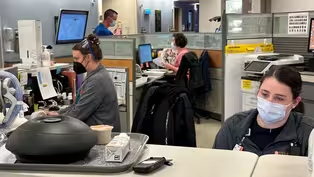
ADRIENNE MCGIBBON: In the healthcare workforce, there's a stigma around seeking mental healthcare, the suicide in 2020 of Charlottesville native and emergency room physician, Dr. Lorna Breen, sparked a nationwide crusade to break that stigma.
COREY FEIST: We envision a world where seeking mental health treatment for healthcare workers is universally viewed as a sign of strength by the workforce.
ADRIENNE MCGIBBON: Corey Feist co-founded the Dr. Lorna Breen Heroes Foundation named for his sister-in-law.
He says her death shined a light on an unspoken issue in the system.
COREY FEIST: The stigma around taking a break, let alone getting mental health treatment or speaking to someone about your challenges, is really reinforced from the early days of training.
ADRIENNE MCGIBBON: Feist says his sister-in-law worried that seeking help could jeopardize her medical license and prevent her from getting future jobs.
The suicide rate among physicians is double the general population with more than 300 physician deaths a year in the US.
Feist's nonprofit is working to prevent employers from inquiring about prior mental health issues during the hiring process and he advocates to pass laws that fund wellbeing programs for healthcare providers.
UVA Health is one of three Virginia institutions to receive funding.
They've already begun implementing a system called Care First Aid.
RICHARD WESTPHAL: One of the advantages of COVID is that it stripped bare the illusion that the healthcare workforce was okay.
ADRIENNE MCGIBBON: Dr. Richard Westphal developed Care First Aid while working with the military.
He says the approach teaches people how to care for colleagues.
RICHARD WESTPHAL: And like all other forms of first aid, it's a lay response.
It's what do we do first?
It's not being a clinician, it's not being a mental health professional.
This is what peers and buddies and friends and neighbors can share with each other.
SCOTT AUSTIN: Stress first aid, it's very simple, but it's not easy.
Have a conversation with your team and then reach out to your support structures to give them the best help.
ADRIENNE MCGIBBON: Austin also implements a color coded check-in system that allows team members to easily communicate feelings during a shift.
SCOTT AUSTIN: Let me know if you need anything, okay.
I don't know that I've ever had those type of conversations with employees here at the hospital.
ADRIENNE MCGIBBON: At Chesapeake Regional Medical Center, Dr. Ray McCue, the Chief Medical Officer, says dealing with physician burnout has been a long time challenge.
RAY MCCUE: When you talk about mental health broadly for physicians is because of their commitment and the responsibility to the patient, that has to come first and oftentimes they don't have the avenues to bring that forward.
ADRIENNE MCGIBBON: In 2020 that changed.
Virginia's legislature passed a safe haven law that provided confidential resources for healthcare students and professionals seeking support.
(keycard reader beeps) Dr. McCue says hospital culture has to change in order to address mental health issues and burnout.
RAY MCCUE: Get rid of the culture of shame and blame and you really have to involve into a culture of trust and transparency.
ADRIENNE MCGIBBON: That shift could lead to a better working environment for caregivers and a safer environment for patients.
COREY FEIST: Just like you care about the wellbeing of your pilot before you get on an airplane, you want your flight crew or your physician or your nurse to be of sound mind and body, be at their best when they're taking care of you and they can't be at their best under the current set of circumstances.
ANGIE MILES: A recently released Medscape study found that healthcare professionals say time spent on bureaucratic tasks and paperwork is the biggest contributing factor to their burnout.
ANGIE MILES: VPM News Focal Point is interested in the points of view of Virginians.
To hear more from your Virginia neighbors, and to share your own thoughts and story ideas, find us online at vpm.org/focalpoint.
ANGIE MILES: In February, former president Jimmy Carter chose to enter hospice care.
At that time, the 98-year-old was the longest surviving former president and had been managing cancer for many years.
But hospice care means foregoing radiation, chemotherapy, all aggressive treatment options.
Hospice is meant to facilitate a peaceful, natural transition out of this world.
It's intended to allow time for reflection, time with family, a good death.
More people are dying in hospice care now than at any point in the past.
But are these deaths always the right people at the right time and for the right reasons?
Could pressure on our healthcare system lead to people being designated for hospice care and dying prematurely?
We spoke with several families who implore others to think, to talk, and to plan carefully.
ARCHIE HARRIS: Okay, bye-bye.
ANGIE MILES: Kelly and Archie have been through this before.
The brother and sister work closely along with caregivers to oversee the needs of their mother, who's almost 90 years old.
KELLY HARRIS-BRAXTON: We have the best mother ever.
Sweet, loving, and she deserves the best.
ARCHIE HARRIS: She does.
KELLY HARRIS-BRAXTON: And it's our priority to make sure that she gets the best.
ANGIE MILES: Because they want her final days to be comfortable and pain free, they're using hospice services.
KELLY HARRIS-BRAXTON: When our father was ill, he went to the hospital, we had a family meeting and they said, "I'm sorry Mr. Harris, there's nothing more we can do for you."
And my dad, I remember him saying, "Well, I don't feel like I'm dying.
I don't feel that sick."
He was very clear at that time and he was gone three weeks later.
But when he came home, we did bring hospice in.
ANGIE MILES: The Harris' know that their mother wishes to stay in her home of 50 years, and hospice with regular check-in visits and ready advice by phone, is part of the plan that makes this possible.
Hospice is a form of palliative care.
That's care focused on limiting suffering and improving quality of life without aggressive medical interventions and curative treatments.
And in many cases, previously prescribed medications as well.
Hospice is used primarily by seniors and is intended for those with terminal illnesses and not expected to live more than six months.
♪ Well I'm near the end ♪ And I just ain't got Wisconsin-based musician, Rob Anthony, wants the world to know about his mother Judy's unexpected return to life after what seemed certain death in hospice.
ROB ANTHONY: I said, "Well, you don't have high blood pressure.
Why don't we take you off this medication and see what happens?
You're on hospice care.
You got nothing to lose now, everything to gain.
And I swear, within three, four weeks, her breathing got better, she was up and moving like, no problem.
Back to her regular self.
ANGIE MILES: Anthony says he believes people are dying prematurely and unnecessarily because of a well-meaning but overwhelmed healthcare system that's sending people to hospice when they might actually recover.
This Virginia couple uses the word "miracle" to describe Shelley's total paralysis, predicted death, and return to life, after contracting West Nile virus in Powhatan SHELLI WHITEHURST: I ended up with complete paralysis.
Including my eyes were paralyzed, everything was paralyzed.
And in the hospital they didn't know what was wrong with me.
They kept trying things.
There most certainly was pressure from the hospital to put me in hospice, to turn off the the ventilator, because there was no quality of life according to them.
I wasn't a person, I was just a blob laying there.
ANGIE MILES: The Whitehursts are concerned that people are too quick to accept a medical prognosis that leaves them hopeless and unwilling to fight for life.
FRANK WHITEHURST: We've got doctors that are telling her she's never going to get better, but I've got a therapist that's saying, "No, we're going to get you out of bed and make it work."
SHELLI WHITEHURST: If you don't have family fighting for you when you're in the hospital, they're just going to do what they want to do because they aren't willing to wait for you to get better.
And lots of diseases require wait time.
If they're having the doctors tell 'em constantly, "Oh, you're never going to get better," it makes you think, ‘Maybe they know what they're talking about.
'Cause we expect that doctors know what they're talking about.
ANGIE MILES: There's a general consensus that hospice affords people a better death.
One that's free of uncomfortable and invasive procedures and that might allow them to die at home.
Hospice deaths also have the potential to save hospitals money and earn hospice companies money, which raises some ethical concerns about who is being referred to hospice and why?
JOEL KUPFER: When I see patients, I'm really seeing one patient at a time.
My focus really should be on that one patient and what's best for that patient.
ANGIE MILES: A decade ago, cardiologist Joel Kupfer, wrote this editorial.
It appeared in The Journal of the American Medical Association.
The Affordable Care Act ushered in value-based incentives meant to improve care and lower costs.
There are financial benefits to hospitals if certain patients with serious illnesses don't die or re-admit to a hospital within 30 days of treatment.
However, ... JOEL KUPFER: If a person came into the emergency room with a heart attack and they were placed into hospice care within 24 hours of admission, they would be excluded from the metric.
So you can imagine that if death or the risk of mortality was fairly high, hospitals would be incentivized to move those patients quickly into hospice care.
ANGIE MILES: Has this happened?
Since the introduction of value-based financial incentives for hospitals, there has been much higher enrollment in hospice care, up by more than 20 million people each year.
There don't appear to be any studies that indicate hospitals referred patients to hospice for financial reasons, but there are families and health professionals who've raised concern that hospitals may be under pressure to make this kind of choice.
JOEL KUPFER: In an attempt to improve value in our healthcare system, we introduced these ideas, which on their surface may seem very good to someone who's not involved the healthcare.
ANGIE MILES: And there are studies that suggest the 30-day re-admission rule led to seriously ill patients returning for treatment, but being kept in a hospital emergency room or held for observation only, instead of being re-admitted and impacting a hospital's bottom line.
One difficult aspect of hospice enrollment is determining whether an admission was appropriate or not.
Patients under hospice care, especially those in facilities run by providers or their partners, sometimes receive medications intended to alleviate pain.
Drugs that make patients drowsy or disoriented inhibit their ability to eat, drink, and communicate, increasing the likelihood of death.
The National Institutes of Health list the most commonly used drugs in hospice.
The top three are acetaminophen, commonly known by the brand named Tylenol, lorazepam, which is a powerful benzodiazepine used to treat anxiety, and morphine, a narcotic derived from opium.
Depending on how they're used, these drugs can provide comfort for the dying but also render people who are not necessarily on the verge of death, unable to perform the functions necessary to stay alive.
Drugs can hinder the ability to have communication or any meaningful interaction with loved ones in the final days.
ARCHIE HARRIS: You have to have people who love you, people who care and who get along.
And that way the patient has, you know, a much better chance of living and living well, and enjoying the last stages of their life, as opposed to ending up in a bed somewhere stuck between the mattress and the railing and not knowing what's going on.
KELLY HARRIS-BRAXTON: When you have strong advocates, you don't have to be a lawyer, but you can make great decisions.
You just have to have information.
You have to educate yourself.
You have to ask lots of questions.
ARCHIE HARRIS: Always.
KELLY HARRIS-BRAXTON: And that's what we did.
We asked lots of questions.
When we didn't like the answers, we made a different choice.
ANGIE MILES: For the Whitehurst's, the Anthony's and for the Harris family, the recommendation is the same.
Talk about end of life plans well in advance.
Write an advanced directive so there's no confusion about what you want if facing a serious, even terminal, illness.
And educate yourself about the possible benefits of hospice care, but also the potential drawbacks if you don't fully understand what happens when you make that choice.
ANGIE MILES: What started as a small nonprofit movement to help people die with dignity has grown into a mostly for-profit business, with 4,700 certified providers nationwide.
It is a $35 billion industry.
A series of reports from ProPublica demonstrating fraud and abuse in the hospice business has led to congressional calls for more regulation.
The families included in our story all say be sure to entrust your life or death decisions to someone you trust, who knows your wishes, who will ask questions, and who will advocate for you.
ANGIE MILES: The Centers for Disease Control reports that racial and ethnic minority groups in the United States experience higher rates of illness and death when compared with white counterparts.
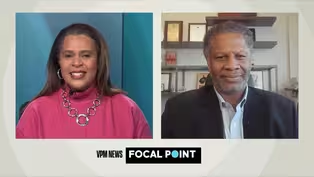
Dr. Robert Winn is director of VCU Massey Cancer Center and is spearheading efforts to close that gap.
We know that there are health disparities between black people, white people, but also rural communities, you know, or ultra-urban communities.
Where is it that you see Massey being able to make a difference, you being able to make a difference, with regard to this problem?
ROBERT WINN: The bridging of the discovery scientists and the implementation of that scientist, of getting into our communities matter, and one of the tools that we're using is to make sure that we are developing not only high tech ways of reaching communities, but reminding that the most effective way is high touch.
And so, boots on the ground, making sure that our navigators and community activators are absolutely evolved and at the center of what we do.
ANGIE MILES: We want to hear a little bit more about how pronounced the health disparities are in Virginia, both health conditions and access to treatment.
Can you just elaborate a little more on that?
ROBERT WINN: You look at our rural groups, whether you're talking about breast or colorectal or you're talking about GI cancers, all of those are disproportionately negatively affecting, in the Commonwealth, rural communities and communities of color.
It turns out in Virginia and the Commonwealth, we have a substantial number of underrepresented minorities that are in rural communities.
What are we doing about those communities?
How are we getting to them?
The science is always going to be there.
In fact, we're going to create new cures.
We're going to have new medicines.
That's not the issue.
The issue is how do we get those new medicines to our most at risk so we can improve the health of the Commonwealth as a whole and how do we build trust doing it?
And in fact, I think by addressing the health disparities issue, it will actually put us down a path that, in addition to creating new drugs, we have to do these other things like care and actually making sure that our communities aren't invisible.
ANGIE MILES: You've also talked about a symbiotic relationship between people in communities and the providers.
Can you talk about that a little bit?
ROBERT WINN: So we have launched a great experiment here, in the 21st century here at Massey, of being able to say that if we collect community data first, it helps our basic scientists, our clinicians, and everyone else be better at asking what are the questions that not only advanced science, but will be beneficial to our communities, and that we're really proud about.
ANGIE MILES: You can watch the full interview on our website.
ANGIE MILES: For thousands of years, Chinese medicine has offered people an alternative way to deal with pain and illness.
In 2006, the Blue Ridge Center for Chinese Medicine opened in Floyd County, Virginia, giving people in the New River Valley access to drug-free pain relief.
VPM News multimedia reporter Keyris Manzanares brings us the story.
NILE BACHMANN: My name is Nile Bachmann and I'm the owner and operator of the Blue Ridge Clinic for Chinese Medicine here in Floyd, Virginia.
I specialize in drug-free pain management for the people of the New River Valley, mostly using acupuncture, [SPEAKING TO CLIENT] tap the needle in and something called Tuina.
It's an acupressure massage.
We have a lot of retired people, that's a big population here in Floyd.
So all of the complaints that go along with that are something that I see frequently.
Any type of joint pain, back pain, neck pain.
But we do have a fairly thriving community of younger to middle-aged homesteaders and they do a lot of gardening, farm work, physical labor.
So we have the pain that is associated with that.
We see that quite a bit.
JOY FRANCE: I had had a car accident many years ago that I have a really bad neck and neck injury that's just going to be with me for the rest of my life.
And so I was trying to get pain relief and just be able to move through the rest of my day, you know move through my days without pain as much as possible.
And the chiropractor did a great job.
The massage therapist that I was going to did a great job, but it just didn't seem to be holding for my body and every body is different.
And so I came here and I thought, I though I'm going to give it a shot.
NILE BACHMANN: What we're doing with the needles has both a local and a non-local effect.
The local effect is to stimulate the healing and growth factors in the tissues where we insert the needles.
And the non-local effect is more nervous system mediated.
The stimulation of the needles will release the body's natural painkillers, endogenous opioids in the spinal cord and change the perception of pain to some degree higher up in the central nervous system.
JOY FRANCE: My neck pain is something that's just always there, but it can be excruciating.
It can be something that stops you in your tracks and stops how you live your life and how you exist and how you are for your family.
What is done here in this facility is not only good for pain relief, it's really an overall, all body help.
NILE BACHMANN: We really need in this country and in the world alternatives to pain management that do not involve medications, that do not necessarily involve costlier higher interventions, ways that we can address the pain before it becomes debilitating.
This area has a history of opioid abuse and it certainly needs alternatives for pain management that don't involve medication.
JOY FRANCE: Patient care is everything.
How you're treated as a patient and how you're listened to as a patient is everything.
And it's very lacking in our system today.
And you are listened to when you come here.
Everything that you need to say is said.
Every concern that you have is valid and it's heard.
ANGIE MILES: From traditional healthcare to ancient healing remedies, we hope you've enjoyed our coverage.
Visit vpm.org/focalpoint to learn more about these stories and provide your feedback.
You'll also find links there to our full interview with Dr. Winn.
Thank you for watching.
We'll see you next time.
Production funding for VPM News Focal Point is provided by The estate of Mrs. Ann Lee Saunders Brown.
And by... ♪ ♪
Addressing inequities in health care treatment
Video has Closed Captions
Clip: S2 Ep4 | 9m 11s | Building trust among populations previously disenfranchised from medical research. (9m 11s)
Video has Closed Captions
Clip: S2 Ep4 | 4m 25s | Virginia doctors are breaking down barriers that stop care professionals from getting help (4m 25s)

Chinese medicine provides relief in Floyd, Virginia
Video has Closed Captions
Clip: S2 Ep4 | 3m 13s | Chinese Medicine is becoming a more common practice for people of the New River Valley. (3m 13s)
Video has Closed Captions
Clip: S2 Ep4 | 1m 42s | Efforts in Virginia to help those suffering sometimes debilitating symptoms of the disease (1m 42s)
How do we ensure the right people are enrolled in hospice?
Video has Closed Captions
Clip: S2 Ep4 | 7m 53s | Changes meant to improve quality and cost of medical care may impact more than intended. (7m 53s)
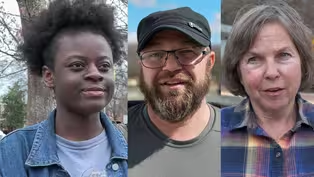
People of Virginia | Health and Medicine
Video has Closed Captions
Clip: S2 Ep4 | 1m | People of Virginia share their concerns about the high cost of health insurance and drugs (1m)
Providing Support for PBS.org
Learn Moreabout PBS online sponsorship
- News and Public Affairs

Top journalists deliver compelling original analysis of the hour's headlines.

- News and Public Affairs

FRONTLINE is investigative journalism that questions, explains and changes our world.












Support for PBS provided by:
VPM News Focal Point is a local public television program presented by VPM
The Estate of Mrs. Ann Lee Saunders Brown