
Health Care
2/14/2025 | 26m 46sVideo has Closed Captions
In health care deserts, rural community members are pioneering new ways to care for their own.
Health care deserts are expanding across rural parts of the U.S., but communities in NC have taken bold steps to bridge critical gaps. By developing grassroots solutions, they’re creating sustainable models for health care access. These include a dental outreach clinic in Hyde County, integrated care tailored for NC’s Cherokee communities and nursing apprenticeships in Surry and Yadkin counties.
Problems playing video? | Closed Captioning Feedback
Problems playing video? | Closed Captioning Feedback
ncIMPACT is a local public television program presented by PBS NC
Health Care
2/14/2025 | 26m 46sVideo has Closed Captions
Health care deserts are expanding across rural parts of the U.S., but communities in NC have taken bold steps to bridge critical gaps. By developing grassroots solutions, they’re creating sustainable models for health care access. These include a dental outreach clinic in Hyde County, integrated care tailored for NC’s Cherokee communities and nursing apprenticeships in Surry and Yadkin counties.
Problems playing video? | Closed Captioning Feedback
How to Watch ncIMPACT
ncIMPACT is available to stream on pbs.org and the free PBS App, available on iPhone, Apple TV, Android TV, Android smartphones, Amazon Fire TV, Amazon Fire Tablet, Roku, Samsung Smart TV, and Vizio.
Providing Support for PBS.org
Learn Moreabout PBS online sponsorship- [Announcer] "ncIMPACT" is a PBS North Carolina production in association with the University of North Carolina School of Government.
Funding for "ncIMPACT" is made possible by.
- [Announcer] Changing the course of people's lives.
That's the impact UNC Health and the UNC School of Medicine work to deliver every day.
Our 40,000 team members across the state of North Carolina are committed to caring for you, our patients and communities, as well as educating the next generation of healthcare professionals.
Individually, we can do a little, but collectively we can do a lot to create impact.
- Medical care is vanishing from some small towns in America.
We find out how rural leaders are pioneering new ways to care for their own.
This is "ncIMPACT."
[laid-back jazz music] Welcome to "ncIMPACT."
I'm Anita Brown-Graham.
Access to healthcare is not equal.
Native Americans, for example, often face a critical lack of access.
We visited with the Eastern Band of Cherokee Indians in North Carolina.
There the tribe is working with others to create its own healthcare solutions.
Their efforts may well offer lessons for improving health outcomes across America.
[pensive piano music] - This is the average American life expectancy and this is the life expectancy for Native Americans.
In fact, native Americans have the lowest life expectancy of any race or ethnicity in the country.
But here's the thing, the US government is legally obligated to provide healthcare to all federally recognized tribes.
Yet these disparities have been going on for decades.
So some tribes have been taking matters into their own hands and creating their own healthcare systems that actually get results.
[gentle woodwind music] [crowds chatter faintly] We're here deep in the mountains of Cherokee County, North Carolina, where an ambitious project is working to save Native American lives.
We'll ask the tough question: Can this success story be replicated elsewhere?
I'm David Hurst.
This is "ncIMPACT."
[laid-back jazz music] - All right, everyone.
- Today marks a significant milestone for the Eastern Band of Cherokee Indians.
[attendees cheer] It's the ribbon cutting of the Tsali Care Center.
The 125,000 square foot residential care facility offers 120 private rooms.
It's designed to provide a continuum of care from skilled nursing and assisted living to a specialized 20-bed memory care unit.
It blends modern healthcare with rich Cherokee traditions.
[attendees chatter] Yet this celebration stands in stark contrast to a harsh reality.
Despite their deep-rooted history and traditions, the Cherokee, like many Native American tribes, have been grappling with serious health challenges.
- Anytime you have a population that has the ill effects of intergenerational trauma and stress and then the manifestations of stress leads to high rates of chronic diseases and maladaptive coping mechanisms.
- Maladaptive coping mechanisms such as substance use through other addiction disorders.
American Indian and Alaska Native people had the highest overdose death rate of any racial or ethnic group in 2022.
They also face other alarming health disparities.
Diabetes rates are more than double the national average, tuberculosis is six times more common, and mental health issues like depression and anxiety are also widespread.
But in order to really understand the story, we need to go back in time.
The 1921 Snyder Act marked the first formal congressional authorization for Native American healthcare.
Signed into law by President Calvin Coolidge, it mandated healthcare funding for all federally recognized tribes.
Then in 1955, the Transfer Act established the Indian Health Service, also known as IHS.
It currently serves about 2.5 million Native Americans, but there's a critical issue at play: severe underfunding.
A federal report revealed that the IHS 2022 budget of nearly $7 billion covered less than half the actual patient needs.
It's one of the reasons why the Eastern Band of Cherokee Indians decided to take full control of their healthcare.
It's a concept called self-governance, and it's allowed the Cherokee to use profits from their casino and build a state-of-the-art hospital.
That hospital blends modern medicine with traditional healing practices.
Here they've implemented the Nuka System of Care.
It's an Alaskan Native model that emphasizes holistic patient-centered treatment.
Under this system, patients are assigned a comprehensive care team addressing all their medical needs in one location.
Hannah Orr is a member of the Eastern Band of Cherokee Indians and an RN case manager at the hospital.
She says that unlike traditional healthcare, this approach integrates the four domains of health: physical, mental, spiritual, and emotional.
- We have patients that come in for their doctor's appointments and things like that.
And because of the setting that we have, we're able to get them to see pharmacy, nutrition, behavioral, health.
We even have a social worker in clinic.
So while they're there, we try and knock all of those things out while they're in one visit.
That way, they're not trying to come back and forth and battle transportation needs, battle, making time out of work and doing all of those things.
- And the results?
Well, community leaders say they're starting to see a difference.
The type 2 diabetes rates among the Eastern Band of Cherokee Indians decreased from 27% in 2013 to 21% in 2023.
However, this rate still remains higher than the national average.
I imagine, despite the success, you're probably not immune to some of the challenges that the traditional healthcare system faces.
What obstacles still need to be overcome?
What keeps you up at night?
- Well, one thing that keeps me up at night is having an adequate workforce in rural parts of North Carolina, especially Western North Carolina, to be able to staff these beautiful facilities.
- Facilities like the brand new Tsali Care Center.
While there are challenges in staffing a place like this, Cooper is optimistic about a collaboration with Western Carolina University.
They developed a nursing program that emphasizes cultural competence.
- And it was based in Cherokee culture and the Cherokee language.
Because again, that is so important.
It's important to the Cherokee to be grounded that way.
And it's important to just nursing in general to really understand the culture of your patient that you're taking care of.
- This is all great news for the Cherokee, but not all tribes have the same access to resources.
Many tribal territories are in remote areas with few economic opportunities, but they still need the care.
This raises a crucial question: How can tribes that don't have casino profits or other financial resources improve their health outcomes?
Well, some recent developments may improve funding.
The federal government has proposed a 16% increase in the IHS budget for the fiscal year of 2025.
If approved, this could potentially benefit tribes that are currently unable to self-govern their healthcare systems.
Additionally, a recent Supreme Court decision requires the IHS to reimburse self-governing tribes for certain healthcare costs.
This means that some IHS funding could be used to pay for the Cherokee's own healthcare system.
Cooper thinks other tribes should give self-governance of their own healthcare system a shot if they can swing it financially.
I asked you earlier about what keeps you up at night, but when you wake up in the morning and look forward, what gives you hope for the future?
What excites you as you continue this work?
- So what really excites me is seeing what I believe are the visible symbols of a healthier community.
I see young people now who they look healthier and they look vibrant and they look like they have hope in their face.
[attendees applaud] - Tribes like the Eastern Band of Cherokee Indians have made significant strides in improving healthcare delivery through self-governance and innovative partnerships.
But big challenges still remain.
And the success story we've explored, while promising, is not yet the norm, because many Native American communities still face severe healthcare disparities, workforce shortages, and limited resources [singers chants in a foreign language] For "ncIMPACT," I'm David Hurst.
- As we've seen, workforce shortages are jeopardizing healthcare in our communities.
This is especially true in the nursing field.
Hospitals and clinics face critical staffing gaps.
"ncIMPACT" visits Surry and Yadkin counties where an innovative grow-your-own pipeline brings the right collaborators together to train healthcare leaders of tomorrow.
- North Carolina is facing a critical shortage of nurses.
By 2030, North Carolina faces an estimated shortage of nearly 9,000 registered nurses.
By then, 41 other states across the nation are projected to face similar nursing shortages.
And that's not just a number: it's misdiagnoses, delayed treatments, and lives at risk.
Imagine rushing to the ER here with chest pain only to experience a waiting room overflowing with patients and a skeleton crew of exhausted nurses.
And we are facing this shortage even before the pandemic.
Covid only made things worse.
So how did we get here?
What's working and what still needs to be done?
I'm David Hurst.
This is "ncIMPACT".
[laid-back jazz music] Welcome to the fast-paced life of registered nurse Carrie McKeaver.
- Good morning.
She manages six patients per shift ranging from pediatric to elderly care.
Some days her 12-hour shifts are so packed that she doesn't even have time to eat, but today she squeezed us into her busy schedule.
I know there's been a lot of talk just about the nursing shortage kind of across the nation.
Do you kind of see any of that on a day-to-day basis?
- Yeah, we do have some staffing issues sometimes.
- And how does that affect your day-to-day?
I mean, you seems pretty busy this morning.
- Yeah, yes, I mean, some days, 12 hours, it's like some days it just flies by because you're so busy.
Other days it's like, really, when you have a hard day it's like, "Gosh, this is really hard."
And you have to just remind yourself why you became a nurse in the first place and remind yourself that nobody wants to be in a hospital sick.
And everybody needs somebody to be able to take care of them and everything, so.
- [David] A lot of Carrie's hard days come when the hospital is short staffed, and the stakes are higher than just exhausted nurses.
You see, when we don't have enough healthcare workers, it becomes harder for people to get the care they need.
But how did we get here?
Well, it's not a simple answer, but it's definitely a perfect storm.
In North Carolina, a significant demographic shift is unfolding.
Like other states, our population is aging, and this is increasing the demand for healthcare.
And that same generation in the nursing workforce, they're approaching retirement age themselves.
But it's not just nurses retiring, it's also those who teach nurses, leaving a critical nursing educator shortage.
Oh, and before I forget, remember that whole North Carolina Medicaid expansion thing?
Well that means more people have access to healthcare, but it's also fueling an increased demand for services when the state is already shorthanded.
So where do we even begin?
Community leaders in Surry and Yadkin counties decided to begin in high school.
They've created one of North Carolina's first youth apprenticeship programs for nursing.
Here's how it works: High school students interested in healthcare can work as certified nursing assistants at local hospitals or long-term care facilities.
They complete their CNA certification while going through this pre-apprenticeship program.
These students may then enter a full apprenticeship, earning a free nursing degree at Surry Community College, all while continuing to get hands-on experience.
What is one of the benefits of providing high school students with this experience and exposure?
Do you feel like that helps them kind of get into the pathway?
- Definitely, 'cause sometimes it's hard to decide what you want to do when you grow up, and it is hard to know what you wanna do if you haven't seen it.
But then if they decide they do want to go into nursing or one of these healthcare fields, then we have this pathway that they can work here, they can get educational assistance, they can stay here, save mom and dad a lot of money, go right here to the community college, and work here while they go to school.
And then hopefully we'll keep them once they graduate.
- [David] After graduation, many apprentices are hired full-time by the facilities where they trained.
This approach addresses both workforce and instructor shortages by creating a direct path to nursing careers and prioritizing experienced students.
[students laugh] - [Teacher] Yeah, that looks.
- [David] But while North Carolina's four-year institutions have increased their output of bachelors nursing graduates since 2012, the community college system hasn't seen a comparable rise in associates nursing degrees.
Community college leaders point to their unique student body as a potential reason.
- A lot of times people think of college students as coming right outta high school and that is not the case at the community college.
In the community college system, we serve all students.
So we have 45-year-old mothers of five.
We have one of those in our program right now who works a full-time job and is in the RN program.
And so it's really challenging to be a student and have all of these other kinds of obligations that you have from your personal life, financial, and things like that.
- [David] So the community college offers students up to $10,000 in educational assistance.
The idea is that with this money, students can get help with anything they might need to finish the program such as transportation or childcare.
- So that way when life is getting too much and nursing school is getting too much, that they can get some help when they need it.
- [David] But while educating more nurses seems like an obvious solution, research tells us that a 10% increase in nursing graduates would only reduce the projected shortage by about 2,000 nurses, barely making a dent in the problem.
So what's the missing piece?
Well, it's retention.
The North Carolina Institute of Medicine recently led a task force to develop strategies for retaining nurses.
The task force identified four key areas for improving retention: enhancing career development, fostering a supportive workplace culture, expanding leadership opportunities, and more flexible work conditions.
Oh, and paying them a little more may help too.
When it comes to paying our nurses, North Carolina falls short.
Both licensed practical nurses and registered nurses in our state earn less than the national average.
But back in Surry and Yadkin counties, they're testing a theory: Can early investment in nursing careers lead to better long-term retention?
- And so I think the partnership has really helped dour students understand that they're investing in me, so I want to invest back in them.
- [David] One nurse Northern Regional Hospital hopes to keep around is Carrie McKeaver, a graduate of the nursing apprenticeship program.
For Carrie, the shifts may be long, but she says the work is deeply rewarding.
- I love being a bedside nurse.
It's challenging sometimes, but you get to see patients at the worst and get better and go home usually.
So for right now, I'm happy where I'm at.
- [David] Healthcare facilities will likely need to continue to come up with comprehensive strategies to attract and retain nurses like McKeaver.
These approaches could include partnerships with educational institutions or offering flexible programs and initiatives to improve job satisfaction and career growth.
For "ncIMPACT," I'm David Hurst.
- While nursing shortages threaten our rural healthcare, we have yet another crisis: A lack of dental care.
It may be hard to believe for those of us who live in urban areas, but in some North Carolina counties, there are no practicing dentists.
We had to one of these areas to witness a creative collaborative approach to dental care.
- 58 million Americans have little to no access to a dentist.
It's an epidemic that's costing us billions and leaving millions in pain.
And those Americans don't live here, here, or here, but in rural small towns across the country, North Carolina alone has five counties that don't have a single practicing dentist.
The solution seems simple, right?
Just get more dental school graduates to move to rural communities.
But how do you get a student who just racked up massive student loan debt to move to a community that's smaller than their graduating class?
Now I know what you're thinking.
You'd probably rather go to the dentist than listen to someone talk about the dentist for the next few minutes.
But this story is about the cracks in rural healthcare an old Zumba studio, and the surprising ways people are fighting back.
I'm David Hurst.
This is "ncIMPACT."
[laid-back jazz music] Tucked away in the Coastal Plains, Hyde County serves as a gateway to North Carolina's famed Outer Banks.
The county seat is Swan Quarter.
And like many things in small town America, there used to be a practicing dentist, but they left decades ago.
- And there's been nothing since that point.
And that would've been in the early '80s.
- So where's the closest dentist from here?
- There's a dentist, Dr. David Elliott, in Belhaven, which is 25 miles west.
- So what do most people do for dental care?
Do they go to him or what do they do?
- Well, people who live in Hyde County are very used to have having to travel great distances for many things.
So people travel to Dr. Elliott in Belhaven.
They go to Washington.
We have people that will travel to Greenville, North Carolina.
People who will travel to the Outer Banks.
But then we also have several people who don't have the option, I guess.
They don't travel, so therefore they don't get the dental care that they need.
- When they then have a dental emergency, what do they do?
- I suspect that they go to an emergency department.
- Suddenly hospitals are juggling dental emergencies that a routine cleaning could have prevented.
And the dental shortage is just one symptom of a larger rural healthcare crisis where communities are losing not just dentists, but primary care doctors and even entire hospitals.
I'm told behind this post office in an old Zumba studio is the secret to solving the problem.
The Hyde County Outreach Clinic operates once a month.
It's run by East Carolina University's School of Dental Medicine.
Melony Grace Hodges is an ECU graduate who grew up in Hyde County.
She's one of the clinic student leaders.
So what got you interested in dental work?
- Well, I had already known that I was interested in the medical field, but I wasn't really sure what I wanted to do.
But I also knew that I wanted to come back home.
And so I came to ECU and I actually heard about this clinic, and so I contacted the previous clinic coordinator and I asked her if I could come in and shadow and just kind of see what's going on.
And once I saw my first dental procedure done, I was like, "Okay, this is cool.
This is definitely something I want to do."
And knowing that there's no permanent dentist here, I knew this is a way that I could help impact my community.
- [Staff] That is for a.
- The clinic sees about 20 patients a month.
One of those patients here for her six-month checkup is Cynthia Fisher.
What did you do for dental care before this clinic?
- I went to a commercial dentist in Dare County.
- So how long of a drive was that?
- About an hour.
- And how inconvenient was that two-hour round trip?
- Ah, okay.
To get to Dare County, one way is an hour to get there.
So then the hour to get my teeth cleaned normally.
So that's two hours, then an hour to go back to work.
So that was a three-hour journey.
- So that's pretty much half your day right there.
- Half my day.
- [David] Now Fisher and others can get their teeth cleaned during their lunch break.
But as nice as that is, providing care one day a month is not enough to treat all patients or issues that require multiple visits.
So ECU partnered with the county health department to set up teledentistry.
It allows ECU faculty to diagnose oral health problems from miles away.
- And so the nurse at the health department has this.
And if they have an emergency come in, and we're not here, they can call us and do the same kind of consultation and show us what's in the patient's mouth so we can say, "Hey, they need to come in right now 'cause it's a bad infection, or we'll schedule 'em when we come out here next month."
And it works really well.
- How long have you all been using it?
Has it kind of taken off during Covid?
- That's a great point.
Yes.
We were using it long before.
In fact, the first time I personally used this was in 1994 in the Army, and we did it from remote areas, almost identical setup.
But Covid really caused us to use it a lot.
- Sometimes it takes a pandemic to try something new, but let's face it, teledentistry can't fix everything.
You can't get a root canal over Zoom.
At the end of the day, we need to make rural areas more attractive to dentists.
But setting up shop in a small town is a tough sell when it's not really financially sustainable.
You see in rural communities, a high percentage of residents rely on Medicaid.
In Hyde County, it's about one in four people.
Relying on Medicaid creates a financial squeeze for dentists.
In North Carolina, reimbursement rates have been frozen for 15 years, while everything else from equipment to staff wages keeps getting more expensive.
Why do you think it's so challenging to get dentists to come to a community like this?
- Well, we're just about as rural as you're gonna find in North Carolina.
We don't have Walmarts, we don't have Food Lions, and we're a poor county, we're a tier one county.
So anybody that does come here isn't going to likely make the money that they would in a metropolitan area.
- But here's where things get interesting.
The ECU dental school isn't just providing pop-up clinics, they're training future rural healthcare heroes.
Here's how it works: Fourth year dental students go through a unique rotation program.
They spend 27 weeks living and working in what's called community service learning centers.
These centers are located in rural and underserved areas.
As part of the program, students can volunteer at the Hyde County Outreach Clinic.
This experience often inspires graduates to establish practices in underserved communities.
- But the fact that now all of our students, for the last two years, every single student that's come through East Carolina University has worked in this clinic and met the people of Hyde County and seen the impact that we're having here and they're having here.
So not only learning clinical dentistry, but learning how important it is to develop trust within your team and within the community.
And hopefully they fall in love with this type of work and this community, and they want to come out, whether it's in Hyde County, or the county they're from, they want to go out and make a difference in rural America.
- And one future success story could be right here in Hyde County.
Melony Grace Hodges says she wants to return to her hometown to open a practice after graduating.
And when you think about your future, I mean, you could probably go and practice somewhere in Raleigh or Charlotte and make a whole lot more money, but what is it about coming back here to this hometown and serving your community?
- Yeah, I would have to say it's the people.
I mean, the amount of support that I've received, I don't know how I could go off to Raleigh without coming back and helping them.
They've all helped me so much.
And like I said, Hyde County isn't just the residents, it's like a family here.
And so that's why I would love to come back.
- [David] Hodges' story is inspiring, but in order for her to succeed, it likely requires a perfect storm of solutions.
This could include updated Medicaid dental reimbursement rates, more dental schools stepping up to fill workforce needs, and other passionate graduates like Hodges committed to making a difference.
For "ncIMPACT," I'm David Hurst.
- We're trying something new this season.
We're focusing more on the experts on the ground.
Thank you to the local leaders featured in this episode who all so generously allowed us to share the inspirational stories of their collaborative work.
And as always, thank you, to you, our amazing audience, for watching and engaging at such high levels.
Let me know what you think about the new format.
I also love hearing about the solutions you know of out there when we do what we do best as North Carolinians: when we work together.
Tell us what your community is doing or how we can help you.
Email us at ncIMPACT@unc.edu, or message us on Facebook or LinkedIn.
And be sure to join us every Friday night at 7:30 on PBS North Carolina for new episodes of "ncIMPACT".
[laid-back jazz music] [laid-back jazz music continues] [laid-back jazz music continues] Coming up on "ncIMPACT."
Public safety is under unprecedented strain.
We reveal how counties are working with community partners on pioneering new ways to protect their communities.
- [Announcer] "ncIMPACT" is a PBS North Carolina production in association with the University of North Carolina School of Government.
Funding for "ncIMPACT" is made possible by.
- [Announcer] Changing the course of people's lives.
That's the impact UNC Health and the UNC School of Medicine work to deliver every day.
Our 40,000 team members across the state of North Carolina are committed to caring for you, our patients and communities, as well as educating the next generation of healthcare professionals.
Individually, we can do a little, but collectively we can do a lot to create impact.
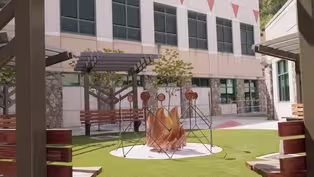
How The Cherokee Are Disrupting Healthcare
Video has Closed Captions
Native American response to healthcare crisis offers lessons for better health outcomes nationwide. (7m 16s)
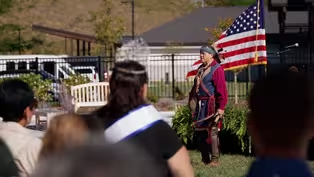
Video has Closed Captions
In health care deserts, rural community members are pioneering new ways to care for their own. (30s)
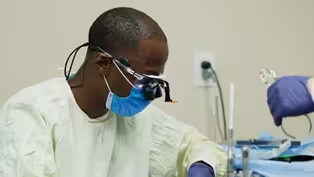
Why Dentists Are Disappearing from Small Towns
Video has Closed Captions
The rural dental crisis inspires unlikely solutions. (8m 6s)
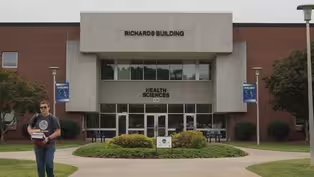
Why the Nursing Shortage Hasn’t Recovered From COVID
Video has Closed Captions
North Carolina's nursing shortage crisis drives search for innovative healthcare staffing solutions. (6m 37s)
Providing Support for PBS.org
Learn Moreabout PBS online sponsorship
- News and Public Affairs

Top journalists deliver compelling original analysis of the hour's headlines.

- News and Public Affairs

FRONTLINE is investigative journalism that questions, explains and changes our world.












Support for PBS provided by:
ncIMPACT is a local public television program presented by PBS NC