
Heart Health/Scarab Club
Season 49 Episode 9 | 23m 55sVideo has Closed Captions
Heart Health/Scarab Club | Episode 4909
It’s time to focus on heart health. Stephen talks about heart disease and stroke in the African American community and how once can reduce their risk. Plus, a longtime Detroit organization holds its first ever art exhibition featuring all black artists. Episode 4909
Problems playing video? | Closed Captioning Feedback
Problems playing video? | Closed Captioning Feedback
American Black Journal is a local public television program presented by Detroit PBS
Heart Health/Scarab Club
Season 49 Episode 9 | 23m 55sVideo has Closed Captions
It’s time to focus on heart health. Stephen talks about heart disease and stroke in the African American community and how once can reduce their risk. Plus, a longtime Detroit organization holds its first ever art exhibition featuring all black artists. Episode 4909
Problems playing video? | Closed Captioning Feedback
How to Watch American Black Journal
American Black Journal is available to stream on pbs.org and the free PBS App, available on iPhone, Apple TV, Android TV, Android smartphones, Amazon Fire TV, Amazon Fire Tablet, Roku, Samsung Smart TV, and Vizio.
Providing Support for PBS.org
Learn Moreabout PBS online sponsorshipComing up on "American Black Journal", it's time to focus on your heart health.
We're gonna talk about heart disease and stroke in the African American community, and how you can reduce your risk.
Plus, a long-time Detroit organization holds its first ever art exhibition featuring all black artists.
Stay right there, "American Black Journal" starts now.
Announcer 1: From Delta faucets to Behr paint, Masco Corporation is proud to deliver products that enhance the way consumers all over the world experience and enjoy their living spaces.
Masco, serving Michigan communities since 1929.
Announcer 2: Support also provided by the Cynthia and Edsel Ford Fund for Journalism at Detroit Public TV.
Announcer 1: The DTE Foundation proudly supports 50 years of "American Black Journal" in covering African American history, culture, and politics.
The DTE Foundation and "American Black Journal", partners in presenting African American perspectives about our communities and in our world.
Announcer 2: Also brought to you by AAA, Nissan Foundation, Ally, Impact At Home, UAW, Solidarity Forever, and viewers like you.
Thank you.
♪♪ Welcome to "American Black Journal", I'm Stephen Henderson.
February is American Heart Month.
And even though the observance is wrapping up, wanna talk today about the importance of living a heart healthy lifestyle all year long.
That's especially true for African Americans, who are at higher risk of experiencing heart disease and stroke, the two leading causes of death in the United States.
However, the good news is you can lower your risk.
Here's my conversation with Dr. Kimberly Farrow, president of Central City Integrated Health, and Kimberly Heard, a stroke and heart disease survivor.
Dr. Farrow, I'm gonna start with you.
Heart health month is something we talk about each year here on "American Black Journal".
And each year we talk about how critically important this issue is for African Americans.
It's just different for us, because of lots of inequities that exist in society.
But talk about why heart health in particular stands out among African Americans as something we've just gotta deal with.
Well, as we know, heart disease has always been a number one killer among African Americans in the African American community.
Recently, and what we've learned about COVID is that, you know, we thought it was a lung disease, but really what we're finding is that it affects all organ systems.
In particular, the heart.
And so we now are more aware of its effects and its impact on the cardiovascular system.
So, you know, certainly during the COVID pandemic, we are acutely aware of how COVID in particular affects the heart.
We also know that for women, this looks different than it does for men.
And for African American women, it looks different than for men.
The signs and symptoms of heart disease aren't often the same between men and women.
And they're less detectable, I feel like, for women often than they are for men.
Very true.
So we know that among women, women tend to have what's called atypical symptoms.
So usually the characteristic symptoms of a heart attack are chest pain, maybe shortness of breath.
But for women it seems that, you know, they may have symptoms such as a bellyache.
May just a general feeling of just feeling badly, generalized malaise, they just don't feel well.
You know, I'm having this pain in my shoulder.
And so we really encourage women, especially women who are over the age of 45 to, you know, if you have these symptoms, please immediately seek help.
We don't want you to, you know, dismiss them as just a bellyache or shoulder pain.
We really want you to be evaluated.
Kimberly Heard, all of this is very personal for you.
Yes.
Talk about your experience.
My experience with this was, you know, as women, we just continue to go on and continue to just work and work and work and never take time for yourself.
So the feeling of tiredness is just, oh well, I've been working too much or, oh, you know, I'm being pulled this place and this place, and just not being able to get that extra rest.
Well, that is a tell sign of a stroke or a sign of a heart attack, and that's what I had.
I was extremely tired.
And it was like I just couldn't get over the hump.
And fortunately for me, for the detection was I had an MRI scheduled.
And I almost canceled it (chuckle) 'cause I was tired and wanted to go home.
And I said, no, I'mma go.
And that's when it was told to me that you're actually having a stroke right now.
Come on back.
Take us to that moment when they told you that was what was happening.
I mean, I can't imagine the range of emotions you must have felt.
The range of emotions that I had was I'm the strong one.
I have five sisters and I'm the strong one.
And anything that has to do with medical issues, I'm the one, I'm the sister to go to.
Even though I'm the sister that has the most medical issues, (chuckle) but I'm that strong one.
So to get that call after I leave and I'm with my family.
I'm actually with my mom and my sisters, dad.
To get that call was not me.
You say me?
(laugh) And it was just a rush.
I just bust out crying.
It was unbelievable.
And to still think about it, I don't wanna start crying right now, so.
(chuckle) Aw.
We really appreciate your being here, though.
Thank you.
And Dr. Farrow, talk about the experience that someone like Kimberly has with this, and what the things are that, A, stop it from happening in the first place, but then, you know, afterward.
What do you do to stop it from happening again?
Yeah, I mean, you know, important questions.
So, you know, firstly, we encourage diet and exercise.
And I want people to understand that the diet and exercise go together.
You know, you often hear people complain, "I've been exercising and I've been on the treadmill, "but I can't lose any weight."
Well, it really has a lot to do with your diet.
You really have to incorporate lean meat and green leafy vegetables into your diet.
Really ideally, we want people to move to a plant-based diet.
So being completely vegetarian, that has shown to have the greatest and best impact on the prevention of heart disease.
But if you can't do that, then please, you know, try to avoid red meat.
You know, within the African American community, we love, you know, we love our soul food.
We love that home-cooked food, right.
But it's always, you know, it's often not the best choices for us, right, because it's laden with calories and fat and cholesterol.
So, you know, we really want to incorporate a healthy diet and exercise.
Especially during COVID, I know it's hard to exercise.
I mean, the gyms are closed.
So we are encouraging people to, you know, take walks around their neighborhood.
Exercise at home, put on some good music and start dancing around your house.
I mean, there are multiple ways to get that body moving and that heart pumping to help decrease your risk of heart disease.
In addition to that, we wanna make sure that people are paying attention to their blood pressure.
A lotta people aren't aware that the goal blood pressure is less than 120 over 80.
And any time that blood pressure is greater than 120, 120 to 129, we consider that abnormal, we consider that to be pre-hypertension.
And so these could be, like Miss Heard said, a telltale sign that perhaps something else is going on.
So we want you to be evaluated by a healthcare professional.
That being evaluated, too, it's gotta be regular, right?
Oh yeah.
Gotta go to the doctor and, look, I catch myself as much as anybody else slacking and not keeping up with that.
But especially as you get older, you know, seeing your physician at least once a year is a key to this.
Absolutely.
Also, the physicians have to work with you.
I had high blood pressure for over 20 years now.
Wow.
I have a underlying issue of sarcoidosis.
So my blood pressure has always been elevated.
I have never had it under control in the last 20 years.
What I can say right now is my blood pressure is under control.
And I think because it took me to have the stroke to get real about myself.
I could tell you about anybody else, make anybody else do whatever they need to do.
But when it comes to yourself, you kinda move a little differently.
So right now I can say as of, my stroke was October the 4th and the 5th.
My blood pressure is normal and has been normal since I left that hospital a week later.
That's good.
That's fantastic, Miss Heard.
Yeah.
Blood pressure is, you have to get it controlled.
And I think you hit on a very important point, that even if, you know, you've suffered a heart attack and a stroke, the most important thing you can do is, you know, stay in contact with your healthcare professional.
You know, don't be lost to follow-up.
Make all those follow-up appointments and use the physician as a partner in you achieving your ultimate wellness.
They should be a partner to you.
I love what you said, Miss Heard.
Thank you.
That has to play a big part, because I had so many underlying issues already against me.
And I did do one major step, and that was to stop smoking.
I have not had a cigarette since October the 4th, when they told me return back to that hospital.
I'm sorry, October the 5th.
So I haven't smoked then.
And that is a major thing to do.
And it's so hard to do.
I've tried numerous times, but this time I just cold turkey, nothing.
But you have to have that support system to get past that.
And if you don't have a physician who is working with you, it makes it a lot harder.
All great advice.
All great advice.
For the first time in its history, Detroit Scarab Club is hosting a Black History Month art exhibition that celebrates the works of black artists.
The collection is titled Souls of Black Folk, and it runs through March 20th.
Donna Jackson of DMJ Studio curated the exhibit, which showcases established and emerging African American artists right here in Detroit.
The Scarab Club was founded in 1907 by a group of artists and the art lovers who wanted to socialize and support each other.
Today the organization promotes and celebrates the visual, literary, and performing arts.
I spoke with Mariuca Rofick, the club's first black president, and with Taurus Burns, one of the artists whose work is on display.
You're the club's first black president, and this is the first black exhibition we're having at the Scarab Club.
Talk to me about those firsts, and how important they are.
Yes, we're excited about both firsts.
I, you know, came to the club initially just as an artist interested in the photography club.
And enjoyed myself, kept coming, and eventually was asked to join the board.
That was in 2014.
And then in 2018, I was voted in as the board president.
So it seemed very organic.
You know, I really love the club and am very happy to be in this position right now.
And this show that we have right now, The Souls of Black Folk, last summer our curator, Donna Jackson, she submitted a proposal for this show.
And it happened at around the same time that I'd drafted a Black Lives Matter statement for the club, saying that we stood in solidarity with it.
And obviously there were a lot of conversations in the organization about how can we be, you know, part of the solution and not part of the problem.
So at the point that we received this submission, and it being centered on W.E.B.
Du Bois' book, "The Souls of Black Folk," and how it is to be black in America, and the relevancy of it here a hundred years later, just as relevant now, it was a perfect pairing to have this show at the Scarab Club during Black History Month.
Yeah, and again, the first exhibition of its kind at the Scarab Club, a place that has such a rich history in the city.
I have to say, I was surprised to learn that this was the first exhibition like this at the Scarab.
Yes, I think we all kind of wanted to say, is that really the case.
But it is.
And I think that the stars just all aligned for it to happen this year.
I think in organizations like ours, you know, there can be a tendency to kind of keep doing what we've always done.
And perhaps in other years, this wasn't necessarily seen as quite the priority it was seen as this year.
And you know, whatever way we come about it, we're just happy for it to happen, and wanna see more of this as an organization Taurus Burns, you are one of the contributors to this exhibit.
Tell us about your contribution and your relationship with the Scarab Club.
I like the Scarab Club, I've been going there for years, and I think they're a great institution.
They support the arts and up and coming artists.
And I really enjoy going to the figure drawing classes when they're active.
Obviously we can't do that now, but it's a great institution.
And I think what Mariuca was saying about this being the first exhibition of its kind, it's kinda shocking that this is happening in 2021.
You're like, what's taken so long.
But at the same time, I think it really reflects the changing tide in America.
Even in my last, you know, 20 or so years in Detroit, when I was first starting out, there was less interest in what black artists had to say about the black experience.
You know, time and time again and I would get the response, like, it's not like that anymore.
So, you know, kind of what are you doing, (chuckle) you know what I mean.
But it's really refreshing that there's more interest in the black voices and what black artists have to say.
So I was really excited to be invited into this show.
I remember as a young man reading the quotes by W.E.B.
Du Bois about Tunis and double consciousness, and they really resonated with me at that time.
You know, it was very clear to me at a young age that my life was really being defined by race.
Because of the experiences I was having out in the world and even in my own family.
I am biracial, so I've got white and black family.
But there was even experiences of racism within my family.
So that was something that really bothered me (chuckle), obviously, and something I've spent, I think, most of my adult life coming to terms with and trying to figure out.
So the piece that I submitted to the show, actually, I felt like it fit really well with Du Bois', just his eloquent statements about double consciousness.
My piece is called Black And White Thinking.
It's very personal, it's a self-portrait.
And it's in many ways disturbing, but it's meant to be.
You see the picture of me basically in that, laying on a gurney, and two pathologists are performing an autopsy to determine my cause of death.
And then (chuckle) in the piece, you see the top of my skull is opened up and my brain is exposed.
And it's been so transformed by living in this society that half of it is black and half of it is white.
And I really feel like this piece deals with the effect of racism, living in a racist society, the effect that that has on our mental health, and our wellbeing, and the challenges that we face, and coming to terms with this.
So that's it in a nutshell.
(chuckle) Yeah, so it is a really wonderful piece, but it is, as you say, a pretty jarring piece too.
I mean, it really does startle you when you first look at it.
And it's really great to hear your explanation of it, which makes me even more interested.
Thanks.
And one other thing I'll say about it is I think sometime last year I was listening to a program, and I heard a therapist talk about the concept of black and white thinking, and how that's a hallmark of depression.
And while they weren't specifically talking about race, I really felt like it really related to dealing with race and just the impact on our mental health and how it can lead to depression.
And obviously there's a lot of issues in the black community, like how to deal with the stress and the pressure and all of that.
So, it's an important issue to talk about.
And maybe that's another conversation, but I really wanted to kinda touch on that with this piece that I have in the show.
Yeah.
Mariuca, talk about how this piece fits in with the other parts of the exhibition and the other things that people will see if they show up to take in the exhibition.
I really found Taurus' explanation interesting.
I found the piece compelling when I saw it, and now I feel even moreso compelled by it.
But I think the one thing that a viewer would find in the show is obviously our black experience is not monolithic.
And every artist brought with them their experience or their piece of the experience that they wanted to bring for this show.
And so it includes kind of the breadth of the black experience.
The highs, the lows, and everything in between.
I really liked Phillip Simpson's piece, that is a very hopeful piece of Stacey Abrams, which is a really striking piece.
Cydney Camp, a beautiful piece of people in the park.
We have artists Yvette Rock, Mandisa Smith, Sabrina Nelson, Carl Wilson.
And each of them brought kind of a slice of black America to the table.
And one nice thing about the curator, Donna Jackson's, her website, it has a link to all of the artists, their pieces, and also an explanation of what that piece is.
And so you're able to just go on there and get to see the explanations that really even make it much more powerful than it is visually.
It is very powerful visually.
When I first saw it, I happened to be in the club by myself.
And I got a chance to take the time and look at each one.
Which is something I don't often get to do, because usually when I'm at openings, I'm talking.
So I just was very, very emotionally moved at just taking the time to look at each piece and be with it.
But reading the explanations just opens it up even moreso.
So it's definitely a show that you don't wanna miss.
I'm glad that it was extended and that it is going to be up now until March 20th.
That will give more people time to see it.
But no matter what your background is, it is a very valuable show and something that you don't wanna miss.
Yeah, so through March 20th at the Scarab Club.
Yes, yes.
And it is the first all black exhibition, but it will not be the last, I'm certain, (chuckle) at the Scarab Club.
No, it will not be the last.
We want to have more exhibitions like this, more opportunities for black curators and artists.
Perhaps in the past, some curators were hesitant to submit proposals to the Scarab Club.
But we welcome all submissions, all people of color, black people.
We want to be able to relate to everyone in their experiences artistically.
So this is something that we're aiming for.
On the board side, as the board president, obviously I'm always thinking about the organization that way, but we're working on our first diversity, equity and inclusion policy.
And that's something that I wanna be my legacy when I come off the board, which I do at the end of June.
I want that to stand in place.
And so that we're thinking about diversity in every area of our organization.
Governance, hiring, our programming.
It's always something that's just baked into our thinking.
And so that we can carry on with programming like this on into our feature That is gonna do it for us this week.
Thanks for watching.
You can find out more about our guests at AmericanBlackJournal.org, and you can always connect with us on Facebook and Twitter.
Stay well, and we'll see you next time.
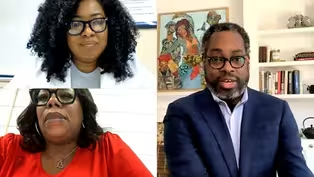
Video has Closed Captions
Clip: S49 Ep9 | 9m 23s | Heart Health | Episode 4909/Segment 1 (9m 23s)
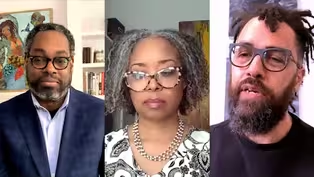
Video has Closed Captions
Clip: S49 Ep9 | 11m 10s | Scarab Club | Episode 4909/Segment 2 (11m 10s)
Providing Support for PBS.org
Learn Moreabout PBS online sponsorship
- News and Public Affairs

Top journalists deliver compelling original analysis of the hour's headlines.

- News and Public Affairs

FRONTLINE is investigative journalism that questions, explains and changes our world.












Support for PBS provided by:
American Black Journal is a local public television program presented by Detroit PBS