
Heart Month
2/2/2023 | 24m 30sVideo has Closed Captions
Heart Month
February is National Heart Month. In this episode of InFocus, a conversation with two women who experienced cardiac events with few risk factors or symptoms, and a cardiologist who explains some of the unique challenges in diagnosing cardiovascular disease in women.
Problems playing video? | Closed Captioning Feedback
Problems playing video? | Closed Captioning Feedback
InFocus is a local public television program presented by WSIU
Support provided by:

Heart Month
2/2/2023 | 24m 30sVideo has Closed Captions
February is National Heart Month. In this episode of InFocus, a conversation with two women who experienced cardiac events with few risk factors or symptoms, and a cardiologist who explains some of the unique challenges in diagnosing cardiovascular disease in women.
Problems playing video? | Closed Captioning Feedback
How to Watch InFocus
InFocus is available to stream on pbs.org and the free PBS App, available on iPhone, Apple TV, Android TV, Android smartphones, Amazon Fire TV, Amazon Fire Tablet, Roku, Samsung Smart TV, and Vizio.
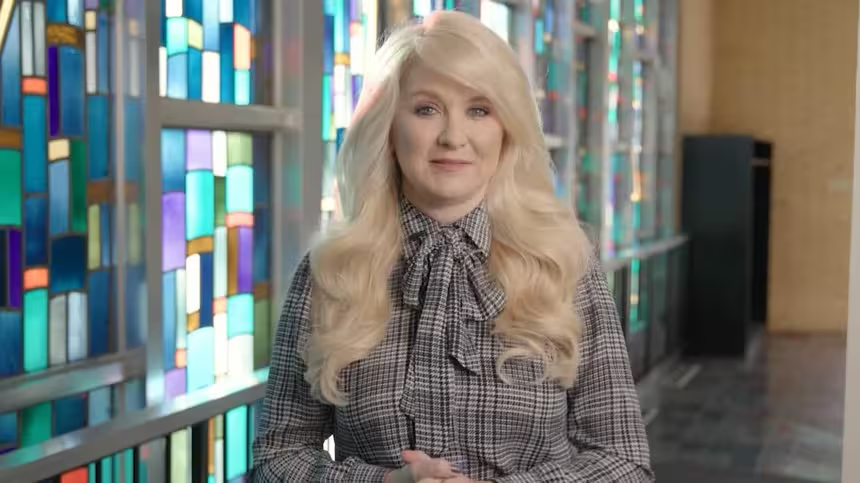
InFocus
Join our award-winning team of reporters as we explore the major issues effecting the region and beyond, and meet the people and organizations hoping to make an impact. The series is produced in partnership with Julie Staley of the Staley Family Foundation and sponsored locally.Providing Support for PBS.org
Learn Moreabout PBS online sponsorship(soft piano music) (bright music) - Welcome to another episode of "In Focus."
I'm Jennifer Fuller.
February is Heart Month across the United States, a time when advocates and experts try to raise awareness about the risk factors and symptoms of cardiovascular disease, including heart attack and stroke.
The first Friday in February is generally designated as wear red day to raise awareness particularly of the risks and symptoms for women because a lot of times those symptoms don't match what traditional heart attack symptoms are.
Two women in southern Illinois learned that all too well over the last year.
I talked with them, Melanie Emory and Beth Roberts, about their experience.
They work together at a school district in southern Illinois and didn't realize about a year ago how much more they would share.
- Actually, I woke up and it was a Sunday and I had pain, like, all across my chest, it just ached.
And I didn't think anything of it, I thought maybe it was heartburn or something, so I just took me an aspirin, woke up, and it was gone.
And then Monday was fine, and Tuesday I woke up with the same pain in my upper shoulder area and it just kept going, and then my husband told me he was calling the ambulance to come and get me, and we argued for a while, and then I finally said fine.
But up until then, I hadn't experienced any pain, anything like that.
I'm not the healthiest person, by any means, but nothing outrageous or, you know, anything like that.
So then they took me to Heron Hospital, the ambulance came and took me to Heron Hospital and that's when they let me know that I was having a heart attack.
And I was cool, calm, and collected and anybody who knows me knows that's not me because I panic and freak out and cry, but I was cool, calm, and collected and they did whatever they had to do at Heron, and then next thing I know I'm in the ambulance going to Carbondale for a heart cath.
And so, we get to Carbondale, and they had the elevator open waiting on me and I said, "Whoo, I'm high class, I have the elevator here waiting," and they were all laughing about it, telling me that's how they do it Carbondale.
And so, they wheeled me in and ended up doing the heart cath, I ended up having 100% blockage, and they put two stents in.
And then I would say that it started probably at 5:45ish and by the time my husband called, I got to the hospital, then got to Carbondale and got the heart cath, I was back in the room by 7:30 in recovery after everything had been said and done.
- I was just noticed that I was, I had to take the trash can down the road and it's not like a big hill, it's just, like, a little hill back and forth up, and I was having trouble pushing the trash can down and bringing it up, I couldn't breathe, I had to stop and go ah all the time to try to get back up and then catch my breath when I got up to the hill, and that's not like me, so I thought, ah, I better go ahead and call the doctor.
So I called the doctor, went to go see the cardiologist, and they ran a bunch of tests, and they came out and they said, "Well, I think you're gonna have to have a stent again."
I said, okay, because I have three of them already, two in my heart and one in my kidneys, and I said, okay, I can handle that.
Well, they tried to stent me, the stents would not go through.
So they said, "Well, you're gonna have to have bypass surgery," and I said, oh, okay.
So then they set it up for, like, the eighth of July, and I said, if we're gonna do it, we've gotta do it, like, right away, I can't wait, I'll back out of it, I know, you know?
Because it was scary.
And so, I got to the hospital that morning and changed and just kind of a calm came over me 'cause they took such good care of me, like Mel said, and Heron and Carbondale was the same way, and the only thing I was worried about was the power going out, what happens if the power goes out when you're on the table and you're on the bypass machine?
What do you do, you know?
And, but it didn't, I was in surgery about five or six hours, maybe a little bit more, but I came through it with flying colors, I came out, took me a little while to wake up and come off the, not the respirator, whatever they put in your mouth, and when they finally got that off, I was back to myself, and I got up the next day and started walking in the hospital and I've been going ever since.
I was off about two and a half weeks from work because I couldn't stand staying at home anymore.
I called the doctor, I said, you gotta send me back.
If I can sit at the kitchen table and type for school, I can go to school and work.
And so, he said, "Okay, but you gotta start half days," that lasted about two days and then I stayed at school all day.
But they didn't let me lift or pull or tug or anything, I just got to answer the phone, type, and answer the phone, so it worked out really well for me.
I came through really well.
- I hear from so many people about when they've had their procedure they didn't realize how bad they felt or how much better they would feel, whether it was a stent, or even open heart surgery.
Is this your experience as well?
- Yes.
- It's true.
That's true, we both agree on that one, that's true.
- Yes, because I had been feeling tired and, you know, worn out all the time, and then this happened and I have the two stents now and I'm not near as tired as I was before, so.
- Yeah, me either.
I can get up the hill now with no trouble.
It's good.
- A lot of times we hear from women that their symptoms didn't match the traditional symptoms of a heart attack and they were surprised when they received their diagnosis.
Is this your story?
Were you surprised?
- I was, yes, because I had no family history and nothing and it took me a while to realize that I really did have a heart attack and it really did happen.
- Yeah, I'm a diabetic, so there's kind of a little difference there because diabetics tend to have more heart troubles, and my dad had a bypass when he was in his 50s, so I was 68 when I had mine, or 67, so, you know, I kind of would have suspected it because I'm a lot like my dad, but it kind of surprised me that they couldn't get the stent to go through and they told me I had to have bypass surgery, and especially when they told me, when I came out, I had three.
I was really kind of shocked about that.
- What would you say to women who are in a similar situation to you in terms of listening to their body, advocating for themselves when they're talking with their doctor or anything like that, in terms of making sure that their care is the best that they can get?
- I actually would tell them that they need to go get checked out.
I had a friend that asked me what my symptoms were a while back and I told her, and she goes, "Well, I kind of feel like that too," and I said, "Well, go."
- Yeah.
- I said, "Don't take a chance.
I'd rather go to the hospital and it just be heartburn or a panic attack or something like that and know that that's what it was instead of just in case was a heart attack."
So I would definitely tell women to make sure you listen to your body, we were just talking about that beforehand, about listening to your body 'cause it knows what's going on, and to go to the doctor when you feel like you don't feel right.
- Make an appointment, go to the doctor, and listen to what the doctor tells you.
If he tells you you need a procedure done, have it done.
And if he says, oh, I would just insist on having it done.
You know, it's an important thing, 'cause like I said, we both feel so much better.
- Mm-hmm.
- Melanie and Beth are symbols of patients that cardiologists see all the time.
Women who don't recognize that their symptoms and their risk factors may look and feel a little bit different than what they've heard as cardiovascular symptoms in the past.
I talked about that with Dr. Rizwan Khan, an interventional cardiologist with Prairie Heart Institute and he said that there are a lot of things women need to keep in mind.
- So essentially from the heart disease standpoint and specifically we're talking coronary disease right now, meaning patients who come in with either blockages in the arteries of their heart or if they're presenting with a heart attack, so you're right, it's really highlighted in the media that, you know, the symptoms that women sometimes present with can be more atypical, essentially they are not as usual as, you know, we are classically used to understand that, you know, a heart disease presents as.
But the first thing and the most important thing we need to recognize is that, for the most part, even for females too, the most classics symptoms of a patient who's having a heart attack are pretty much the same as men are and the most common ones are that you will have the chest pain, feeling like, you know, there's an elephant sitting on the chest, sometimes they can have, you know, a radiation to the jaw.
And so, these are the most classic ones and, you know, majority of the females, when they present with a heart attack, they do present with some similar symptoms.
But the concern is that one thing that we are slowly recognizing more are that a lot of the times females tend to present, and even though that's a small minor amount, but they do present with some symptoms that are not as classic as these are.
And since there are less amount of patients who present with those symptoms, that gets missed sometimes.
So they might present with, like, a feeling that you're having a burning sensation in the upper gastric region, they might feel like they're just nauseous and they might think they just ate something bad and that's why they're having those symptoms, sometimes they can have some back pain symptoms or shoulder pain symptoms.
Once again, it's less frequent, but that's even more difficult, right, because when you are not used to seeing those symptoms as frequently and that's not even in your radar that this could be heart disease.
And that's what we're trying to highlight more that, you know, whenever we are dealing with a patient coming into the hospital or in clinic with some of these symptoms that might not look like a heart issue, but you should always try to think that could it be that?
Because this way we are able to catch more patients who could be having a heart attack.
So just to give you an example, so this past weekend I was on call and a patient actually came in with back pain, really bad back pain as well as nausea.
There was some chest pain that might have been there, the ER physician very nicely picked it up, got an EKG, and the patient was actually having a major heart attack, and I had to open up the blockage of the artery in the front of the heart for that patient.
So symptoms, if not classic, we still have to be more open-minded and be more conscious that sometimes females might not present with those classic things.
- I talk to women a lot about advocating for themselves whether it comes to their doctor or just their care in general.
How important is that advocacy for women in terms of asking for a specialist or tests when they think that they might be at risk of cardiovascular disease?
- I think that's a very important point.
So to just give you a little bit of perspective that how, you know, the last few decades, the disparities have been, so classically when you always think of, you know, heart disease, we always think of, you know, an elderly male person who has some of those traditional risks where they're smoking, they're not taking care of themselves, but we slowly have to come out of that idea now because what we realize is, and for a certain reason, this was true to a certain extent because earlier in the life, females don't have as much risk of coronary disease or blockages in the arteries as males do, but then as soon as they, you know, they get to the age where they get menopause, then suddenly the risk of heart disease really upshoots very quickly.
And now we realize that through the lifespan of a male and female, the risk is the same.
So now you have to think that for males it's more steady, but for females it just suddenly goes really high really quick.
So, and because of that overall, not just in, you know, general public, even in healthcare professionals too, there has been a sort of bias that, you know, when we see a female patient we might think that it might not be heart disease, and if similar symptoms a male patient is presenting we might be more biased to thinking that they could be having heart disease.
So that's true, you know, that we need to try and have very high suspicions even with symptoms that are not very classic for heart disease, especially for females when they do hit that age where the risk is only getting even higher.
And, you know, I'm glad that it's brought up more and more and traditionally we always think of breast cancer when we think of females, but we don't really think of heart disease as much, but heart disease is the number one killer of the patients, for females, and it's almost seven times more patients die every year due to heart disease than breast cancer, so you know, we have to keep that in perspective.
And I agree with you that if symptoms, if they are having any symptoms that they're concerned about, definitely advocate for yourself, definitely see and bring up those symptoms, don't try to dismiss, and even for yourselves too, sometimes I've seen this, that the patients, they try to just justify, you know, when you see them and they're like, oh, no, I think this is probably just acid reflux, but then you have to kind of talk them through this, that, you know, it could be that, but acid reflux won't be as dangerous, but if it's truly heart disease, that can be a very dangerous thing.
So you just have to, from a patient perspective too, it's a good idea not to dismiss any symptoms that you're having.
- What about risk factors that are specific to women?
I'm thinking of things like pregnancy induced high blood pressure or preeclampsia, those things that maybe are affecting a woman early in their life, but then it comes back later in life.
Are these things that are increased risk factors?
- So that's actually a great question because, you know, classically we always talk about the risk factors for heart disease, the biggest ticket items always are, you know, smoking, diabetes, hypertension, you know, obesity, the kind of food and the lifestyle that you have, and it is true for females too, those are truly the biggest risk factors for females too.
But the thing is that more and more we are realizing that there are a lot of specific diseases that females have, especially earlier in their life, that actually have shown that when we look through this patient 10, 15 years down the road, they have a lot more cardiovascular events that happen and now we are realizing that we need to be more aggressive about screening these people and seeing them earlier.
So to give you some example, the most common things, you know, are that during pregnancy, sometimes you can have high blood pressure, called gestational hypertension, during pregnancy you can have high blood sugar levels, called gestational diabetes.
Oftentimes they resolve after pregnancy, but they have very risk of developing chronic hypertension or chronic diabetes down the road.
Especially for gestational diabetes, almost 50%, close to 50%, of the patients will have diabetes in the next 20 years.
So imagine if the patient in their late 20s, early 30s, if they are pregnant and they have this, we have to be really aggressive in making sure we are following them, that they are not getting those issues down the road.
Other things like pre-term delivery, patients who actually have breast cancer history and they undergo chemotherapy, a lot of those patients end up developing a lot of heart disease down the road.
More serious things, like preeclampsia, is a situation where it's a high blood pressure situation in pregnancy, during the end stages of the pregnancy, that can be very catastrophic sometimes.
Patients develop swelling in the legs, they also have issues with protein, losing it in the urine, and they can get kidney failure or liver failure and very bad things like this and we've found that these patients who actually get preeclampsia, they actually have almost four times higher risk of developing heart failure, which is essentially the pump failure of the heart, down the road and almost twice as much risk of getting coronary disease down the road.
So a lot of these risk factors, we have to be very conscious about, especially in these pregnant patients.
Now, there are other situations, patients who have autoimmune diseases, like lupus, they are at high risk of getting coronary disease and other cardiovascular diseases down the road.
So we have to be very conscious about a lot of these risk factors that are more attributable to females and understand that, you know, most of these things are happening earlier in their life and we are not even thinking about cardio disease for them and they will predispose them to having some cardiovascular issues down the road.
- When it comes to taking care of your heart health, you know, we hear all the time about mammograms, colonoscopies, pap smears, things that are regular screenings to watch out for specific diseases, but we don't hear about regular screenings for heart disease.
Should there be screenings like that?
- The problem is that even right now we struggle with even those patients who actually have high risk of getting heart disease, having the risk factors of smoking, you know, high cholesterol, diabetes, and all those things.
Heart disease can be sometimes challenging and, you know, in a broader group, the main three issues with the heart disease is one is the issues with the plumbing of the heart, meaning the blockages in arteries of the heart, one is the issues with the electrical circuitry of the heart called cardiac rhythm issues, and one is essentially the pump failure of the heart, which means that just the heart is not able to pump as much blood forward as it should.
And all these things, it's harder to screen them earlier sometimes, even with high risk patients too, but that shouldn't discourage us from following these patients closely because oftentimes we are able to catch them before somebody has a heart attack, we're able to catch them before somebody gets really end stage heart failure.
So we wanna keep following these patients closely for clinical signs, regular yearly followup, and you don't necessarily have to have any lab tests, just clinical science has a very good picture oftentimes to tell us that if somebody is having an issue or not and we can start a workup with an echocardiogram or with blood work and with EKG and other rhythm monitoring tests to look for all of these problems.
So the bottom line for these patients basically is that we need to mentally be prepared that somebody had a medical issue like this and they are at high risk of getting coronary disease down the road, so we have to be more diligent about following them closely, making sure they're not having any symptoms that could be an index that they're getting any of these medical problems.
- We talk all the time about how rural America has higher statistics when it comes to those risk factors for cardiovascular disease, whether it's a sedentary lifestyle, increased smoking rates, obesity, diabetes, all of those things.
How do you advocate to your patients about these things which, in many cases, can be changeable, things that they can make changes to in order to lower their risk of disease?
How do you talk to patients about that?
- I think that's actually a very good point.
For the most part, cardio disease, specifically if we talk about coronary disease, issues with blockages in the arteries, they have two classic kind of risk factors.
One of the ones that we can't change, you know, if your parents had heart disease, we can't change that, the chances that you can get heart disease are definitely higher with that.
The older we get, we can't change that, the risk of heart disease is gonna be higher.
But then all these modifiable risk factors that can start from, you know, being able to quit smoking, monitoring the blood pressure and maintaining the blood pressure in a good range, if you have diabetes and maintaining your blood sugar levels in a good range by making sure that you're taking medications, you're taking insulin therapy if you have to, from the diet standpoint of course decreasing the amount of salt in the diet, decreasing the amount of carbs, portion control, and, you know, activity standpoint, making sure that we are staying as active as we can.
These are the most important things and, you know, obviously over time we've seen that they have improved the overall health, but I think there's still a lot of work to be done because I think when we grow up a certain way, it's hard to change those habits, and so we just have to slowly, and, you know, from a physician's standpoint, our goal is that we try to just keep bringing these things up so that patients at least understand that what it can lead to 15 years down the road.
- What about that buddy system?
Whether it's a family member or a friend, how should they be advocating both to the patient and perhaps even getting them to the care that they need, watching the symptoms like shortness of breath, fatigue, those sorts of things, and telling that person, hey, you haven't been feeling well, maybe you need to get this checked out.
- I think that's actually a very good point and I see this all the time.
We end up seeing patients in the ER who should have been in the clinic probably six months ago.
And I think, you know, a very nice reprieval, we are slowly trying to create in public with the Heart Month and with all of these different avenues is an idea that you understand that any symptoms that you are having, could it be a sign that you are having heart disease or you are having any cardiovascular issue that needs to be looked at.
The majority of the heart problems, they don't, you know, short of somebody suddenly having a heart attack, most of the other medical problems whether that's heart failure, you'll slowly start getting short of breath, you'll slowly start noticing swelling in the legs, heart rhythm issues, you'll slowly start noticing some palpitations and feeling that your heart is racing faster, and most of the patients, they end up having these symptoms for months before they get to the point that they're really sick.
And if you're able to catch them earlier, you're able to alter the timeline of things for them if you treat them, and most of these diseases are very manageable in this day and age and all of the technology and advances we have right now.
It's just that we wanna make sure that we catch them earlier and start treating them quick instead of seeing them at the very last stage, you know, or only when they end up in the ER.
- Finally, doctor, what else do you think patients and their caregivers need to know?
- From a female health perspective, from a cardiovascular standpoint, I think the biggest and most important thing is that we need to just start realizing that cardiovascular disease is probably the most important thing in their health that they need to pay attention to and, you know, the further we get along in life, we need to start being very conscious of all of these risk factors that we discussed about and not to dismiss any symptoms, you know.
Always it's better to go to the ER, or go to the urgent care, or go to the clinic, and be looked at for any symptoms that you think might be acid reflux or something less benign because if we miss something that can be from a cardiovascular standpoint that can mean death for some people, which would be a tragic thing.
- That'll wrap things up here on "In Focus."
I'd like to thank Dr. Rizwan Khan of the Prairie Heart Institute, as well as patients Melanie Emory and Beth Roberts for telling their story during Heart Month.
You can get more information about Heart Month by talking to your primary care provider or by going to the American Heart Association website at heart.org.
From all of us here at "In Focus," thanks for joining us, we'll see you next time.
(bright music)

- News and Public Affairs

Top journalists deliver compelling original analysis of the hour's headlines.

- News and Public Affairs

FRONTLINE is investigative journalism that questions, explains and changes our world.












Support for PBS provided by:
InFocus is a local public television program presented by WSIU