One-on-One
Heather Eckhardt & Kate; Carmen Phaneuf; Steven Feifke
Season 2023 Episode 2636 | 27m 49sVideo has Closed Captions
Heather Eckhardt & Kate; Carmen Phaneuf; Steven Feifke
Heather Eckhardt, Student Assistance Counselor at Delaware Valley Regional High School, and student activist Kate Kraynanski, highlight their prize-winning PSA; Carmen Phaneuf, a Nurse Practitioner at Parker Family Health Center, living life to the fullest; Steven Feifke, Grammy-winning Jazz composer, celebrates his accomplishment of being the youngest Grammy Award winner in his category.
Problems playing video? | Closed Captioning Feedback
Problems playing video? | Closed Captioning Feedback
One-on-One is a local public television program presented by NJ PBS
One-on-One
Heather Eckhardt & Kate; Carmen Phaneuf; Steven Feifke
Season 2023 Episode 2636 | 27m 49sVideo has Closed Captions
Heather Eckhardt, Student Assistance Counselor at Delaware Valley Regional High School, and student activist Kate Kraynanski, highlight their prize-winning PSA; Carmen Phaneuf, a Nurse Practitioner at Parker Family Health Center, living life to the fullest; Steven Feifke, Grammy-winning Jazz composer, celebrates his accomplishment of being the youngest Grammy Award winner in his category.
Problems playing video? | Closed Captioning Feedback
How to Watch One-on-One
One-on-One is available to stream on pbs.org and the free PBS App, available on iPhone, Apple TV, Android TV, Android smartphones, Amazon Fire TV, Amazon Fire Tablet, Roku, Samsung Smart TV, and Vizio.
Providing Support for PBS.org
Learn Moreabout PBS online sponsorship- [Narrator] Funding for this edition of One-On-One with Steve Adubato has been provided by NJM Insurance Group.
Serving New Jersey'’s drivers, homeowners and business owners for more than 100 years.
Johnson & Johnson.
Hackensack Meridian Health.
Keep getting better.
The New Jersey Education Association.
New Jersey Sharing Network.
Rutgers University Newark.
PSC.
Where your story is our business.
Horizon Blue Cross Blue Shield of New Jersey.
Here when you need us most.
And by Robert Wood Johnson Foundation.
Working for a more a healthier, more equitable New Jersey.
Promotional support provided by CIANJ, and Commerce Magazine.
And by New Jersey Monthly.
The magazine of the Garden State, available at newsstands.
- This is One-On-One.
- I'm an equal American just like you are.
- The way we change Presidents in this country is by voting.
- A quartet is already a jawn, it'’s just The New Jawn.
- January 6th was not some sort of violent, crazy outlier.
- I don't care how good you are or how good you think you are, there is always something to learn.
- I mean what other country sends comedians over to embedded military to make them feel better.
- People call me 'cause they feel nobody's paying attention.
-_ It'’s not all about memorizing and getting information, it'’s what you do with that information.
- (slowly) Start talking right now.
- That's a good question, high five.
(upbeat music) - Hi everyone, Steve Adubato.
Safe Driving, that is the theme today.
And we kick off the program with Heather Eckhardt, who is a student assistance counselor at Delaware Valley Regional High School.
And Kate Kraynanski, who is secretary of Students Against Destructive Decisions.
She's a junior in high school as we speak.
How you doing, both of you, you doing all right?
- Good, how are you?
- Yeah, good.
- Yeah.
- Well, first of all, let's tee this up.
We're about to see a public service announcement that you, Kate, and your colleagues put together.
It's called, what's the name of the PSA?
- It's Students Against Distracted Driving.
- Okay, and there's a competition that, the Just Drive competition that was organized by the folks at NJM, New Jersey Manufacturers Insurance Company, and also the Brain Alliance of New Jersey.
Why don't we take a look at, Georgette, our executive producer, can we take a look at the PSA, 'cause it's all about safe driving.
The young people at Delaware Valley Regional High School did it.
They won second prize, that's 10 grand.
Not bad.
- Not bad.
- Let's take a look at the PSA.
- Should we go to Starbucks after school today?
- Yeah, I'll drive.
- With all of us?
- No, no, no.
According to NJ's GDL laws, drivers with a probationary license are only allowed one additional passenger.
- Yeah, we should take a pic.
- Should you be using your phone while driving?
- Oh, no, no, no, probationary drivers may not use any handheld or hands-free devices at any time while driving.
- Wait, Macy, it's getting kinda late.
Can you drive me home?
- Yeah, of course.
- Are you allowed to drive after 11?
- Oh, probationary drivers are not permitted to drive a motor vehicle after 11:01 p.m. Get there alive.
- (clapping) Heather, I gotta ask you, how proud are you of your students?
- I am so proud.
All the hard work that they put into this, and our vision was even different than what it came out to be.
The editor did an amazing job, and I think they really worked hard on it.
- Talk about that, Kate, from your perspective.
You were one of the writers, correct?
- Yeah, so we made a bunch of different scenes that we wanted to have in the video, and we wanted to make sure that it was very fun, and exciting, and not just a boring public service announcement.
So a lot of the editing that our editor did was to make it super fun, and very exciting.
And we're really happy about the way it turned out.
- We have two young men in our home, our sons, they're not just young men in a home, our sons, who are both driving, our daughter Olivia's 12, and talking about a car down the road, and I'm thinking, "I can't even deal with the other two.
And this one's talking about driving."
Point being, for most of us as parents, Heather, there's a lot of panic, there's a lot of fear, there's a lot of anxiety.
And that PSA was so clear, these distractions, right?
- Yes.
- How much is that a part of the problem in terms of safe driving, distractions, particularly with phones?
- I think it's a big distraction, especially for teenagers, 'cause I think they are just so used to always having their phone, using their phone, using social media.
And I think in the car, it is a, obviously it's a huge no-no.
But I think distracted driving for teenagers is a big issue, and it's a big concern.
- Hey, talk about that, because again, I see our kids with their phones constantly, and their friends with their phones.
How challenging has it been for you to be a student leader, to talk about, "Hey, time out.
This is dangerous, let's put the phones away."
How hard has that been?
You're smiling as I'm saying it.
- Yeah, it's been really hard.
I always have my phone on me, I always use my phone.
And driving with phones is definitely very dangerous, and you should not do it at all.
It's against the law.
And just working with phones all of the time, it's very hard to just put it down, and not get distracted by it easily.
- What's been the reaction, Kate, to the PSA among your colleagues, among the students?
- It's been very positive.
I think most people agree with the rules.
I mean, they are laws.
Most people I know follow them, everyone should follow them.
I think that it definitely brought awareness how we wanted it to, so yeah.
- We're at over 625 views right now on our PSA, so we're pretty proud of that.
- Yes, it's pretty good.
- 'Cause we're from a pretty small school.
- Heather, how did you get into this whole thing?
- As far as being the leader, the advisor for SADD?
As soon as I started working here, at Del Val eight years ago, I started back the club, because it was not in existence anymore at Del Val.
Just to get the positive message out there to our school about making good choices, when it comes to drugs and alcohol, when it comes to your mental health, when it comes to driving, stress, all of those things.
So I wanted to, I'm the student assistance counselor here, so I, as part of my job, I address a lot of those issues and concerns, individually in a group level with our students at Del Val.
So SADD helped me get a group of kids together that also wanted to focus on those issues, and bring awareness to our school on those topics.
- And SADD is Students Against Destructive Decisions, correct?
- Yes, it used to be Students Against Drunk Driving, like MADD, but then I think they realized that there were other decisions that we also wanted kids to be able to focus on, and making good choices just in general, not just on drunk driving.
- Kate, what's this done for you to be involved in this?
- So I was in another group called Girls Group, with Miss Zucker, and she was talking about it one day, and I thought it was a really great idea for me to join it.
And then once I joined it, I found out that I really enjoyed what we were doing, and all of the activities and clubs like that we were doing within it.
And so then I wanted to be secretary of it, and I just wanted to help more with the club.
- I'm a student of leadership, and I know a leader when I see a leader, and you are a leader.
Real quick, one of the other themes in the PSA, Heather, I want you to talk about this, and Kate as well, was the number of kids in the car.
- Right.
- Right?
Let's clarify that, what is the law?
- New Jersey's law for someone who is only on a graduated driver's license, which is what the GDL stands for, a probationary license, is you are only allowed to have one other member in the car at the same time, yes.
- What about, hey, put you on the spot, nighttime, what are the rules?
- So when you have your graduated driver's license, you can't drive from 11:01 p.m. to 5:01 a.m. - So those are the rules, those are the laws.
There's a reason for them.
We wanna thank the folks at NJM, and at the New Jersey, the Brain Alliance, Brain Injury Alliance of New Jersey, for putting this initiative together, the Just Drive initiative.
We will continue to do programming about safe driving and the importance of it.
And it's not just for those of us who have teenage drivers, it's for everyone out there on the roads.
So Heather, Kate, congratulations.
You won second prize, that's 10 grand.
That's a really good cause.
And we wish you and your colleagues all the best.
Thank you.
- Thank you.
- Thank you so much.
- Job well done.
Stay with us, we'll be right back.
- [Narrator] To watch more One on One with Steve Adubato find us online and follow us on Social media.
- We're now joined by an extraordinary young woman, Carmen Phaneuf.
And Carmen has been living with multiple myeloma and is a nurse practitioner at Parker Family Health Center.
And is just, I mean, you've had a 20 year journey with multiple myeloma, right?
- Yes, yep.
I was diagnosed in 2002 when I was 34 years old.
- And I never like asking the question, describe your journey, because if you, oh yeah, we've got a really short period of time.
Describe your journey.
But this journey has, you've had extraordinary treatment, right?
- Right.
- Groundbreaking treatment.
- Yes.
- But you've also kept this amazingly positive attitude and done just a few things during this time.
Including, did you actually ski in Switzerland?
- Yeah, I skied in Switzerland and in France and Iceland.
I skied in Iceland last April.
Yeah.
- What's the helicopter thing?
- That was helicopter skiing in Iceland.
Yeah, it was amazing.
You see the ocean from where you're dropped off from.
I skied right down to the ocean actually.
It was pretty amazing.
- And what about these, what are five sprint triathlons?
What's that?
- They're short triathlons, usually a 500 yard swim, a 12 mile bike, and a 5K.
So I've done a lot of those for fundraising for an organization that I'm passionate about.
- Yeah.
- Yeah.
- What is multiple myeloma?
- Multiple myeloma is a cancer of the plasma cells, and plasma cells are white blood cells and they're actually very large cells.
They take the place up in the bone marrow which increases the risk for fractures.
And that's how a lot of patients are diagnosed, with a fracture.
They also damage the immune system and they can clog up the kidneys and cause damage.
- And some of the treatments that you've been through, could you talk about them please?
- Sure, so my first treatment was an autologous stem cell transplant.
So that's when they remove stem cells from my body, give me high dose chemotherapy to bring down the immune system, and give back the stem cells.
I had tandem stem cell transplants in 2012, and then that failed after two and a half years.
And I had an allogeneic transplant, which is a much more invasive type of transplant.
And that's from someone else.
I needed to be a perfect match.
And we found someone, a gentleman in England, and he donated his stem cells to me, and I had that in 2016.
And then most recently, I had a T-cell transplant, or CAR T, in November of 2022.
- Where'd you do that?
- At John Theurer Cancer Center Hackensack.
- Right.
- Yeah.
- Lemme ask you this.
As I was reading about your background, one of the things that striked me, and I did say this in the beginning, is your extraordinarily positive attitude.
Where does that come from, Carmen?
- I think just a sheer will to live.
And I was young when I had this, in the prime of my life, wanted to have a baby, and that led to discovering through blood work that this was growing inside of me.
And just wanting to live life to the fullest every day, trying to make that happen and be here for my family and friends that have supported me.
- Describe your family.
- My family, my husband Michael is just an absolute rock.
I mean, I developed this early in our marriage.
We didn't know if we could have a child.
He has stuck by me through sickness and in health has been there every step of the way.
My daughter is 19 years old, which when I was diagnosed, I'd never thought I would see the day that I would see her graduate high school.
Just finished a freshman year at Boston College.
She was born, she's grown up with a mom who's had incurable cancer all her life.
We were upfront and honest with her at a young age and she's been amazing, an amazing support as well.
- You're a nurse practitioner?
- Yes.
- Why, why?
- Ever since I was a young girl, I started working in a nursing home when I was 15 years old as an aide and a volunteer and I just loved taking care of people.
I became a nurse and worked for six years up in Boston and absolutely loved that, and was mentored by a woman who was a professor.
And really she encouraged me to go on and receive my master's for nurse practitioner.
And I just find it so incredibly rewarding and just love it.
- Carmen, you're a big supporter of support networks.
- Yes.
- What does that mean?
- Well, the one that I am supportive of is the Multiple Myeloma Research Foundation.
They were founded by a woman, similar story to mine, who was diagnosed at a very young age.
She happened to be a pharmaceutical executive, Kathy Giusti.
And she just turned her unbelievably sad story into something that, the MMRF has helped found and pioneered new treatments for multiple myeloma.
I mean, without them, I don't think we would be where we're at right now with all the current treatments and the research opportunities that they've brought to market.
So yeah, I'm very passionate about this organization and all our fundraising was basically done for them.
- Yeah, well, you not only do fundraising, but I know you talk to other patients who are dealing with cancer.
And how important, before I let you go, how important is that, Carmen, is talking to others?
- That's incredibly important.
I mean, that's been very, very rewarding sharing my story.
Since I am a 20 year survivor of this incurable cancer, I think that I give them hope.
I talk to them about my experiences and all my different transplants, and yeah, I think that it gives them hope to know that I am still surviving and living with this cancer and living a full life right now.
- Carmen, I know you just helped a lot of folks right now, once again, helping people, making a difference.
And we wish you and your family all the best, and particularly you, that you continue to have the strength to do extraordinary things.
Thank you so much, Carmen.
You honor us by joining us.
- Thank you.
Thank you for having me.
- Stay with us, we'll be right back.
- [Narrator] To watch more One on One with Steve Adubato find us online and follow us on Social media.
(upbeat orchestral jazz music) (upbeat orchestral jazz music fades) - We're now joined by Steven Feifke who is a Grammy award winning artist.
Congratulations, sir.
- Thank you very much.
- He's a band leader, composer, arranger, and pianist.
Hey, how you doing?
How cool is that Grammy?
- It's pretty cool.
- (laughs) Break it down exactly.
What did you win for?
- So I won for the Best Large Jazz Ensemble Album for this record right here which is called, "The Generation Gap Jazz Orchestra."
(Steve clapping) And this album right here is all about celebrating and showcasing generational diversity.
And I produced it alongside my collaborator and mentor for this project, Bijon Watson, who's a great lead trumpet player.
And it was just so incredible too, one of the cool things is that I'm actually the youngest-ever band leader to win this award in this category, and to win it for this record right here for a mission like this is very, very special.
- That's awesome, and we're happy for you, proud of you, congratulations.
- Thank you.
- Curious, jazz came into your life, and this is part of our Arts Connection series, you'll see the graphic up.
Jazz came into your life when?
- Yeah, so I started playing the piano when I was four years old.
My mom was my first teacher and I was very shy as a kid.
And so piano and music in general, kind of gave me a bit of a voice that I didn't have otherwise.
And when I was around nine or so, what started to happen is that I became a little bit frustrated by reading music.
And I was a little kid, I was a lot younger.
20/20 hindsight, I wish that I had stuck with classical music, but what happened next kind of became one of the greatest gifts that could have possibly happened for my career which is that when I told my teacher that I was feeling a little bit bored by reading music and kind of feeling like I was unable to really give my own voice to the music, she said, "Well, have you heard of Jazz and improvisation?"
And I said, "No, I haven't."
And she basically walked me through, during my first lesson on that tip with her, she walked me through this incredible, I remember the lesson exactly, she walked me through how to play a waterfall on the piano.
She said, "Okay, play me a waterfall," and like any little kid, I run my finger down the piano.
She's like, "Great, now what happens "when the water hits the ground?"
And I was like, "Can I do it?"
And she's like, "Yeah, do it," and I crash my fingers on the piano, and she's like, "Okay, a little bit softer, "but yeah, that's the right idea."
And so she started walking me through, basically, how to realize what I was seeing and feeling on a deeper level in my head through my music.
And I basically learned about Jazz and about improvisation through composition.
And Jazz is all about making music in the moment.
And so through that, I really felt like I was able to, I didn't have the words for it then, but I really felt like I was able to return to that place that I knew when I was four years old, five years old, again, even though I wasn't conscious of this at that age, I really was able to return to being able to kind of make music that came straight from my heart.
And so as I've gotten older and older, I develop more and more tools and techniques that help me say more.
- Steven, was that in Lexington, Massachusetts?
- Yeah, so I'm from Lexington, Massachusetts originally, and moved to New York in 2009 to go to school.
- Hold on, was that a teacher?
I'm sorry for interrupting.
Was that a teacher who did that for you?
- Yeah, yeah, her name is Susan.
- What was that teacher's name?
I have to do this.
- No, no, no, please.
I say her name.
We keep in touch to this day.
Her name is Susan Capestro, the greatest teacher I ever had.
- Ms. Capestro.
- Yeah.
- She saw something in you.
- She was an incredible teacher.
She really embraced everybody at the level that they were at and just kind of helped them do what they felt that they needed to do.
And I'm forever grateful for the lessons that she taught me, and also for just our friendship and relationship now as adults.
- Yeah, we're big fans of celebrating public school teachers.
Generation Gap Orchestra, your orchestra, talk about it.
- Yeah, Generation Gap Jazz Orchestra, it's an orchestra that was founded by myself and Bijon, and we have about two decades between us.
And so this is where we got the idea for the name, Generation Gap.
It was actually be Bijon's idea to call the album and subsequently the band that.
- Tell everyone who your colleague is.
- Yeah, so Bijon Watson, incredible lead trumpet player who has performed on records that you've probably heard and listened to if you've ever checked out Michael Bublé or Diana Krall or you've seen the movie, "La La Land."
And we met backstage at a concert.
One of my other mentors, John Beasley, invited me to one of his performances.
And I was a lot younger than I am now.
And I met Bijon backstage at that show and we just hit it off.
Bijon is also from Massachusetts, and we started chatting here and there over the phone, and he became a really important figure in my life.
And as our friendship developed, there was one time that he asked me, he was like, "Hey Steven, "can you arrange some big band music for me?
"I need this or that."
And you know, this is a big part of my career as well is that I write music for a lot of artists and for other mediums as well.
And so usually I say, "Yes, of course," but with Bijon, I just said to him, I was like, "Man, why don't we start our own big band?
"I'll write the charts "but let's start our own band."
He was like, "That's a great idea."
And so that's how the band started.
And we're huge into education so Bijon and I first presented this ensemble at the Jazz Educators Network Conference.
And the ensemble itself is comprise comprised of almost five decades of musicians.
And it wasn't an intentional thing that we had got like five generations.
You know, the whole idea here is that everybody who has something to say should be given a platform to say it.
And so Bijon called some of his friends, some of his mentors, some of his students, I called some of my friends, some of my mentors, some of my students, and we basically got together this very diverse-aged ensemble.
And so when we had our release show at Berkeley College of Music, we played at the Berkeley Performance Center in Boston as one of our release shows when the album came out in October, what we did is that I was able to actually bring in some of my students at Berkeley at the time to perform with us.
So like one of the singers, one of the trombonists, one of the saxophonists, one of the guitarists, and this is sort of like the whole message of the ensemble is- - Which is what?
- To do this, celebrating and showcasing generational diversity in music, especially in Jazz.
- And the new CD?
Talk about the new CD.
- Yeah, the new CD is this one right here.
It's called, "Catalyst."
This is my sixth album in two years.
It's my seventh album as a leader.
And this is a big band album and I just love big band music.
And so for me, this is a special album for a number of reasons.
The music on it is very, very personal to me, special to me in many ways, and there's a couple of reasons why it's called, "Catalyst," but I'll give you two of them right now.
Number one, there's an incredible group of musicians on the album.
People who have been playing in my band for over 10 years at this point, in the Steven Feifke Big Band.
And they are incredible musicians, but I just started thinking to myself, "Well, everybody's in the recording studio, "everybody's on stage, "Like what do they need to make the music actually happen?"
'Cause 18 people, it's a lot.
And I started thinking like, "What is the catalyst "for that situation?"
And could I possibly give music that allows everybody to be themself, musically speaking?
And so in that way, this is one of the ideas of, "Catalyst."
And the second, the one that I personally feel is very, very close to my heart is that there's a track on the record called, "Patience's Promise."
And I don't know if you've ever heard the phrase or the age old quote, "Good things come to those who wait."
And I started to notice at a certain point that I was waiting and waiting and waiting for something to happen to me, slash for me, and that I, in the meantime, was developing and having these other ideas for myself about what I actually wanted my future to look like.
And so the track on the record is called, "Patience's Promise," and it is kind of alluding to that quote that good things come to those who wait, but actually, "Patience's Promise," is an abridged title for the song.
The actual full title of the song that I say to myself in my mind is that, "Patience's Promise is a Lie."
And that if we want something in our own lives then all we have to do is go out and make it happen for ourselves.
And so in that way, I see myself as my own catalyst in my own life, and I hope that other people as well can see themselves as their own heroes, and to become their own catalyst to make their own dreams a reality because this right here is a dream come true for me.
- Well said, Steven.
Congratulations and wish you all the best.
- Thank you so much, Steve.
I really appreciate it.
And likewise.
- Yep, you got it.
One of the youngest Grammy award winners ever.
We'll see you next time.
- [Narrator] One-On-One with Steve Adubato has been a production of the Caucus Educational Corporation.
Funding has been provided by NJM Insurance Group.
Johnson & Johnson.
Hackensack Meridian Health.
The New Jersey Education Association.
New Jersey Sharing Network.
Rutgers University Newark.
PSC.
Horizon Blue Cross Blue Shield of New Jersey.
And by Robert Wood Johnson Foundation.
Promotional support provided by CIANJ, and Commerce Magazine.
And by New Jersey Monthly.
NJM Insurance Group has been serving New Jersey businesses for over a century.
As part of the Garden State, we help companies keep their vehicles on the road, employees on the job and projects on track, working to protect employees from illness and injury, to keep goods and services moving across the state.
We're proud to be part of New Jersey.
NJM, we've got New Jersey covered.
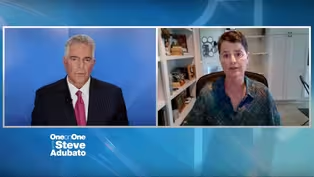
Living Life to the Fullest with Multiple Myeloma
Video has Closed Captions
Clip: S2023 Ep2636 | 8m 46s | Living Life to the Fullest with Multiple Myeloma (8m 46s)
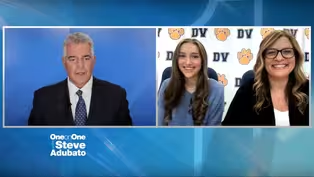
Safe Driving Activists Share Their Award-Winning PSA
Video has Closed Captions
Clip: S2023 Ep2636 | 8m 31s | Safe Driving Activists Share Their Award-Winning PSA (8m 31s)
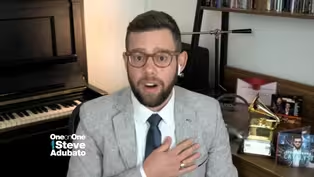
Steven Feifke Celebrates Grammy-Award-Winning Career in Jazz
Video has Closed Captions
Clip: S2023 Ep2636 | 11m 2s | Steven Feifke Celebrates Grammy-Award-Winning Career in Jazz (11m 2s)
Providing Support for PBS.org
Learn Moreabout PBS online sponsorship
- News and Public Affairs

Top journalists deliver compelling original analysis of the hour's headlines.

- News and Public Affairs

FRONTLINE is investigative journalism that questions, explains and changes our world.












Support for PBS provided by:
One-on-One is a local public television program presented by NJ PBS