
Heather Thompson; Kris Kolluri; Steven K. Libutti, MD
8/29/2026 | 26m 46sVideo has Closed Captions
Heather Thompson; Kris Kolluri; Steven K. Libutti, MD
Executive Director of Table to Table Heather Thompson discusses how food rescue efforts with farms, grocery stores, and distributors combat food insecurity. Kris Kolluri, President and CEO of NJ TRANSIT examines the efforts that moved thousands of fans during the FIFA World Cup. Steven K. Libutti, MD, Sr. VP of Oncology Services at RWJBarnabas Health talks about the new Melchiorre Cancer Center.
Problems playing video? | Closed Captioning Feedback
Problems playing video? | Closed Captioning Feedback
Think Tank with Steve Adubato is a local public television program presented by NJ PBS
Heather Thompson; Kris Kolluri; Steven K. Libutti, MD
8/29/2026 | 26m 46sVideo has Closed Captions
Executive Director of Table to Table Heather Thompson discusses how food rescue efforts with farms, grocery stores, and distributors combat food insecurity. Kris Kolluri, President and CEO of NJ TRANSIT examines the efforts that moved thousands of fans during the FIFA World Cup. Steven K. Libutti, MD, Sr. VP of Oncology Services at RWJBarnabas Health talks about the new Melchiorre Cancer Center.
Problems playing video? | Closed Captioning Feedback
Where to Watch Think Tank with Steve Adubato
Think Tank with Steve Adubato is available to stream on pbs.org and the PBS app.
Providing Support for PBS.org
Learn Moreabout PBS online sponsorship- [Narrator] Funding for this edition of Think Tank with Steve Adubato has been provided by Horizon Blue Cross Blue Shield of New Jersey.
The Adubato Center for Media Leadership.
Because media matters more than ever.
EJI, Excellence in Medicine Awards.
A New Jersey health foundation program.
Community FoodBank of New Jersey.
Valley Bank.
PSEG Foundation.
Robert Wood Johnson Foundation.
Working to create a future where health is no longer a privilege, but a right.
Garden State Initiative And by New Jersey Sharing Network.
Promotional support provided by Meadowlands Chamber.
Building connections, driving business growth.
And by New Jersey Globe.
[MOTIVATIONAL MUSIC] - Hey, everyone.
Steve Adubato.
Ever wonder why so much food is being wasted, what happens to that food, and what could and, what should we be doing with that food?
Here to talk about that and so much more is Heather Thompson, who's executive director of an organization called Table to Table, trying to make a difference.
Their website is up as we speak.
Heather, great to have you with us.
- Good morning.
Thanks for having me.
- Hey Heather, what is up with more than three billion pounds of food is wasted each year just in the state of New Jersey?
A, why is that happening?
B, more importantly, what the heck should we be doing?
- Hey, it's really a staggering number.
And it happens for a lot of reasons, right?
We all know that sometimes we're wasting food in our own homes.
We're not eating leftovers.
We're letting produce sit too long, and then we're saying, "Oh, this isn't good anymore.
I'm gonna toss it."
So a lot of waste does happen at the household level, but what a lot of people don't recognize is how much waste happens also all along the food supply chain.
So we're talking about crops that go unharvested from farms, and that might just be that the farmers are, you know, planting enough to make sure that they have sufficient product to move to market, but then they don't end up harvesting everything.
It happens at the manufacturing level.
It certainly happens at the retail level.
People pass over food that's perfectly good because it doesn't look quite right.
It's too small or there's a mark on it.
So all of that food can end up in landfill unless there's a deliberate choice to divert it to where it needs to go.
- And restaurants as well.
- Restaurants, caterers, everywhere.
- What does table to, sorry, sorry for interrupting, Heather.
What does Table to Table do to try to, you're a food rescue organization, not a food bank.
We're partners with the Community FoodBank of New Jersey.
That's a different discussion.
- Right.
- What's food rescue?
- Food rescue is really a model by which an organization like ours, Table to Table, can get out, work with all of these different food businesses, retailers, manufacturers, distributors, farms, meet them at their food business, pick up their surplus, and immediately deliver it out to community.
So we're working with food that's highly perishable.
We're delivering it right away in real time out to a network of hundreds of pantries, shelters, community kitchens, distributions, making sure that that food gets into the hands of people who need it before it goes bad.
- So we'll put up the website again right now, and this is the question I'm sure a lot of people are asking.
I'm wondering it myself because there, I know I waste food.
I know I do.
And I know what happens in our family, and I know at a restaurant, I'm like, "Yeah, well, I'm trying to cut back."
And okay, you just wasted all that food.
- Right.
- What about putting in a, "Well, no, I don't want to take it home."
And I don't think twice about, until I was getting ready for this program, I thought, "Wait a minute, there's so many people that are food insecure.
So many people are going hungry."
- Right.
- What could and should we be doing?
We don't solve the problem, but we can help.
- Yes.
- What could and should, Heather, we be doing to be part of the solution?
- So there are a lot of ways that absolutely anyone can be part of the solution.
Being mindful, as you just mentioned, right, of wasting less food at home, of bringing your leftovers home from your restaurant, or maybe not ordering as much.
But when it comes to the model of food rescue and how people can get involved, we have an app called our I-Rescue app.
- Anybody living in Northern New Jersey, you can download this app from your Apple Store, your Google Store.
And it essentially organizes volunteers to run smaller scale rescues.
So when there's leftover meals from a school cafeteria or a farmer's market has a few boxes of things that didn't sell, a volunteer can mobilize to go pick that up, and we've already prearranged where it's going to go, getting it to a local place that's open and ready to receive it.
And the rescues are all within a couple of miles.
It takes less than an hour.
It's a really effective way to be part of the larger solution.
- What about your fleet of refrigerated trucks?
What are they, and why are they part of food rescue?
- We have six full-time drivers and six refrigerated trucks that are out every weekday handling the large-scale rescues.
So they're the ones going to the big retailers, the big distributors.
They're loading on pallets and pallets of food every trip and then delivering that right out to community as well.
So last year in total, our rescues were about 25.2 million pounds of food.
The trucks handled about 23 million pounds of that.
The rest was volunteers using I-Rescue.
- Heather, we're a nonprofit media organization.
You're a nonprofit.
Raising money is most of my job.
- Right.
Mine too.
- I was just gonna say.
- I get it.
- I know you get it.
And by the way, go on the website if you want to contribute to Table to Table.
You should do that as well.
Heather will not turn you down.
- Never.
- That being said, where does the money come from?
Corporate foundation money, where does it come from?
- We are very fortunate since 1999, since we were founded.
It's really been the generosity of our community.
Thousands of individuals have contributed to our organization.
A lot of great corporate partners, a lot of wonderful foundation partners.
We host several special events, fundraising events throughout the year that attract more people in, help them get to know us, raise funds to support what we do.
And it's really effective.
Every dollar that is contributed to us gives us the resources to rescue close to food for about 10 meals.
- Yeah, and let me also disclose that one of our underwriters in public broadcasting is one of yours at Horizon.
- Oh, yeah.
- I know they're very supportive as well.
- Great friends there.
- So before I let you go, why did you get into this work?
- What a great question.
I've been in nonprofit work for most of my career.
And I could, you know, a whole other program tracing back to kind of experiences from my childhood that just opened me up to the broader world and helped me develop, you know, just a sense of, you know, we're here to make life better for those around us.
But much of my nonprofit career has been in food security-related work.
Citymeals on Wheels in New York for a number of years.
Norwescap, you know, Mark Valli is a mutual close friend, right?
Worked for him for a number of years.
Eva's Village in Paterson.
- The best.
- And so I've just connected with so many people who are just extraordinary people who just can't quite pull together the resources or the supports or need that extra support to sort of live their best life, move towards thriving.
And so I just feel like it's a calling to do whatever any of us can to lift up our neighbors.
And then coming here and seeing the other side of things on the food side, how much, how much food goes to waste needlessly and how easy it is really to put systems in place to move that food to solve two problems at once.
Less food waste, more people getting nourishing food.
It just makes so much sense, and it gives me such a wonderful feeling to be a part of a movement that is making such a positive impact.
- You are.
You and your colleagues at Table to Table making a difference.
A terrific nonprofit.
Heather Thompson, the executive director of Table to Table.
We'll continue to highlight this issue.
We'll continue to have you back and others who are involved in the field.
We need all of us.
Thank you so much, Heather.
We appreciate it.
- Thank you, Steve.
- You got it.
Stay with us.
We'll be right back.
- To watch more Think Tank with Steve Adubato, find us online and follow us on social media.
- We got him, he's Kris Kollouri.
He's the President and CEO of, oh that's right, New Jersey Transit.
You've heard a little bit about them, and also Executive Director of the New Jersey Turnpike Authority.
Kris, good to see you.
- Good to see you, Steve.
Good to be with you.
- Okay, now, Kris, we're taping this on the 22nd of July.
There was a pretty big event that happened over in the Meadowlands, the World Cup final game here.
All kinds of talk beforehand.
People don't need me to remind them.
What was your greatest concern?
What was the greatest success?
And what's the greatest lesson?
Loaded question.
Go ahead, my friend.
- Well, the greatest concern was the unknowns, right?
Whether it was the weather or infrastructure problems, or mechanical problems.
I think the greatest success was, to me, the team worked together, and we never wavered from our plan.
And I think that says a lot about team building.
That says a lot about team execution.
And, for me, the greatest lesson is New Jersey, despite sometimes, New Jersey Transit, I should say, underdog status.
We could do big things, and we did big things very well.
- Let me also, I was remiss.
Let me disclose New Jersey Transit is a new underwriter of our programming.
Kris, you said, what was the reference... I don't want to get this wrong.
Give me the Super Bowl quote.
Come on.
- Yeah, look, Super Bowl happened in 2014, and for 12 years- - Kris, was there a problem?
I hadn't heard.
- Well, people were talking about it for 12 consecutive years.
- Exactly.
- I felt like we finally beated that curse because we proved not once, but for eight consecutive games.
We can move a record number of people, 370,000 to be precise, to and from the game in record- - Was that the number you expected?
- No.
Look, there's multiple factors that went into why that it wasn't more.
But, look, I think for me, every transportation mode worked.
There was a price point for everybody to get to the match.
And, for us, we did more than we've ever done before in a span of eight games, and I'm so proud of the team.
- How did you balance the needs of everyday commuters in New Jersey Transit with those who were using New Jersey Transit to get to the World Cup?
- That was the biggest challenge.
Look, not only it's that, we live in the most densely populated region in the country.
And to move record number of fans and record number of commuters at the same time was an incredible challenge.
And, on top of that, weather that was so unpredictable.
We went through a heat wave, we went through record storms.
We had a Taylor Swift wedding.
We had Knicks playing.
We had America 250th anniversary.
So you name a challenge, we had.
But, I got to tell you, it bodes well for the team.
The team stuck together, and we promised ourselves we would never let each other down, and we didn't.
- Kris, but you also, we talk partnerships a lot.
Talk about some of the partnerships that were critical to pulling this off.
By the way, that doesn't mean perfect.
It means there are a lot of things, I'm sure, Kris, I've known him long enough to know the post-game analysis was pretty intense regardless of the success, lots of things to work on.
That being said, talk about some of the partners.
- Yeah, look, I mean, the state police, the federal law enforcement officials, the federal transportation officials, Amtrak, New York City Police, there wasn't a group that did not touch this event.
And I think this is the biggest coordination event we've ever pulled off in this part of the world.
And I think the results speak for themselves.
- Was this the toughest thing you've ever done as a leader?
- I think this ranks among the most challenging things I've ever done, mostly because I didn't like the fact that there were a lot of things that were not within my control.
But I got to tell you, the governor, and I've said this before, Steve, and I think it's worth repeating.
This governor, Governor Sherrill, wanted to understand what the plan was.
And her only direction to me and my team was execute the plan as designed.
No distractions and no deviations.
If there are challenges, you deal with it, but you execute the plan.
And I got to tell you, that level of confidence and trust in the team meant that we had the ability to go do it without having to worry that somebody's gonna second guess us.
- A lot of pieces to this, and one of the ones I keep thinking about, which was obviously... I don't know if it was the case with the Super Bowl.
What year again, 2014?
- 14, yeah.
- So I keep thinking technology, 12 years.
Well, how much has technology changed?
Seriously, we all know.
To what degree did technology play a role, positive, negative, whatever, on social media.
Go ahead.
I'm sorry, Kris.
- Yeah, I think, Steve, I think technology played a big part of it from an information dissemination standpoint, direction of how to get places, how to pay for tickets.
That's all good, but I think the biggest lesson we learned from the Super Bowl is you have to plan for a predictable movement of people.
You can't have waves of people that show up that you didn't account for.
And that's exactly what happened in the Super Bowl.
And we said to ourselves, "We are never going to repeat that mistake again," and we didn't.
We have a controlled environment, predictable number of people that got out of the system, and we moved them successfully.
And the fan experience was amazing.
- Yeah.
Well, I was at one of the games, and I saw Mbappe play.
That's all I can say.
I don't know anything about soccer, I just went to see him with our son.
And I'm there at the game, and there's all the New Jersey transit signs and information.
And I'm watching, and I'm realizing you can't get on.
You couldn't get on a New Jersey Transit.
We were on a bus that took us wherever.
But here's the thing, if you didn't have a round ticket, if you didn't have a ticket, help me on this, Kris, I don't want to get this wrong.
And I think one of the problems in 2014 is a lot of people just got on the trains who didn't have two-way tickets.
What was different here?
- It was a controlled environment.
You had to have a ticket for the game, and for the New Jersey Transit trip, both to and from.
- Both ways, both ways.
- Both ways.
And we had wristbands.
A simple thing like a wristband, where people showed their wristband, did the trick.
And, in 2014, it was a free-for-all.
And you can't run a system like this with that kind of an uncontrolled environment.
And that's the lesson we've learned.
- You know, I'm a student of leadership, I think about it all the time.
I don't want to disclose anything too much.
When an event like this happens, and you're up at night, you're working with your people and partners, wherever, when it's over, what's it like to decompress?
Or is it the next challenge?
- Well, for us, it's always the morning rush hour, which happened within a few hours after the end of the game.
But I got to tell you, decompression for us came in the way of thanking each other.
And I got to tell you, the biggest lesson in leadership that I've learned in my years is you trust the team that you have.
You trust them to execute the plan you have, and you recognize them for their efforts post-facto.
And if something goes wrong, you as the leader own it.
- Kris, I'm not getting on my soapbox.
I said the other day in a leadership seminar, blame and responsibility move up, credit and recognition goes down.
Fair?
We agree?
- That's the only way to do.
- Yeah.
That's Kris Kolluri, he's the President and CEO of New Jersey Transit, Executive Director of New Jersey Turnpike Authority, who's going to get some rest, hopefully.
Thank you, Kris.
- Thank you so much.
See ya.
- You got it.
Stay with us, we'll be right back.
- To watch more Think Tank with Steve Adubato, find us online and follow us on social media.
- We have him back and we're honored to have him.
He's Dr.
Steven K. Libutti, Senior Vice President of Oncology Services at RWJBarnabas Health and the William N. Hait Director at Rutgers Cancer Institute.
And also our partners at NJBIZ have a power list, a healthcare power list.
And Dr.
Libutti was highlighted with a very elite group of leaders.
Good to see you, Steve.
- Good to see you.
- A lot of good things happening.
By the way, let me just close RWJBarnabas Health, a longtime underwriter of public broadcasting, our broadcasting together with our PBS partners.
Doctor, help us understand this.
There's a new Melchiorre Cancer Center in Livingston.
What is it, why is it so significant?
And we'll also talk about the role of philanthropy in healthcare.
Go ahead.
- Of course, and thanks, Steve.
So we're very excited about the opening of the Melchiorre Cancer Center, which is on the campus of Cooperman Barnabas Medical Center in Livingston.
The Melchiorre opened its doors to patients just over a week ago.
It was a week ago Monday, and has already seen over 1,500 patients just since that opening.
We're very excited about it because our strategy at RWJBarnabas Health and Rutgers Cancer Institute was to build a program that had many doors to that program.
So patients in New Jersey don't have to travel great distances to get the sort of exceptional cancer care that one would expect to receive from a National Cancer Institute designated comprehensive cancer center.
And since we're the only such center in the state, we felt an obligation that we expand access to patients across the state.
And the Melchiorre is the northern entryway, so to speak, to that program.
It's a roughly 150,000 square foot facility with exam rooms that are designed around a multidisciplinary approach to cancer.
So surgeons, medical oncologists, radiation oncologists could all see their patients together based on the patient's type of cancer.
We have infusion chairs, roughly 40 infusion chairs at the Melchiorre for treating patients with cancer with various both standard therapies and advanced targeted therapies.
And then radiation oncology resources, including one of only three MRI linear accelerators, which is a fancy.
- Explain what that means, Doctor.
- Yeah.
- I'm sorry to interrupt.
What's that mean?
- It's a fancy, fancy way of delivering radiation therapy.
So it's an MRI machine which does imaging connected to and integrated within a linear accelerator, which delivers the high-intensity radiation that we use to treat tumors.
And this machine allows us to be very precise and avoid off-target toxicity by really zeroing in the treatment to the imaging all in one device.
And so we have one of those at the Melchiorre and one of those at the Morris Cancer Hospital in New Brunswick.
- Actually, that's where I wanted to go, Doctor.
So our good friend, Jack Morris, we knew when this was happening.
The Jack & Sheryl Morris Cancer Center in New Brunswick.
Explain to folks what that is.
We have video that we're showing, but also the lessons learned from the Morris Cancer Center that you used for the Melchiorre.
Please, Doctor.
- Absolutely, so the Morris Cancer Center is the first of its kind in the state.
It's a freestanding cancer hospital, one of only 13 such cancer hospitals in the country.
It is designed around the patient, so it's really focused on improving patient experience.
There's outpatient activity at the Morris, very similar to what I just described with the Melchiorre, infusion therapy, radiation therapy, examination rooms, multidisciplinary, from pediatrics all the way to geriatrics in terms of outpatient cancer care.
Imaging, just like the Melchiorre has.
So PET scans, CT scans, MRIs, all under one roof.
But in addition, the Morris also has 96 inpatient beds and nine operating theaters.
And so it provides state-of-the-art cancer care for inpatients as well as outpatients.
And the ideas are most complicated cases that need admission to a hospital are brought to the Morris.
And again, in keeping with the strategy I mentioned, our idea was to have many doors to one program.
So the Morris serves as the hub for our central region of the state, the Melchiorre as our entryway in the north, and next spring we'll be opening the cancer center on the Vogel Medical Campus in Tinton Falls, New Jersey, similarly sized to the Melchiorre.
- Doctor, let me ask you this.
You and I have had many offline conversations as well, and you've also, let me disclose, been helpful to our family in certain situations that are incredibly challenging and difficult around the issues we're talking about.
I'm curious about this, philanthropy, the Melchiorres, the Morrises, the Vogels.
How important is philanthropy in healthcare?
- Oh, it's critical.
Without their leadership and generosity, these facilities wouldn't be possible, quite frankly.
Philanthropy is critically important in medicine and healthcare.
It's also critically important in research with the challenges that we're facing in research dollars to be invested in next generation discoveries, new therapies.
Philanthropy plays a critical role in that.
And I think the Melchiorres, the Morrises, and the Vogels really epitomize the importance of opening your heart to your community and really being willing to put a marker down that you're gonna make a commitment and therefore develop excitement and energy among your friends and peers to do the same.
I have to acknowledge the Coopermans as well in that group who have made tremendous investment and philanthropic gifts to the system.
And to the MacMillans, Duncan and Nancy MacMillan, who have made impactful gifts at Rutgers for our research efforts.
So without that kind of philanthropy, major donors that can set the standard for others, we wouldn't be able to do what we do as effectively as we do it.
- Dr.
Steven Libutti, he and his colleagues doing important work every day.
thank you so much for being with us.
Thanks, Steve.
- Thank you, Steve.
- You got it, I'm Steve Adubato.
That is Dr.
Steven Libutti.
And we'll see you next time.
- [Narrator] Think Tank with Steve Adubato is a production of the Caucus Educational Corporation.
Funding has been provided by Horizon Blue Cross Blue Shield of New Jersey.
The Adubato Center for Media Leadership.
EJI, Excellence in Medicine Awards.
A New Jersey health foundation program.
Community FoodBank of New Jersey.
Valley Bank.
PSEG Foundation.
Robert Wood Johnson Foundation.
Garden State Initiative And by New Jersey Sharing Network.
Promotional support provided by Meadowlands Chamber.
And by New Jersey Globe.
- To watch more Think Tank with Steve Adubato, find us online and follow us on social media.
- Next, please.
Okay, we need a neutral expression.
Sir, you're smiling.
- Oh, am I?
- [Narrator] Over 1 million lives in the US have been saved by organ donations.
So when you choose to become a donor, you're doing something good, which can make you feel really good.
- Next.
(woman sighs) - [Narrator] Register today at NJSN.org.
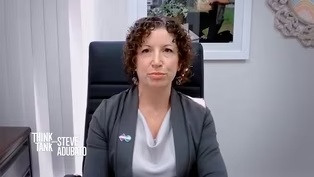
How Table to Table's food rescue combats food insecurity
Video has Closed Captions
How Table to Table's food rescue combats food insecurity (9m 9s)
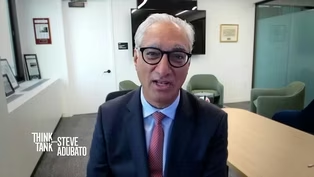
Lessons and efforts from the FIFA World Cup w/ Kris Kolluri
Video has Closed Captions
Lessons and efforts from the FIFA World Cup w/ Kris Kolluri (9m 39s)
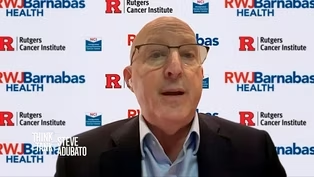
Melchiorre Cancer Center: expanding cancer care in NJ
Video has Closed Captions
Melchiorre Cancer Center: expanding cancer care in NJ (9m 3s)
Providing Support for PBS.org
Learn Moreabout PBS online sponsorship New Episode
- News and Public Affairs

Top journalists deliver compelling original analysis of the hour's headlines.
 New Episode
- News and Public Affairs

Today's top journalists discuss Washington's current political events and public affairs.




 New Episode
 New Episode
 New Episode

 New Episode
 New Episode
Support for PBS provided by:
Think Tank with Steve Adubato is a local public television program presented by NJ PBS