
Helping Refugees Become Entrepreneurs
Clip: Season 3 Episode 157 | 3m 37sVideo has Closed Captions
The Village Childcare Project is helping refugees open family childcare businesses.
The city of Louisville is working with the immigrant and refugee-focused non-profit See Forward Ministries to support economic development, women entrepreneurships, and childcare. Through the Village Childcare Project, women in those communities are opening family childcare businesses.
Problems playing video? | Closed Captioning Feedback
Problems playing video? | Closed Captioning Feedback
Kentucky Edition is a local public television program presented by KET
Helping Refugees Become Entrepreneurs
Clip: Season 3 Episode 157 | 3m 37sVideo has Closed Captions
The city of Louisville is working with the immigrant and refugee-focused non-profit See Forward Ministries to support economic development, women entrepreneurships, and childcare. Through the Village Childcare Project, women in those communities are opening family childcare businesses.
Problems playing video? | Closed Captioning Feedback
How to Watch Kentucky Edition
Kentucky Edition is available to stream on pbs.org and the free PBS App, available on iPhone, Apple TV, Android TV, Android smartphones, Amazon Fire TV, Amazon Fire Tablet, Roku, Samsung Smart TV, and Vizio.
Providing Support for PBS.org
Learn Moreabout PBS online sponsorshipThe city of Louisville is working with the immigrant and refugee focused nonprofit See Forward Ministries to support economic development, Women, entrepreneurship and child care through the Village Childcare Project.
Women in those communities are opening feminine opening family childcare, businesses.
So we all know across the state of Kentucky and especially in Louisville, that child care and lack of child care is a big issue for everyone.
And we also know that some women in the community, including immigrant and refugee women, may also face additional barriers of language and culture and just not understanding that bureaucracy in order to open up businesses or to get employment.
So this project really is an example of a strategy of investing in women deeply, narrowly, but deeply investing in a group of immigrant and refugee women to remove those barriers of language and just the confusion that can exist when you try to open up a business, but then allow more women in the community and men to go to work because now they have increased childcare options.
That means these women can take care of these kids in their own languages.
They don't have to learn English.
They don't have to do all these things.
So when they came with that proposal, I'm like, This is a perfect timing.
So we can help these women also be self-sufficient.
They can open something in their homes and they don't have to be waiting for someone else to come and do it for them so they can also help in other ways on the high.
I didn't know they had to actually get going, but yeah, so she's there to help someone to go work and then she can take care of that for that child so they can go to work.
There are 18 family childcare homes that have been opened as a result of this grant and this project summer, what are called certified homes somewhere are registered homes.
And the main thing that that means is that those homes can receive child care subsidies.
So people coming to seek their services can use federal child care subsidies.
Prior to that happening, maybe some of these women were doing were doing childcare, but they were not able to receive those those benefits and those subsidies.
And so we as a as a city were leaving those federal dollars on the table, and now we're drawing those down.
And you're empowering people and you're allowing more people to to go to work.
This program is really empower them to where they're able to express themselves.
And also they don't have to worry about how to pass a class, how to do all these things.
They don't need to worry about all those other barriers that everyone has to have, which is good for people who wants to further their education.
We encourage them to do that.
But if they cannot, they're not able to do that.
They're also able to they can contribute to something, to do something in the society.
And this is something that they can it can it is close to the American dream.
They also getting some income coming in, helping the family as well.
We believe that when you have strong, healthy women, communities thrive.
And that is a strategy that's used worldwide that you invest in women and your dollars are evidence shows they're more likely to go back into communities and be developing education and health and well-being.
They go further.
So when you invest in women, it goes further for a community.
Every business owner is able to provide childcare for up to ten children.
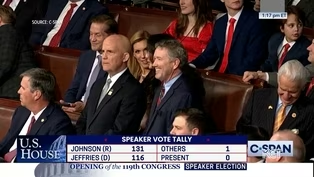
Massie Sole Republican to Vote Against Johnson
Video has Closed Captions
Clip: S3 Ep157 | 8m 45s | Rep. Mike Johnson was reelected Speaker of the House by the narrowest of margins. (8m 45s)

Police Union Wants Louisville's Consent Decree Denied
Video has Closed Captions
Clip: S3 Ep157 | 3m 1s | The union says it wasn't at the table and now wants a federal judge to intervene. (3m 1s)

Winter Storm Takes Aim at Kentucky
Video has Closed Captions
Clip: S3 Ep157 | 4m 18s | A winter storm is expected to bring snow, ice, and freezing rain to parts of Kentucky. (4m 18s)
Providing Support for PBS.org
Learn Moreabout PBS online sponsorship
- News and Public Affairs

Top journalists deliver compelling original analysis of the hour's headlines.

- News and Public Affairs

FRONTLINE is investigative journalism that questions, explains and changes our world.












Support for PBS provided by:
Kentucky Edition is a local public television program presented by KET