
Helping Students Navigate the Perils of Paying for College
Clip: Season 5 Episode 74 | 3m 39sVideo has Closed Captions
Western Kentucky University program gives student affordable college options.
It's October, the month of all things spooky, and one thing that can certainly be scary - the cost of college. Our Laura Rogers talks support for students at Western Kentucky University.
Problems playing video? | Closed Captioning Feedback
Problems playing video? | Closed Captioning Feedback
Kentucky Edition is a local public television program presented by KET
Helping Students Navigate the Perils of Paying for College
Clip: Season 5 Episode 74 | 3m 39sVideo has Closed Captions
It's October, the month of all things spooky, and one thing that can certainly be scary - the cost of college. Our Laura Rogers talks support for students at Western Kentucky University.
Problems playing video? | Closed Captioning Feedback
Where to Watch Kentucky Edition
Kentucky Edition is available to stream on pbs.org and the PBS app.
Providing Support for PBS.org
Learn Moreabout PBS online sponsorshipIt's October, the month of all things spooky.
And one thing can be certainly scary.
The cost of college.
A larger conversation on that topic still to come this evening.
But first, a preview as our Laura Rogers talks support for students at Western Kentucky University.
This is my heart as glass.
Jamison McPherson is a graduate student in his fifth year at Western Kentucky University studying applied economics.
I really do feel like I have a leg up.
I mean, I'm getting noticed in job interviews and getting callbacks.
He plans to work in public policy or corporate finance, but there was a time McPherson was unsure he'd be able to attend college at all.
My dad, he didn't graduate high school.
So growing up, when your mom's at home and your dad is working like a factory job, it is kind of tough.
He saw its guidance and support through trio programs at W.K., including Educational Opportunity Centers, where he connected with Bethany Smith.
She really does just go above and beyond for her students.
It inspired my thesis, actually, the effectiveness of the program.
I want students to.
Smith has helped students afford college for more than two decades.
I wanted to be able to help students like myself who were first in low income.
A UK alumnus from Eastern Kentucky.
She first attended community college.
I had a great mentor at the community college that knew how to, like, get scholarships, what to do.
Today, she's that mentor for students like Jamison McPherson, helping them get free money for college and offering advice on options like student loans.
And I'm a firm believer that student loan debt is okay as long as you don't maximize it and only use what you have to use.
She says the thought of borrowing money may deter some students from pursuing college at all, but that shouldn't be the case if you're really committed to getting that degree.
I would rather you borrow a little bit and be able to complete than borrow nothing and not go at all.
My goal when I work with students is that if we're going to borrow a penny, we're going to finish this degree.
But much of her focus is on the money.
Students don't have to pay back.
Like scholarships and grants, there's big scholarships.
There's local scholarships.
It's just about applying and applying and applying and applying.
Smith suggests students apply for one scholarship a week.
Making a spreadsheet with due dates to stay organized.
Where else are you going to get $2,500 for one hour a week?
You got a $2,500 scholarship that's renewable for four years.
That's a lot of money that didn't take them that much time to give her advice for parents communication.
Take time to talk with your teenager.
You really need to have conversations with your children about what are your plans?
Where do you plan to go?
And for students, write your own scholarship essay instead of having a parent or artificial intelligence do it.
It needs to be your words, and it needs to be your story.
And it needs to tug at the heart strings of that person reading.
Why do you need this money or what?
What are you going to do to impact the world when you graduate?
She also suggests filling out the Fafsa, the application for Federal Student Aid, even if you don't think you'll qualify.
You don't know what's going to happen tomorrow.
Every summer I help somebody whose parent has passed away over the summer.
It's not what you think is going to happen.
Nobody expects that to happen.
But it could happen.
When obstacles do arise already, having the Fafsa completed saves time and stress down the road.
What?
A lot of people don't get it.
If you can't pay for, you can't pay for it.
You can't go to school if that bill isn't covered.
McPherson has weathered setbacks and challenges with his financial aid.
I've put a lot of time, thought and stress into my financial situation while in college.
But is now set to graduate in December with a masters degree for Kentucky edition.
I'm Laura Rogers.
 New
NewGroup Celebrates 15 Years of Supporting Women Entrepreneurs
Video has Closed Captions
Clip: S5 Ep74 | 6m 54s | Women's Business Center of Kentucky celebrates 15-year anniversary. (6m 54s)
 New
NewKentucky Marks Indigenous Peoples' Day, Reexamines History
Video has Closed Captions
Clip: S5 Ep74 | 3m 54s | Kentucky marks Indigenous Peoples' Day with Focus on history, Columbus myths. (3m 54s)
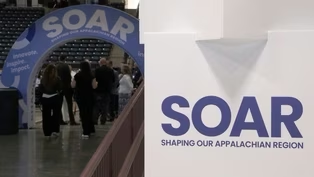 New
NewSOAR Summit Brings Together Eastern Kentucky Leaders
Video has Closed Captions
Clip: S5 Ep74 | 3m 20s | SOAR Summit highlights economic opportunities in Eastern Kentucky. (3m 20s)
Providing Support for PBS.org
Learn Moreabout PBS online sponsorship New Episode
- News and Public Affairs

Top journalists deliver compelling original analysis of the hour's headlines.
 New Episode
- News and Public Affairs

Today's top journalists discuss Washington's current political events and public affairs.

 New Episode
 New Episode
 New Episode
 New Episode


 New Episode
 New Episode

Support for PBS provided by:
Kentucky Edition is a local public television program presented by KET