
Henry David Thoreau and Transcendentalism
Clip: Episode 1 | 5m 9sVideo has Closed Captions
Thoreau is introduced to Ralph Waldo Emerson and the radical ideas of transcendentalism.
After graduating from Harvard Divinity School, Henry David Thoreau is introduced to an electrifying new social movement: transcendentalism. Transcendentalism is the first youth movement in American history, and it boils down to one simple, but powerful idea: that there is a spark of divinity within everyone, including enslaved people. This idea calls the entirety of American society into question.
From
Problems playing video? | Closed Captioning Feedback
Problems playing video? | Closed Captioning Feedback
Episodes presented in 4K UHD on supported devices. Major funding for HENRY DAVID THOREAU was provided by The Better Angels Society and its members: The Keith Campbell Foundation for the...
Henry David Thoreau and Transcendentalism
Clip: Episode 1 | 5m 9sVideo has Closed Captions
After graduating from Harvard Divinity School, Henry David Thoreau is introduced to an electrifying new social movement: transcendentalism. Transcendentalism is the first youth movement in American history, and it boils down to one simple, but powerful idea: that there is a spark of divinity within everyone, including enslaved people. This idea calls the entirety of American society into question.
From
Problems playing video? | Closed Captioning Feedback
How to Watch Henry David Thoreau
Henry David Thoreau is available to stream on pbs.org and the free PBS App, available on iPhone, Apple TV, Android TV, Android smartphones, Amazon Fire TV, Amazon Fire Tablet, Roku, Samsung Smart TV, and Vizio.
[Bells ringing] Thoreau graduated from Harvard College on August 30, 1837.
It was a time of significant change.
♪ Political issues, particularly slavery, were dividing states, communities, and even families.
The Industrial Revolution and the westward expansion of the country were reshaping the lives of many Americans.
Those in the younger generation often had to choose between settling further west, where farmland was more plentiful, or moving into the cities to work in factories.
Robert A. Gross: This is a generation for whom there's no single clear path to follow.
There's not enough land in Concord anymore for most farmers to set up their kids.
Bill McKibben: Mills going up everywhere up and down Massachusetts and New Hampshire, people streaming off the farm to work in those factories, being forced into worlds that they did not understand and were not suited for them.
Thoreau understood what it would mean to the human spirit.
♪ Narrator: In his senior year, Henry had read a book called "Nature" written by a 34-year-old philosopher and fellow citizen of Concord named Ralph Waldo Emerson.
In it, he spelled out an entirely new and radical approach to life.
♪ Ralph Waldo Emerson: The foregoing generations beheld God and nature face to face.
Why should not we also enjoy an original relation to the universe?
Why should not we have a poetry and philosophy of insight and not of tradition, and a religion by revelation to us, and not the history of theirs?
There are new lands, new men, new thoughts.
Let us demand our own works and laws and worship.
Narrator: Emerson had graduated from Harvard Divinity School and later served as a minister in Boston.
He then left the church for a new kind of ministry, an electrifying, spiritual, philosophical, and social movement that was attracting reformers and intellectuals dissatisfied with society's values.
It was called transcendentalism.
Lawrence Buell: Transcendentalism is the first youth movement in American history.
It was a reform movement to incinerate orthodoxies and rebuild from the idea that the individual genius trumped received wisdom.
That was music to Thoreau's ears.
Laura Dassow Walls: Transcendentalism boils down to one very simple but very powerful idea-- that there is a spark of divinity within absolutely every single human being.
[Birds chirping] That means every person who is enslaved, you are enslaving part and particle of God.
Every woman who doesn't have full human rights, every child that you're depriving of an education, you're depriving that spark from developing.
Rochelle L. Johnson: They're questioning religion, education, politics.
They're asking questions about labor and freedom and enslavement.
They're questioning the entire grounds of society.
That's pretty radical.
Narrator: Emerson's book "Nature" had established him as the leader of this new movement.
Henry, now 20 years old, became his protege.
"I delight much in my young friend," Emerson wrote, "who seems to have as free and erect a mind as any I've ever met."
Ralph Waldo Emerson: Brave Henry is content to live now and feels no shame in not studying any profession, for he does not postpone his life, but lives already, and pours contempt on these crybabies of routine and Boston.
Narrator: Emerson saw Thoreau's potential as a writer and encouraged him, asking, "What are you doing now?
Do you keep a journal?"
On October 22, 1837, Thoreau wrote, "I make my first entry today."
Laura Dassow Walls: His journal was meant to catch the flow of thoughts, of observations, and take that little emergent flame of whatever little spark is there and just explore it.
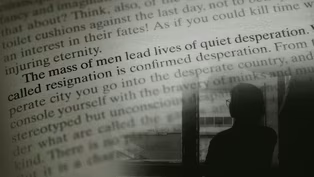 New
NewAn Introduction to the Words and Life of Henry David Thoreau
Video has Closed Captions
Clip: Ep1 | 8m 20s | Henry David Thoreau spent his life experimenting and contemplating on how to live a good life. (8m 20s)
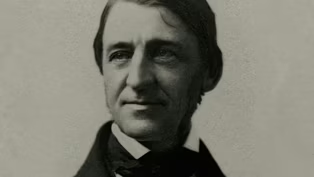 New
NewRalph Waldo Emerson's Mentorship of Henry David Thoreau
Video has Closed Captions
Clip: Ep1 | 9m 9s | Thoreau moves in with Ralph Waldo Emerson's family, but personal tragedy strikes both families. (9m 9s)
Providing Support for PBS.org
Learn Moreabout PBS online sponsorship










Support for PBS provided by:
Episodes presented in 4K UHD on supported devices. Major funding for HENRY DAVID THOREAU was provided by The Better Angels Society and its members: The Keith Campbell Foundation for the...