
Henry David Thoreau Moves to Walden Pond
Clip: Episode 2 | 11m 14sVideo has Closed Captions
On July 4th, 1845, Henry David Thoreau moves into a 10x15-foot house on Walden Pond.
On July 4th, 1845, Henry David Thoreau moves into a 10x15-foot house on the northern shore of Walden Pond. He fills his days tending to his garden, walking in the woods, and most of all, writing. He takes detailed notes on the nature that surrounds him and studies Greek, Roman, and Buddhist literature. But, Thoreau also practices doing nothing and seeing the beauty in staying still.
From
Problems playing video? | Closed Captioning Feedback
Problems playing video? | Closed Captioning Feedback
Episodes presented in 4K UHD on supported devices. Major funding for HENRY DAVID THOREAU was provided by The Better Angels Society and its members: The Keith Campbell Foundation for the...
Henry David Thoreau Moves to Walden Pond
Clip: Episode 2 | 11m 14sVideo has Closed Captions
On July 4th, 1845, Henry David Thoreau moves into a 10x15-foot house on the northern shore of Walden Pond. He fills his days tending to his garden, walking in the woods, and most of all, writing. He takes detailed notes on the nature that surrounds him and studies Greek, Roman, and Buddhist literature. But, Thoreau also practices doing nothing and seeing the beauty in staying still.
From
Problems playing video? | Closed Captioning Feedback
How to Watch Henry David Thoreau
Henry David Thoreau is available to stream on pbs.org and the free PBS App, available on iPhone, Apple TV, Android TV, Android smartphones, Amazon Fire TV, Amazon Fire Tablet, Roku, Samsung Smart TV, and Vizio.
[Insects calling, birds chirping] Henry David Thoreau: July 5, 1845.
Yesterday I came here to live.
[Wind blowing, birds chirping] Narrator: On July 4, 1845, Henry David Thoreau moved into a 10-by-15-foot house on the northern shore of Walden Pond.
He had built most of it himself, cutting down trees to make a post and beam frame, which friends helped him raise.
He then attached siding from a shanty he had purchased from an Irish railroad worker, hauled up rocks from the pond for a chimney, and dug a root cellar.
He moved in, bringing along his cane bed, green writing desk, a small table, and three chairs: "One for solitude," he said, "two for friendship," and "three for society."
Some people called it a "lonely hut" and a "wooden inkstand."
For Henry, it was home.
Henry David Thoreau: My dwelling was small, and I could hardly entertain an echo in it.
It was kitchen, chamber, parlor, and keeping-room; I enjoyed it all.
[Thunder] [Rain] July 6th.
I wish to meet the facts of life-- the vital facts, which are the phenomena or actuality the gods meant to show us.
Life!
Who knows what it is, what it does?
♪ July 7th.
Tonight as I sit by my door, I hear the far off lowing of a cow.
[Cow mooing] Why should I find anything to welcome me in such a nook as this?
[Train whistle blowing] After the evening train has gone by and left the world to silence, and to me, the Whippoorwill chants her vespers for half an hour-- and when all is still at night, the owls take up the strain like mourning women their ancient ululu.
[Birds calling] Narrator: On most mornings, Henry got up at dawn to tend to his vegetable garden, including row after row of beans-- an endless task, only made harder by the woodchucks that dined on the shoots.
Henry David Thoreau: Every morning was a cheerful invitation to make my life of equal simplicity, and I may say innocence, with Nature herself.
I got up early and bathed in the pond; that was a religious exercise, and one of the best things which I did.
"Renew thyself completely each day."
Lawrence Buell: His morning bath he describes as a "religious exercise," not just as some sort of random dunk that he took in the pond, but as a sort of ritual act that has suddenly a significance beyond itself.
Clay Jenkinson: Thoreau also said, "I needed to clean the house, so I took all the furniture out," and "the furniture was happy to have a little excursion into nature."
He said, "I almost regretted having to bring it back in."
Michael Pollan: He waited till November to plaster his house, and before that, there were all these cracks, where, you know, animals came in, bugs came in, and the air came in.
And he loved that.
Narrator: In the afternoon, he often took long walks and made detailed field notes of everything he heard and saw-- a practice he would continue for the rest of his life.
♪ Laura Dassow Walls: Walking was a writing practice, a process of taking notes that would become the content of his journals, as inspiration or a spark to turn it into a kind of larger mythology.
Kristen Case: What he observed fed what he would write about, but what he wrote about would also lead him deeper back into observation.
♪ Narrator: Thoreau filled page after page of his journal with reflections on nature and the human condition, often referencing Greek and Roman literature, as well as ancient Eastern texts like the "Bhagavad Gita" and Buddhist sutras.
Rebecca Kneale Gould: He's saying, "All of these texts and traditions have something to teach me."
Thoreau's taking his own experience, and he's elevating it.
Pico Iyer: The vision of simplicity had been explored in Hinduism, Islam, Buddhism.
But in Concord in 1845, I think it was something radical and liberating.
So whether he knew those works or not, he inwardly rhymed with them.
♪ Narrator: Thoreau would find a way to incorporate many of these ancient teachings into the project he went there to write: a book about the trip he took on the Concord and Merrimack Rivers with his late brother John.
♪ Kristen Case: He strengthened and oriented himself in writing.
Writing was a way of being alive that was deeply nourishing to him.
♪ Henry David Thoreau: I am convinced that to maintain one's self on this earth is not a hardship but a pastime, if we will live simply and wisely.
Narrator: Throughout his stay at Walden Pond, Henry kept meticulous track of his finances.
He needed to spend money on seed and other garden expenses, but he actually made money selling his produce.
It cost him less than $20 to live there for the first six months.
Henry David Thoreau: The cost of a thing is the amount of what I will call life, which is required to be exchanged for it.
Michael Pollan: His goal is to remind us how much energy it takes, how much work it takes to make a living.
But why are you making a living?
Well, to buy these things.
Well, why do you need these things?
Henrik Otterberg: His focus was on, "How much do I have to work to secure my sustenance so that I can do what I really want to do?"
Henry David Thoreau: Our life is frittered away by detail.
Let your affairs be as two or three, and not a hundred or a thousand.
Simplify!
Simplify!
I went to the woods because I wished to live deliberately, to front only the essential facts of life, and see if I could not learn what it had to teach, and not, when I came to die, discover that I had not lived.
[Indistinct conversations] Michael Pollan: We all get lost in the challenges of everyday life.
And our world has been set up to help you do that.
As I understand it, the root of "deliberate" is from "freedom."
And it's to do something because you choose to, not because fate dictates it.
Narrator: On some days, he simply chose to do nothing.
♪ Henry David Thoreau: There were times when I could not afford to sacrifice the bloom of the present moment to any work, whether of the head or hands.
Sometimes, having taken my accustomed bath, I sat in my sunny doorway from sunrise till noon, rapt in a revery, amidst the pines and hickories and sumachs, in undisturbed solitude and stillness, while the birds sang around or flitted noiseless through the house, until by the sun falling in at my west window, or the noise of some traveller's wagon on the distant highway, I was reminded of the lapse of time.
I grew in those seasons like corn in the night, and they were far better than any work of the hands would have been.
Pico Iyer: He practiced doing nothing, which can be the hardest thing of all for many of us.
He saw the beauty of sitting still, and he knew that if he just sat by his pond reflecting, in every sense of that word, he could find everything he needed.
Clay Jenkinson: He says that one of his job descriptions is to know the nick of time, to be able to notch it on his stick.
He wants to be present.
He gets down and on the ground to look at the battle of the black ants and the red ants.
At the pond, he goes into the shallows and he finds a way to pet fish.
Try that sometime.
You have to surrender to nature and nature's rhythms if you want to be whole.
And you will see things you never saw before.
And what you see will mean more than it ever did.
♪ Henry David Thoreau: What sweet and tender, the most innocent and divinely encouraging society there is in universal nature.
There can be no really black melancholy to him who lives in the midst of nature and has still his senses.
While I enjoy the sweet friend-ship of the seasons, I trust that nothing can make life a burden to me.
Here I know I am in good company.
 New
NewJourney to Mount Katahdin and Untamable Nature
Video has Closed Captions
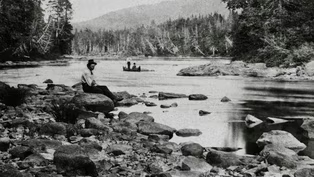
Clip: Ep2 | 9m 22s | Leaving Walden Pond, Thoreau joins his cousin on an excursion to Mount Katahdin in Maine. (9m 22s)
 New
NewThoreau Challenges Justice with His Essay "Civil Disobedience"
Video has Closed Captions
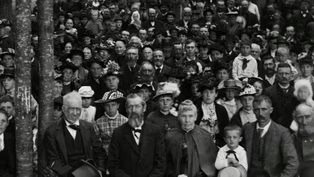
Clip: Ep2 | 7m 14s | Thoreau's refusal to support what he saw as injustice culminates in his essay "Civil Disobedience." (7m 14s)
 New
NewThoreau Tells the Stories of the Black Community in Concord
Video has Closed Captions
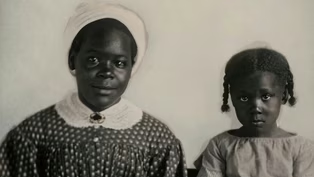
Clip: Ep2 | 5m 50s | While slavery is illegal in Massachusetts, Black communities are forced to the margins of society. (5m 50s)
Providing Support for PBS.org
Learn Moreabout PBS online sponsorship













Support for PBS provided by:
Episodes presented in 4K UHD on supported devices. Major funding for HENRY DAVID THOREAU was provided by The Better Angels Society and its members: The Keith Campbell Foundation for the...