
Henry Ford Health System COVID-19 Memorial/Leonard Slatkin
Season 5 Episode 36 | 26m 46sVideo has Closed Captions
Henry Ford Health System COVID-19 Memorial/Leonard Slatkin | Episode 536
In understanding the role art has in healing, Henry Ford Health System has been creating initiatives to provide direct emotional support for team members throughout the COVID-19 pandemic. WRCJ’s Peter Whorf interviews the Detroit Symphony Orchestra’s Music Director Laureate, Leonard Slatkin. A story of displacement and resettlement. Episode 536
Problems playing video? | Closed Captioning Feedback
Problems playing video? | Closed Captioning Feedback
One Detroit is a local public television program presented by Detroit PBS
Henry Ford Health System COVID-19 Memorial/Leonard Slatkin
Season 5 Episode 36 | 26m 46sVideo has Closed Captions
In understanding the role art has in healing, Henry Ford Health System has been creating initiatives to provide direct emotional support for team members throughout the COVID-19 pandemic. WRCJ’s Peter Whorf interviews the Detroit Symphony Orchestra’s Music Director Laureate, Leonard Slatkin. A story of displacement and resettlement. Episode 536
Problems playing video? | Closed Captioning Feedback
How to Watch One Detroit
One Detroit is available to stream on pbs.org and the free PBS App, available on iPhone, Apple TV, Android TV, Android smartphones, Amazon Fire TV, Amazon Fire Tablet, Roku, Samsung Smart TV, and Vizio.
Providing Support for PBS.org
Learn Moreabout PBS online sponsorship- Hi, I'm Christy McDonald, and here's what's coming up this week on One Detroit Arts and Culture.
Henry Ford Health System honors its team members through art for their part in fighting the COVID-19 pandemic.
Plus the words of legendary music director, Leonard Slatkin.
And then exploring the Japanese-American experience here in Detroit.
It's all just ahead on One Detroit Arts and Culture.
- [Narrator 1] From Delta faucets to Behr paint, Masco Corporation is proud to deliver products that enhance the way consumers all over the world experience and enjoy their living spaces.
Masco.
Serving Michigan communities since 1929.
- [Narrator 2] Support for this program is provided by: The Cynthia & Edsel Ford Fund for Journalism at Detroit Public TV, The Kresge Foundation, Community Foundation for Southeast Michigan.
- [Narrator 3] The DTE Foundation is a proud sponsor of Detroit Public TV, among the state's largest foundations committed to Michigan-focused giving.
We support organizations that are doing exceptional work in our state.
Visit DTEfoundation.com to learn more.
- [Narrator 4] Business Leaders for Michigan.
Dedicate to making Michigan a top 10 state for jobs, personal income, and a healthy economy.
Also brought to you by: The Fred A. and Barbara M. Erb Family Foundation and viewers like you.
(gentle upbeat music) - Hi there and welcome to One Detroit Arts and Culture.
I'm Christy McDonald.
Thanks so much for being with me as we continue to showcase all the Detroit Arts and Culture scene has to offer.
Coming up: Henry Ford Health System and their ongoing efforts to provide emotional support for team members.
And they're doing it in an artistic way.
Then, Detroit Symphony Orchestra Music Director Laureate, Leonard Slatkin, and his new book.
Plus, learning what Japanese Americans had to endure on their way to a life here in Metro Detroit.
It's all coming up this week on One Detroit Arts and Culture.
Let's kick things off with the role that art has in healing.
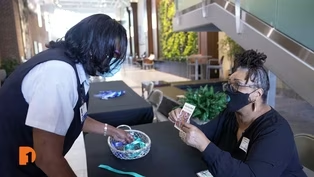
The Henry Ford Health System has created initiatives to provide direct emotional support for team members throughout the COVID-19 pandemic.
And this month they're unveiling custom art pieces, reflecting and celebrating the diversity of its team members and their unique experiences through this trying time.
Take a look as we hear from some of the artists and Henry Ford Health System CEO, Wright Lassiter III.
- [Wright] You know, for me and for our organization, we clearly understand that art is synonymous with healing.
And so when you look around Henry Ford facilities, you see expressions of art in every facility.
This project for us of unveiling art pieces across our system is a way to say to our team members, we thank you for your service and sacrifice.
It's a way to say to the community, we honor those who we've lost during this time.
And we also say to the community, we honor those who's lives we have touched and saved during the same time.
- Everybody in every walk of life, all of the people that cared for the people that were sick throughout all of this COVID.
I watched, and I watched all the medical people that I know and how they reacted and what they did.
And they all moved forward.
I hope when people see this finished piece of art on the wall, I hope that they will see themselves in it.
They will see in the reflection themselves, but they will also see in the movement and the way all the people, the wide variety of the population, moves together towards whatever's coming.
- Art is also a way to connect to the community you serve.
And so one of the things has been very important to Henry Ford is not only to have great art that helps in the healing process, but to have art that comes from the communities that we serve, so that we have an ability to embody the fabric of the community that we're trying to help be and stay healthier.
- Each ribbon represents a life.
So when people observe the piece, what I want them to do is recognize and celebrate, really, these people's lives, as they look at the piece.
And reflect upon that.
- Art transforms, art inspires and art uplifts.
And so I'm hopeful for our organization that it will do all of those things for the team members that sees all these amazing projects across our system.
- For more on the Henry Ford Health System Healing Arts program, just head to our website at onedetroitpbs.org.
All right, let's turn now to the music world.
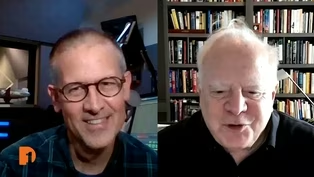
WRCJ's Peter Wharf talks with the Detroit Symphony Orchestra's Music Director Laureate, Leonard Slatkin, about his book, Classical Crossroads, The Path Forward for Music in the 21st Century.
(orchestra music) - Maestro Leonard Slatkin is Music Director Laureate of the Detroit Symphony Orchestra.
His latest book is called Classical Crossroads, and is rich in stories from Maestro Slatkin's early musical life until the present.
And I wanted to ask you a little bit about chapter, about page 24, where you say, "In fact, the facility in which the ensemble performs is the instrument of the group."
Can you kind of, in a nutshell, describe the Detroit Symphony Orchestra's instrument?
- Sure.
What I meant by the phrase is really quite simple.
Violinist has their violin, trumpet has their trumpet.
They're the instruments that they play.
They learn to adjust to the quirks and strengths of that particular instrument, and orchestras do the same thing with their halls.
A great orchestra can actually have a hall, which may be less than what some people would consider ideal.
Detroit has been very, very fortunate to have one of the great halls, not just of the country, but of the world.
The size is just right, between 1700, 1800 people.
The decay time, meaning the sound that reverberates seems just about right.
The players can hear each other very well on the stage.
These are all qualities that you look for with your orchestra.
And to that end, it made it, at least during my time, really perfect for me, because I could emphasize the incredible sound that came out of the string section.
(orchestra playing) The brass never really overwhelmed the rest of the orchestra.
They learned that over-blowing in orchestra hall was just not what one does.
So that's what I mean by, a kind of adjustment one has to make.
(orchestra music) Also, it's important to know that because its stage is a little bit smaller than some other halls, and the sound more focused, the Detroit Symphony didn't need to have quite as many members as some other orchestras do.
- So cool to hear some of the earlier stories that you tell too, about your life in LA and the meaning that LA high school had for you.
- [Leonard] When I was in high school, I was in the band, as well as the orchestra.
In band I played the glockenspiel and timpani and whatever I could.
And the reason for this, it's a horrible reason and I shouldn't admit it but I will, in the 1950s, early 1960s, at my public high school, LA High, if you were in the band, you didn't have to go to phys ed classes.
I don't know why they thought we were that athletic out there.
And just because I would lead one line down the 45, and then make a left, go five yards, it was the tip of the L in LA, I don't think qualified me to be excused from climbing ropes and stuff, but I took it.
And more to the point, after football season was over, I don't think the administration realized we weren't outdoors anymore.
We just became a concert band, and we still didn't have to go and do pushups.
- Studying at Julliard with French conductor, John Morrell, and then a time as Music Director in Leone, what does it mean to you to be a part of Detroit's French heritage, Paul Paray included?
- It meant an awful lot.
When I came to Detroit, you know, we had these festivals, that one case, we played all the symphonies of Beethoven, and there was every orchestral work by Brahms and Tchaikovsky cycle.
But then we veered away from the composer aspect and went to a different area.
And one of the festivals was a French festival, where we were able to play music by Hector Berlioz, along with Camille Saint-Saëns, and so many others.
- You devote much of the later section, "Road to Recovery" to your perspective on music in the COVID times.
How does it feel to know that you're coming back to Detroit to play at one of your former home bases?
- [Leonard] Well, not only am I coming back, but it was an important place, because the last thing I did before COVID shut us down was in Detroit.
It was a dress rehearsal for Carmina Burana.
And when I think about it, I realized if that was going to be the last piece I ever conducted, I would not be happy at all.
So you're not doing your job at a hundred percent.
You're trying to, but it is just not quite the same thing.
For me, coming back to Detroit, should be very exciting.
It's a terrific program, difficult, but one which the orchestra I know will handle, as they always do, with great musicianship and professionalism.
- So many great stories in Maestro Leonard Slatkin's newest book, Classical Crossroads.
Highly recommend.
Maestro Slatkin, thanks so much for taking the time to speak with us.
- Thank you very much.
Take care of yourself.
(orchestra music) - For more on Leonard Slatkin and the Detroit Symphony Orchestra, just go to our website at onedetroitpbs.org.
Next is a story of displacement and resettlement.
Japanese Americans were sent to incarceration camps during World War II.
Their choices were limited.
Stay in the camps with the people they know, or head east and start new lives in places they'd never imagined.
One Detroit's Bill Kubota knows something about that.
His parents came here right after the war.
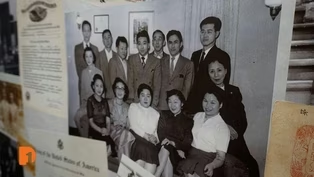
He takes a look into the exhibition that showed at the Detroit Historical Museum called "Exiled to Motown," and explores the journey.
- [Bill] An exhibit at the Detroit Historical Museum, "Exiled to Motown," presented by the Japanese American Citizens League.
- I wanted to get involved and support in whatever way I could, because I knew that it meant a lot to my family, but also to the broader community.
And I felt like it was a really important opportunity to delve into these histories in a way that felt accessible to us.
- [Bill] Celeste Goedert's great grandfather Tadae Shimoura, one of the first Japanese here in 1919, he knocked on the Henry Ford's door.
Got hired as a company chemist.
Shimoura's friend, James Hirata, worked for Ford too.
When Diego Rivera painted the Detroit Institute of Arts mural in the early '30s, Hirata was part of it.
But it would be the 1940s, the mass relocation that brought a lot more Japanese Americans to Detroit.
- The incarceration in Japanese American history writ large often feels not only like a coastal story, but like a Pacific Coast story.
And what I learned in coming here is that there is a very kind of vitally important part of that history that is kind of embedded and integral to the Midwest.
- [Bill] Most came during and after the war.
John Okada wrote "No-No Boy" here, considered the first great Asian American novel.
Larry Shinoda helped create the Corvette Stingray and Boss 302 Mustang.
(old-timey radio ad playing) Minoru Yamasaki designed the One Woodward building downtown, and later, the Twin Towers in New York.
They were a nisei, U.S.-born Americans.
Ni as in two, second generation.
- And the way that Japanese Americans count generations, we start the first generation as the first generation in the United States.
Not necessarily born in the United States.
So my great grandparents came to this country as issei.
- Issei.
I as in ichi, one.
San, three.
Sansei, third generation.
That's me.
- Usually I say I'm yonsei, or fourth generation Japanese American.
- [Bill] The wave of Japanese immigrants came at the turn of the last century, mostly to the west coast.
- [Radio Host] Consider the record of the Japanese people in America.
It's something to be proud of, making the Western deserts into some of the most productive lands in the world.
- [Bill] Then the incarceration and resettlement that's defined Japanese Americans to this day.
- [Radio Host] "The Way Ahead," where does it lead?
That's what this young couple is wondering.
Their life together lies in front of them.
- And resettlement is something that actually began as early as 1943, where the U.S. government was looking for places that they could relocate Japanese Americans to, out of these incarceration camps, without returning to what was then termed the Western Exclusion Zone.
- [Radio Host] Your friends, as they board the bus to leave the center, are going to new experiences and to a better way of living.
- [Bill] Many hundreds came here, you could say, exiled to Motown.
On display, artifacts of displacement, heirlooms from the old country, the new country, things crafted in the camps, items saved by Goedert's great aunt Toshi Shimoura.
- It is believed by some of my family members that this is the very suitcase, and actually the only piece of luggage at all, that Toshi was able to carry out of Topaz Incarceration Camp in Utah.
- I was born in Stockton, California, and I was 11 when we got put into camp.
- [Bill] Mary Kamidoi told One Detroit her story at a gathering before the pandemic, her family sent to a camp in Arkansas.
- [Mary] Our family and 12 others were the last people to leave the camps.
And these people didn't have a place to go to either.
So we ended out in Missouri, and talk about discrimination.
- [Bill] Kamidoi and her sister came to Detroit, both working in an office at Ford Motor Company.
- When I went to Ford, I had to go to the general manager because everybody was so discriminating against me and my sister.
And they didn't trust us.
Every time we got up from our desk, somebody followed us.
So one day the stupid jerk that did it all the time to me, I went to the ladies room and he had to go around the corner to go to the men's room.
I said, "Here, this is where I'm going into.
You want to come in here?"
"No, no, no."
And I said, "Well stop following me."
- [Bill] The headline: "Transplanted Nisei Find City Kind & Considerate."
But Mary Kamidoi was deterred from buying a house in Dearborn.
So she rented one on Grand Boulevard next to Hitsville, USA.
- So on one hand, we had Japanese Americans who were being touted as these model newcomers to the city, who are going to contribute to the society of Detroit.
But also had these instances where they were prohibited from buying property or from living in certain neighborhoods.
- [Bill] The curators see the resettlement curiously deliberate.
Many came from tight knit communities, places like Little Tokyo in Los Angeles.
Here, they'd spread out across Metro Detroit.
- If they intermingled with the Midwest, which here is coded as being kind of the white Midwest, then there would be no Japanese American community to kind of feel threatened by.
- They were really, really trying to strategize and craft a way that Japanese Americans would assimilate and not talk to each other.
- [Bill] An article tells how they found success.
To the curators it seems to imply it's because of their inherent racial qualities that others who've come to Detroit might not have.
- It's like watching the Model Minority Myth being crafted before your eyes.
- [Bill] Another headline, "Set to Stay."
But many would return to the west coast in the decades since.
The 1980s, more history, with Japan blamed for the demise of the U.S. auto industry, a concern for all Asian Americans around here.
- You know how they killed my son.
They all pulled in, the son hold him, the father hit him in the head.
- [Bill] Vincent Chin, a Chinese American, was killed as Japan-bashing became the rage.
(protesters chanting) - And in that moment, I think it became clear for Asian Americans living in Metro Detroit, that the distinctions between our communities under the heel of white supremacy ceased to matter.
- [Bill] This was when the Redress Movement gained traction.
Demand the government officially apologized for the mass incarceration.
- The Japanese American Citizens League Detroit Chapter President at the time wrote a letter to Ronald Reagan.
He said that, "It may feel as though World War II was part of some distant past.
But when we see what happens, for instance, to someone like Vincent Chin, that past is not distant.
And that these things are connected."
- [Bill] President Reagan signed the Civil Liberties Act of 1988.
Japanese Americans who went to the camps received $20,000.
(crowd applauding) - It's easy to look back and be like, oh, like, so redress happened, like, that was awesome.
But that was years and years of organizing very hard labor, of having to work with the U.S. government, which I'm sure was very re-traumatizing for a lot of families.
- [Bill] Along with the history, the exhibit brings us back to today.
- There are many more Asian-Americans moving into the city.
- [Bill] Laura Misumi is a local activist.
- [Laura] There's kind of a wave of more, kind of professional, young professional millennial generation of Asian-Americans that are moving into the city and downtown area.
But I wouldn't say like a whole community, you know, just kind of individuals.
- [Bill] Now there's "Tsuru for Solidarity."
(bells ringing) Fight against the mass incarceration of immigrants and refugees, symbolized by the folded cranes.
- [Celeste] One of the larger points that we're trying to get at continually through this exhibit is as a Japanese-American person, you could look at your own family history, you could look at our broader history, and maybe decide to keep your head down.
But I think our hope is that you let it politicize you and realize that you do have a responsibility to those other communities, and that we are all connected in building this better future that we're all hoping for.
- For more on our Arts and Culture stories, or live performances, just had to onedetroitpbs.org for more, as well as on social media @OneDetroit.
That is going to do it for me, but I'm going to leave you with a performance from Laura Rain and the Caesars.
It's from our show, Detroit Performs: Live From Marygrove.
I'll see you next week.
Take care.
(soft R&B music) ♪ How could you know ♪ If you never know me ♪ But my love is pure ♪ Just look and see ♪ How can I show you ♪ I've lost a lifetime of love ♪ If you don't need me ♪ I've already given up ♪ I'm chasing my past ♪ Where would I go ♪ I'm running too fast ♪ Where would you be ♪ My love is all I have ♪ I've found the only chance ♪ What would I do without you ♪ I only live and learn with you ♪ ♪ If I can't have you ♪ If I can't have you ♪ If I can't have you ♪ If I can't have you ♪ If I can't have ♪ How could you feel ♪ What I can't see ♪ When you let go ♪ You still have me ♪ How can I show you ♪ I've lost a lifetime of love ♪ If you don't need me ♪ I've already given up ♪ I'm chasing my past ♪ Where would I go ♪ I'm running too fast ♪ Where would you be ♪ My love is all I have ♪ I've found the only chance ♪ What would I do without you ♪ I only live and learn with you ♪ ♪ If I can't have you ♪ If I can't have you ♪ If I can't have you ♪ If I can't have you ♪ If I can't have you ♪ Where would you go ♪ What would you do ♪ Who would you be ♪ If I can't have you ♪ If I can't have you ♪ I'm running too fast - [Narrator 5] You can find more at onedetroitpbs.org or subscribe to our social media channels and sign up for our One Detroit newsletter.
- [Narrator 1] From Delta faucets to Behr paint, Masco Corporation is proud to deliver products that enhance the way consumers all over the world experience and enjoy their living spaces.
Masco.
Serving Michigan communities since 1929.
- [Narrator 2] Support for this program is provided by: The Cynthia and Edsel Ford Fund for Journalism at Detroit Public TV, the Kresge Foundation, Community Foundation for Southeast Michigan.
- [Narrator 3] The DTE Foundation is a proud sponsor of Detroit Public TV.
Among the state's largest foundations, committed to Michigan-focused giving.
We support organizations that are doing exceptional work in our state.
Visit DTEfoundation.com to learn more.
- [Narrator 4] Business Leaders for Michigan.
Dedicated to making Michigan a top 10 state for jobs, personal income, and a healthy economy.
Also brought to you by: The Fred A. and Barbara M. Erb Family Foundation and viewers like you.
(gentle upbeat music) (bright tones)
Video has Closed Captions
Clip: S5 Ep36 | 8m 21s | Exiled to Motown | Episode 536/Segment 3 (8m 21s)
Henry Ford Health System COVID-19 Memorial
Video has Closed Captions
Clip: S5 Ep36 | 2m 23s | Henry Ford Health System COVID-19 Memorial | Episode 536/Segment 1 (2m 23s)
Video has Closed Captions
Clip: S5 Ep36 | 6m 17s | Leonard Slatkin | Episode 536/Segment 2 (6m 17s)
Providing Support for PBS.org
Learn Moreabout PBS online sponsorship
- News and Public Affairs

Top journalists deliver compelling original analysis of the hour's headlines.

- News and Public Affairs

FRONTLINE is investigative journalism that questions, explains and changes our world.












Support for PBS provided by:
One Detroit is a local public television program presented by Detroit PBS