
Her Winning Formula: Grit, Confidence, and Expertise.
Season 5 Episode 9 | 26m 46sVideo has Closed Captions
Glenda Thomas talks about her dedication to excellence and her desire to empower others.
Host John E. Harmon, Sr., Founder and President/CEO of the African American Chamber of Commerce of NJ, talks with Glenda Thomas, President/CEO of Elecrtra Grid Solutions (A Power Distribution Contracting Company). They talk about her dedication to excellence and desire to nurture and empower others. Produced by the AACCNJ, Pathway to Success highlights the African American business community.
Problems playing video? | Closed Captioning Feedback
Problems playing video? | Closed Captioning Feedback
Pathway to Success is a local public television program presented by NJ PBS
Her Winning Formula: Grit, Confidence, and Expertise.
Season 5 Episode 9 | 26m 46sVideo has Closed Captions
Host John E. Harmon, Sr., Founder and President/CEO of the African American Chamber of Commerce of NJ, talks with Glenda Thomas, President/CEO of Elecrtra Grid Solutions (A Power Distribution Contracting Company). They talk about her dedication to excellence and desire to nurture and empower others. Produced by the AACCNJ, Pathway to Success highlights the African American business community.
Problems playing video? | Closed Captioning Feedback
How to Watch Pathway to Success
Pathway to Success is available to stream on pbs.org and the free PBS App, available on iPhone, Apple TV, Android TV, Android smartphones, Amazon Fire TV, Amazon Fire Tablet, Roku, Samsung Smart TV, and Vizio.
Providing Support for PBS.org
Learn Moreabout PBS online sponsorship- Support for this program was provided by Horizon Blue Cross Blue Shield of New Jersey.
- Hello, this is John Harmond, founder, president and CEO of the African American Chamber of Commerce of New Jersey.
And welcome to Pathway to Success.
Today's guest is a lady that is in the power and you know, women do everything, but she does something rather unique When we talk about transmission lines, when you see telephone poles and and wires running from one place to the other, when you hear about major storms where people will lose power, her organization restores power and more work keeps power going on the continual flow.
I'm speaking no other than Miss Glenda Thomas, she's president and CEO of Electric Grid Solutions, LLC.
Welcome to Pathway to Success.
- Thank you so much, John for having me here.
I'm excited to be here to talk to you about my pathway to success.
So anything that you wanna know that we can share, I'm definitely here for - It.
That's fantastic.
Let's just start with a little bit about you and your, your upbringing.
- Well John, I'm from Birmingham, Alabama.
I am from a small family but a big family.
Our house was known as the Freedom House with all the cousins, my mom's students, kids running in and out.
It was a house to have fun, joy, good food learn, but to really be a place where you could just be you and learn how to be you in the best environment with a lot of loving coaching and discipline.
So it's just re really just me and my brother who lives in Dallas, Texas, who's now retired as a federal warden.
My dad military.
So he traveled all over the world.
My mom who went to Tuskegee, my mom was not just a educator, she was a interior decorator, she was a seamstress, she was a chef on the side, her and my dad.
So anything that they could provide, not just for our own family, but to help other family flourish.
So I followed in my mom's side of the family, I going to HBCU, Alabama a and m, and that's where I majored in accounting Midway get my accounting and my minor in computer science from Alabama a and m University.
I realized that I hated accounting, so that curve ball hit me.
I realized, no, to accounting, I'm going to com, I'm going to tech.
And so I started working for IBMI got interested in utilities was I ended up working on the in run account and while I was working for IBMI became a project manager and I ran around all across the United States where they were deregulating, electric utilities and gas.
And so I would find out from the Public Service Commission or public Utilities Commission what were the requirements and built systems.
And then as my mom got older, she retired and got sick.
I needed to move closer to home and I took a job in Atlanta, Georgia, moving from Charlotte, North Carolina with IBM to moving to Atlanta, Georgia with Southern Company.
And I started in an audit.
I said, well, let me not just write off the accounting, let me do a job.
I've done the tech, I like the energy.
Let me see, can I do a job in the, in my accounting field, which was my main degree.
And I did.
And I started internal auditing.
And lo and behold, I got to audit over and over a group in the transmission line construction and distribution construction.
I audit them so good that they was like, Hey, can you just come over here and help us?
And so that's how I got to really learn the business from a contract management.
I had a interesting assignment where I have to learn to rewrite all the contracts.
I spent quite a bit of time in the field learning what goes on so I could put the right contracts in place for them to outsource this work for Georgia Power and Southern Company.
Talk - A little bit about Southern Company and what you did.
- Southern Company is one of the top five electric utilities that's in the United States.
So they generate, transmit, and distribute power across the southeast.
They serve over 9 million customers.
I had the opportunity to learn the whole cycle of the business for working in the generation.
And the generation is either fossil coal plants, which people usually don't like to hear hydro plants.
I spent a few years, about six years in our nuclear power plant construction, whether it was maintaining construction activities, major projects for existing power plants, but the two new units that just went on for the first time in the United States in over 35 years.
And I was proud to be a part of that piece where not only did I help source products, help the construction, but also help local, small and diverse black and women-owned companies be a part of that nuclear renaissance.
- Was there someone, as you stepped into the energy space that provided mentorship?
- I would say I've had plenty mentors and have plenty more in my toolkit that I call on on a daily basis.
I would say one that stands out was Willie Palmer.
He was a CPA accountant, had worked in the utility space, but he was also on the business diversity side.
And we had coffee one time.
He said, Hey, what do you wanna do?
I see you moving around, I want you in my group.
I said, well, one day I just wanna have my own construction company.
He allowed me to opportunity to shadow in his group and introduced me to so many people across the southern companies by him introducing me to Abe, American Associations of Blacks in energy Naba.
And so that relationship opened up to so many more and helped me pin down that after I worked my first storm 2004, an ice storm in the storm center, I decided I wanted to have a power line construction company.
I wanted all these bucket trucks to go run down the highway with my logo and we're we're rescue and we're doing the storm restoration.
'cause at the end of the day, my mom raised me not just to do something for yourself, but help others as much as you can.
You - Know, I I was just fascinated just hearing you articulate your vision, your trucks with your logo going throughout the country and different job sites.
Can you kinda speak to that?
- I definitely will.
It's very surreal to have it happen.
So to see the goddess of light elektra, I found out about her when I was in middle school.
So I've always had that image of this strong woman clothing goal that can protect and provide.
I get so happy when I get to see my logos.
It's like, oh god, it means something that I thought of years and years ago.
So it's very rewarding to see that if you manifest a dream, you write your vision, which I wrote my first vision plan in 2006.
And so I'm excited to now see we are actually rolling.
I always knew in high school when I was doing future business leaders of America competing all across the southeast or other country that I wanted to own a company, - You know?
Did you ever have any obstacles that you may have had to overcome that you could share as a woman and particularly a woman of color navigating through those various corporations?
- Definitely.
When I worked for IBM, huge tech, giant, worldwide, giant, working on the in run account, I realized I was always gonna be probably the only female in the room if no more than three.
And I definitely was gonna be the only black.
So I had to get comfortable and confident with myself.
But I would go and research, reap trade journals and try to be the best that I could be because I knew that I had to have that confidence when I walked in that room.
But I had to have the technical expertise to win each and every day.
So a lot of it was taking the foundation that I had and adding upon it, asking for people where I did not have the expertise.
Could I learn from them?
Could I shadow?
And that's what helped me.
But I would tell you in business as a woman in color, there are only five companies of maybe a thousand that do what I do in the United States.
- How did the George Floyd situation in a recent rollback in terms of de and I impact your ability to, to help that village - Around that time that George Floyd, it was to make sure from a stronger stance that we had company policies in place to protect the local, small and diverse companies.
So it was really to make sure that they have the opportunities.
Nobody's asking for a handout.
People are asking for the right opportunity to shine and pr, whatever their product or service to make sure they deliver.
So opening doors wider, giving more access, having more what I would call champions on the inside of the company to wear the diverse company's t-shirts when they're not in the room.
During that time, I had an opportunity, I worked with Lowe's, the building store, Vicki Irwin, who's who's still at Georgia Power, we did a program to introduce, but we realized that people of color and in rural areas, regardless of color, don't get those opportunities.
So we created a trade program to show them access to the trades.
But it wasn't until I went to the black belt right outside of Selma that I realized that some kids don't have that opportunity.
But the game changer is when I could actually help kids make the next decision on how they can take care of themselves and their families through offering jobs and teaching them about entrepreneurship.
- When did you come to the conclusion that it was time for you to step out on your own?
- The workforce development that I did in the rural parts of Mississippi and Alabama really opened my eyes.
That really struck the fire for me and the passion that I get up each and every day since then.
And our job is to run my race and turn, turn over the baton, many batons to other people.
When I took that first step, yeah, I was nervous to leave a pension job, a certain pay every two weeks, health and benefits.
But it was worth it because when I took that first step, I had so many people that I have helped and people I don't even know that come back, come up beside me and push me and helping God as I walk this, this journey.
And so this journey is not really about me, it's about helping others and working with those that you know, that God puts in your path.
And so I'm very thankful for every person that God connected me to as a woman of faith because either I helped you, even if you just cheer me on, it helps me get to the next stage.
I'm committed to make sure that this company is a multimillion dollar company for years to come.
As we go to the billion dollar round table, that is what I'm on this path to in the energy sector.
- So we've heard a lot, but there's more to come.
We're gonna take a break at this time on Pathways to Success.
I'm enjoying our conversation with Glenda Thomas, president and CEO of Electric Grid Solutions, LLC.
We're back in a moment.
The - The African American Chamber of Commerce of New Jersey is your pathway to success.
We encourage you to visit our website@www.accnj.com or call us at (609) 571-1620.
We are your strategic partner for success.
- Welcome back to The Pathway to Success.
I'm your host, John Harmon, founder, president and CEO of the African American Chamber of Commerce of New Jersey.
Our guest today is Glenda Thomas.
She's president and CEO of Electric Grid Solutions, LLC.
And just excited about having this conversation with her today.
And so Glenda, let's talk a little bit more about the black belt.
- The black belt is middle part of Alabama known for black rich soil heavy back in the day for cotton plantations.
But that is a area that has not economically grown and so great people there.
One thing every time, I always learn more about my heritage and the heritage of the United States, but it's really about making sure that everybody had that opportunity to really present their self.
I talked earlier about the home that my parents created.
The Freedom House is really about giving everybody what does freedom really mean economically and having access to opportunities.
So that's the area that needs a lot of work.
And so that is the area that I'm passionate about.
- Your first contract, share with us a little bit about that.
- My first contract experience is not a home run.
It's just not.
But it is a winner.
So my first contract was with Georgia Power.
Remember my dream ice storm?
I wanna have all these bucket trucks going all the way down the highway.
My first contract was distribution, overhead construction, which is the bucket trucks.
And my secondary contract was distribution underground, bearing the cables and putting them underground and connecting, you know, I got my contract signed, I get the call, Hey, we need three to four crews, which is about 24 million.
And so I get to moving, calling people, getting equipment, ordering bucket trucks.
They're not cheap and getting everything tooled up and just right before they start the customer calls and say, Hey, we got a budget cut, we, we gotta defer those crews.
And so you can imagine as a new business ani like, ah, Okay, all right, I got it.
God got something different.
So then we waited and we waited.
But it was really good time for me to retool and think about as a new business owner when things don't go.
So we started in underground construction and I have to really highlight the group that I have because they do a lot of specialty boring thumping.
They do specialty underground services.
And so we are servicing a customer.
So something I thought would be secondary became primary.
And then I moved from my underground to lighting back nine months later to my dream.
So not, not not, no, but just deferred and delayed - Establishing your initial management team.
How did you go about doing that?
- I really did a search committee.
First thing I put in my leadership competency model.
What does it take to be a leader at Electric Grid?
It takes grit, it takes accountability, it takes trust and having the expertise and always having the entrepreneurship value.
'cause if you got somebody that always wanna know how, why I can be better, that's who you want on your team.
So we hired a really good team and in this industry it's really about who you know.
If you hire the right people, all the right people come with them, you got the right culture, the right people fit.
So that's kind of my motto there.
And then you nourish and keep empowering your people.
You hire them to do a job, you let them do that job.
- Now your baby, I wanna know what you do.
What did you set out to do with the company, what you currently do and a little bit about your clients today and the types of projects.
- John, I'm doing exactly what I set out to be is one of the top infrastructure power line contractors.
We want to build power lines, whether they're transmission lines, transmission towers, distribution lines that feed into the home, whether overhead or underground street lighting, ev, installation, part of clean energy.
We wanna be that top infrastructure company that does work safe and high quality products.
Also with a customer focus.
So our ideal customers are investor owned utility.
So right now we're working in the southeast with Southern Company as well as we work for EMC.
So we started out with a small co-Op Coleman Co-op in Alabama.
We're doing electric power board of Chattanooga and Tennessee.
Mississippi Power.
Alabama Power.
And then a year and a half ago I started a union based company based out of Indiana where I've opened operations here in New Jersey.
I am very committed to the trades, I'm committed to IBW and Nika.
It's just in certain areas of the country.
Some use union and some do not.
So I'm double breasted in that manner to provide these jobs as great workforce development options for not just inner city but rural for all people of color.
But really to have a strong sense of hiring people that look like me and that can excel.
- I think you've given a great overview of your vision and your value proposition.
So what types of opportunities are you looking to compete for here in New Jersey, New York region?
- I want it all done.
I want every investor owned utility, JCP and L-P-S-E-N-G, ace, DeMar Power.
We really wanna provide transmission line construction and maintenance.
We wanna construct your power lines, maintain them.
We also wanna do distribution overhead, underground network, undergrounding, any street lighting and anything that is tapping to the clean energy in regards of EV installation or any solar battery storage.
That's the type of work that I wanna do.
So I wanna just stay in those lanes.
- Fantastic.
So you talked about storms and bucket trucks going out to respond to emergencies.
What is the process when a storm occurs, the call comes in, walk us through, how do you respond to that?
- So when, when there's a storm, we storm watchers now.
Once you get in this business, you, you watch every storm.
So the weather channel's our friend.
So when you get that call, you've already prepared.
So we tell our guys, Hey, a storm is coming packed, five to 10 days worth of clothes, get everything handled at home is when you come in.
We're rolling.
We're rolling to wherever the storm is on the back end of that, my fleet and my, I would call my super operations team.
We make sure our gloves, we make sure everything that's on those trucks, everything that they gotta touch is tools that they take to go work is in good condition, is at the right rating.
They have everything they need that they hadn't thought of, that we have all the tools for them to safely get there, maintain till they come back to the shop.
- I think that's fantastic.
From a corporate citizenship perspective, are there programs and initiatives that you're involved in?
- Absolutely.
We're doing one that's dear to my heart.
Heart disease is the number one killer in the United States.
I just lost one of my favorite aunts.
My dad just had a stroke.
I teamed up with American Heart Association along with Southern Company.
If I brought in some other companies, T-V-A-E-P-B.
And what we're doing is hard hats with heart.
So how can you change daily habits, not just for you, but for your family and your friends so that you can live longer and be more productive for yourself.
So that is one thing that we're doing.
The other one is that we put a lot of money back into little league activities.
We put a lot of money back into STEM, into construction.
We're doing the apprenticeship programs where we're our guys and ladies are coaching the people that one is interested in coming up.
So we're spending a lot of that corporate citizenship back into the communities actually where we're working.
- I love it.
Current projects.
You wanna speak about some of your current projects around the country?
- Right now we're doing some really cool transmission line construction projects.
So these are at least five to seven miles where our guys are putting the poles up and anchoring down.
They're wiring.
Nobody thinks about the power lines that go over the interstate.
Hmm.
But we got some really good cool teams that it seems to be there especially 'cause that's what they're working on a lot of.
We're doing some really cool underground stuff at the airport and and around the airport of Atlanta.
Everybody know Atlanta is the fastest moving airports, not the biggest, but it sure is fast moving.
So to keep them connected, we have special teams that they depend on.
And Mississippi, we just started on the Gulf Coast.
I'm very excited for doing that work in a different region.
- Well I tell you, you've given us a lot to think about during our conversation.
So my last question for you deals with our relationship, the significance of the African American Chamber of Commerce, your involvement with the Chamber.
What has the Chamber meant to you and would you recommend the African American Chamber of Commerce to some of your colleagues to consider?
- I never thought that I would like coming to Jersey in my entire life from the south, but it's, it's my second home.
It's no place like home.
There's no place like this chamber, John, the work that you, your team and all your constituent stakeholders that they pour into is bar none.
I am excited to partner and work with you all.
I would not be here with the office here.
We have done some storm work here for some of the utilities, but really to get our boots on the ground long term that we become cemented a part of this community is what Electric Grid Electric Lines is looking for.
New Jersey is gonna be the second home and that's thanks to your leadership, the Chamber.
We appreciate all the work.
I've heard about John Harmon in the chamber for years.
I have many colleagues, Millhouse Young Management, Vernon McDonald that have set nothing but outstanding reviews.
And I would, I could write a book and I've just, it's been just a short time.
But it's the leadership, it is the intentionality and it's the execution that everybody operates on excellence to move the ball forward for the goals of the chamber.
Wow.
- I tell you that really felt good hearing that from you.
And wanna thank you so much, Glenda, for joining us today on Pathways to Success.
- Thank you so much, John, and on behalf of the Chamber, I really appreciate it and I look forward to growing many, many years longstanding to the billion dollar round table and my favorite chamber is gonna be right here with me.
- We thank you so much until the next time on your Pathway to success.
This is John Harmon, founder, president, and CEO of the African American Chamber of Commerce of New Jersey.
Thank you.
The today's message is state.
Of course.
We've just heard from an amazing woman, Ms. Glenda Thomas from Alabama.
We've heard a lot of stories about the tomo over the years, the historical occurrences of adversity.
But what we heard today, not withstanding the tomo, you heard a black woman tell a story of how she is competing within the marketplace in several states across the United States.
So we're pleased to have her a part of the African American Chamber of Commerce in this membership because it enables me to continue to advocate and to push back on the pushback on the perception that black businesses lack the wherewithal to provide value.
We're all about value, but we're also clear-minded in that there's a lot of winds blowing, a lot of different ideologies, a lot of attacks on policies and platforms that enabled us to have access to opportunity.
So my message to you today is if you have a a good business, continue to fortify that business to make it great.
It's always about value, it's always about excellence.
So I'm encouraging you today, but it's no time for mediocrity.
It's all about excellence because your ancestors fought and died.
For you to have this opportunity to demonstrate that you have the wherewithal to succeed state, of course, - Support for this program was provided by Horizon Blue Cross Blue Shield of New Jersey.
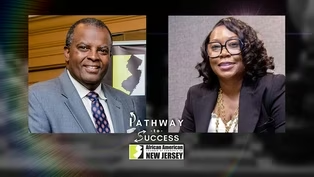
Her Winning Formula: Grit, Confidence, and Expertise Preview
Clip: S5 Ep9 | 32s | Glenda Thomas talks about her dedication to excellence and her desire to empower others. (32s)
Providing Support for PBS.org
Learn Moreabout PBS online sponsorship
- News and Public Affairs

Top journalists deliver compelling original analysis of the hour's headlines.

- News and Public Affairs

FRONTLINE is investigative journalism that questions, explains and changes our world.












Support for PBS provided by:
Pathway to Success is a local public television program presented by NJ PBS