Here and Now
Here & Now for April 11, 2025
Season 2300 Episode 2339 | 26m 48sVideo has Closed Captions
Watch the entire episode of Here & Now for April 11.
Watch the entire episode of Here & Now for April 11.
Problems playing video? | Closed Captioning Feedback
Problems playing video? | Closed Captioning Feedback
Here and Now is a local public television program presented by PBS Wisconsin
Here and Now
Here & Now for April 11, 2025
Season 2300 Episode 2339 | 26m 48sVideo has Closed Captions
Watch the entire episode of Here & Now for April 11.
Problems playing video? | Closed Captioning Feedback
How to Watch Here and Now
Here and Now is available to stream on pbs.org and the free PBS App, available on iPhone, Apple TV, Android TV, Android smartphones, Amazon Fire TV, Amazon Fire Tablet, Roku, Samsung Smart TV, and Vizio.
Providing Support for PBS.org
Learn Moreabout PBS online sponsorshipThe following program is a PBS Wisconsin original production.
>> I'm Afraid of the federal cuts to Medicaid.
>> Concerns about possible cuts to Medicaid are mounting around the nation and here in Wisconsin.
Plus, questions swirl over revoked student visas.
[MUSIC] I'm Frederica Freyberg tonight on "Here& Now".
The latest on dozens of international students in Wisconsin who've had their visas revoked by the Trump administration.
We dig in to the state's role in getting lead out of Milwaukee public schools.
Plus, questions about the impact of possible cuts to Medicaid.
And finally, some lessons about diplomacy on the international stage.
It's "Here& Now" for April 11th.
>> Funding for "Here& Now" is provided by the Focus Fund for Journalism and Friends of PBS Wisconsin.
>> One day they're going to class, the next they're being told to leave the country immediately.
More than 50 international university students in Wisconsin have had their student visas revoked this week, half of them at UW-Madison, but also at system campuses across the state.
At Concordia University and Marquette, according to university officials.
UW-Madison says it played no role in the visa terminations and know of no Ice activity on campus.
Further, university officials say they don't believe the revoked visas relate to political activity.
So what is going on?
We turn to Madison immigration attorney Amanda Gennerman with the Pines firm.
And thanks very much for being here.
you for asking me to be here today.
contacted by by some of these people.
But as to that question, what is going on?
Do you know?
>> It's a great question.
These are one of these things that we have been experiencing in the last 90 days, that every day feels like a new day, right?
There are constant changes happening.
And this being the latest of that experience for foreign nationals in our communities.
>> Is that how it works that they get notice of termination by the US government, and then they have to leave the country immediately.
>> So student visas are its own unique world, and there are systems in place that notify a student if they seem to not hold that status anymore.
And usually it's through the university DSO, a designated student officer who notifies the student or has a conversation and says there's an issue here.
This is not how this unfolded.
For these 40 to 50 students.
It was an email in their box with this notification, no real explanation.
So yes and no to that answer.
>> Well, what happens if the students do not, in fact leave immediately?
Do they run the risk of being picked up by ice?
>> I think that this is definitely an act of enforcemen.
And should people not remove themselves or seek other relief to remain in the United States, or try to establish that status back in place, that Ice could take that action, come to take them and start the removal proceedings?
>> So how urgently are advocates like yourself kind of responding to this?
>> So here locally within the Madison and state of Wisconsin, a group of attorneys as of this week were talking about how do we respond?
What are the things we can do?
Who do we know at the university?
How do we get resources out?
So yes, it's a small but mighty group, but we are here to assist students.
>> Has any information been forthcoming from the university or from federal immigration officials?
>> No, the answer is no.
Nobody is really providing the information.
And that's what the problem is.
You there supposed to be a system here?
There's supposed to be a due process opportunity for students to explore.
What are the issues.
But it's being very, very it's very vague.
>> How broad are the reasons that result in termination of a student visa and removal from the US?
>> So two different answers to that question.
Terminating a status for a student is under a system that we call Cvis.
And there's a check down box and there's 3 to 4.
If you fail to maintain your full caseload, if you do have contact with law enforcement, it could be it could be looked at.
So it's primarily due to participating in school, which is what you are here to do on an F visa.
And so when these things happen, what these students seem to be noticing in their boxes of why they're being terminated is that it's for unknown for other failing to maintain status.
And that's it.
>> But they don't know.
And the university says that it does not appear that these terminations have anything to do with political activity.
>> From what we're seeing right now and again, there are very I have not had access to a majority of these individuals.
That does not seem to be the box that is ticked.
>> So are these students who are terminated, their status terminated, and their visas revoked, presumably as a result of that, are they able to have hearings.
>> That is what we're seeing.
This litigation action, trying to get these students back to having those conversations to say, why was this terminated?
What is the grounds for that?
And was it valid.
>> From from your interactions with these students and other lawyers that you're talking with?
Are they looking over their shoulder?
Are they in hiding?
What are they doing?
>> I think our communities are in crisis right now.
I think that people are very afraid when we're watching people in Boston being taken off the street and half masked officers.
I don't know how you don't look over your shoulder and how you don't worry about what's coming next.
Or am I supposed to be here or am I not?
So I do believe that the community is very much afraid for all of those reasons.
Rightfully so.
>> All right, Amanda Gennerman, we'll leave it there.
Thanks >> Thank you.
>> The legislature's budget writing committee is on a road trip across Wisconsin this month.
The Joint Finance Committee, now fashioning the 20 2527 state budget, is holding public hearings in four cities through the month of April.
The Republican majority will start from scratch on the budget, even after Governor Tony Evers delivered his two months ago.
One item in the governor's budget that legislators will be deciding on is money for lead remediation.
Evers wants $300 million to replace lead pipes and remove lead from buildings statewide.
Of particular concern.
Lead contamination in the city of Milwaukee.
Inside its schools.
Here and now.
Reporter Nathan Denzin is tracking that.
>> It's about doing what's best for our kids and families.
Simple as that.
>> In his state of the state address, Governor Tony Evers declared 2025 the year of the kid.
Part of that declaration was over $300 million in budget proposals that would go towards lead remediation across the state.
>> There is no safe level of lead exposure for kids.
>> Lead is the one.
Lead is the serious one.
That really hurts kids.
>> Marty Kanarek is an environmental epidemiologist and professor at UW-Madison that has studied lead and lead poisoning for nearly 50 years.
>> A little kid exposed to lead doesn't grow as fast, doesn't reach developmental milestones as fast.
It affects behavior.
It causes hyperactivity, attention deficit, bad behavior, disorderly conduct, lack of concentration.
It affects hearing.
It affects speech.
>> Lead exposure affects everyone but children from birth to about six years old are at particularly high risk.
There are many ways to get lead poisoning.
Two of the most common are from inhaling lead dust from deteriorated paint, or from lead pipes carrying water.
Once the toxin is in the body, it can be stored in bones for more than 25 years, and in some communities it can be hard to escape.
>> Milwaukee is like its own state on lead.
>> I think 62% of lead poisoning cases in children are from Milwaukee.
Throughout the throughout the whole state.
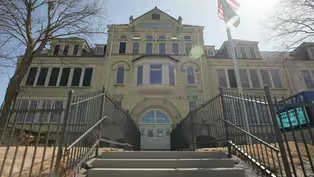
>> Ryan Clancy is the representative for Assembly represents the area around Trowbridge Elementary School, which temporarily shut down in March after dangerously high levels of lead were found.
>> Really, every almost every MPs school and many schools across the state were built before 1970.
They almost certainly have lead paint in them.
>> So far in 2025, seven schools in the MPs district have found a concerning level of lead.
>> That probably is the tip of the iceberg here.
>> Trowbridge was the first to temporarily relocate students, but three more temporarily shut down after health officials found nightly remediation work was unsafe.
In some instances, lead paint chips were found within arm's reach of a child's desk.
The other three schools were able to complete emergency remediation without relocating students.
One of those schools is Golda Meir lower campus.
>> My child is a third grader at Golda Meir lower campus, and on January 13th, we received a letter from MPs and the Milwaukee Health Department alerting us that there had been a lead poisoned child.
And the at the school and the source of that lead poisoning was our school.
>> Kristen Payne was shocked when the Milwaukee Health Department released pictures from inside the school.
The pictures show cracked and of lead dust on windowsills and floors.
Emergency remediation at Golda Meir was done while children were still attending class in the building.
>> I'm deeply concerned about sending my child into an environment that is not safe.
>> While Payne says she's frustrated with how school district leaders have handled remediation, the buck ultimately stops at the legislature.
>> The defunding of our public schools is sort of a longer kind of trajectory of how we got here, right?
That there just hasn't been adequate money for staffing.
know, even lead paint from schools are extreme.
>> Clancy estimated that a single classroom could cost up to $20,000 to remediate, replacing lead water pipes can cost even more.
>> You can't ask a school to sa, how many teachers will you fire in order to do lead remediation?
>> It's not something that we can defer.
And if we do choose to defer it, it will have serious consequences for our communities.
>> Making sure our kids are healthy physically and mentally is a crucial part of improving outcomes in our classrooms.
>> Evers proposals can be broadly broken down into two categories remediation for lead painted windows and for lead pipes.
For window remediation.
The governor is asking for $100 million plus two full time positions for a program that replaces lead painted windows to tackle lead pipes.
The Evers ask includes more than $200 million to fund replacement efforts.
>> You've got not just a classroom.
You've got not just a school.
You've got multiple schools shut down.
So that creates creates this wave of chaos behind it.
>> Chris Kapenga is the state senator from Delafield.
>> Number one, there needs to be accountability in NPS because the parents are upset about it.
Local elected officials are upset about.
>> It.
At the Capitol.
Assembly Speaker Robin Vos said Evers entire budget proposal is dead on arrival for the fourth consecutive biennium, making it difficult to know how much of this funding will be passed.
>> The legislature will most likely just create their own budget, and we always have.
The governor always lays out a budget and it's his wish list.
>> Kapenga said NPS first needs to figure out what went wrong before the state commits to sending more money to the district.
happened so that it never happens again.
So the new superintendent of schools should be the one that says this is important to us.
>> Realistically, Kapinga says Evers entire proposal won't get funded, but he still isn't sure what the legislature will propose yet.
>> That is a big question that cannot be answered in a political sound bite, because we haven't done the work yet to understand what's needed.
>> But Clancy and Payne say even the full proposal wouldn't have been enough to remediate all of the lead in Wisconsin.
>> I'm grateful that there's some money in the state budget for now, write Evers recommended budget, but even that's not enough.
>> $221 million just for lead hazard control.
>> So we're estimating somewhere you know between $600,000,001 billion.
We should be starting there in the budget.
>> It's just a question of money.
Political will to give the money to do the job.
>> Even if the initial cost is high.
Everyone agrees that something needs to be done to keep students safe.
>> This is going to have to be a priority because we can't educate our kids if they can't be in the classroom.
>> Every dollar that is spent on that means an improvement in the quality of life for folks all across the state.
>> It's a losing argument to not focus on lead eradication.
>> The research is exquisite in showing that every little bit of lead hurts kids brains.
>> For "Here& Now".
I'm Nathan Denzin in Milwaukee.
>> This week, the Wisconsin DNR announced PFAS advisories for an additional 50 private wells in the town of Peshtigo.
The wells are added to 32 private wells already tested as contaminated, where homeowners are eligible for emergency water supplies.
Updated health guidelines lowered the cancer causing PFAS levels considered safe for drinking water.
The DNR says firefighting foam manufactured by Tyco contaminated groundwater in the area.
The company previously reached multimillion dollar settlements over the Forever chemical contamination in Peshtigo and Marinette.
Nationally and here in Wisconsin, possible cuts to the health care program known as Medicaid have sparked fear in the low income families, elderly residents and people with disabilities who depend on it.
At a public hearing in West Allis, lawmakers on the state legislature's Joint Finance Committee heard from many about why Medicaid needs to be saved.
>> Medicaid programs allow persons with disabilities to live dignified life.
>> Medicaid really supports a healthy Wisconsin.
We have about half a million children in Wisconsin covered by Medicaid, which is about a third of Wisconsin's kids.
>> People are going to lose their insurance.
Rural and low income hospitals will close, and people will die.
>> Impassioned public testimony on Medicaid before the state budget writing committee.
And now that Congress has passed its budget blueprint, work begins in earnest in Washington to enact major tax cuts paid for with sharp reductions in federal programs that could hit the health care program.
As to Medicaid in Wisconsin, we turn to Bobbie Peterson, executive director of ABC for health, a nonprofit public interest law firm helping consumers navigate the health care system.
And Bobbie, nice to see you again.
>> Thanks for inviting me.
>> So one point that you really want to make clear is that cuts to Medicaid have not happened yet.
That's right.
With that in mind, what's your guidance?
>> Well, I think it's, you know, don't panic, but let your voice be heard.
I mean, Wisconsin people know that Medicaid is a very important program.
It state.
So that's families, friends, neighbors, a lot of folks out there that have potentially affected by this.
But it hasn't changed yet.
And there's opportunities to help influence the process, hopefully make it better.
And to avoid some of the serious issues that that we're concerned about and worried about.
But I think we're going to do our best to try and save them off.
>> So what kinds of coverage does Medicaid represent?
>> It covers, you know, long term care for seniors.
It covers people with disabilities.
It covers a lot of kids on Badgercare, plus some parents, childless adults.
So it's broad and wide.
And so I think if you, you know, you're most of our viewers will know someone who is getting Medicaid services.
This affects every corner of the state.
>> Why are people sounding the alarm on potential cuts?
Is that overstated?
>> No, I think it's important.
And even though it's characterized sometimes as we're not going to cut the benefits, just putting procedural hoops and hurdles in the path of people.
We've seen this before.
We see it even now, and it could get worse.
So bureaucratic red tape blockages to coverage, just making it harder for people to navigate these systems without effective strategies to help people through that system is the problem.
>> As you say, the Trump administration and GOP leaders say they will not cut Medicaid benefits.
They're going after waste, fraud and abuse.
But you were just talking about bureaucratic kind of red tape.
What could they do around eligibility requirements or other things like that to affect reductions?
put in require work requirements for certain Medicaid programs and that it's just the process, the paperwork getting through it.
People that may be ill may not be able to work.
You know, just going through that process deters people, knocks them off to the side.
They lose coverage and they're not getting important health care and coverage that they need with a consequence of running up medical bills and medical debt, which is something that we really want to try and avoid.
>> Now, Wisconsin, as you know, never expanded Medicaid and expanded Medicaid gave state.
The feds gave states 90% of those costs.
Wisconsin never expanded it.
So our share from the feds is 60%.
But with any reductions to Medicaid, could it still blow up, you know, kind of the state budget?
>> Sure.
I mean, I think that it depends if what Wisconsin, how we react to it, you know, but I think for the most part, it's going to be a situation where people are going to face most of the pain, not the budget as much, because I think a lot of folks out there are going to be deterred from getting the care and services that they need.
Their conditions will worse worsen, their health will worsen, and their medical debt will accumulate.
>> So if there are cuts, what are the implications to even those not covered by Medicaid when it comes to things like uncompensated care and hospitals, rural hospitals?
>> Sure.
I mean, they're under stress already.
Rural hospitals are under stress.
We've seen closures, rising levels of uncompensated care make it untenable for them to continue operations in some levels because it's just, you know, they're not meeting their bottom line and they can't provide the services that they need.
Rural hospitals are on very thin margins.
Most of them.
We know that in Wisconsin in 2023, the last year that that data is available, there was $1.4 billion in uncompensated care.
That's a lot.
But that's going to go up and it's going to affect more people with more bills and unpaid bills.
It's going to affect hospitals with unpaid bills.
It's a system issue.
>> And what does it mean?
Apart from uncompensated care to hospitals to people who are not on Medicaid, but otherwise covered by other health care.
>> Programs.
It's another one of the long term effects.
It's cost shifting.
So if we think about, you know, people talk sometimes about socialized medicine, I talk sometimes about socialized medical debt.
So if you think about all that debt that's unpaid, it doesn't just go away, but it gets spread out in the system to everybody else.
So we all have a price to pay when people don't have adequate coverage.
thanks very much.
>> You're welcome.
>> With all of the anger and uncertainty in international politics today, it seems that common ground is impossible to find.
But it can be done.
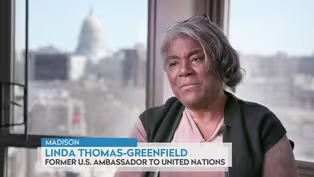
According to the former United States ambassador to the United Nations, Linda Thomas-Greenfield returned to her alma mater of UW-Madison to give a speech on diplomacy and negotiation.
She sat down with "Here& Now" reporter Steven Potter to talk about meeting in the middle.
>> Here in Wisconsin, like elsewhere, political division on a number of issues has really fractured our state.
There are things like abortion or school choice and the voucher system or vaccines that seem to have really only two sides, either for or against.
Where does negotiation fit into these kind of two sided debates or discussions?
>> You know, when I first started in politics, it was so bipartisan.
So you would always find a path to a solution with Republicans and Democrats working together to find a solution.
And I think that's what the American people want.
They want their politicians to find solutions.
They don't want the divisions that they're seeing.
And I know that many of them will not always get what they expect, but what they don't expect is to see gridlock.
They don't expect to see their politicians disrespecting each other, screaming in profanity at each other, screaming insults at at each other.
This is a new kind of politics in America that I think the American people broadly don't want to see.
We all have our different views about immigration, about abortions, about gender and LGBT.
But to fight about those issues in the halls of, of our Congress and the halls of our state legislatures really don't provide solutions for ordinary citizens who want to see our government work.
They want to see the government work for them.
And what they're seeing now is that the government is not working for them.
And what I would say to them is they have to raise their voices to make sure that the politicians that they voted for represent their views, but also represent the interests of the country.
>> How does the ever growing impact of misinformation and disinformation affect the ability to navigate and negotiate on issues that need solutions?
>> You know, people start to fight for things that may not be factual.
And so we have to find a way to ensure that people get the actual facts, that they know what they're hearing is, is really based on on truth.
People don't know what they're voting for.
They don't know what where the truth lies.
And I don't know what the solution is to that, because we're in a world now where it's instant information and someone puts out something on Twitter and suddenly it's the truth, when maybe it's not the truth.
You have to find a way to get to the truth.
And I think so many people now don't know how to do that, because we're being fed information from so many different sources, whether it's X or it's Instagram or just, you know, podcasts.
You're just getting news from too many different sources.
>> What can Wisconsin residents do to encourage their elected officials to come back to the negotiating table and actually compromise more?
>> That's the million dollar question.
I think part of it is to ensure that they vote.
We have very low turnout in elections all over, all over the United States, and particularly in in statewide elections, local elections.
And even in some of the congressional elections, if it's not a presidential election year, people don't turn out to.
>> Vote.
>> So that's the first thing people need to vote with.
With commitment, regardless of what the election is.
And then they need to hold their their elected officials accountable for what they promised to do and what they are doing.
If they're not ensuring that they're making the government work for them.
And, you know, I think there's also a sense that when.
A representative is elected, he only represents the people who voted for him, when in fact he represents the entire state.
He represents the people in his district who may not have voted for him, or she represents the people in her district who may not have voted.
And I think we've lost that sense of we're here to support the good of all.
>> For more on this and other issues facing Wisconsin, visit our website at PBS Wisconsin.
Org and then click on the news tab.
That's our program for tonight.
I'm Frederica Freyberg.
Have a good weekend.
>> Funding for "Here& Now" is provided by the Focus Fund for provided by the Focus Fund for Journalism and Friends of PBS Wisconsin.
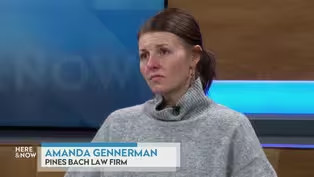
Amanda Gennerman on Student Visa Revocations in Wisconsin
Video has Closed Captions
Clip: S2300 Ep2339 | 5m 40s | Amanda Gennerman on the government revoking visas of international students in Wisconsin. (5m 40s)
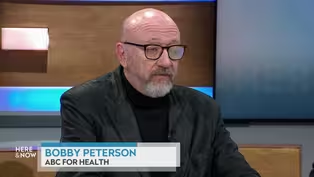
Bobby Peterson on Medicaid Funding and Budgeting Blueprints
Video has Closed Captions
Clip: S2300 Ep2339 | 6m 5s | Bobby Peterson on fears about Congress making cuts to Medicaid and the state budget. (6m 5s)
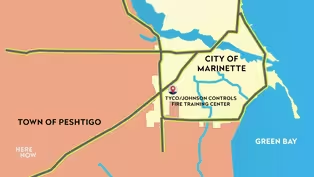
DNR Issues PFAS Advisories for 50 More Wells in Peshtigo
Video has Closed Captions
Clip: S2300 Ep2339 | 40s | The Wisconsin DNR issued PFAS advisories for 50 private wells in the town of Peshtigo. (40s)
Here & Now opening for April 11, 2025
Video has Closed Captions
Clip: S2300 Ep2339 | 1m 6s | The introduction to the April 11, 2025 episode of Here & Now. (1m 6s)
Lead Levels and Cleanup Costs Are High in Milwaukee Schools
Video has Closed Captions
Clip: S2300 Ep2339 | 7m 9s | Cleaning up lead paint and replacing pipes is one element in Wisconsin's 2025-27 budget. (7m 9s)
Ambassador Linda Thomas-Greenfield on Diplomacy and Politics
Video has Closed Captions
Clip: S2300 Ep2339 | 25m 33s | Linda Thomas-Greenfield on challenges and rewards of conducting international diplomacy. (25m 33s)
Providing Support for PBS.org
Learn Moreabout PBS online sponsorship
- News and Public Affairs

Top journalists deliver compelling original analysis of the hour's headlines.

- News and Public Affairs

FRONTLINE is investigative journalism that questions, explains and changes our world.












Support for PBS provided by:
Here and Now is a local public television program presented by PBS Wisconsin