Here and Now
Here & Now for December 1, 2023
Season 2200 Episode 2221 | 26m 48sVideo has Closed Captions
Watch the entire episode of Here & Now for December 1.
Watch the entire episode of Here & Now for December 1.
Problems playing video? | Closed Captioning Feedback
Problems playing video? | Closed Captioning Feedback
Here and Now is a local public television program presented by PBS Wisconsin
Here and Now
Here & Now for December 1, 2023
Season 2200 Episode 2221 | 26m 48sVideo has Closed Captions
Watch the entire episode of Here & Now for December 1.
Problems playing video? | Closed Captioning Feedback
How to Watch Here and Now
Here and Now is available to stream on pbs.org and the free PBS App, available on iPhone, Apple TV, Android TV, Android smartphones, Amazon Fire TV, Amazon Fire Tablet, Roku, Samsung Smart TV, and Vizio.
Providing Support for PBS.org
Learn Moreabout PBS online sponsorship>> The following program is A PBS Wisconsin Original production >> Partisans wait expectantly for a decision.
After a new liberal majority on the state, Supreme Court hears oral arguments in a lawsuit over Wisconsin voting maps and high tech intervention for young children learning how to communicate after the isolation of a pandemic.
I'm Frederica Freyberg.
Tonight on Here & Now , now the Wisconsin Supreme Court will soon rule on the lawsuit over state voting maps.
We hear from a former state senator who voted for the maps that cemented the Republican majority and his regrets.
The first of our year-end interviews with legislative leaders and Zac Schultz reports on the soaring numbers of children with speech delays.
It's Here & Now for December 1st.
>> Funding for Here & Now is provided by the focus fund for journalism and Friends of PBS Wisconsin.
>> A case before the Wisconsin Supreme Court could upend state district voting maps and the new balance on the high court suggests the liberal majority could find the maps unconstitutional.
Marissa IC has more, >> What we have here today is a constitutional violation.
>> When the Wisconsin Supreme Court heard oral arguments challenging the state's legislative voting maps, it felt a little like Groundhog's Day.
>> The districts aren't contiguous and they violate the separation of powers.
>> Plaintiffs say the case now before the court makes different challenges not addressed by the court in 2022.
The last time it ruled on the state's district maps.
The new arguments primarily centered around the continuity of some districts says Marquette Law School research fellow John Johnson >> That have weird little island areas that are disconnected from the rest of them.
>> These islands were caused by towns being annexed from municipalities over time.
One party argued the result violates state constitutional requirements because these districts are not physically contiguous.
The other side says contiguity has a broader definition and the lines as drawn have 50 years of precedent behind them.
If the court were to find the maps unconstitutional, an alternative would be needed.
>> I think if they choose the separation of powers complaint, then they have to institute entirely new maps.
Well, certainly one problem argument.
If they only throughout the maps on the basis of the contiguity challenge, then perhaps they would try to come up with a new map that only solved that problem.
Because the continuity issue does not affect every district.
It affects about half the districts in the state.
>> Experts caution the justices not to redraw the maps themselves, calling it a slippery slope.
>> If we are to find these maps unconstitutional and we were to turn to a map, draw someone to help draw the maps.
Do you have names of people that you would suggest >> Justice Brian Hagedorn pushed both parties on what true partisan fairness looks like for Wisconsin.
What >> Would be neutral?
What's the acceptable range of Republican or democratic leaning assembly districts or Senate districts that's within the permissible range?
The key question is, which maps are most likely to support rather than fort majority rule.
>> Current maps have assembly Democrats holding 35 seats, Republicans have 64.
There are many methods to draw maps and Johnson says it is possible to calculate a range of partisan fairness.
>> Mathematicians have really pioneered over the last few years is using algorithms to generate enormous ensembles.
You do that in Wisconsin and you get, oh, in the neighborhood of 55, 56, maybe 57 seats leaning Republican in a 50 50 year.
It's consequential because our technology allows us to more precisely target certain kinds of voters.
In a fundamental way, gerrymandering works because voters are, are so polarized between the parties.
And I think that that means that really any solution is going to leave a lot of people deeply disappointed.
>> No matter how the court rules, there's no guarantee this won't happen all over again.
>> Is there any end to this litigation?
>> We're making it up as we go along.
If the balance of power on the Supreme Court changed, you could be right back here again.
>> If the maps are found unconstitutional, new ones would be needed.
Prior to the 2024 elections reporting for here and now, I'm Marissa Wojcik.
>> Following oral arguments, the court is expected to issue its ruling no later than early 2024.
One former senator and Senate majority leader who voted for the Republican maps that passed in 2011 has been fighting against that gerrymandered nearly ever since.
Former state Senator Dale Schultz joins us now.
Thanks very much for being here.
>> I'm delighted to be here Fred.
>> So if, if you think that the 2011 maps that cemented Republican majorities were so offending in their lopsided partisan favor, why did you vote for them in the first place?
>> Well, it's a great question and I'm glad you asked it.
When I was briefed on what the plan was, all I saw was my own district and historically redistricting had meant maybe a percent or a half percent difference in, in how the votes came out.
So it wasn't that shocking to, to me, when I saw my map, it was shocking to me after the votes came in and I realized that suddenly the what was happening in the legislature did not reflect the overall trend in the state.
And not by a little bit, but by a significant amount.
And as time went by, I learned that we had the most gerrymandered maps in the state.
And I've always thought politicians ought to compete on issues and on principles, not on rigging elections.
And Democrats have done it, Republicans have done it, it doesn't mean it's right.
>> So when you had that realization, what did you do then?
>> Well, I, I found a partner, which wasn't real hard to do because Senator Tim Collin and I had, you know, gone through Act 10 together, sort of as the odd men out trying to figure out what we could do to bring the state back together, bring the, the political parties back to a point where they could discuss things with one another.
So I went with to him and we decided it was an issue that was important.
And then what happened next was kind of a surprise.
Two majority leaders couldn't even get a hearing on a bill that was of longstanding in the neighboring state of Iowa.
And so we decided, you know what, we don't have to operate entirely within the process.
And we took the matter directly to the people in Wisconsin and made, I don't know, a hundred or 150 speaking engagements around the state trying to educate people and build support for the whole idea of taking a look at this a second time.
>> But meanwhile here we are with this latest lawsuit brought by Democrats before the newly liberal majority Supreme Court.
You listened in on the oral arguments in this case.
Do you think the arguments against the current maps hold up like, like the argued need for contiguous districts or separation of powers?
>> Well first of all, I need to admit that I'm not an attorney and I don't even get to play one on Wisconsin public television.
But I listened to the arguments.
I thought the court did a good job.
Regardless of your feelings for either side, I thought the court acquitted itself well, and I do think that the plaintiffs made the case very well.
But I'm less concerned about the court than I'm about the legislature.
You know, both Republicans and Democrats don't have clean hands in this whole regard.
We've now had the governor say he is in favor of an Iowa plan.
We've had Speaker Voss saying the same thing.
All that's really necessary to deal with this is for one of those two gentlemen to pick up the phone and call the other and say, let's have a quiet discussion about what both sides can live with.
Now that doesn't negate what the courts would and should do.
I, I don't think we should have to suffer under these maps any longer.
But more importantly is let's not focus so much on the past or even the present and start thinking about the future.
>> Why should the maps be drawn not by the legislature or the courts in your mind?
>> Well, I, I think that the time has shown in Iowa over 50 years that this system works, that it's fair.
No legislator has ever put in a bill to repeal it and the public is highly satisfied with it in Iowa.
Whereas in Wisconsin we've seen a situation develop in the last few years where no one is in favor of what we've done, not even Republicans.
>> And just to back up a little bit, under the Iowa model, it would be a nonpartisan commission.
>> Correct.
Or a civil servant would work and and develop the maps.
And I don't think more than once has, have they ever had two votes?
And the reason that they haven't had two votes is every legislator looks at their district and they go, well, I'm in my district and it looks pretty good to me, so I'm gonna vote for it 'cause I could get worse.
>> One of the things that I think Justice Rebecca Bradley brought up was this idea that it was undemocratic.
If you have, if you force everybody to go up for reelection under new maps, including state senators who are still in the midst of their terms.
>> Well, but that conveniently ignores the argument that people have been operating under maps that dilute the power of the voters and they've had an unfair advantage.
Why should they be able to continue that even two more years?
>> Why do you think taking the hyper-partisan out of voting maps is good for the electorate?
>> Because I, I don't think when people are engaged in that process now, given the new technology and tools that are available to them, that they're thinking about the voters first.
They're thinking about power because this is really an exercise about power.
My friend Tim Cullen makes that point all the time.
It's not a Republican or a democratic issue.
And it seems every time we engage in this process, the only real loser is the general public.
They ought to be picking their representatives.
It shouldn't happen the other way around.
>> So having lived this now for a decade and been very immersed in it, what do you think is going to be, be the outcome of this state high court ruling?
>> Well, I think that they probably will find it unconstitutional.
I think there seems to be broad consensus on that.
It's not any great insight that I have.
I, I don't have any awareness of what they may or may not do.
I think there's a broad consensus that the public wants a fair set of maps, but that's not the issues before the court.
But I think that the court has sufficient grounds to do something and they could actually be joined by two politicians who said, we're going to take care of the future.
You take care of the immediate present and we would be in a better place in Wisconsin this next spring.
>> We leave it there.
Dale Schultz, thanks very much.
You >> Bet.
Thank you.
Happy holidays to you and all the listeners.
Thank >> You.
As to the Supreme Court, former Republican Wisconsin Attorney General Brad Schimel came out early announcing this week he is running for the State Supreme Court against Liberal Justice Ann Walsh.
Bradley Bradley's term is up in 2025.
She was first elected to the Supreme Court in 1995 and is the longest serving justice on the court.
She is part of the four three liberal majority elected in 2015.
Schimel served one term as AG and is currently a Waukesha County Circuit Court judge.
As a prosecutor, Schimel had been outspoken against abortion.
He defended Republican drawn redistricting maps, strongly supported voter id and joined a multi-state lawsuit over the Affordable Care Act.
>> So on August 1st of this year, the balance of the supreme courtship, we all knew what we had to tell us liberal the liberals.
Now in majority, they've been in the majority before and we know the damage they've done in the past when they've been in the majority, but this time it's different as they see this is not your father's liberal majority, it's different.
And Nick demonstrated that they intend to make big changes.
>> A lawsuit has been filed over the state's near total ban on a collective bargaining for most public employees.
Act 10 was enacted under former Governor Scott Walker in 2011 prompting massive protests in and around the state capitol.
On Thursday, seven unions representing teachers and other public employees filed the lawsuit arguing Act 10 violates the Wisconsin Constitution's Equal Protection guarantee because the law exempts police and other public safety workers from its union limitations.
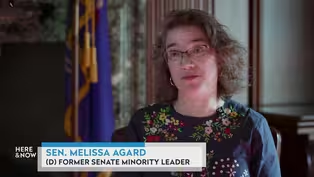
As of this afternoon, democratic state Senator Melissa Agard is out as minority leader, having announced she will not run for reelection to the legislature.
To instead throw her hat in the ring for Dane County executive just ahead of her announcement, she sat down with senior political reporters, Zac Schultz, to talk about the last year as leader.
>> Well, Senator Agard, thanks for your time today.
>> Thank you.
>> So wrap up 2023 for me.
How do you view the year as a whole from the Senate minority perspective?
>> Well, certainly every legislative session that I have been in the building has a different feel and a different flavor and this is no exception.
I think with the undertones of the redistricting lawsuit that was gonna be coming before the Supreme Court, it has created different relationships here in the Capitol building.
But despite the fact that there is division, I am really proud of the ability that we have had as a legislator legislature to be able to get some real good things done for the people in Wisconsin, whether it's the shared revenue bill or more recently ensuring that the brewer is continue to call Wisconsin home.
I think those are big wins, but at the same point, knowing what people across Wisconsin are really prioritizing the issues that they would like the legislature to be addressing, we're not getting that done.
Whether it's expanding healthcare.
So everyone in Wisconsin has access to quality, affordable healthcare, ensuring that our kids have safe places to go by extending the childcare counts program, legalizing cannabis, protecting reproductive health rights and protecting our environment, addressing our PFAS contaminations as well as lead laterals and water contaminants across the state.
Those are just a few examples of the things that people are concerned about at their kitchen tables.
I'm sure they were conversations that people were having over the recent Thanksgiving holidays.
So while we've been able to get some real good things done, it's clear that the legislature still isn't addressing the needs of the ordinary people in Wisconsin.
>> So one of the biggest things that happened this year outside of the, the Capitol was the election of Janet Pro se, which the Wisconsin Supreme Court.
How much has that changed the dynamic in terms of people understanding the court is now a different majority and the possibility of opening up redistricting and changing the makeup of the legislature.
>> So we know in Wisconsin that we are a gerrymandered state on top of another gerrymandered.
Our state has been gerrymandered twice in a row and many scientists and mathematicians will point to Wisconsin as being the most gerrymandered state in the nation, both in the Assembly and the Senate.
That isn't good for clean government.
That is not what people in Wisconsin are asking for.
I am hopeful that by having a more balanced court here in the state, that we will have a more balanced legislature and that the will of the people will in fact become the law of the land.
>> Are you anticipating the possibility that the entire Senate will be up next year?
>> I think it's a real possibility that the whole Senate, all 33 seats will be up for election next year as well as we already know all 99 members of, of the assembly.
So having 132 legislative seats up for reelection in 2024 provides a real opportunity for a reset in the state of Wisconsin and empowers the voters who are ultimately our bosses to make real choices.
>> What do you think the impact of the GOP convention in Milwaukee will be in the fall?
>> You know, I think it's great for our economy when we can bring big groups like that into the state.
Whether it's the dairy forums that come here in Madison or big entertainment or political caucuses.
You know, we were supposed to have the Democratic caucus here in Wisconsin, but we had unfortunately COVID so it, it took a different look.
I think it's great when we can be front and center with these debates and have a front seat to what it is that people are talking about.
>> But do you think that will give Republicans a boost in the state?
>> Well, it may give Republicans a boost, but what we've seen here in the Capitol building is a lot of extremism from the Republicans in the legislature to be more extreme.
Whether it's the threat of impeaching Justice Protasiewicz before she even ruled on anything threats to impeach Meghan Wolfe, who is ensured that our elections in Wisconsin are safe, secure, and fair attacks on trans rights attacks, on reproductive freedoms, the inability to stand up and protect our water quality and our environment.
Folks not willing to have conversations about cannabis legalization.
That's what matters most to folks.
Alright, >> Senator Agard.
Thanks.
Thank you.
Schools >> Across the state are dealing with a dramatic increase in the number of kids with speech delays.
It's especially prominent among our youngest students who were just toddlers.
When the COVID-19 pandemic sent the world into lockdown here and now Senior Political Reporters Act, Schultz tells us what's behind the delays and whether schools have the resources to help the students speak up.
>> The children in this early Head Start classroom look and sound like typical two to three year olds.
>> That's A good, but they were born during the COVID-19 pandemic and chances are some of them may be at risk of developing a speech delay.
>> So we have actually seen a very big uprising in speech and speech impairments and language impairments.
And >> Nichole Spooner is the director of Comprehensive Services at Nextdoor Foundation, a Head Start program in Milwaukee.
She says young children were severely impacted by the lockdowns.
>> They were facing isolation, stress with their families, trauma, things of that nature.
And so they're coming in now with really some challenging behaviors, speech delays, things of that nature.
I think we're up about 10% right now in children who have speech delays diagnosed >> Across the state.
It's the same story.
>> Say "S".
>> I've definitely seen an increase in the number of referrals.
I would say it's not abnormal for me to get at least one speech referral per day.
>> Max Long is the director of Student Services at the Platteville School District.
He has four full-time speech language pathologists on staff, and their caseloads are maxed out.
>> We often go back to the drawing board quite a bit with our schedules when we get new students and our caseloads to try to move things around and make it work.
>> Once a student is diagnosed with a speech delay, federal and state law mandates the district provide the services they need, whether they have the funding or not.
There's >> Just too many kids for me to fit >> In.
Megan Bolten has been at Platteville for 12 years and says the issue isn't just that kids can't articulate, some kids struggle to use speech to interact at all.
There >> Are definitely kids who will just hand you stuff and expect that you know what they want to do with it and not say anything to you.
Well, you know, early language skills are one of the best predictors of academic social vocational outcomes.
>> Rebecca Alper is a UW assistant professor and a researcher at the Waisman Center studying early language and literacy intervention.
We're >> Really just kind of trying to get a sense for where the child's language levels are.
>> She says the COVID-19 pandemic highlighted a lot of existing health disparities along the lines of race, income and access to services and young children were no different.
>> It's very hard to focus on early language intervention when you're experiencing housing insecurity, food insecurity, all of those sorts of things.
>> Helper's team is studying how best to support caregivers of young children since language development starts at birth >> For do they have this word?
So like if they say Nana for banana, we would still count it on this measure.
What would be the most supportive long-term is to really help support early identification and early intervention.
Because the earlier we can intervene, the better the long-term prognosis are.
>> I have one for everybody.
Peyton, would you like to put a vest on >> Back at next door?
In Milwaukee, they use a system called Lena to help identify kids with possible speech delays.
>> These vests are going to record the amount of interactions that we're having with each other.
It's gonna tell us how often we talk to each other because talking is very important.
It's like a superhero this time.
Yes, >> Shakeda Caldwell is the lead teacher in this classroom and convinces the kids to wear vests that contain a small device that monitors and counts interactions between kids and teachers.
>> But guess what it's gonna do?
It's gonna help you to talk more and it's gonna help your teachers talk to you more and we're gonna build lots of vocabulary together.
>> They are actually recording the frequency of the interactions between the teachers and the children.
>> Tonya Hameister is the Director of Education Services at Nextdoor.
She says, Lena is a coaching program.
When they download the data from the recorder, it creates a chart to show the number of times a student and teacher talk to each other.
That lets the teachers know which students need more attention.
>> So if I have that child who scored lower who wasn't having many interactions, then I will plan to, okay, I'm gonna have a one-on-one with this child.
Maybe I'm gonna read more books with him.
I want him to name, I'm gonna ask him what does he see in the book so I can get those words out of him.
>> Hameister says, Lena started as a research program, but now Nextdoor has adopted it for all early Head Start classrooms >> For our children.
We saw an increase, especially in the children that were not as verbal, not as expressive.
We saw an increase, a pretty significant increase in the amount of interactions.
>> Hameister says Nextdoor is fortunate enough to have a lot of community support, but she worries about schools that are dealing with the budget crunch and a surge in speech referrals.
>> It's a challenge.
It is a huge challenge.
We know a lot of our systems are resource depleted and they're tired.
>> In the last state budget, governor Tony Evers proposed using the budget surplus to put an extra $1 billion into special education funding that would've brought the state's contribution towards special education costs to 60%.
A dramatic jump from the current 31% Republicans in the legislature allotted an extra $107 million statewide over the next two years, just a 2% increase and Platteville Max Long says the increase isn't even a real increase.
>> They did not adjust for inflation.
When you look at those numbers, it's not necessarily that we're getting slightly more, we may be getting slightly less.
>> Megan Bohlken says Burnout in her industry is a real concern.
And while they're doing okay right now, next February, they start screenings for the 4K students where the next wave of speech delays is waiting to be identified.
>> The thing that's making me a little overwhelmed is like the number they keep coming, those referrals keep coming as those kids are evaluated.
And if they qualify, getting them added onto my schedule, that's when it's gonna start to be okay.
Now I feel like I'm drowning.
Now what are we gonna do?
>> Reporting from Platteville.
I'm Zac Schultz For here and now >> For more on this and other issues facing Wisconsin, visit our website at pbswisconsin.org and then click on the News tab.
That's our program for tonight I'm Frederica Freyberg.
Have a good weekend.
>> Funding for Here & Now is provided by the Focus Fund for Journalism and Friends of PBS Wisconsin.
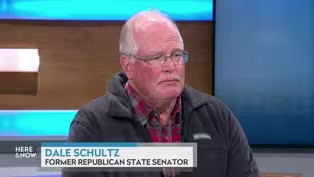
Dale Schultz on the Wisconsin Legislative Districts Lawsuit
Video has Closed Captions
Clip: S2200 Ep2221 | 7m 11s | Dale Schultz on state legislative district maps and advocacy against gerrymandering. (7m 11s)
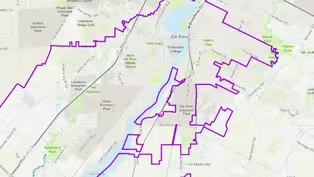
District Maps Lawsuit Heard by the Wisconsin Supreme Court
Video has Closed Captions
Clip: S2200 Ep2221 | 3m 51s | A legislative district maps lawsuit focuses on "contiguity" and separation of powers. (3m 51s)
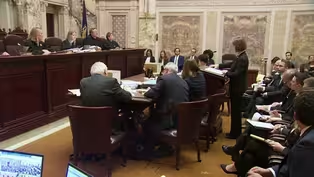
Here & Now opening for December 1, 2023
Video has Closed Captions
Clip: S2200 Ep2221 | 1m 9s | The introduction to the December 1, 2023 episode of Here & Now. (1m 9s)
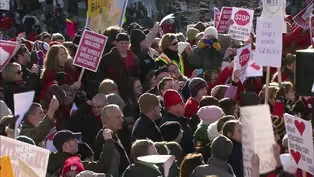
Lawsuit Challenges Act 10 over Public Employee Exemptions
Video has Closed Captions
Clip: S2200 Ep2221 | 36s | A lawsuit argues Act 10 violates equal protection rights for Wisconsin public employees. (36s)
Schimel Enters Race for Wisconsin Supreme Court in 2025
Video has Closed Captions
Clip: S2200 Ep2221 | 1m 22s | Brad Schimel is running against Justice Ann Walsh Bradley on the Wisconsin Supreme Court. (1m 22s)
Sen. Melissa Agard on Wisconsin politics in 2023 and 2024
Video has Closed Captions
Clip: S2200 Ep2221 | 4m 53s | Melissa Agard on 2023 in the Legislature, state Supreme Court and 2024 RNC in Milwaukee. (4m 53s)
Wisconsin Educators Take on the Surge in Early Speech Delays
Video has Closed Captions
Clip: S2200 Ep2221 | 6m 53s | Teachers and researchers struggle to provide support for kids with speech impediments. (6m 53s)
Providing Support for PBS.org
Learn Moreabout PBS online sponsorship
- News and Public Affairs

Top journalists deliver compelling original analysis of the hour's headlines.

- News and Public Affairs

FRONTLINE is investigative journalism that questions, explains and changes our world.












Support for PBS provided by:
Here and Now is a local public television program presented by PBS Wisconsin